OTD 17 July in 2003, my novel Foxy-T was published by Faber and Faber. I thought it might be interesting to revisit publication with a few posts from behind the scenes. I’d started writing the novel in late ’99 early 2000 – on a massive old laptop that had come with a new job at the Arts Council – and finished it in the autumn of 2001.
My beloved grandmother (RIP) was very excited to hear that Faber would be publishing Foxy-T. ‘Ooh,’ she said, ‘maybe you really are a writer then!’ She’d heard of Faber because they published Old Possum’s Book of Practical Cats by T.S. Eliot (1888–1965). There were not many books in her house, but she knew that one. I might also have told her that at the first Faber event I attended that summer I’d been introduced to T.S. Eliot’s second wife, his widow Valerie Eliot (1926–2012), who in the early ’00s was still very much an active and interested presence at Faber events and parties.
Speaking of which, this was the recent Society of Authors summer party. I’m a member of the Society of Authors – they’re like the writers’ trade union in the UK. If you’re a published author, I would recommend joining.

Among many conversations in Southwark Cathedral this year, I got talking to the comic artist/writer duo Fantom Limb. We were exchanging stories. I’d asked them about their work. They asked me about my work, so I told them about my latest novel.
‘So how did you get published by Faber?’ they asked. ‘Did you know someone?’
‘No,’ I said, ‘it wasn’t like that.’
But it’s a good question. And maybe taking this opportunity to look behind the scenes might demystify the process a little, if anyone needs it demystifying.
I told them (long-short) that when I started out I’d known nobody and nothing. That my first three novels had been published by small presses, un-agented. But that I did by then – the early ’00s – have a literary agent (BTW if you need to know how to get a literary agent, read the Writers & Artists Yearbook) and he’d submitted the full manuscript of Foxy-T to Jon Riley, now at Quercus but then Publisher at Faber. Riley and Faber were on a list we’d drawn up of six editors/publishing houses we’d thought might respond to the novel. Three others on that list were already in the process of turning it down, and two more would bow out. But Jon had called Ant (Antony Harwood, my agent at the time) within a week of receiving the manuscript, wanting to get me in for a meeting. This was fast work, and a good sign…
I would have had to take half-a-day off work to go to the meeting. Faber’s offices at the time were in an elegant, purpose-built modernist block in Queen Square, Bloomsbury. As I was shown around, first to say hello to then CEO now Chair Stephen Page, I was astonished to find that other people in the building had read the manuscript too. The meeting with Jon Riley went well, and he said that Faber would almost certainly be in touch with Antony to make an offer, but that the acquiring editor would be Lee Brackstone, who had also joined the meeting. Since 2019 Lee has been the force behind Orion’s new music imprint White Rabbit Books, but twenty-one years ago he was a younger editor who’d worked across Faber’s lists, before becoming Jon’s assistant; an intensive training that had included a spell working at FSG in New York. After the meeting, Lee showed me to the lift, and in a gently agonistic act of editorial and rhetorical brinkmanship, i.e. with impeccable timing just as the lift doors were sliding shut, he said, ‘We’re gonna have to change the title though…’ [CLUNK – and I was whisked away.]
With the novel acquired in spring 2002, copy-editing was done in-house by Charles Boyle, now of CB editions, but then part of Faber’s poetry department.

Actually, I’ve slightly misremembered. Checking through the papers in my archive (successive copyedits and proofs, scene-by-scene breakdowns, pages of detailed notes, and the responses to those notes, and the accompanying correspondence) I see that Charles not only did the copy-edit, but also oversaw and managed the whole process through to print. Copy-editing and proofing was still done on-the-page in those largely pre-digital days. Here’s a photo of the copy-edited print-out, full of Lee’s and Charles’s comments, and my Post-its as I’d gone through making changes.
One thing you learn quite quickly during the publication process, is that finishing a novel and getting it into a good enough state to be submitted for publication is not the end of a journey, but just the beginning. You could say that’s when the real hard work begins. Only now you’re working against the clock, because the book will have been scheduled for publication. But you’re also working in collaboration with lots of people who want the book to succeed. It’s an exhillarating ride.
We never did change that title though.
Thinking about it, I had met Charles Boyle once or twice before. He’d enjoyed my 1999 novel Charlieunclenorfolktango, published by the then Hove-based small press Codex. If I remember correctly, the thinking was that Charles’s prior knowledge of that one book at least, plus the fact that he could bring a poet’s close attention to the text, would be a good match for the sustained linguistic experimentation and the voice of the novel. They were right: it was.
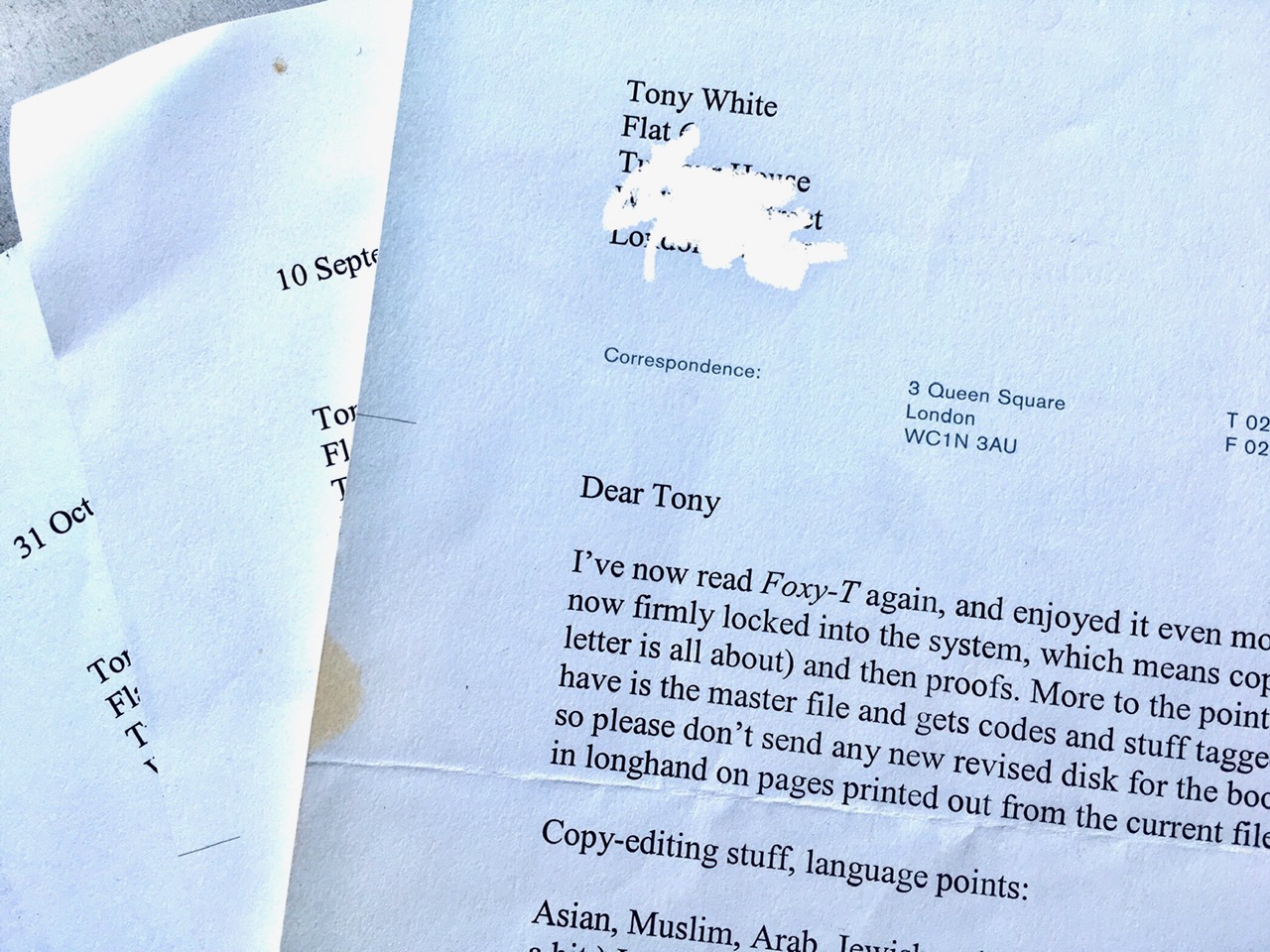
Charles patiently coached me through each stage, and two months later in October 2002 we had fully typeset page proofs. One set that I kept for file, and another that I sent back, marked up.
The first edition of Foxy-T was a ‘demi’-format trade paperback, complete with dust-jacket. The strikingly simple and graphic cover design was by Gray 318, AKA Jon Gray. This was a great thrill, because at the time he’d just done the very striking and influential cover for Jonathan Safran-Foer’s best-selling novel Everything is Illuminated.

The Gray 318 concept for Foxy-T had glitchy typography and bold, free-style marker-pen work emulating the tags mentioned on page one of the novel. It had two hearts (echoing the Papermate pen logo) picked out in red foil. The design seemed really in tune with the novel, but also to continue Faber’s tradition of typographically-based cover designs. I loved it.
I seem to remember being told that a couple of booksellers had fed back to say that readers don’t like yellow and black covers, because the colour-combination reminds people instinctively of wasps, of danger…
That edition is of course long sold out. A mass-market paperback edition published in 2004 (with a different jacket design) is also close to being sold out, give or take a copy or two. But since 2018 the novel has also been available in Faber ebook for all platforms/devices.
More ‘behind the scenes’ posts about Foxy-T at twenty all this week: clichés, ‘the art of the advance quote’, and more…
§
Buy my latest novel The Fountain in the Forest direct from publisher Faber and Faber…

 Piece of Paper Press & tonywhite.london
You must be logged in to post a comment.