My novel Foxy-T was published twenty years ago this week, so I thought it might be interesting to revisit publication with a few posts from behind the scenes. In setting the novel on Cannon Street Road, in turn-of-the-century Whitechapel and Shadwell, London E1, Foxy-T attempted to take a snapshot of a new language form – a sociolect? a dialect? a patois? a vernacular? – that was emerging all around the East End where I lived, and would several years later become known as Multicultural London English (MLE). At the time I would simply talk about ‘the language I was hearing all around me’, as I watched and listened in respectful awe. Of course, language changes and evolves all the time, even if the velocity and scale of those transformations may vary; from something seismic like the emergence of MLE, to tiny shifts in usage.
A decade earlier, in the mid-nineties, my good friend the Scottish artist Rose Frain had a residency as part of an exhibition called Zij Sporen (‘side tracks’) at Gynaika, in Antwerp, Belgium. This would have been very shortly before we worked together on an artist’s book by Rose that I published on Piece of Paper Press, which was itself to be distributed by post.
Rose’s Belgian residency had involved working in and with a restored TPO (or ‘travelling post office’) rail carriage. The work that she made involved a facility to receive and to send post, including an officially designated franking machine that incorporated her own postmark. Here’s a photo from her own archive:

You probably already know that the word ‘cliché’ (derived from the French passive past participle of the verb ‘to click’) comes from the world of print and typesetting. Where a common phrase was used particularly frequently, in order to save time the typesetters would have it pre-cast as a permanent block. That way they wouldn’t have have to set it, character by character, every time that phrase was used; they could simply insert the whole, pre-cast cliché. Maybe the click is the sound of this larger piece being snapped into place; a different sound quality compared to the lighter, looser rattle of type.
As it happens, usage of the word cliché is shifting slightly in contemporary culture. The way that I was taught is that something can be (noun) a cliché, or it can be (adjective) clichéd. However, as anyone who has taught in Higher Education in recent years will tell you, these distinctions have become blurred, perhaps by usage in international English.
Increasingly in UK English, cliché is being used as the adjective form (rather than clichéd). As in, this observation is so cliché, but I’m saying it anyway.
Another example: until recently, UK English usage would say ‘to set foot in (a place)’ meaning ‘to enter’, where e.g. international or American usage – which is increasingly adopted by a younger generation of emerging writers and sub-editors in the UK – would say ‘to step foot in…’ See also, the growing contemporary use in UK English texts of the archaic English form ‘gotten’. (And don’t get me started on how you or I or anyone might pronounce ‘ay’, ‘eh’, and ‘uh’…) If you were writing an English-speaking character who was in their twenties right now, a character who writes, the way they wrote would maybe need to reflect such subtle shifts.
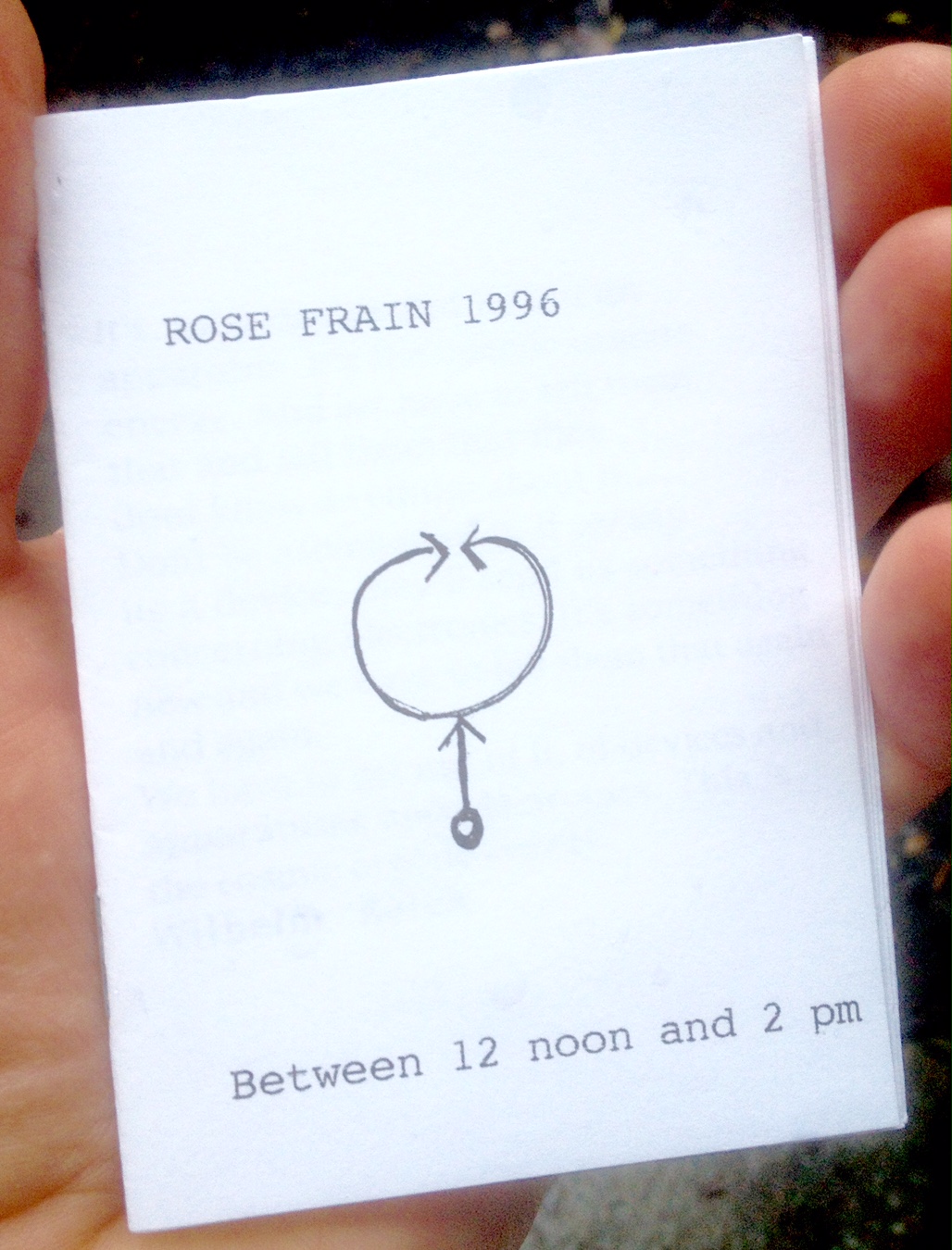
In the Belgian postal system, Rose Frain told me, back in the mid-’90s, the cliché was the name given to the pre-cast or moulded postmark stamp that would be inserted into the franking machines to communicate the official message of the day.
This would have struck a chord because at the time of the conversation, and for most of that decade I worked for the Royal Mail, first in the former London NW1 Mail Centre on St Pancras Way, and later in the Islington Mail Centre off Upper Street. I was never out on deliveries, but worked in the sorting offices. Arriving in London with a degree in Fine Art at the start of a recession, the job had been a lifeline. I’d replied to an ad in the Camden New Journal, and when I joined it was a condition of the job offer and the pay-grade that you had to pass a touch-typing exam: more power to this young writer’s elbow. Chatting about all this with Rose today, she reminds me that in the same conversation in 1996 I had told her that just that week I’d sorted a postcard addressed to ‘The Queen’ from ‘God’.

All of which is prompted by the recollection that for a week or two around publication, Foxy-T was the official postmark on the Faber and Faber franking machine. Every item of post that left the building in that week or two bore Gray 318’s ‘Foxy-T’ device. How cool is that?
Or maybe it was just the former postal worker in me that found this prospect exciting.
Once the Foxy-T franking machine was up and running, Anna Pallai who was Faber’s publicist on Foxy-T sent me a couple of printouts, which I have just found in the archive. Then when it was finished-with, she very thoughtfully sent me the actual stamp (or cliché) as a souvenir. It’s been in a little glass box on the shelf ever since. Thank you, Anna!

More ‘behind the scenes’ from Foxy-T at twenty tomorrow: OMG a big review
§
Buy my latest novel The Fountain in the Forest direct from publisher Faber and Faber…

 Piece of Paper Press & tonywhite.london
You must be logged in to post a comment.