I’ve gathered various reviews of Foxy-T on my press page. But going through the archive recently, I came across some other clippings that I’d missed. It feels like a different time. Foxy-T was published before social media existed, and if your book wasn’t a big acquisition with a correspondingly big marketing budget, in the early ’00s reviews were about all there was.
But Time Out liked Foxy-T, and in the week of publication they ran an interview. This was filleted for a quote to go on Amazon and on the paperback jacket, but I just found a couple of photocopies of the whole thing:
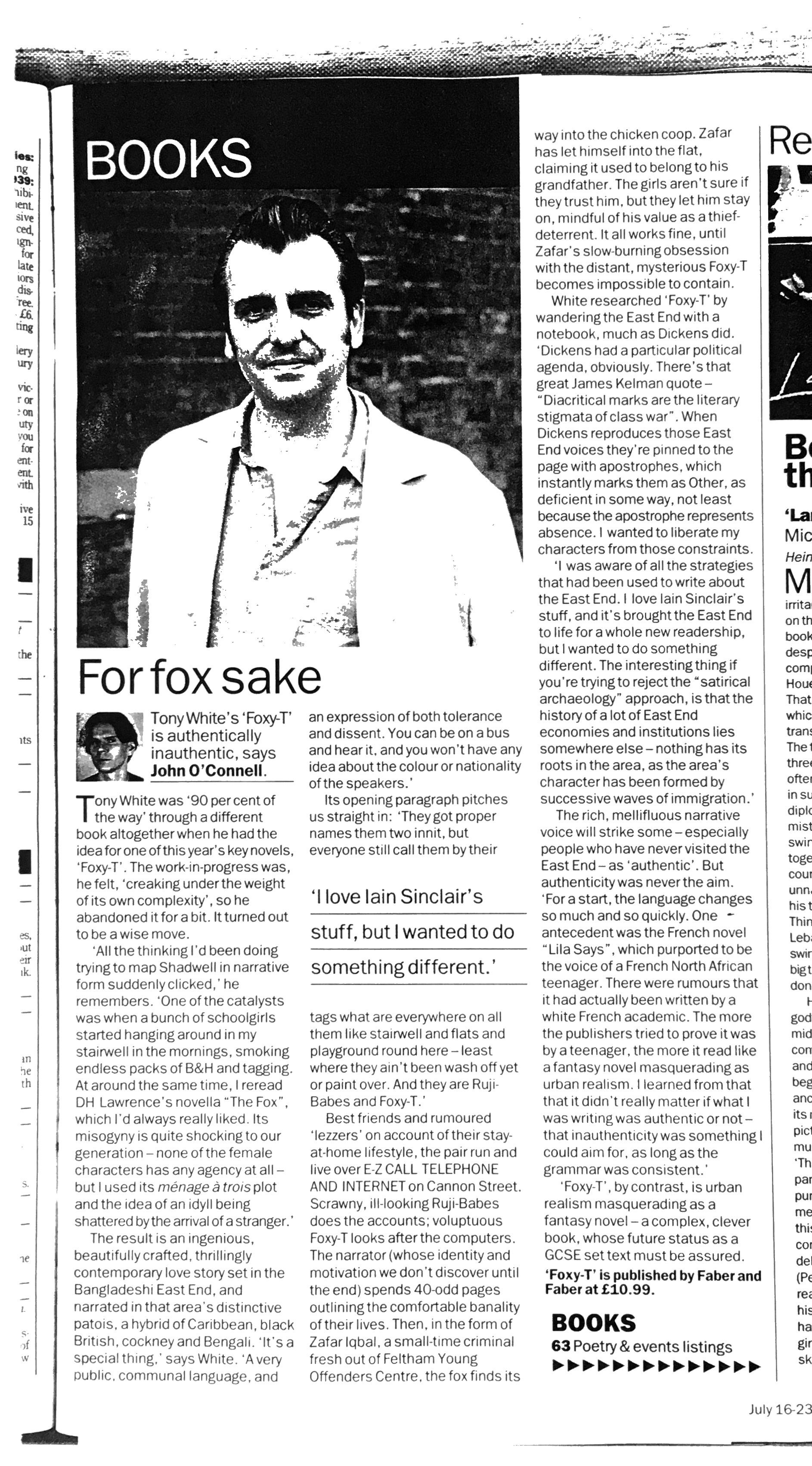
Wow, Time Out was a big deal.
How big? Well, recently I took part in ‘The Big Read’ at The King’s Head in Crouch End. It was part of National Crime Reading Month, a books, reading and literacy promotion that runs through June each year. As well as readings there was a Q&A, and author Jennie Ensor who’d put the event together tried out some of her questions on us: ‘Has it changed the way you write,’ she said, ‘now that you get recognised in the street?’ Cue much laughter all round.
But then I remembered something. Before it moved over to free-giveaway and online models in 2012, Time Out supposedly sold around 110,000 copies weekly, and up to 300,000 or more at its peak, but each of those copies would reach many more individual readers, whether in homes and house-shares, in schools, colleges and public libraries, workplaces, staff rooms and waiting rooms, etc. I don’t know how that broke down in terms of age and other demographics, but the net result was that if you were lucky enough to get a big photo like this in Time Out, people would see it. You’d go into a shop and someone would say, for example, ‘How’s the writing going, Tone?’
‘Yeah, alright, thanks!’ you’d say, once you’d got over the shock.
Blimey.
Some of the early reviews were a bit meh, like these two from Metro (L), and Sleazenation.

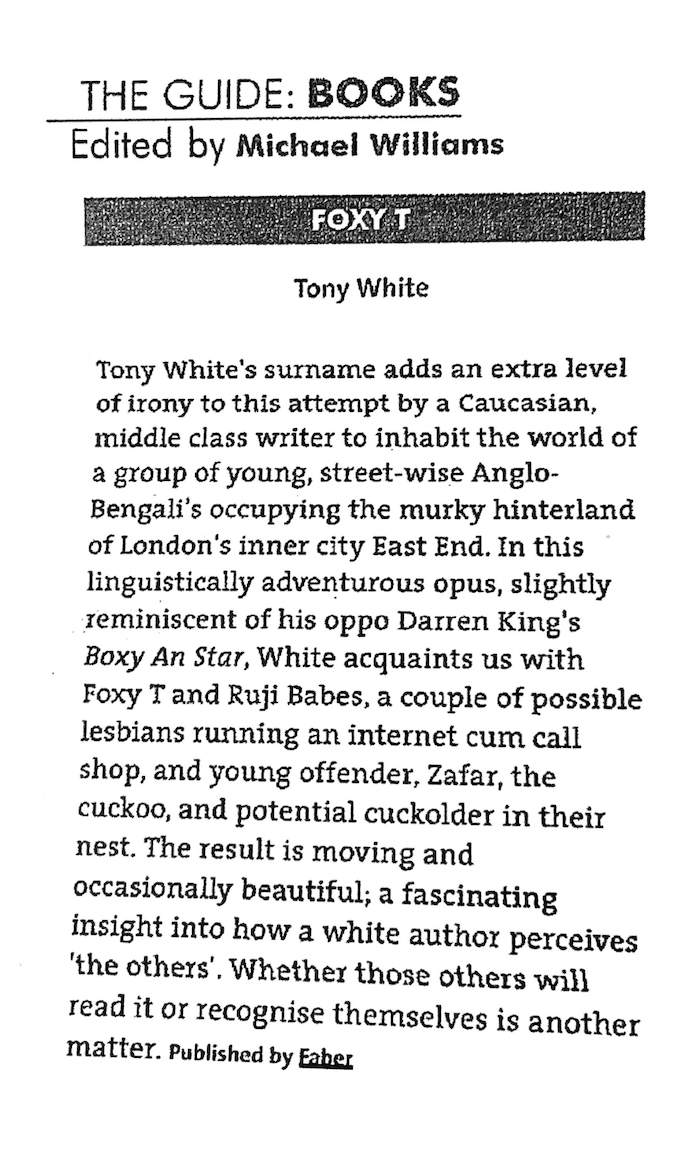
(‘Who are you calling middle class?’ I remember thinking. Quickly followed by, ‘But there aren’t any bookshops in Shadwell!’)
The review that changed everything came later; more than two months after publication. It was a Saturday morning. I was in Islington and bought The Guardian before catching a bus on Upper Street. I can’t remember where I was going or why, but I got a front seat on the top deck. Settling in for the ride, I opened the paper, turning habitually to the ‘Books’ section.
We hadn’t known the review was coming – sometimes you do, sometimes you don’t – and it took a moment to recognise what I was seeing.
‘Benglish for beginners,’ said the headline. And above it the standfirst: ‘Michael Moorcock celebrates the voice of the modern city in Tony White’s Foxy-T.’
Constantly invigorated by successive waves of immigrants, London produces a literature unrivalled by any other great city; she’s a powerhouse of fiction, using whole cultures for fuel. London erupts with street language to match the tenor of the times, drawing vitality from the word-hoards of the powerless and disenfranchised. Working novelists, usually too poor to live anywhere but the ghettos, listen and take notes.
Michael Moorcock, ‘Benglish for Beginners’, The Guardian, 27 September 2003
I was gobsmacked. They say you shouldn’t take reviews too seriously, and some authors claim not to read or be interested in them at all. But this was by the great London novelist Michael Moorcock, so of course I was going to read it. I’d want to know what he thought about almost any book, let alone one of mine.
You can still read Michael Moorcock’s full review of Foxy-T on the Guardian website here…
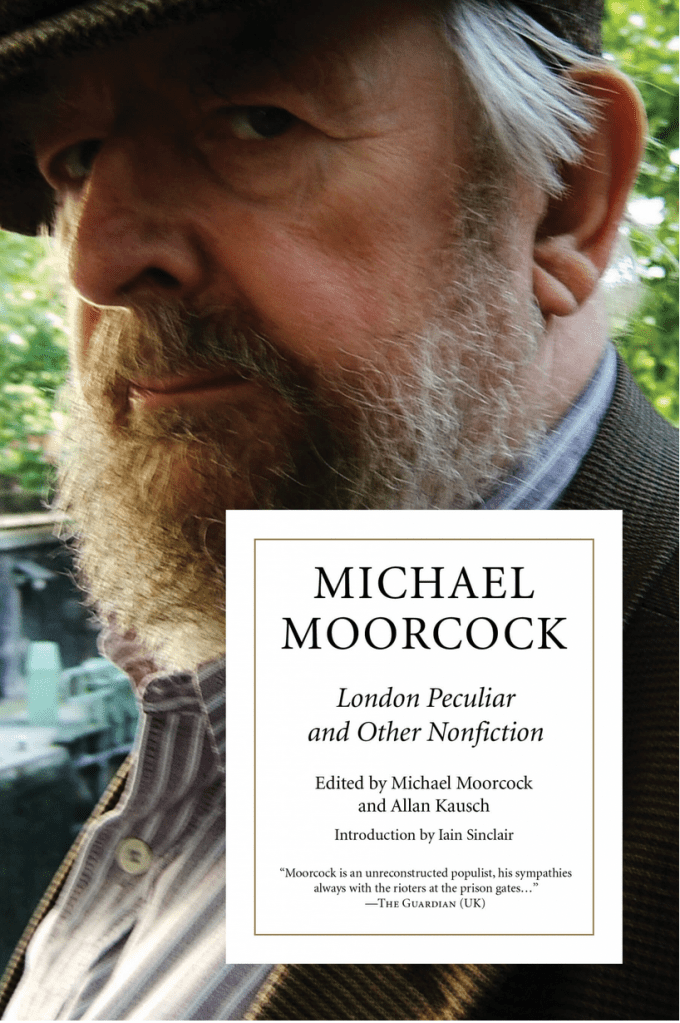
The review is also collected in Moorcock’s excellent 2012 collection London Peculiar and Other Non-fiction, which I would highly recommend. In fact, it’s essential reading for anybody with any interest whatsoever in London’s literatures.
A great thing about books is that they are out there in the world, doing their thing, regardless. And you never know who will pick one up in a bookshop, a library, or a charity shop, and what it will mean to them. It’s a huge thrill when people get in touch from the other side of the world to tell you; or from just around the corner.
Towards the end of that same year, Faber had a call from an East End journalist named Hussain Ismail. A near neighbour of mine it turned out, he’d missed publication of Foxy-T, but had borrowed a copy from what was then the public library in Watney Market (now replaced by a more modern Idea Store). Hussain was planning to write about Foxy-T for a recently-launched style-press magazine called The LIP that was then being published out of Brick Lane. I’d seen posters for it around the place. He wanted to meet up for a chat.
It may be surprising to some readers to learn that there were hardly any bookshops in the East End of London in the 1990s and the early ’00s. Not like there are now. I wish that Pages of Hackney, Donlon, The Broadway Bookshop, Brick Lane Bookshop, and Burley Fisher had existed when I was starting out! In 2003 I’m pretty sure there were just the Newham and Stoke Newington Bookshops, and nothing in between but the small bookshops at Centerprise in Dalston and Eastside in Whitechapel. There was a newsagent on the Narrow Way near Hackney Central station that stocked a limited selection of books (it’s where I’d have bought Victor Headley’s Yardie) and a bookshop in the Whitechapel Art Gallery, but they didn’t do any fiction. So thank goodness for public libraries.
We fixed a date for the interview. I took a couple of hours off work and met him in one of the cafés in the arcade by St James’s Park tube station. A few weeks later, the review came out:
Although this kind of language may surround us, we are not used to reading it, and for this reason Foxy-T is a difficult book to get into for the first 30 – 50 pages. But the effort pays off . . . This is the real sound of the East End, and it deserves to be recognised.
Hussain Ismail, The Lip, No. 3
Hussain Ismail’s review and other issues of The LIP are archived online here…
Two things:
I wouldn’t be a writer now if public libraries hadn’t been there to give me access to literature when I was a child and a teenager.
A quarter of a century later, without public libraries Foxy-T would not have had a way to reach readers in London E1.

§
Buy my latest novel The Fountain in the Forest direct from publisher Faber and Faber…

 Piece of Paper Press & tonywhite.london
You must be logged in to post a comment.