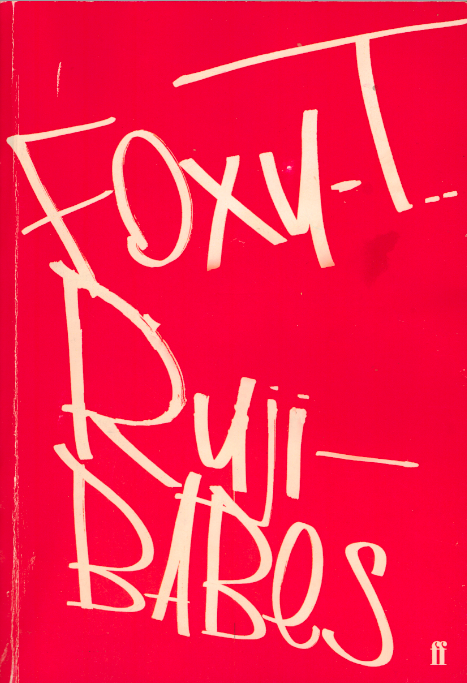
My novel Foxy-T was published twenty years ago this week, so I thought it might be interesting to revisit publication with a few posts from behind the scenes. Today the art of the advance quote…
Around the time that bound proofs of Foxy-T were being prepared, my commissioning editor at Faber Lee Brackstone called to ask if I had any thoughts who about we might approach to give us an advance quote, i.e. a brief and personal pre-publication endorsement. Fairly standard practice, but with a novel as experimental as Foxy-T it was felt that we needed some critical backup pre-publication from disinterested allies.
There are mixed feelings among authors, readers, and in the industry generally, about the value or otherwise of advance quotes.
I’ve heard from colleagues, authors who’ve hit a certain level of public visibility – winning a major prize, for example – that the number and frequency of requests for advance quotes goes through the roof. They are inundated, and they have to start saying no.
On a more day-to-day basis though, I’ve seen both readers and emerging authors claiming that it is off-putting to see the same old rent-a-quote names on book after book. But perhaps advance quotes are aimed less at readers per se, or as much at sales forces and retail, and at potential reviewers via the press release: trusted names helping to gently position a book.
It is also true that I’ve sometimes seen authors under pressure to get advance quotes and overdoing it: getting too many advance quotes from the wrong people.
Yikes! What do I mean by ‘the wrong people’? Aren’t all advance quotes good?
Well, no. Here’s a Pro-tip: don’t make the mistake of getting advance quotes from anyone who might otherwise have reviewed your book. Why? Because having given an advance quote that’s ended up there on the cover, they won’t be able to review it.
For Foxy-T I suggested the authors Michael Bracewell and Stella Duffy, while Lee suggested Niall Griffiths, who I don’t think I’d met at the time (unless fleetingly at Richard Thomas’s Vox ‘n’ Roll events) and Matt Thorne, co-editor of the short story anthology All Hail the New Puritans, to which I’d contributed. Thankfully, all of them agreed.
Michael Bracewell had reviewed my Britpulp! short story anthology for the Guardian, and I was and remain a great admirer of his writing; in particular his novels, and especially The Conclave. At the time I’d quite recently reviewed his 2002 novel Perfect Tense for The Idler. Bracewell’s response to our request – he phoned me at work – was typically modest. He said something along the lines of being flattered to be asked, though unsure he’d be much help, but if I thought so then he’d of course be delighted. I’ve lost the full text of the quote that he sent through a week or two later, which would have been emailed to me at work via my now-defunct Arts Council email address. A bit about the novel being (IIRC) ‘confrontational, in a good way’ got edited out somewhere along the line. Anyway, this is what survived and was used:
An astonishing and audacious novel – the compelling voice of Foxy-T reads like a 21st-century update of Salinger’s Holden Caulfield.
Michael Bracewell
Niall’s advance quote followed shortly after, as did Matt’s. Stella, meanwhile, emailed me separately to tip me off that she’d designed her quote tactically. She wanted, she said, to give us something that might get Foxy-T on the news. Here’s what she wrote (and it’s a lesson in how to give a quote a topical political hook):
In his new novel Foxy-T, Tony White writes the urban contemporary in perfect modern English: a broken-rhythmic patois that has nothing to do with the Literacy Hour and everything to do with real words coming out of real mouths. What’s more, unlike so much of the hard/urban/gritty ‘realism’ being traded at the moment, his is also a sweet and sad love story that stars real girls, instead of wish fulfilment faux-chicks. Truly impressive.
Stella Duffy
‘Perfect modern English’ — genius! If you were writing this now, you might say ‘fronted adverbials’ instead of ‘literacy hour’. And that hook of Stella’s didn’t find any traction with first publication, but fast-forward a year to the mass-market paperback, and Foxy-T was now in B-format with a new jacket, complete with reviews front and back. (That quote on the front cover is from Michael Moorcock’s Guardian review of course.)


With a paperback publication date in mid-August, there were not many events planned. And I was unavoidably out of the country, attending ISEA for work: a roving international electronic arts festival, which that year was taking place in Finland and Estonia, and various points between.
Before leaving for Helsinki, I gave my schedule – hotels and contact numbers – to Anna Pallai, Foxy-T’s publicist at Faber, just in case. Remembering Stella’s email, we agreed that Anna would send the paperback to The Today Programme, highlighting Stella’s advance quote. Because it was also A-Level results season.
The trip to ISEA was all consuming, an endless round of gigs and shows, most of which took place on a ship that sailed from Helsinki to a disused military island in the Swedish Archipelago, and then on to Tallin, where there was a further day and night of gigs and exhibitions to be seen.
Arriving back at my Tallin hotel late that night I found a sheet of A4 paper had been slid beneath my door. It was a fax from Anna at Faber. The next day was A-Level results day, with all the predictable stories expected about falling standards in English. As part of their coverage they would be interviewing the then Schools Minister David Milliband and others about these supposed falling standards in secondary education, after which they would turn to me to talk about Foxy-T. I was to call them for a chat with the producer at whatever time I got back to the hotel; no matter how late. This I immediately did – borrowing a friend’s phone to do so.
Come the next morning, and allowing for the time difference, I was waiting by the phone in my hotel room with a cup of coffee. It turned out to be simpler for Today to call me there than for me to go to the small, city-centre radio studio that the BBC often used when reporting from Tallin. The hotel were primed to put the call through. I was really nervous. I’d never done a radio interview before, let alone a live one, and I listened to The Today Programme regularly, so knew they had a reputation for giving interviewees a hard time. And here I was, presumably being brought in to represent those very same falling standards. What if I was up against John Humphreys? He’d have my guts for garters.
But I’d prepared a little, by writing down the two or three key things I wanted to be sure and say whatever happened: that language evolves, to namecheck Linton Kwesi Johnson and James Kelman, to talk about the new language that had been emerging in the East End.
As I waited for the call to come in, a bit of ‘stage craft’ kicked in: wisdom learned from years of giving live readings. I realised that I had a trump card here; grist for the mill that I could call upon if at any point the interview threatened to go astray. If that happened, I could simply say, ‘Sorry I can’t hear you, I’m in Estonia! – but the thing is…’ and then quickly shoehorn in whatever point I did want to make.
During the interview, Today presenter Ed Stourton gamely read a section of my novel aloud before asking whether by using such contemporary language I was in fact excluding ‘some of us’.
(This fantasy of exclusion by people in power is an interesting one.)
Curiously, The Today Programme‘s sound archive which includes every programme broadcast since 2003, seemed to always be missing this one section, even though it was listed at 08:20 on 19 August 2004. However I do own a low quality cassette recording, which (with apologies for sound quality) I digitised and put on YouTube.
Here it is. Take a listen to how Ed Stourton seizes upon Stella Duffy’s tasty bait… (Thank you, Stella!)
§
Buy my latest novel The Fountain in the Forest direct from publisher Faber and Faber…

 Piece of Paper Press & tonywhite.london
You must be logged in to post a comment.