No, it’s not a steampunk typewriter, or a primitive computer in some Jet Age laboratory. It’s a second generation Post Office ‘Code Desk’, and in the first half of the 1990s I learned to type on these behemoths. And if it looks like a machine from another age, that’s because it is.
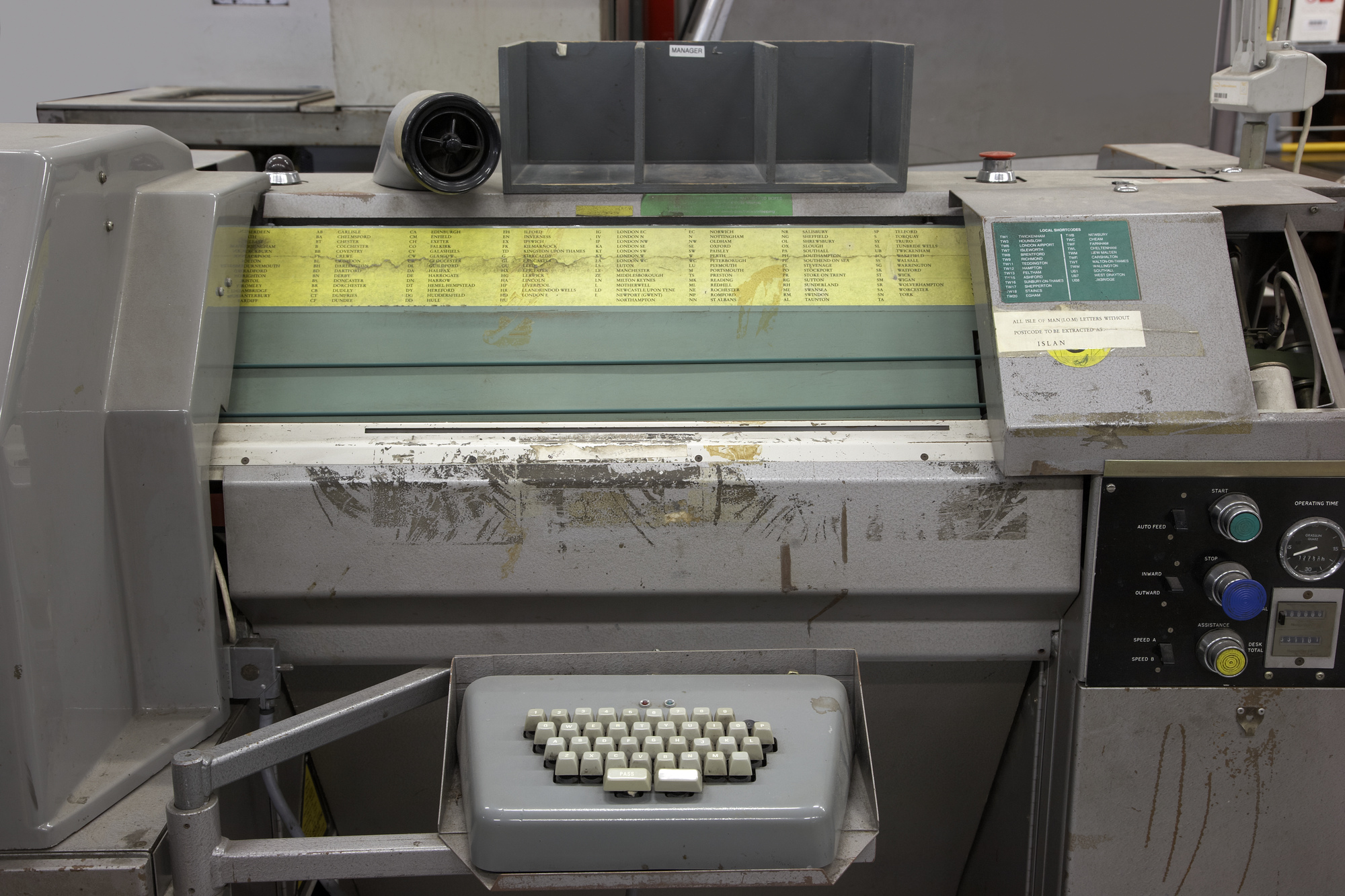
If you knew me in the early ’90s, chances are you’d have known that I worked for the Royal Mail, and did everything else around the long shifts and the anti-social hours required. A lot of my working day – whether on late or early shifts – would have involved sitting at a machine almost identical to this one. With the (adjustable-height) keyboard low on my lap, and my headphones on, the fan blowing to keep me awake, I’d have been watching letters whizz by and typing frenetically.
‘Oyessoyess! I never dramped of prebeing a postman,’ says James Joyce in Finnegans Wake. And nor had I, but there was a recession on, and I saw an ad in the Camden New Journal. Passing an intensive touch-typing course in the first couple of weeks was, they told me at the interview, a necessary qualification for the job. It’s a skill that has stood me in very good stead as an author ever since.
A product of the wave of advances in postal technology, from mechanisation to automation, and still operating into the early days of email, these Code Desks enabled their operators to translate the post code that was part of the address written onto each letter into a system of more-easily machine-readable dots that would be printed onto each item. In the absence of a visible post code, the names of certain ‘Post Towns’ and cities could be rendered as a ‘short-code’. The Code Desk output was boxed up and fed directly into another huge machine nearby that sorted the letters on towards their destination by reading said dots.

In the then Royal Mail NW1 Mail Centre on St Pancras Way, London, where I worked as Postman Higher Grade or ‘PHG’ (until NW1 and N1 merged, and we all moved up to the N1 Mail Centre on its huge site behind the Almeida Theatre, on Upper Street in Islington, a site long-since redeveloped into luxury flats and restaurants, etc.) there were two long lines of Code Desks, perhaps as many as forty or fifty in total. Each of which could process thousands of letters per day. Letters to be coded were stacked end-on along a conveyor that ran right to left along the top of the machine. They’d jiggle along the belt then drop down a chute one-by-one, to be routed around and appear face-out on the lectern surface in front of the operator. It was really noisy – the sound of all those conveyor belts going at once in all these great clattering machines. Letters would pass from right to left, stopping in front of you for just long enough that you could type the post code, then (IIRC) you’d immediately hit the right hand ‘space bar’ key with your thumb to send that item off and line up the next. You’d do a couple of thousand an hour.

Unlike the machine illustrated above, the keyboards on the Code Desks in London NW1 and N1 were intentionally left blank. The thinking being, we were told, that if you had to look down and search for the correct key every time then you’d never hit the numerical target of items-per-hour. Whereas if you were trained to touch-type on a blank keyboard with a very low error rate, you wouldn’t need to waste time looking for the key for each letter, you simply knew where they were by muscle memory.
That muscle memory lasts a long time.
Here’s an interview with another former Code Desk Operator (from a different office), that was published by the Postal Museum and Archive as part of their Sorting Britain exhibition last year. That’s where the Code Desk photo above came from too.
By the time I left the Royal Mail, these Code Desks were starting to be phased out in favour of ‘video coding’, but by then I’d been transferred to non-coding duties, sorting the ‘NW1 Inward’ by hand on the night shift. I wrote most of the first draft of my 1999 novel Charlieunclenorfolktango in long-hand during the tea and dinner breaks on those night shifts at Upper Street through 1996.
More recently, a job application form asked applicants to enumerate the usual employment history. It also (quite progressively, i thought) asked applicants to state what they had learned from each job or work experience listed. Against my job for Royal Mail, I wrote ‘touch-typing’, ‘St John Ambulance first-aider (expired)’, and ‘London at dawn.’
§
Buy my latest novel The Fountain in the Forest direct from publisher Faber and Faber…

 Piece of Paper Press & tonywhite.london
You must be logged in to post a comment.