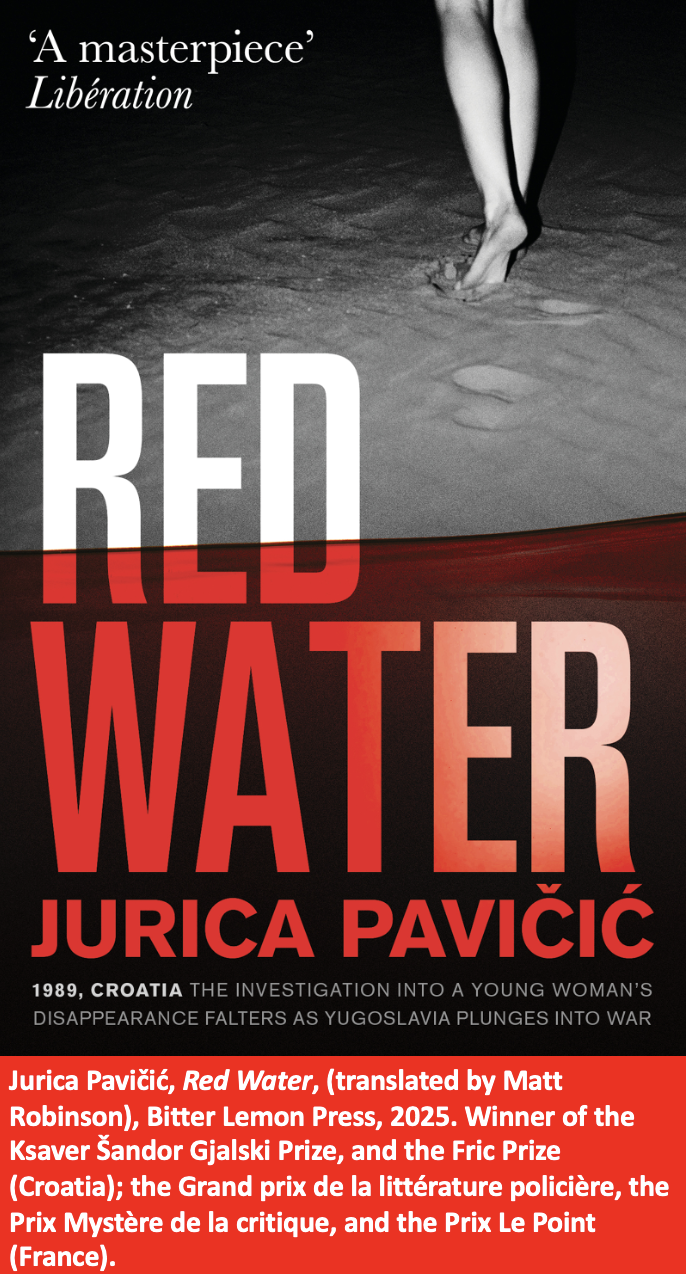
London author Tony White speaks to Croatian novelist and critic Jurica Pavičić during his recent UK visit to promote the publication this year of the English translation of his multi-award-winning novel Red Water

Congratulations! – Red Water is the first of your novels to appear in English translation. What’s it about?
Red Water is my seventh novel, first published in Croatia in 2017. Compared to my other novels, it’s less a thriller and more a classical whodunnit: a history of the disappearance of a 17-year-old girl from a small coastal community. It’s September 1989, the whole pre-existing universe is collapsing, and everybody is distracted by huge political changes: the fall of socialism, followed by the break-up of Yugoslavia, war, etc. But I wanted all these big events to be in the background, not the main topic. For my characters, their own drama is so big that there is no emotional room for global concerns. But vice versa: since everyone else is focused on massive social upheavals, nobody cares about a missing teenager. From that point, I follow several characters through the next twenty-six years, until the mystery is solved. I wanted to write a novel in which one big event transforms the lives of all the characters involved, propelling them in different directions like billiard balls scattered when you ‘break’ at the start of a game. Inspiration also came from a great ‘cold case’ novel: Blackwater by Kerstin Ekman (my title is a kind of homage).
Does your work as a film critic contribute to your novel-writing?
My film criticism shaped my taste. If you are a film critic you don’t divide ‘high’ and ‘low’ cinema. You are trained to equally appreciate Bergman, Fellini, Hitchcock or Raoul Walsh. As a film critic I like good, intelligent and deep genre cinema. So inevitably I started asking myself: ‘What is the equivalent of this in literature?’ At some point I discovered Le Carré, James Ellroy, Patricia Highsmith… For example, I heard about Highsmith for the first time in an interview the young Slavoj Žižek gave a Zagreb weekly in 1986. He influenced me by promoting the values of good popular fiction. At that time he was a local star but internationally unknown. I thought, ‘He is a clever young Slovenian philosopher, if he says Highsmith is good, then she must be.’
Why write crime fiction?
As a writer I try to give readers all the guilty pleasures, all the reasons we read crime fiction: the suspense, the mystery, the riddle, the uncertainty. I want my books to be page-turners, but I also want them to be rooted in a specific society. It seems wrong somehow to write an American or British-style crime novel that just happens to take place in Croatia. It needs to be a Croatian crime novel, to include a Croatian type of crime, and Croatian models of family, of institutions, attorneys, police, economy, food, dialects, etc. For example in former Yugoslavia the only genre in which police were the main characters was jokes: there was a whole genre of jokes about stupid constables. Also, a good crime novel is almost always a social novel. You could say that crime and thriller fiction stepped into the shoes of the big social novels of the 19th century, as mainstream-literary fiction moved towards psychology, introspection, stream of consciousness. If you want to learn about the US in the thirties, you read hard-boiled crime fiction. If you want to understand Britain after the collapse of the Empire in the fifties and sixties, you read Le Carré. Right now Croatia is a bit like everywhere else, the market is dominated by Anglo-Saxons and Scandi Noir. Jo Nesbo is the top seller.
Is there a home-grown crime writing scene in Croatian literature?
Croatia is a small country (pop. 3.8m) with a small literature. The entire Croatian production is about fifty novels a year. The literary field is relatively elitist, venerating more ‘highbrow’ literature – autofiction, historical novels, family sagas. Nevertheless, there is a crime fiction tradition that started in the late seventies, early eighties, a period when the socialist publishing industry in the proto-capitalist hybrid that was late-communist Yugoslavia was already market-orientated. At that time two bestselling writers started writing genre fiction: Pavao Pavličić and Goran Tribuson. In the early eighties, Tribuson introduced the first recurring investigator, Nikola Banić, who started out as a policeman, then became a private investigator. Today the most celebrated crime writer in Croatia is Drago Hedl, author of a series of inter-connected crime novels set in his home town of Osijek in the north east of the country.
Can you tell us about UPiT?

Udruženje Pisaca Trilera (UPiT) – ‘Association of Thriller Writers’ – is a new crime and thriller writers’ association, announced in January 2025 by author colleagues in Belgrade. It covers the whole of former Yugoslavia. I’m a member. UPiT is based in Belgrade because the genre fiction market is stronger in Serbia than elsewhere in ex-Yugoslavia. It’s the biggest market, and the most commercially-driven. The normal work of the society has been somewhat disturbed by the riots and social upheavals in Serbia over the past ten months. We have founded an annual prize that was awarded for the first time at the inaugural Belgrade ThrillerFest in May of this year, to Polje Meduza (Field of Medusas) by Oto Oltvanji.

This interview first appeared in a slightly different form in Red Herrings (December 2025, Issue 825), the journal of the UK Crime Writers’ Association.
§
Buy The Fountain in the Forest (Faber, 2018)…

 Piece of Paper Press & tonywhite.london
You must be logged in to post a comment.