Reblogging this post from October 2014 for your enjoyment, with a couple of updates: a) the MixCloud link now repaired to archive audio of ‘Stormbringer’ performed live at Roshven, Scotland with musical accompaniment from Peter Lanceley, and b) to include a link to a subsequent republication of ‘Stormbringer’, in Jean-Marc Lofficier’s 2017 anthology Michael Moorcock’s Legends of the Multiverse (Black Coat Press).
My short story ‘Stormbringer’ will be broadcast on Resonance 104.4fm at 4pm today, 28 October 2014. Here’s what it says in the Resonance 104.4fm schedule:
By way of tribute to the late Jack Bruce, a special broadcast of Tony White’s short story first broadcast as part of Remote Performances in August 2014. ‘Stormbringer’ was inspired by talk of a period in Jack Bruce’s life when it seems he was entitled to be formally addressed as The Much Honoured Laird of Sanda. Voice: Tony White. Guitar: Peter Lanceley.
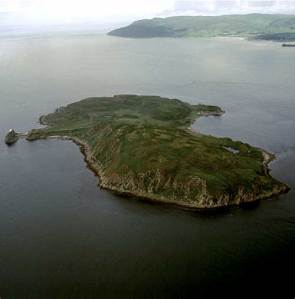
In 1999 I had been invited to be part of an art project that was to take place on the remote Scottish island of Sanda, off the southern tip of the Mull of Kintyre. Bruce Gilchrist and Jo Joelson of London Fieldworks had invited a group of artists…
My new short story inspired by the life and work of the aeronautical engineer Sophie Robinson, specially commissioned for episode 3 of the groundbreaking new Inventive Podcast series, mixing engineering fact and fiction. Listen now at www.inventivepodcast.com
Episode 3 of the groundbreaking Inventive Podcast airs today, featuring Professor Trevor Cox’s in-depth interview with the brilliant aeronautical engineer Sophie Robinson, and my new short story inspired by Sophie’s life and work, ‘The Hotwells Cold Water Swimming Club’.
The Inventive Podcast series mixes engineering fact and fiction, and in my story I wanted to explore further some of the ethical dimensions of Sophie’s work – plus ideas around class and access to education – via the medium of wild swimming.
At one point I began thinking of the story as a kind of ‘prose portrait’, and I tried to use Sophie’s voice wherever I could, finding that incidental comments from the interview recordings and my notes – e.g. ‘Go on, ask me that question again.’ – might provide me with the actual narrative building blocks of my story. But I was also mindful that a story always needs to assert its own logic, and I remembered what the poet Louis Aragon says in the preface to Vol. 1 of his great Henri Mattisse: a Novel about the moment when a written portrait begins to diverge into fiction:
to justify the liberty taken with my subject, my own variations, the sort of detachment I aimed at . . . Just as a painter, having started a portrait, finds his hand running away with him and . . . eventually changes from a photographer into a novelist.
Aragon, Henri Matisse: a novel, Volume I, p.16
You will notice that the fictional engineer in my story is called Fiona/Fi rather than Sophie/Soph, but I hope I have done the real Sophie proud nonetheless!
It was a great privilege to talk to Sophie and to write a piece of fiction inspired by Trevor’s interview and our subsequent conversations, so I really hope you enjoy the episode.
Here’s the blurb:
In the third episode of Inventive Podcast, Trevor meets aerospace engineer Sophie Robinson. Sophie works on groundbreaking eVTOL (electric vertical take-off and landing) aircraft that will change the way we travel in the future. Writer Tony White’s inspirational story ‘The Hotwells Cold Water Swimming Club’ captures perfectly what Sophie gets up to in her spare time – she’s a self-confessed mermaid! – and the ethical dilemmas she has faced at work.
A beautifully performed extract from my specially commissioned new short story ‘The Hotwells Cold Water Swimming Club’, inspired by the life and work of aeronautical engineer Sophie Robinson, formed part of a great Edinburgh Science Festival event for the Inventive Podcast series yesterday. The online event is now up on YouTube and on the Festival site.
I was really hoping for a strong northern female voice to read the story, so I’m super pleased with the casting by Inventive’s production company Overtone! See what you think (the extract starts around 13:42, but the whole event is really worth a watch).
My story premieres in full next week as part of Sophie Robinson’s and my episode which airs on 7 July.
They are all of them themselves and they repeat it and I hear it, a marathon reading of Gertrude Stein’s The Making of Americans instigated and organised by Anna Barham and Irene Revell, and which I participated in over the past year or so, will be broadcast in its entirety for 52 hours starting Friday 25 June at 6pm, as part of Town Hall Meeting of the Air, an exhibition and public programme conceived by Kate Liston & Tess Denman-Cleaver that thinks about the poetics of civic gathering. Town Hall Meeting of the Air is at Baltic39, Newcastle upon Tyne until 2 August 2021.
Here’s more info from Anna Barham on Instagram:
In January 2020 @i_a_revell and I organised a year long collective reading of #TheMakingofAmericans We met in person for the first 3 sessions and then hosted 20 more online. Listen to all the sessions stitched together in a marathon broadcast from 6pm Friday @townhallmeetingoftheair an exhibition and radio station conceived by @listonkate and @tessd_c (who’re both among the readers) throughout the weekend on townhallonair.com
Superstar engineers and fantastic fiction writers collaborate on the brand-new Inventive Podcast
I’m really excited to be part of the Inventive project. Each writer was introduced to an engineer, with a brief to write a piece of fiction inspired by any aspect of their life and work. Starting 23 June, each story will be broadcast alongside an interview with the engineer. And there will be events, including at Edinburgh Science Festival.
I don’t know the full line-up yet, but I do know that some great writers are involved, including Nina Allan and Tania Hershman.
My episode – with the brilliant aeronautical engineer Sophie Robinson – will be broadcast on 7 July. I can’t wait to share it with you.
“Engineering is so central to our lives, and yet as a subject it’s strangely hidden in plain sight. I came up with idea of Inventive to explore new ways of telling the story of engineering by mixing fact and fiction,” commented Professor Trevor Cox, Inventive Host and an Acoustical Engineer from the University of Salford.
The series will debut on Wednesday 23 June with 6 new episodes dropping across the summer. We’ll have a break and be back with the final five episodes in October.
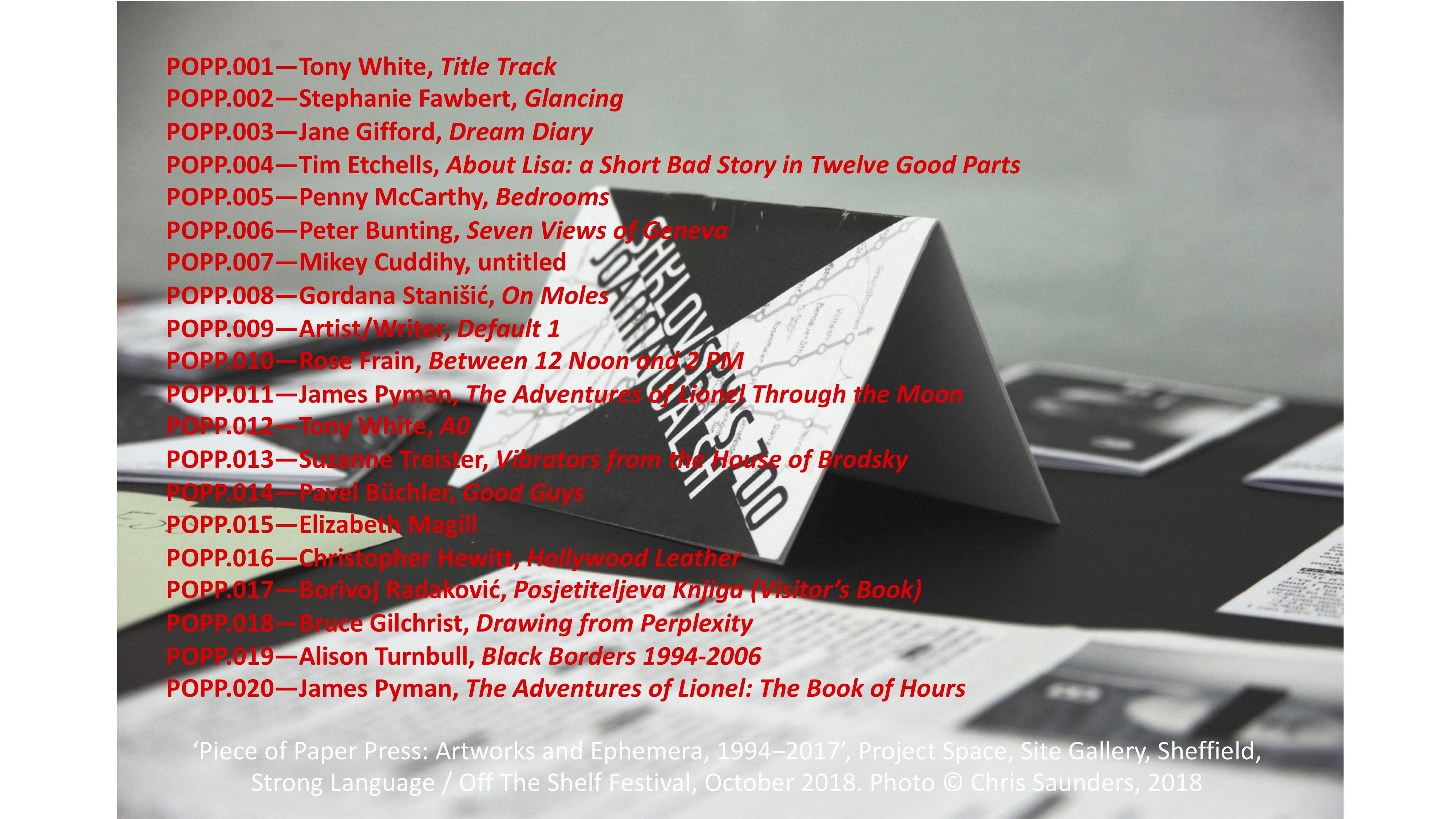
This weekend I was privileged to have been invited to talk about Piece of Paper Press – the artists’ book project I founded in 1994 – for Carthorse Orchestra, David Collard’s online literary gathering. Here are a couple of slides showing the titles published to date. The book in Chris Saunders photo is an untrimmed cover registration test of Joanna Walsh’s Shklovsky’s Zoo, from 2014.
Here’s the blurb for the Carthorse Orchestra event – many thanks to David, and all:
This week we mark the publication of three outstanding works of fiction: Rónán Hession will be reading from his second novel Panenka, Joanna Walsh will discuss Seed with Tim Etchells, and Lynn Buckle will share her new novel What Willow Says. We’ll have close-up magic from Oli Catford, Tony White will talk us through his unique imprint Piece of Paper Press. and theatre maker Laura Hopkins will tell us more about a theatrical work-in-progress ‘Brutal Arithmetic’.
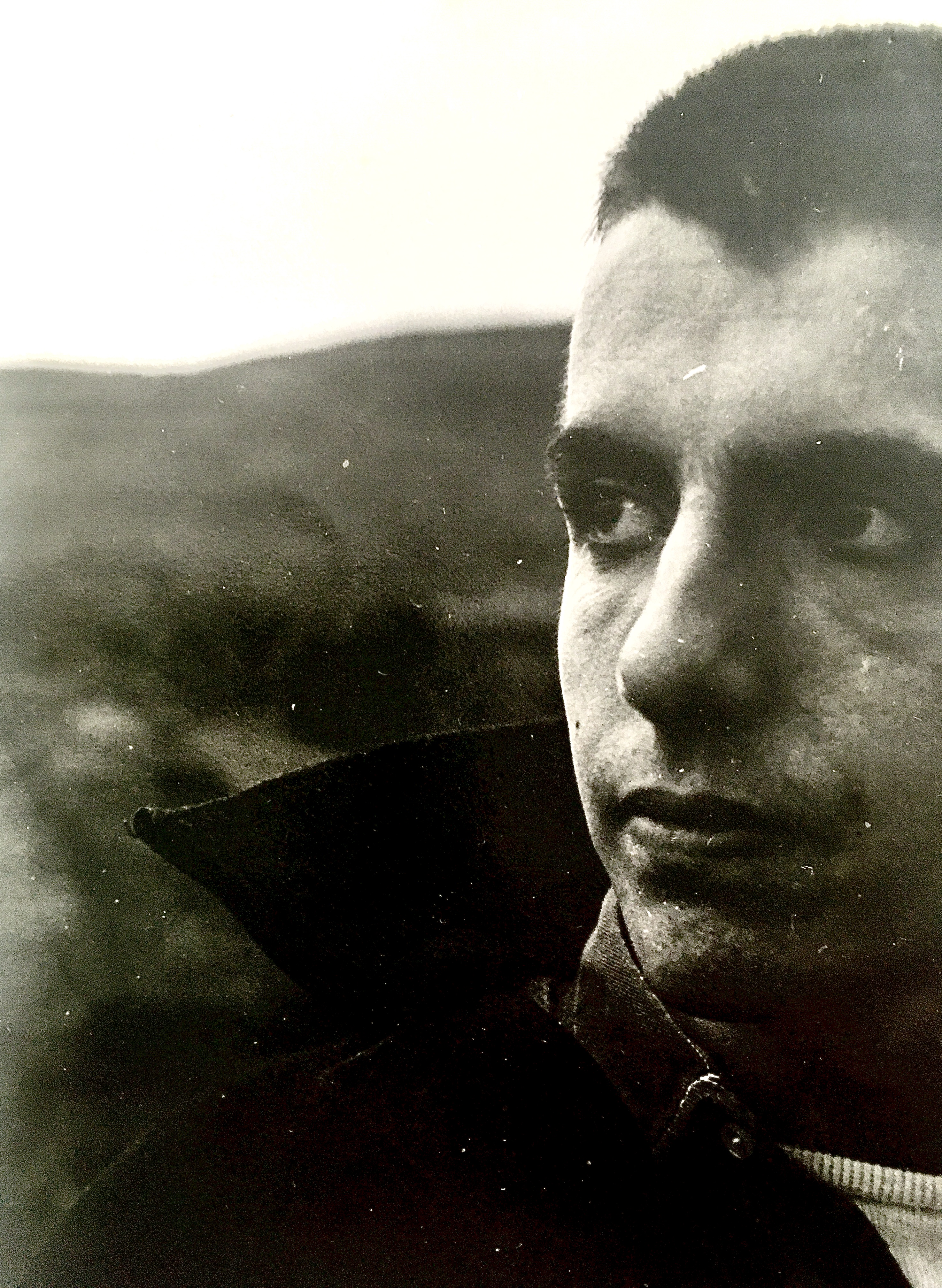
Having been writing around/about the spring of 1985 (and all points in between then and now) for a while, first with my novel The Fountain in the Forest, and latterly with Volumes two (completed) and three (in progress), I found this photogaph of me right then, aged nearly 21, on the edge of the moors outside Otley, West Yorkshire.
Spring in Yorkshire: warm enough for a picnic, cold enough for a donkey jacket!
I lived in Leeds at the time. The photo is by my good friend and housemate Debbie, who had darkroom access via her Fine Art course at what was then Leeds Poly.
In that spring of 1985 – having already done a Foundation Course at the former West Surrey College of Art and Design (now the University for the Creative Arts) in my hometown of Farnham – I was working my way towards going back to study Fine Art myself, although that wasn’t as straightforward as it might have been. Which is partly why I was living in Leeds.
Access to education, especially higher education, is an issue that is really important to me. And it’s a theme I’ve found myself returning to in my fiction, so more on that later maybe – but it will need a longer piece than I can write now, today. In the meantime, thanks to Debbie for taking such a good photo – I’m lucky to have it!
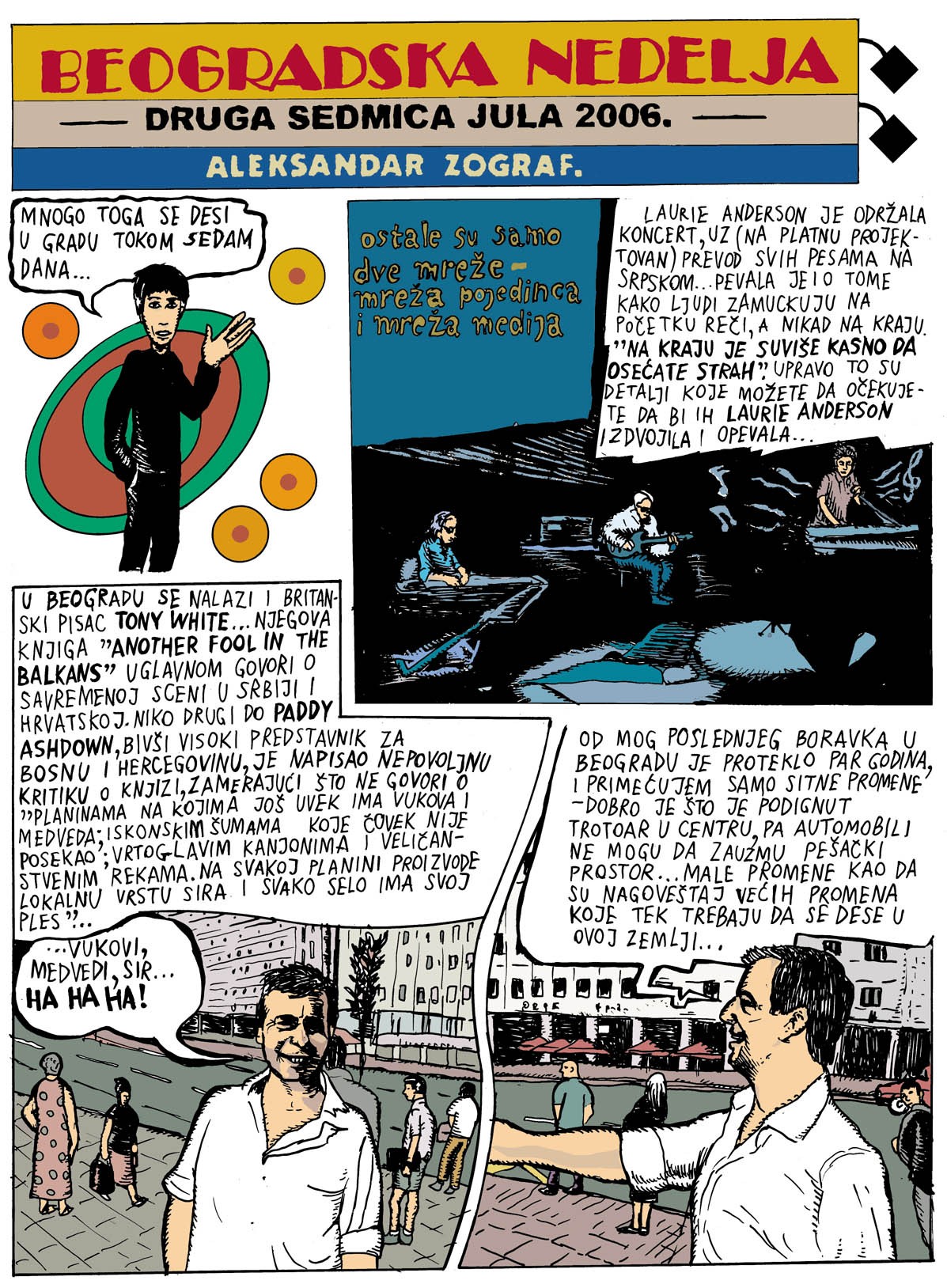
What was happening in Belgrade, Serbia, in the second week of July 2006?
I should know, because I was there. But luckily for us the comics artist Aleksandar Zograf, aka Saša Rakezić of Pančevo, Serbia, drew a weekly diary of goings on in the city for Belgrade-based news magazine Vreme.
It’s a great and really innovative piece of commissioning by Vreme, and a great body of journalistic commentary by Zograf – and I think some of the strips have been collected in book form too.
According to Zograf’s strip from July 2006, the US performance artist Laurie Anderson had performed in Belgrade, and I was visiting (to speak at a Council of Europe conference, although Saša is not asking me about that here). Meanwhile, at various locations around the city, the cult film sequel We Are Not Angels 3 was being shot.
Saša came in to the city to interview me. We had coffee on the pavement outside the Hotel Moskva on Terazije in the city centre, as you do.
Here’s a rough translation of the first page at least:
A lot happens in the city over the course of seven days. Laurie Anderson gave a concert, with Serbian translations of all the songs projected onto a screen. She also sang about how people stutter at the beginning of a word, and never at the end: ‘In the end it’s too late to feel fear.’ These are exactly the details you would expect Laurie Anderson to single out to sing about. The British writer Tony White is also in Belgrade. His book Another Fool in the Balkans mostly talks about the contemporary scene in Serbia and Croatia. None other than Paddy Ashdown, the former High Representative for Bosnia and Herzegovina, has written an unfavorable review of the book, objecting to White’s not talking about ‘mountains where there are still wolves and bears; pristine forests that man has not cut down; dizzying canyons and majestic rivers. Every mountain produces a local type of cheese and every village has its own dance…’
In the first speech bubble I’m laughing at Ashdown’s pompous review: ‘Wolves, bears, cheese . . . Ha ha ha!’ Then, ‘A couple of years have passed since my last stay in Belgrade and I notice only minor changes – it is good that the sidewalk in the center has been raised, so cars cannot take up pedestrian space. Small changes that seem to be a hint of major changes yet to be made in this country . . .’
When Saša sent these JPEGs through at the time, I was stunned by the likeness of me that he had managed to capture in the profile drawn at bottom right of the page. Or perhaps it would be more accurate to say that I was stunned by how much it looked like my father (who sadly died a couple of years later); a resemblance that I hadn’t quite acknowledged before seeing Saša’s drawing.
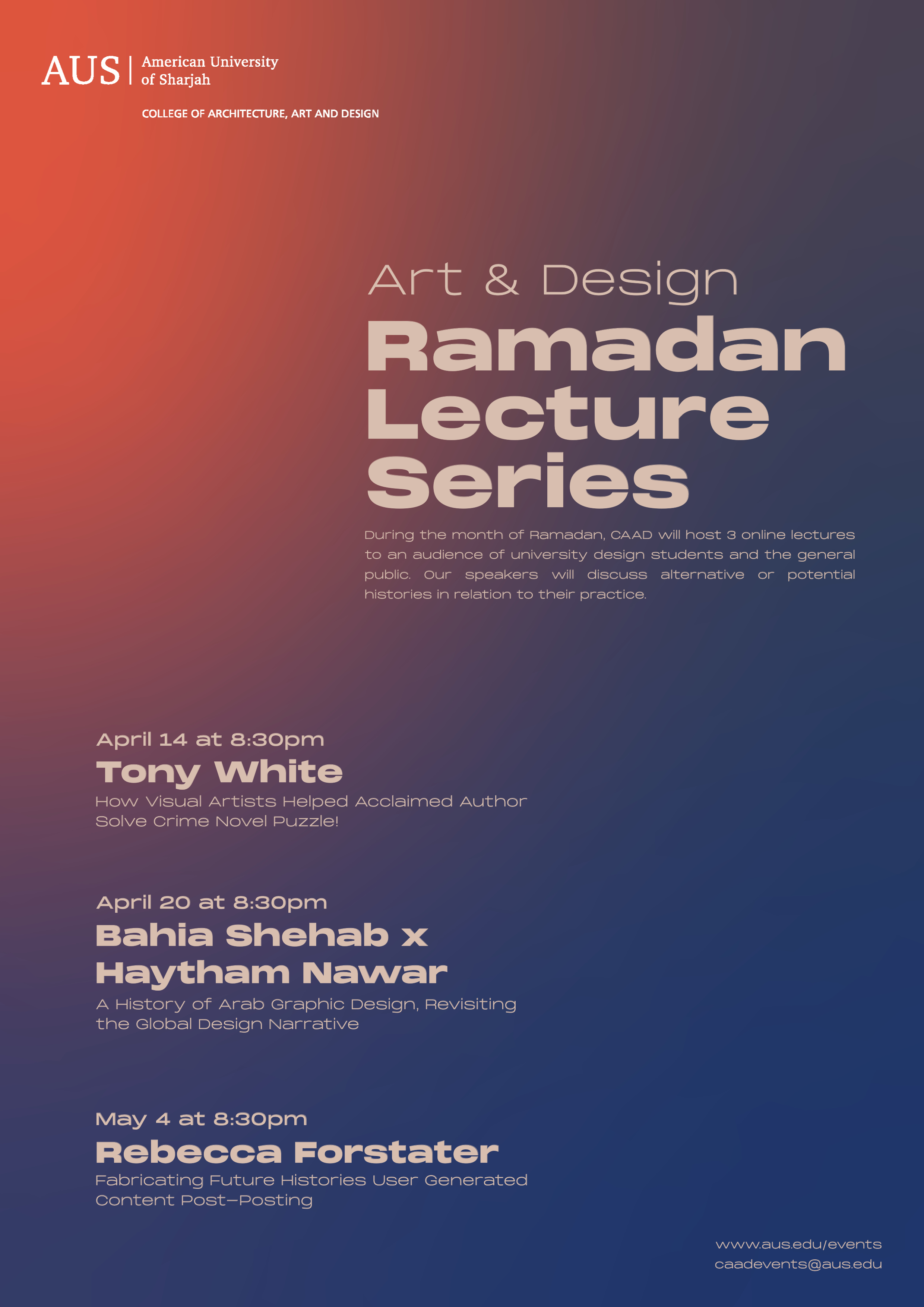
I’m really looking forward to speaking as part of the Ramadan Lecture Series in Art and Design at the American University of Sharjah next week – albeit remotely, due to the Covid-19 global health emergency. The theme of the series is alternative and potential histories, and the title of my lecture is ‘How Visual Artists Helped Acclaimed Author Solve Crime Novel Puzzle’.
I will of course be reading from and discussing my latest novel The Fountain in the Forest – the ideas, and the writing process, and the collaborations that fed into it.
I’m also looking forward to attending the other lectures in the series.

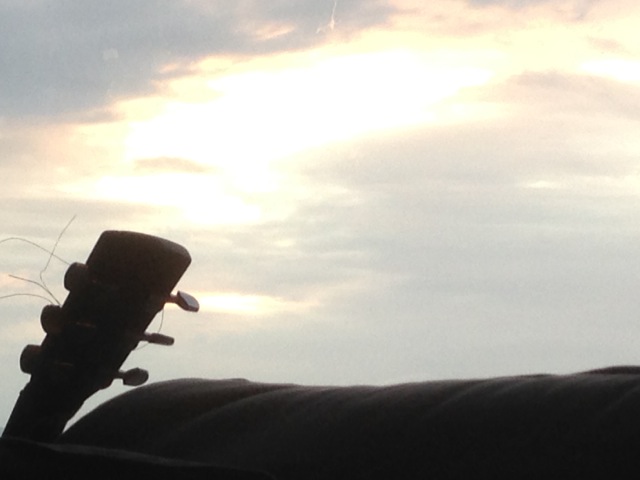 Image © 2014, Jo Joelson, London Fieldworks
  © Anthony Oliver, 1999






 Piece of Paper Press & tonywhite.london
You must be logged in to post a comment.