Out of Site

Screen Shot 2014-01-14 at 13.41.16My new short story, ‘Animate Me’ has been commissioned by PEER and Animate Projects, for publication alongside four new commissions by artists that go on show from Thursday 16 January 2014.

There were dozens of them – a generation, near enough – working as ‘inbetweeners’ and cleaners-up, doing thumb-nailing or little animation tests, getting to know particular characters and ending up as animators, compositors. That’s where it all starts […] So why was I the only one in the Hawley Arms not wearing a Roger Rabbit UK crew jacket?

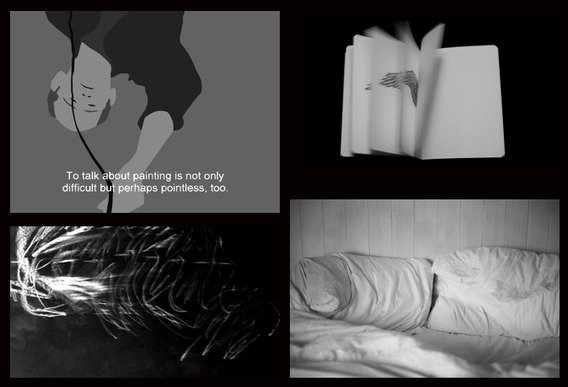
PEER in partnership with Animate Projects has commissioned four new moving image works to be back-projected through PEER’s gallery windows and viewed from Hoxton Street, from 3pm to 8pm Wednesday to Saturday, until 8 March 2014.

‘Animate Me’ is published as a free, A5 one-fold pamphlet, typeset by the brilliant Joe Ewart, and will be available in the gallery throughout the exhibition.

On Saturday 1 March at 4pm I am chairing a panel discussion with artists Savinder Bual, Karolina Glusiec and Margaret Salmon. This will take place at the gallery, and is free, but booking is essential. Click here to reserve your place.

Images clockwise from top left: Kota Ezawa, Paint on Glass, 2013; Savinder Bual, Wing, 2013; Margaret Salmon, Housework, 2014; Karolina Glusiec, Out of Sight, 2013

Images clockwise from top left: Kota Ezawa, Paint on Glass, 2013; Savinder Bual, Wing, 2013; Margaret Salmon, Housework, 2014; Karolina Glusiec, Out of Sight, 2013

Republic of the Moon

Screen Shot 2014-01-07 at 09.04.06I’ll be reading from my short story ‘Occupy the Moon’ on Thursday evening, at the private view of The Arts Catalyst’s exhibition Republic of the Moon — London, which has been getting some good press in the run-up to opening. Coverage includes the Space Policy blog, Wall Street Magazine and the Guardian.

Liliane Lijn, Moonmeme. Click through to go to Liliane Lijn's website.‘Occupy the Moon’ was first published online by The Arts Catalyst two years ago, having been commissioned to accompany an earlier version of the exhibition at FACT, Liverpool. The story responds in particular to the work of Agnes Meyer Brandis and — especially — Liliane Lijn’s Moonmeme (left). It was also an attempt to write a science fiction short story in the mould of those great, old, yellow-jacketed Gollancz anthologies that I loved to borrow from my local library when I was a child.

This is the first time that ‘Occupy the Moon’ has been available in print form, where it is among the writings included in A Manifesto for the Republic of the Moon. (Bibliographical info etc. to follow.)

Eagle-eyed readers will know that I have worked with Liliane Lijn and blogged about her work before.

Here’s the exhibition blurb from The Arts Catalyst’s site:

After two decades working with space dreamers from the European Space Agency to anarchist autonomous astronauts, The Arts Catalyst will transform Bargehouse into an Earth-based embassy for a Republic of the Moon, filled with artists’ fantastical imaginings. Presenting international artists including Liliane Lijn, Leonid Tishkov, Katie Paterson, Agnes Meyer Brandis, and WE COLONISED THE MOON, the exhibition combines personal encounters, DIY space plans, imaginary expeditions and new myths for the next space age.

Marking the start of its twentieth anniversary year, The Arts Catalyst will animate the exhibition with performances, workshops, music, talks, a pop-up moon shop by super/collider and playful protests against lunar exploitation.  A manifesto declaring the Moon a temporary autonomous zone, with responses from artists and scientists to novelist Tony White’s call to “occupy the Moon!” will be published in print and e-Book formats to coincide with the exhibition.

Speeches and readings will begin at Bargehouse at 7:30pm, Thursday 9 January.

§

Republic of the Moon — London
Bargehouse
Oxo Tower Wharf
South Bank
London SE1 9PH
UK

10/01/2014 – 02/02/2014
11am-6pm daily, late opening 6.30-8.30pm Thursday 9 January and 6.30-10pm Thursday 16 January

There is an extensive events programme to accompany the exhibition. For more information see The Arts Catalyst website.

Paolozzi at New Worlds

PrintA quick plug for David Brittain’s Eduardo Paolozzi at New Worlds: Science Fiction and Art in the Sixties, which arrived in the post shortly before Christmas.

Michael Moorcock, ‘A Twist in the Lines’, POPP.027Last year I published a limited edition of a new short story by novelist and former New Worlds editor Michael Moorcock, called A Twist in the Lines. It is a fantastic new Jerry Cornelius short, but also something of a tribute to Paolozzi, suggesting as it does that the central artistic pattern upon which the multiverse depends is Paolozzi’s iconic mosaic at Tottenham Court Road London Underground station. Given these connections, Savoy kindly suggested that we might do a swap.

I’m glad they did, because this is a great book; full of colour plates, essays, interviews and contextual information:

The book contains rare and unseen images from the archives of New Worlds and the Eduardo Paolozzi Foundation, including excerpts from what is thought to be an unpublished science-fiction novel by the artist. There are also new interviews about the magazine and its times with editor Moorcock, art editor Christopher Finch, designer Charles Platt, contributor Michael Butterworth, and critic John Clute.

The whole is beautifully designed by John Coulthart. There are also reproductions of all kinds of New Worlds ephemera, including some tantalizing thumbnails of J.G. Ballard’s ‘Project for a New Novel’, an incredible graphic work from the late 1950s, a shorter version of which is reproduced across a number of double-page spreads throughout New Worlds No. 213 from 1978.

Eduardo Paolozzi at New Worlds is published by Savoy to follow the Brittain-curated, 2012 exhibition of the same name at Manchester Metropolitan University Special Collections. Here is part of the blurb from the exhibition brochure:

Between 1967 and 1970 the British magazine, New Worlds aimed to widen the scope of what could be called science fiction by developing a rich visual culture that mirrored the world around it. Artists as well as writers became involved – including Eduardo Paolozzi (1924-2005) who produced his own radical science fiction in the form of graphic art.

Eduardo Paolozzi at New Worlds follows the 2009 publication of the similarly excellent Jet Age Compendium: Paolozzi at Ambit (Four Corners Books), also edited by Brittain. I am struggling to think of any contemporary equivalent here. Anyone? I can’t think of another artist whose work is so in tune with and so integral to the ethos and the identity of one literary magazine, let alone two.

§

Eduardo Paolozzi at New Worlds
Publication: 16th December 2013
ISBN: 978-0-86130-128-7
Pages: 184
RRP: £17.00

Antarctic negatives?

Screen Shot 2014-01-01 at 14.41.07Thanks to the anonymous British Science Fiction Association members who have nominated my novel Shackleton’s Man Goes South for a BSFA award.

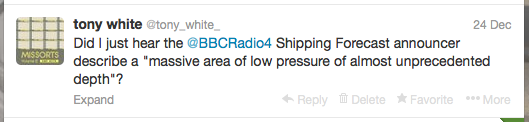
Rather less pleasingly, a few news stories that have emerged over the Christmas and New Year period have seemed to echo elements of Shackleton’s Man Goes South, or to be redolent of the fictional world in which some of the novel’s action takes place. These news stories are in addition to the series of storms, gales and floods (with their attendant severe weather warnings), that have hit the UK in recent weeks. I was astonished in the early hours of Christmas Eve, for instance, when the usually highly codified language of the Shipping Forecast (broadcast at 00:48 on 24 December 2013), was interrupted by discussion of ‘a massive area of low pressure of almost unprecedented depth’ that stretched from the UK to Iceland.

First, the announcement that some extraordinary items of Shackletoniana have been discovered in Antarctica. Twenty-two cellulose nitrate negatives of photographs were found in Captain Robert Falcon Scott’s expedition hut at Cape Evans. The photographs turned out to have been taken not by Scott’s expedition photographer Herbert Ponting, but by person unknown during the occupation of the hut a few years later by members of Sir Ernest Shackleton’s Ross Sea party, who used the hut as a base when they became stranded on Antarctica while attempting to lay supplies for Shackleton’s Endurance party. The terrible hardships endured by the Ross Sea party, and the deaths of Arnold Spencer-Smith, Victor Hayward and party leader Lieutenant Aeneas Mackintosh are often omitted from more triumphalist accounts of Shackleton’s expedition. See a slideshow of the photos on the New Zealand Antarctic Heritage Trust website.

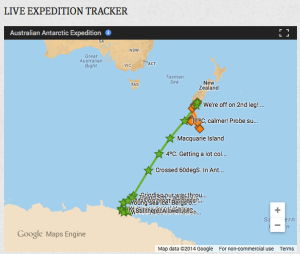
Screen Shot 2014-01-01 at 15.00.11Secondly, in an echo of the 2007 sinking of the MS Explorer, which struck an iceberg and capsized while attempting to retrace parts of Shackleton’s Endurance expedition, a Russian vessel, the MV Akademik Shokalskiy has been trapped in ice for more than a week, with seventy-four scientists, tourists and crew on board. The Australasian Antarctic Expedition 2012-14 set out to retrace the 1911-14 expedition of Douglas Mawson, conducting ‘a programme of research across the region, building on the work 100 years ago, to try to better understand present and future change in Antarctica and Southern Ocean.’ All attempts at rescue have so far failed, and yesterday the BBC speculated that at least one of the rescue vessels — the Chinese vessel Xue Long — had itself become stuck in ice. Back in 2007-8, Dr John Shears of the British Antarctic Survey told me that the passengers and crew rescued from the MS Explorer had been ‘lucky to survive’. One hopes that those trapped on the Shokalskiy share that luck. (Note: Thankfully, 24-hours after I posted this, Chris Turney posted this video clip: ‘The first of the helicopters to take us home!’)

Shackleton’s Man Goes South, square thumbnailThirdly, an article published by the Nation reports the views of a number of scientists who fear that climate change may be both far worse and much more sudden than anticipated, to create what one of those interviewed (John Nissen, chairman of the Arctic Methane Emergency Group) describes as an “instant planetary emergency.” Dahr Jamail’s article for the Nation is a must-read, and it echoes the suggestions of scientists that I’ve interviewed, that IPCC forecasts, however grim-sounding, have been underestimative, best-case scenarios. Another article, published in Nature and widely reported on New Year’s Eve, backs this up, suggesting that (in the words of the Guardian newspaper’s Damian Carrington):

Temperature rises resulting from unchecked climate change will be at the severe end of those projected, according to a new scientific study. The scientist leading the research said that unless emissions of greenhouse gases were cut, the planet would heat up by a minimum of 4C by 2100, twice the level the world’s governments deem dangerous.

In the most alarming echo of Shackleton’s Man Goes South, Dahr Jamail’s Nation article quotes atmospheric and marine scientist Ira Leifer, who says:

“Some scientists are indicating we should make plans to adapt to a 4C world,” [ … ] “While prudent, one wonders what portion of the living population now could adapt to such a world, and my view is that it’s just a few thousand people [seeking refuge] in the Arctic or Antarctica.”

My novel Shackleton’s Man Goes South follows Emily and Jenny, refugees who are trying to reach the safety of  Antarctica. In the slang of their post-melt world, Emily and Jenny are refugees known as ‘mangoes’, a corruption of the saying ‘man go south’. Emily and Jenny’s journey purposely echoes not only Sir Ernest Shackleton’s heroic escape, but those of many contemporary migrants. Even having written about just such a world, I am still surprised and shocked to read Leifer’s vision of the future: ‘a few thousand people [seeking refuge] in the Arctic or Antarctica’.

§

Shackleton’s Man Goes South is available free and DRM-free (in ebook formats compatible with most devices) from the Science Museum website.

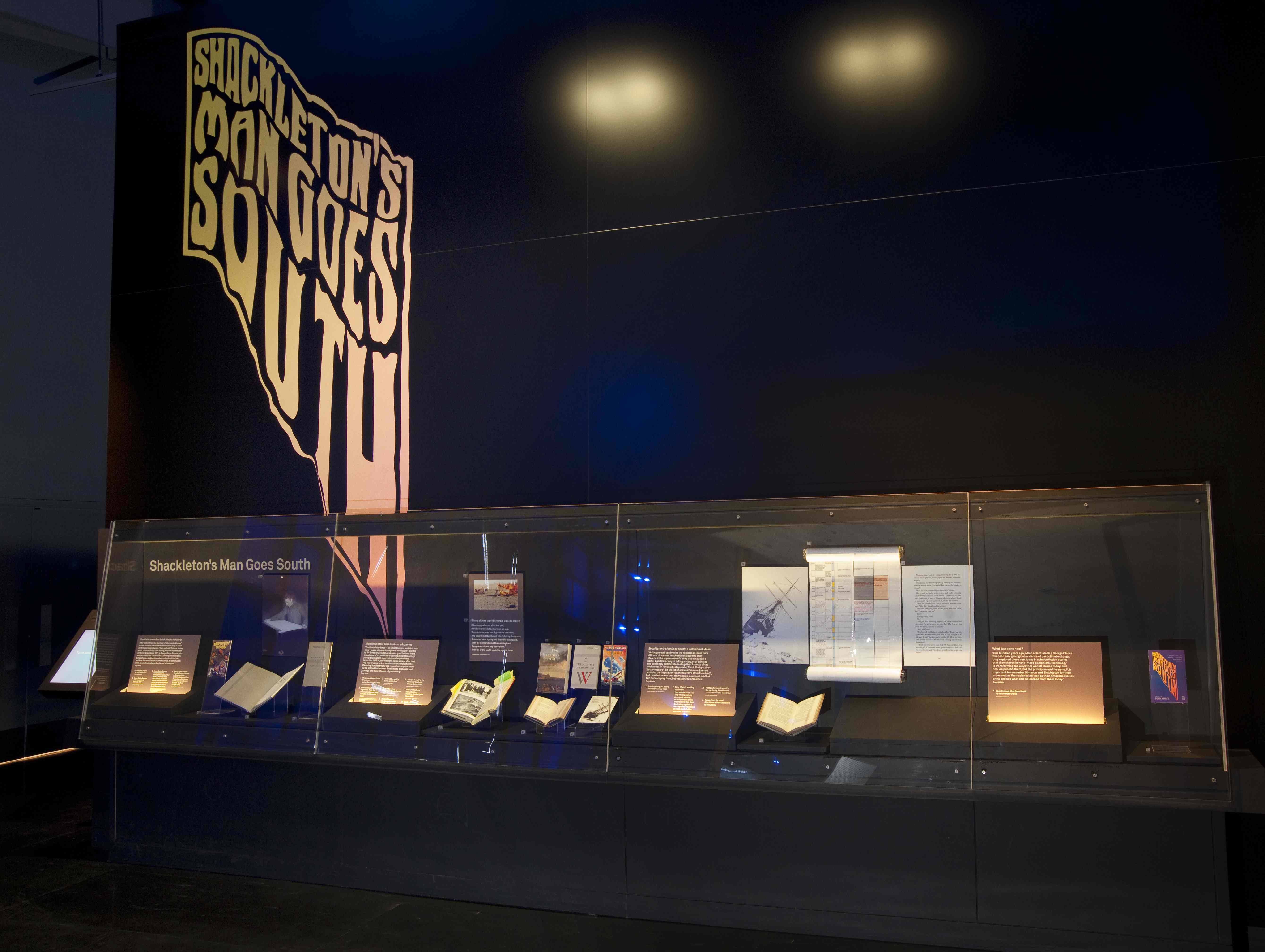
An exhibition accompanying the novel runs in the Science Museum’s Atmosphere Gallery until 24 April 2014.

Press about Shackleton’s Man Goes South.
D132414

Pyman at Paley

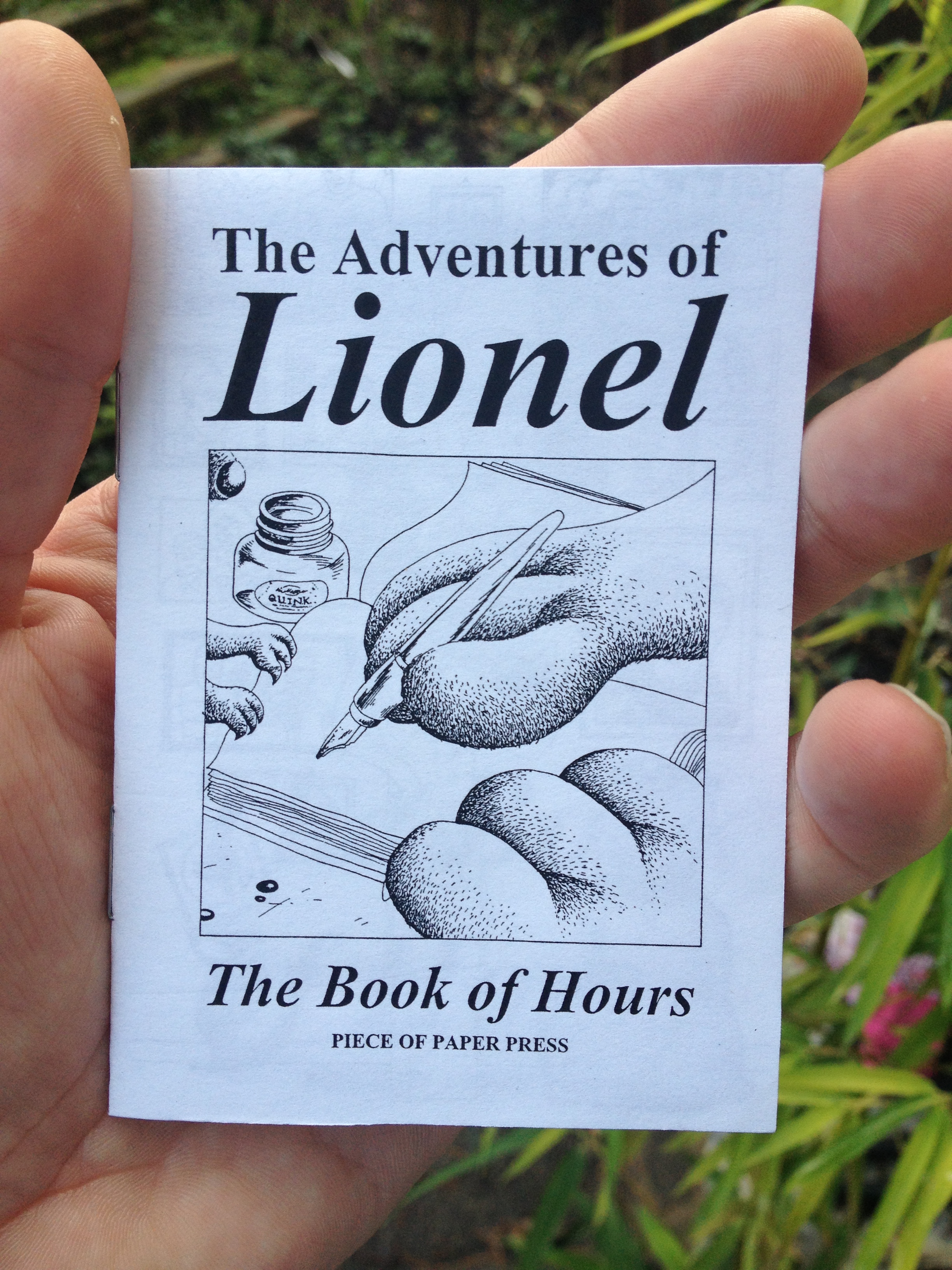
Lionel_Hours_coverI’m pleased to see that my good friend the artist James Pyman has some large drawings exhibited at Maureen Paley in Bethnal Green, London, as part of the gallery’s current group show with Salvatore Arancio and Rachel Cattle & Steve Richards. Do go and see them if you are in the area (gallery opening times etc. below). I love James’s work and have enjoyed watching some of these incredibly detailed and painstaking drawings take shape through my very occasional studio visits.

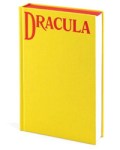
draccover2Readers may also be interested to know that James Pyman contributed a new, illustrated edition of Dracula by Bram Stoker to the wonderful Four Corners Books’ Familiars series, which features artists’ responses to classic novels and short stories. In the words of Four Corners, the books in the series ‘provide a fresh look at the tradition of the illustrated novel, with each artist choosing a text to be reprinted in full alongside their newly created work.’

I have published James Pyman twice on Piece of Paper Press. Firstly back in 1997 with The Adventures of Lionel: Through the Moon, and most recently in 2007 with The Adventures of Lionel: The Book of Hours (right).

Piece of Paper Press titles are usually produced in editions of 150, but there have been additional editions of both of these books. The Adventures of Lionel: Through the Moon was reproduced as a ‘cut-out and keep’ edition for AN magazine in 1997. A further one-hundred copies of The Adventures of Lionel: The Book of Hours were given away in sheet form at Publish and Be Damned, Rochelle School, London, in 2008.

Here is a scan (of a photocopy) of one of James’s drawings for the latter: a portrait of Lionel that was used as a vignette (i.e. an unbordered ornament) on the book’s title page. The drawing was also used on the printed invitations to a party that was held to celebrate the fact that The Adventures of Lionel: The Book of Hours was Piece of Paper Press’s twentieth book. Most of the print run was given away at the party, rather then being distributed by post as might usually have been the case with previous titles.

Given that books published by Piece of Paper Press are slightly smaller than A7-sized, the original printed form of this drawing was less than 3cm high, but I feel that the beautiful pencil work undoubtedly rewards enlargement.

© James Pyman, 2007

© James Pyman, 2007

§

SALVATORE ARANCIO, RACHEL CATTLE & STEVE RICHARDS, JAMES PYMAN

MAUREEN PALEY.
21 Herald Street
London E2 6JT

30 November 2013 – 26 January 2014
Wednesday — Sunday, 11.00 — 18.00 (and by appointment)

Missorts Volume II — new paperback

book-cover-shot---web-friendly.163456

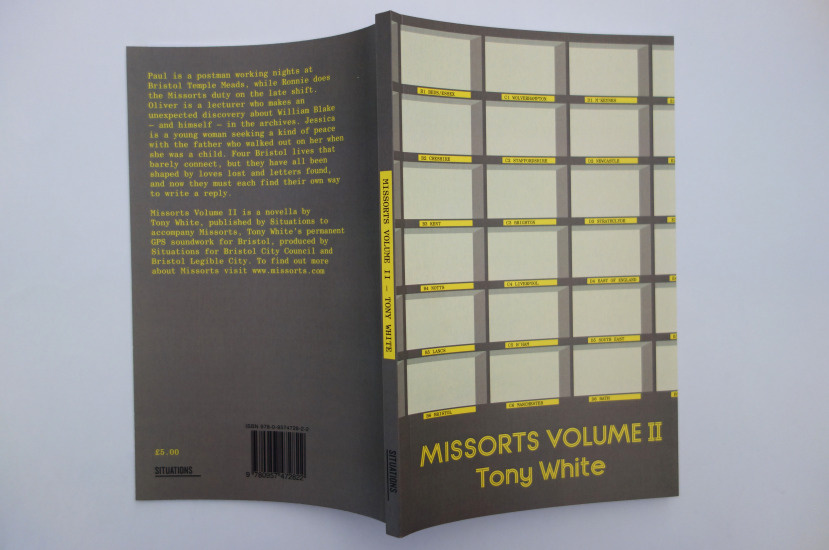
Here is Situations’ announcement of their new limited edition paperback of my novella Missorts Volume II, which has been beautifully typeset by Charles Boyle of CB editions. I’ll be reading from Missorts Volume II at the Winter Shuffle Festival in Mile End, London on Thursday 5 December, sharing the bill with Michael Smith and Adam Foulds. Tickets still available: booking and other info here.

Situations is delighted to announce the print edition of Missorts Volume II

Taking its title from a Post Office term used to describe letters that have got lost in the system, Missorts Volume II takes the cityscape of Bristol as the inspiration for a contemporary work of fiction. Set in the shadow of the derelict former Royal Mail sorting office that is never far from local headlines, Missorts Volume II is a timely reflection on how the city impacts on the imaginative life of its residents.

Available from 10th December 2013 in a limited edition of 250, this will be the first print edition of the novella, which was originally published as a free e-book in 2012 by Situations in partnership with Bristol City Council to accompany Tony White’s permanent public sound work Missorts.

Design of the edition’s cover was the subject of an open-call design prize earlier this year. The winning design from graphics agency An Endless Supply was selected from a shortlist of ten by design historian Emily King and the award-winning graphic designer Fraser Muggeridge.

§

Tony White
Missorts Volume II
Published by Situations
ISBN 978-0-9574728-2-2
Price: £10.00
Format: Paperback
Pages: 128
Publication date: 11 December 2013
Distribution: Central Books

Research for Missorts Volume II was initially undertaken in 2007–8, supported by Media Office as part of the research phase for a planned public art programme for the re-development of the former Royal Mail Sorting Office, Temple Meads, Bristol in association with Ginkgo Projects Ltd. Further research and completion of the novella was undertaken in Bristol and London throughout 2012 with the additional support of Situations and Bristol City Council.

Missorts Volume II at the Winter Shuffle

I am delighted to have been invited to read at the Winter Shuffle Festival taking place in and around the old St Clements workhouse in Mile End, London. I’ll be reading from my novella Missorts Volume II, which is published in a new paperback edition the following week. I’m sharing a bill with fellow Faber author Michael Smith, which is great news because I’ve been looking forward to getting hold of his new book Unreal City.

There is loads of other great stuff on. Here’s the full programme. Click through for tickets and bookings, and more information about the Winter Shuffle film programme.

WEB LIVING ROOM PROGRAMME

Touchscreen ‘ebook dispenser’ at Science Museum

A central component of how the Science Museum has published my novel Shackleton’s Man Goes South — and thus of the display about the novel in the Museum’s Atmosphere Gallery — is that it is being given away in the Science Museum via a touchscreen ‘ebook dispenser’ developed especially for the purpose. (Read more about the novel itself here, here or here. Read more about how we published here.) The touchscreen has now been up and running for nearly six months, which may be a good point to look at how it has worked so far.

Touchscreen kiosks and information points are of course a familiar feature in museums, but as far as we know this is the first time one has been used to give away an ebook ‘on-gallery’ (as they say). Of course, museum or industry-spec touchscreens of this kind (whether wall-mounted or free-standing) are expensive, but certainly not beyond reach of other kinds of arts venues or in parts of the book trade. One could easily imagine a kiosk like this being used to give away an ebook of an exhibition catalogue or a programme, or being used by larger bookshops, by literary festivals or even publishers to distribute a promoted title. The Science Museum are giving away Shackleton’s Man Goes South for free, that is part of the ethos of the project, but there is no reason why the process couldn’t include a secure purchase page.

© Science Museum

© Science Museum

The touchscreen we are using to give away Shackleton’s Man Goes South is a portrait format unit, with sound, that is housed in a steel box and wall-mounted beneath Jake Tilson’s melting logotype, at one end of the custom-designed display case. The glowing screen is just visible at the far left of the installation shot of the Shackleton’s Man Goes South display above.

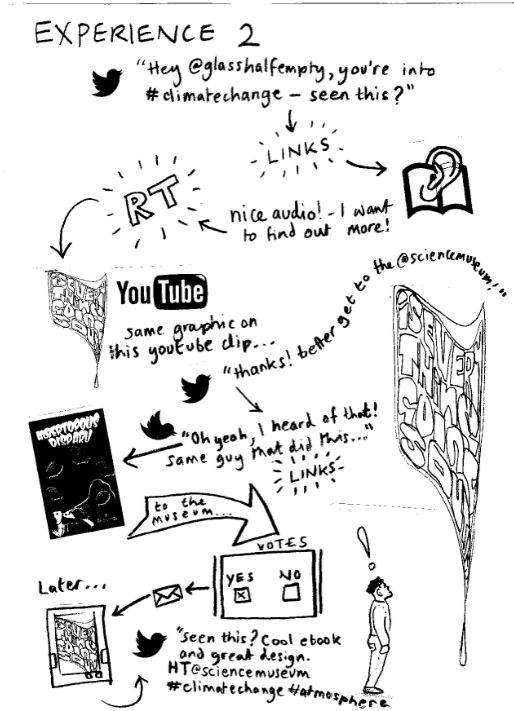
Using a simple, six-button homepage, the Museum visitor can e.g. find out more about the novel, listen to a short audiobook extract, or participate in a visitor poll about climate change. They can also email themselves the book, a function that enables many smartphone users to begin reading the novel there and then.
Screen Shot 2013-11-07 at 16.55.42Screen Shot 2013-11-07 at 16.56.04Rather than emailing every reader all possible files, the email contains a link to a closed page on the Science Museum site from which they can open or download the book in whichever format is compatible with the device they want to use. Email addresses are not kept. The Museum offer the novel as an EPUB or mobi file (both are DRM-free) and as a PDF for on-screen reading on PC or laptop (based on reader feedback, we recommend PDF rather than Adobe Digital Editions for on-screen reading). Some readers with Android tablets also report opting for PDF.

The aim was to make the transaction as quick and simple as possible. The comparison we used was that it should be as easy as buying an ebook on Amazon. Readers with Kindles and some other devices need to side-load the files via USB, which is still very straightforward, but the really exciting thing has been that readers using iBooks on iPhones or iPads, and some other devices, can be reading the book in situ and within a matter of seconds, in just three taps of their screen.

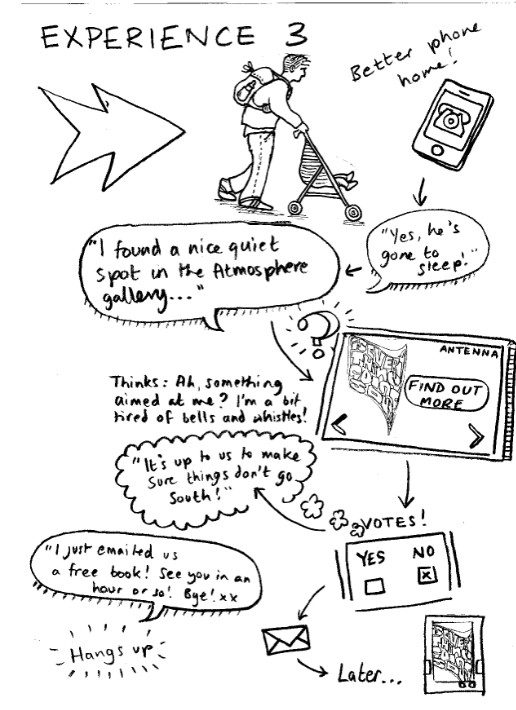
The concept of this as a reader experience came first, before we knew if it was achievable. In the earliest stages of the commissioning process, the Museum asked me to think about how visitors might encounter and engage with the novel, so I had a bash at drawing some ‘experience maps’ to show how I thought it might work. Here are two of those sketches. An existing Museum system (the Antenna news service) already allowed visitors to email themselves a static HTML page, and I initially thought we might need to piggyback on that, but to do so would only have given us a very brief platform in a quickly changing news cycle, so we switched to the idea of visitors emailing themselves from a dedicated terminal. This raised its own technical challenges and for a while it seemed to be touch and go if it could be made to work at all.

In the event it has worked brilliantly well, and proved to be very robust, only breaking down once to date (as an unforseen by-product of a planned server migration) a couple of weeks ago. Interestingly it was a reader who noticed that the system had broken down and alerted us to the fact instantly, via Twitter.

One breakdown — under punishing museum conditions — of a custom-built piece of kit like this in the six-months since the book was launched is pretty good going I think, so full credit to the teams at the Science Museum for doing such a great job.

© Jake Tilson

© Jake Tilson

Whenever I’ve been to show people around the display or demo the touchscreen unit, as I frequently need to do, there have always been people playing with the screen and emailing themselves. Often singly, but sometimes as a group (e.g. two or more people with iPads or tablets, or someone showing a companion how to do it).

The Shackleton’s Man Goes South display runs for a year (until 24 April 2014). The initial plan was for the novel to be available via the touchscreen for the full year, but from the Museum’s website only for the first three months. However we found that readers and reviewers quickly found a workaround, starting to link directly to the files on the closed page even before the three months were up, rather than to the more controlled information page that was promoted around the launch. In response to this the Museum and I now also point readers straight to the files where-ever we can.

The visitor poll that we are running on the terminal asks, ‘Is everything going south?’ Six-months in, I can reveal that 65% of participants in the poll have said YES.

§

Shackleton’s Man Goes South

Missorts cover design prize

editforweb-830x550

Situations have today announced the winner of the Missorts Volume II cover design prize. From a very strong shortlist of ten, the judging panel (i.e. design historian Emily King, graphic designer Fraser Muggeridge and me) unanimously picked this beautifully understated design by An Endless Supply. I love everything about this design. A limited edition paperback of the novella is being published in December. More info on launch events coming soon. See my events page for updates, or follow Situations on Twitter.

Missorts Volume II is published to accompany Missorts, my permanent public soundwork for Bristol, which is produced by Situations, the award-winning Bristol-based arts producers, and funded by Bristol City Council for the Bristol Legible City initiative. 

§

More about Missorts.

If you can’t wait for this paperback edition of the novella featuring An Endless Supply’s gorgeous cover, you can download Missorts Volume II as a free ebook compatible with most devices from the Missorts website.