The Science Museum have released the last of three free audiobook extracts from my novel Shackleton’s Man Goes South, published as their Atmosphere commission for 2013. The extracts can be listened to on the Museum’s SoundCloud page, via the SoundCloud widget here, or downloaded to your own devices. As with the previous two extracts, which can be listened to here and here, the theme and incidental music is composed by Jamie Telford.
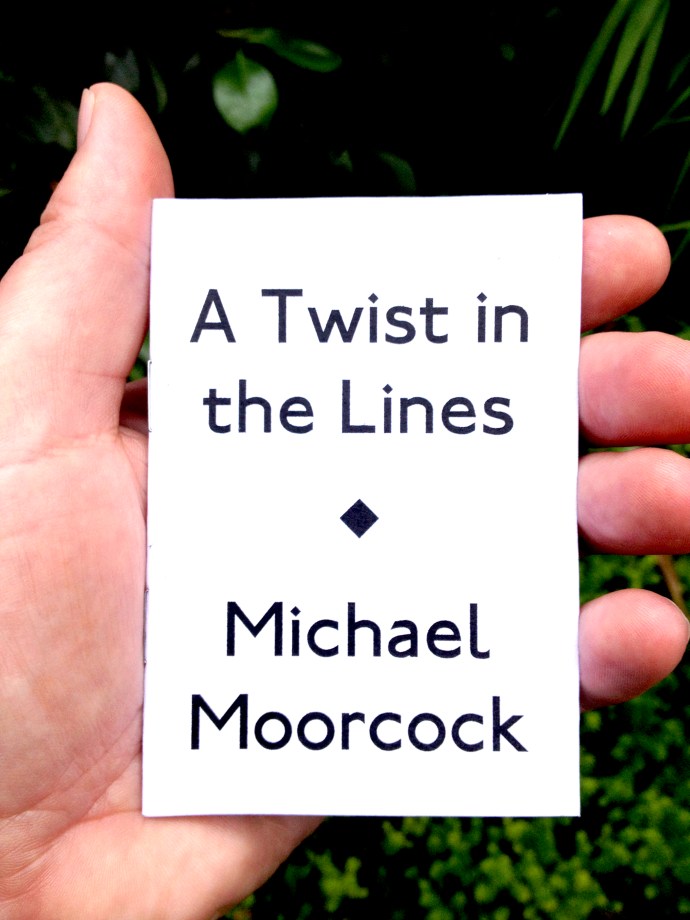
Twenty-seventh title from Piece of Paper Press
Programme notes — audiobook extract #2
The Science Museum have released the second of three free audiobook extracts of Shackleton’s Man Goes South on their SoundCloud page. All of the audiobook extracts are framed by a short musical theme composed by Jamie Telford.
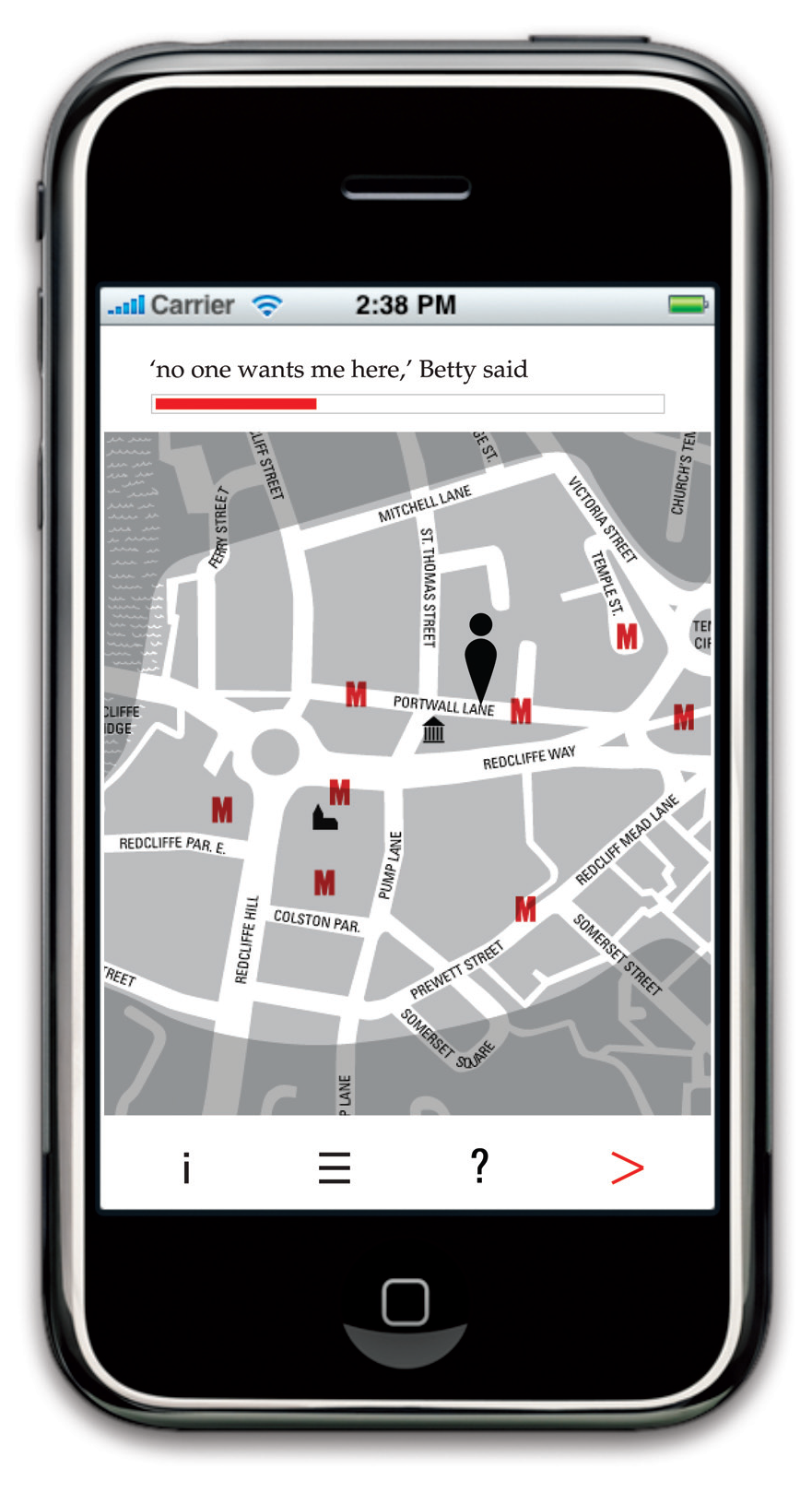 Sharp-eyed readers will know that Jamie and I have worked together before. Most recently he composed eight amazing new works, the Portwall Preludes, especially for the 100-year-old Harrison and Harrison pipe organ in St Mary Redcliffe, Bristol. I commissioned these works from Jamie to form the backdrop and accompaniment for Missorts, my permanent soundwork and GPS-triggered app for the Redcliffe area of Bristol which launched at the end of last year. The Preludes are geo-located to form a kind of musical patchwork that overlays the area of the app (delineated in lighter grey on this iPhone screen simulation) and through which the user/listener walks, cutting from one prelude to another as they do so, and creating their own mix in the process.
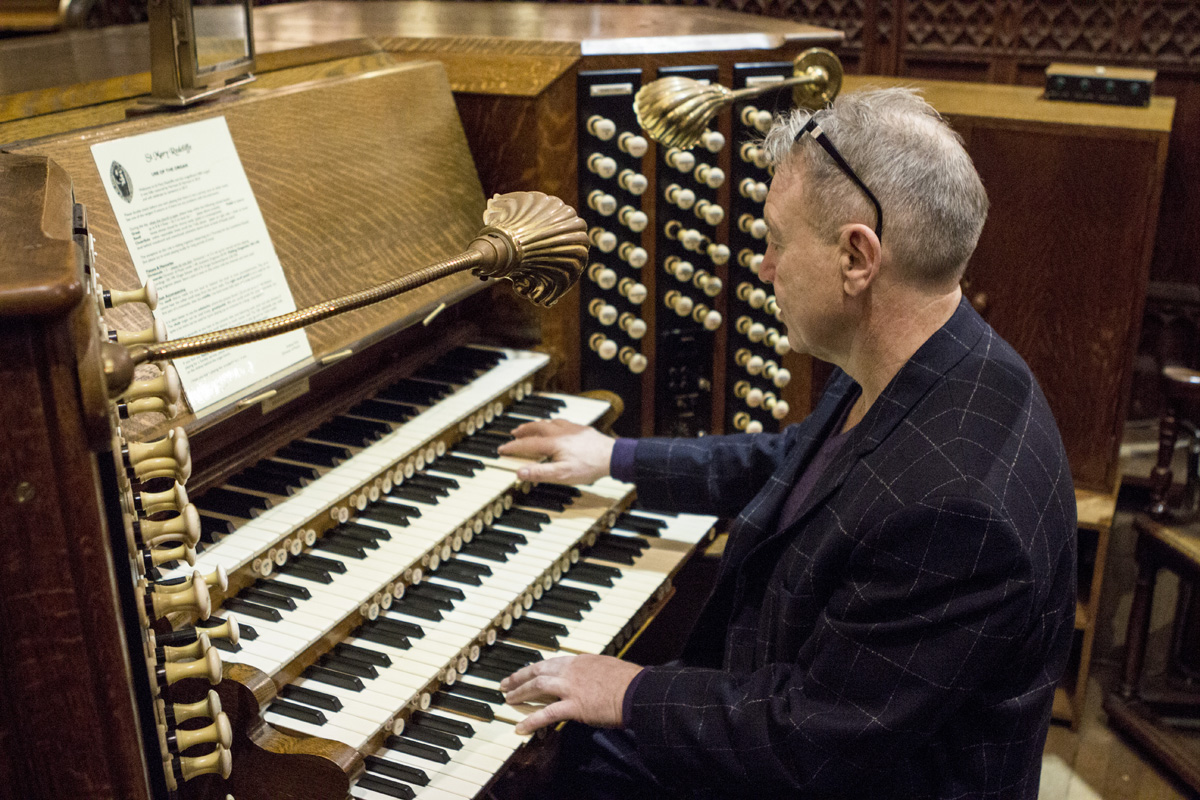
© 2012 Max McClure, courtesy Situations
There is a fascinating short interview with Jamie about his role in Missorts in David Bickerstaff’s great new short documentary about the project, which has just been released by Situations. There he describes the Portwall Preludes as ‘programmatic’ — further explaining for the non-specialist (like me) that, ‘what I mean by programmatic is that they’ve got titles that suggest what the music may contain.’
Take a listen to Jamie’s beautiful, lilting and gloriously wonky ‘House of Mercy’ and you may begin to see what he means. Now imagine listening to ‘House of Mercy’ in situ, as you climb back up Guinea Street from Phoenix Wharf and the Ostrich pub, past the derelict Georgian and Victorian buildings of the former Bristol General Hospital, and the idea of it being programmatic really takes off: with Missorts, the ‘extra-musical material’ is not just supplied by the title, but also by the location.
For Shackleton’s Man Goes South, the brief was very different: a musical theme that could be used to both frame and to punctuate audiobook extracts from my novel. A piece that would never be heard in its entirety, only in part. An intro that would fade out at the beginning and an outro that would fade in at the end, and phrases of which might also provide short interludes throughout the reading of the text.
What emerged in our early conversations — as Jamie and I talked about the novel, and looked at some of the musical content and signposting within it — was that this theme might be a kind of Black Atlantic sea shanty, and one that responded to two particular musical works referenced in the novel: Leadbelly’s version of John Hardy, and a reconstruction of the satirical 17th Century English folk song The World Turned Upside Down. I hope that you like what Jamie has come up with (but be warned: it is ridiculously catchy). We felt that the oddly celebratory tone sat well with one of the ideas at the heart of the novel, that the Shackleton story has become a kind of Columbus myth for migrants to a new continent.
The lyrics of ‘The World Turned Upside Down’ are reproduced as part of my Shackleton’s Man Goes South display in the Science Museum’s Atmosphere Gallery, which is up until spring 2014. Here is one of the Museum’s installation shots.

Image: Science Museum — click-through for higher resolution
And here, courtesy of the Science Museum, is the second of the free audiobook extracts from Shackleton’s Man Goes South. This is an extract from Chapter 4, ‘The Captain’s Table,’ in which ‘the complex and conflicted human trafficker Browning’ (as David Gullen puts it in his fantastic review) makes contact once again with Captain Smiler upon his and Emily’s arrival back in Patience Camp on the island of South Georgia:
Every mile or so there is a gate or a checkpoint, and here the alleys and paths of Patience Camp widen and the nature of its buildings appear to change. They seem to grow more substantial and to serve other purposes than the simple provision of shelter. It is as if this increased density of shops, bars and fast-food joints has been produced by some effect of the more concentrated traffic and the confined space, just as the sudden faster flow and pressure differential caused by the lifting of a sluice creates an eddying turbulence that traps whatever chaff and debris, leaf litter and styrofoam might be carried in the water. There are souvenir shops piled with T-shirts, and faded postcards bearing seemingly random images of countless cities, cathedrals, beaches, castles; a Babel of greetings. Forgotten celebrities of all nationalities and ages blindly stare from the racks as if waiting for some statistically ever more improbable moment of recognition when they will be snatched up by a member of whichever diaspora and revived, reanimated. More rudimentary stalls sell salvaged goods and bric-a-brac of dubious function and origin, servicing unlikely markets and unimaginable demand. There are vacant lots piled high with electrical and other components: motors, cabling, circuit boards. There are relics: here a box of broken calculators and there – trailing wires and hydraulics, partly covered by tarpaulins, bigger than their shelter and recognisable from illustrations in books – the best part of the flight deck of an airliner. A chandelier the size of a bell tent buckles under its own weight.
The Museum have enabled SoundCloud’s download function, so — as ever — feel free to download it and listen on your own device!
Climate Commons – free event
Alice Angus and Giles Lane of Proboscis have kindly invited me to curate an informal studio event where some of the ideas explored in my novel Shackleton’s Man Goes South (Science Museum, 2013) can be discussed with a small audience.
I have invited two other authors to join me for readings and discussion: the artist and activist James Marriott of Platform, a London-based arts, human rights and environmental justice organisation, and performance artist Hayley Newman, who is committed to working collectively around the current economic and ecological crisis.
 James Marriot is co-author with Mika Minio-Paluello of The Oil Road (Verso), an extraordinary book tracing the concealed routes from the oil fields of the Caspian Sea to the refineries and financial centres of Northern Europe. The Oil Road maps this ‘carbon web’, guiding the reader through a previously obscured landscape of energy production and consumption, resistance and profit.
Hayley Newman is the author of a new novella, Common (Copy Press), which chronicles one day of her self-appointed artist’s residency in the City of London. Taking us to crashes in global markets, turbulence in the Euro-zone and riots on hot summer nights, Common opens up the City through richly imaginative stories and empowering political actions.
Readings and discussion will be chaired by curator and interdisciplinary innovator Bronac Ferran
§
Climate Commons: literature, climate change and activism
6-8pm, 19 June 2013
Proboscis Studio
4th Floor 101 Turnmill Street
EC1M 5QP London
Missorts film
Situations have released a new short documentary about Missorts, my permanent public soundwork for the city of Bristol, which launched in November 2012. Here is the blurb:
A new 8-minute documentary short about Missorts, novelist Tony White’s permanent soundwork for the Redcliffe area of Bristol. Produced by the award winning Bristol-based Situations, and inspired by the city’s radical literary heritage, Missorts delivers ten original and interconnected short stories directly to your phone, triggered by GPS and accompanied by the Portwall Preludes, a series of striking new musical works specially commissioned from composer Jamie Telford. David Bickerstaff’s film charts the development and creation of Missorts, including interviews with Tony White, the contributing writers and composer Telford, as well as commentary from leading broadcaster and writer Michael Smith.
Casual prejudice vs perpetual privilege
Casual and/or stupid class-based prejudice should not come as a surprise when there is a Tory government tossing its hatreds around so freely, but still I was slightly surprised on Saturday morning as I listened to the radio while making the coffee. My trusty Roberts R900 was tuned to Radio 4 rather than its usual Resonance 104.4fm, and I couldn’t quite believe my ears when presenter Richard Coles — interviewing the journalist and author Caitlin Moran — said something about growing up in a council house in Wolverhampton being an unusual background for a writer, and that for Moran then, writing was more than just a pastime.
What? I wondered if I could possibly have heard him correctly. It reminded me of the bizarre and thoughtless assertion made by Granta’s outgoing editor John Freeman a couple of weeks ago that ‘Best of Young British’ author Sunjeev Sahota’s life in Leeds was ‘completely out of the literary world’, an apparent geographical deficiency that seemed in Freeman’s opinion to be compounded by the fact that Sahota had ‘studied Maths’. Whatever next?
I had to go back to the BBC iPlayer to listen to the Caitlin Moran interview again and see if I had got the wrong end of the stick. Here is what (an admittedly rather tongue-tied) Richard Coles actually said:
What do you think? Moran more or less ignores Coles’s question, good for her, and he claws back some ground with the more agreeable proposition that writing is fundamental to her identity, but I’m still struggling to understand the bit about council houses and pastimes. Which writers is he comparing her to, and which background, I wonder, might he consider as being usual for a writer? A childhood spent somewhere other than Wolverhampton? Is that enough, or would growing up in private rented accommodation have been more conducive than in a council house. Or does a literary talent depend on having parents who are home owners? Perhaps writers can be thought unusual if their parents ‘bought their own furniture’?
Similarly, I wonder what kind of life John Freeman thinks would demonstrate that a first-time published author such as Sahota was part of the literary world — whatever that is? A life not lived in Leeds, or one that didn’t involve needing to earn a living? Does he really think you have to have studied literature to be a writer? Do you need to have already been a part of Freeman’s (imaginary) literary world before you are published, in order to satisfy some received idea of what a writer is?
Both statements seem to reinforce an idiotic assumption that writing takes place within some kind of metropolitan insiders’ club, and that the writer’s life is ‘always already’ — as the poets say — one of perpetual privilege.
§
More on this or related themes by Tony White:
Science Museum shelf-talkers
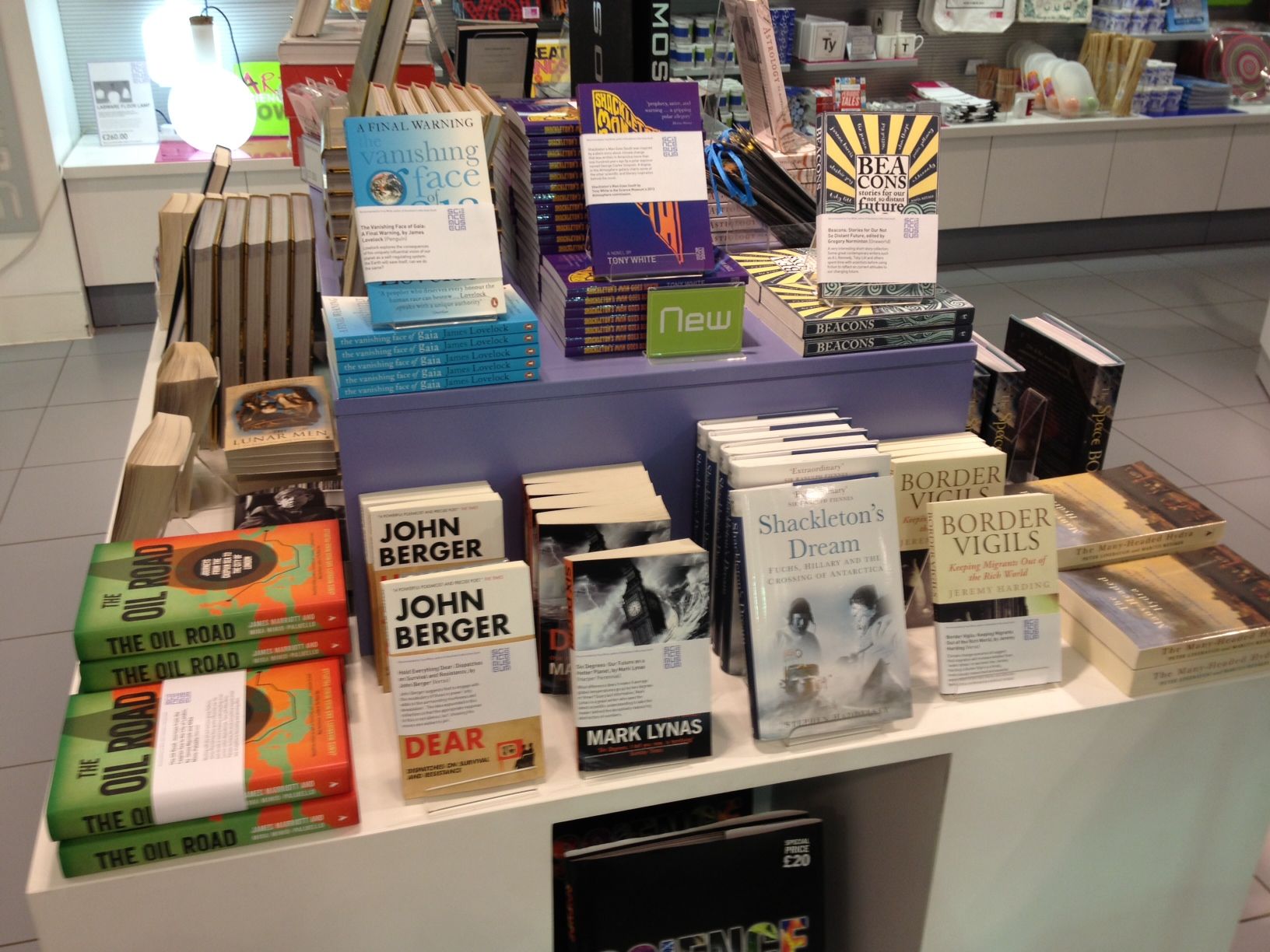
Alongside publication by the Science Museum of my novel Shackleton’s Man Goes South, I’ve worked with the Science Museum shop to do an ‘author recommends’-style promotion of some other titles that are either climate change related, or connect in some other way with my own novel.
Here are the titles that I’m recommending:
- John Berger, Hold Everything Dear: Dispatches on Survival and Resistance (Verso)
- Jeremy Hardin, Border Vigils: Keeping Migrants Out of the Rich World (Verso)
- Robert Henson, The Rough Guide to Climate Change (Rough Guides)
- Peter Linebaugh and Marcus Rediker, The Many-headed Hydra: The Hidden History of the Revolutionary Atlantic (Verso)
- James Lovelock, The Vanishing Face of Gaia: A Final Warning (Penguin)
- James Marriott and Mika Minio-Paluello, The Oil Road: Journeys from the Caspian Sea to the City of London (Verso)
- Michael Moorcock, London Peculiar: And Other Nonfiction (Green Print/PM Press)
- Gregory Norminton (Editor), Beacons: Stories for our not so distant future (Oneworld)
- Georges Perec, W or the Memory of Childhood (Vintage Classics)
And one DVD:
- Frank Hurley (Director), South: Sir Ernest Shackleton’s Glorious Epic of the Antarctic (BFI)
The Museum have produced a series of bellybands and ‘shelf-talkers’ printed with my short reviews of each title. There has been a good response to the promotion, and the bellybands in particular, so the Museum Shop are now thinking of using this promotional device more often. Here are a few of my ‘shelf-talkers’.


Science Museum display
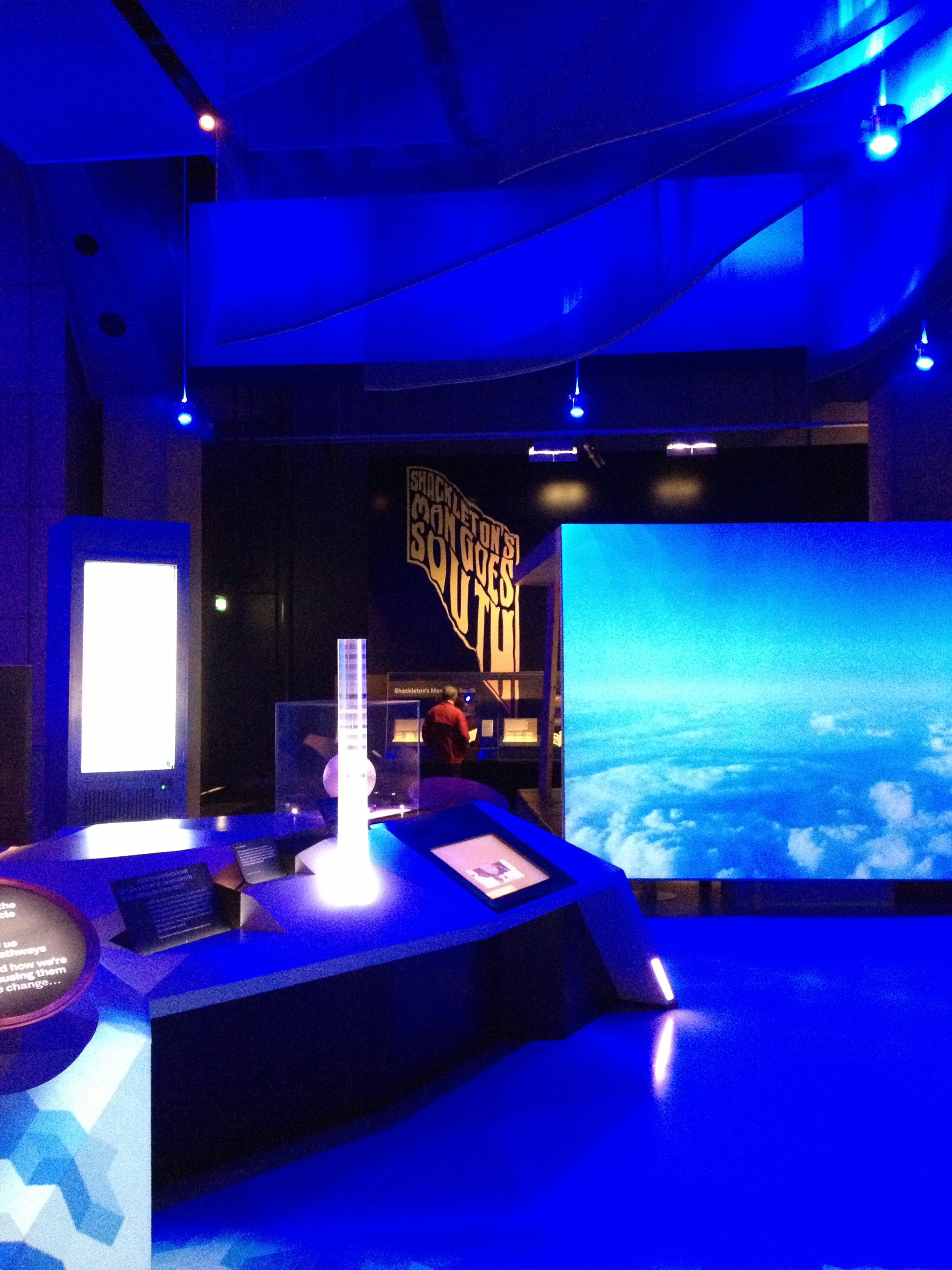
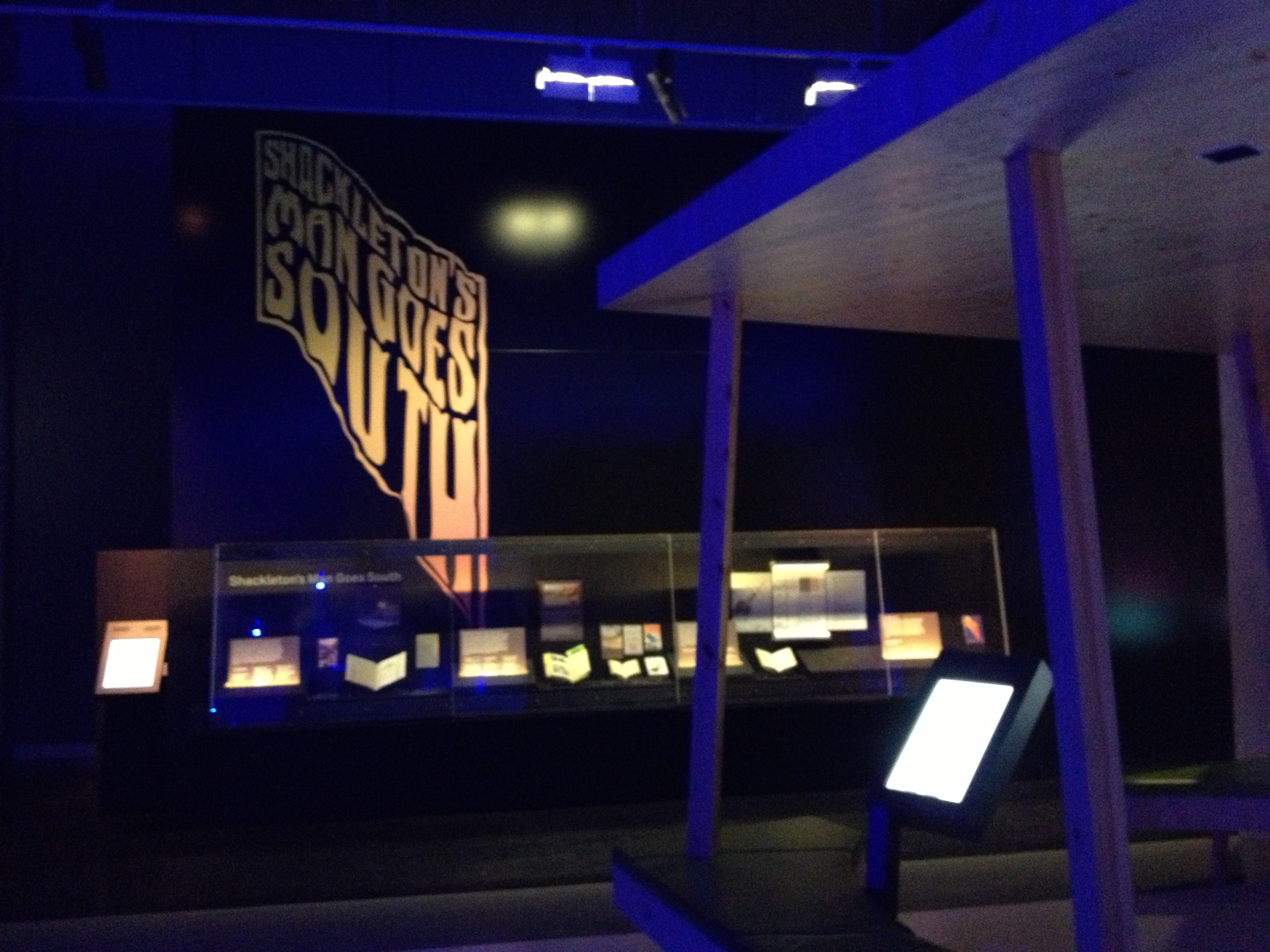
Not great pictures, just a few shots taken on my phone as the Science Museum was closing yesterday afternoon. I wanted to share some glimpses of my exhibition, which opened last night. Actually, in Museum parlance, this is ‘a display.’ Anyway, thrillingly, it is up for a year, so you have plenty of time to see it. And the Museum and I have plenty of time to get some proper photos taken.
It is not quite finished. We still have to tweak the lighting, but getting this far by the end of yesterday involved masses of hard work by lots of very committed and talented people, and we ran out of time. But it is very nearly there.
So pending the production of some proper photos of the final, finished state, here at least are a few snaps.
First a long-shot showing the fantastic, clear sight-line across the Atmosphere Gallery to Jake Tilson’s wonderful 20-foot tall logotype. This is the same logotype as appears on the cover of the book. As you might not be able to make out from my hopeless photo, this is not only visible but also clearly legible from about 100 yards away as you enter the space.
The medium shot below shows both the logotype and the beautiful, custom-built display cabinet, which contains books, papers and ephemera relating to the novel.
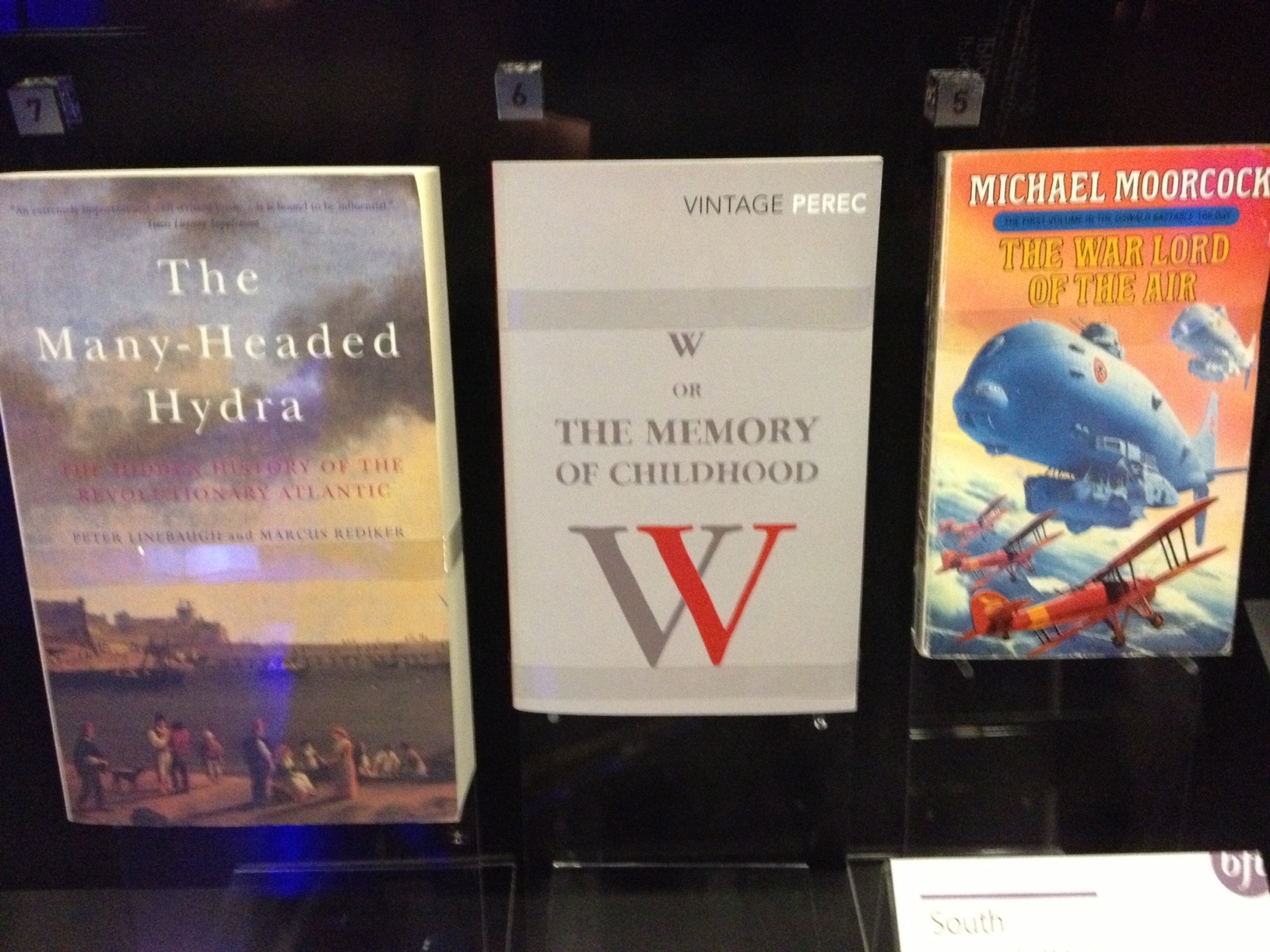 The close-up shows just three of the books that I have included in the display.
I’m thrilled also to say that thanks to the wonderful Folio Society, I have been able to include a beautiful facsmile of the South Polar Times, showing the weird ‘climate change’ short story written by George Clarke Simpson in 1911 that was part of the inspiration for my novel. I am very grateful to them for their support of this project.
A few hours after I got these snaps, the Atmosphere Gallery was heaving with the thousands of people who had come to a climate science-themed Science Museum Lates.
I’m very excited about the novel, and about the innovative way that the Science Museum is publishing it.
A dedicated touchscreen (visible at the left-hand side of the beautiful, custom-built case) enables visitors to email themselves a free and DRM-free copy of my novel Shackleton’s Man Goes South.
The apparent simplicity of this interactivity is deceptive. It has taken a lot of work by a lot of people to make it possible. At one point it looked as if this defining functionality, a central aspect of our publishing experiment, might not be technically possible. Thankfully, that hurdle was overcome.
All of which means that I’m doubly delighted to report that the technology works!
Last night, visitors to the Atmosphere Gallery — some of whom had just come to the novel’s launch event and already bought a copy of the limited edition paperback — were emailing themselves the book and opening it seconds later to read on their phone or tablet. I was slightly kicking myself that we didn’t have a ‘cutting the ribbon’ photo-opp, where some celebrity might have been the first person to email themselves a book via the display. But actually that is not what this is about. It is about finding ways — as the square-footage of the book trade vanishes — to go where readers are, and to learn from what readers do (and I include myself in that group). Sometimes this means collaborating with institutions outside or alongside the book trade, to develop new ways to put books and readers together — in this case using digital technology in a new way.
And it works.
Amazing.

Here’s a screengrab of a nice tweet from my friend and colleague the novelist and critic Nicholas Blincoe.
This evening’s programme

Night at the Science Museum
 I went behind the scenes at an otherwise deserted Science Museum last night, for the get-in of my display in the Atmosphere Gallery. By the time I left, the specially commissioned display case was almost finished, and Jake Tilson’s amazing logotype had been installed on a newly black-clad wall. Finishes will be happening today, before the various objects and papers, and their labels, go into the case ready for the opening tomorrow evening — which coincides with a climate science-themed Science Museum Lates.
I can’t wait for the temporary hoardings to come down, so that I can share this with everyone. This is the culmination of a few year’s work, so I’m really looking forward to hearing what people think.
On Wednesday evening I’ll be talking about the novel with chair Siân Ede, novelist Simon Ings and climate change adaptation expert Dr Emma Tompkins. I’ll post the invite later, although I understand that RSVPs have now had to close as the response has been — in the words of the museum — ‘overwhelming’, which is a good sign.
The exhibition is up for a year, so there is plenty of time to see it, though if you want to get hold of the book you might need to move more quickly. A limited print edition of the novel will be on sale exclusively from the Science Museum shop, while DRM-free ebooks compatible with all/most current devices will be available on the Museum website from 24 April until 24 July.
For the next year, until 24 April 2014, visitors to the Atmosphere Gallery will be able to email themselves a free and DRM-free copy of the ebook from a dedicated touch-screen that is part of the display.
 Piece of Paper Press & tonywhite.london
You must be logged in to post a comment.