I was delighted to discover this week (from one of my Birkbeck MA students) that The London Archives has a book group – an online discussion group that meets monthly – and that their chosen book this month is my novel The Fountain in the Forest! I hadn’t actually heard of The London Archives book group before, but it sounds really interesting. Their mission? To enjoy London literature with an archives twist. What’s not to like?
Recent London Archives book group choices have included Tinker Tailor Soldier Spy by John le Carré, and The Lowlife by Alexander Baron among many others. So Fountain is in some great company.
Here’s their blurb:
The London Archives’ Book Group meets monthly to discuss literature, both fiction and non-fiction alike with a London theme. The group gains further insights through discussion about the book which is complemented by the use of historical documents from our collections.
The history and the people of London have always inspired writers, and the capital features in thousands of novels, history books, biographies and more. The books we enjoy can focus on any period in London’s history.w
Prior to the meeting, our London Archives’ team investigate the archives to discover original documents that relate to the book or the author. We meet virtually using ‘Zoom’ and details of how to join are sent out once you book your free place.
I should say that the event is not something I’ve set up or been involved with, which makes it all the more thrilling to hear about. Especially when The Fountain in the Forest is currently out of print, at least until the No Exit Press reissue which is scheduled for publication 3 December 2026. But nonetheless I continue to find it both wondrous and fascinating how books have lives of their own…
ICYMI my new novel Phantom at the Feast, which is the follow-up to The Fountain in The Forest, is published on 18 June 2026.
The London Archives book group — what a great idea. I wonder what archival materials they will find to complement and inform the discussion!
My occasional radio programme Literature Live returns at 8:00 pm on 4 May for a new season on London’s arts radio station Resonance 104.4fm – broadcasting on FM in London, online and on DAB. Thereafter the series will air at 8:00 pm on the second Monday of each month for the rest of 2026 (excluding the August break).
Here’s the blurb:
London author Tony White presents readings and chat with some of the best novelists and short story writers around, in a monthly programme focusing on live literature with the emphasis on authors reading from and discussing their fiction live on the air. Repeats the following Tuesday (next day) at 10:00 am.
On 4 May Tony is joined by the authors S.J. Fowler and Andrea Mason.
SJ Fowler is a writer, poet and performer living in London. His collections include I will show you the life of the mind (on prescription drugs) (Dostoyevsky Wannabe, 2020), The Great Apes (Broken Sleep Books, 2022) and The Parts of the Body that Stink (Hesterglock, 2024). His work has become known for its exploration of the potential of poetry, alongside collaboration, curation, asemic writing, sound poetry, concrete poetry, and improvised talking performances. He has been commissioned by institutions such as the The National Gallery, Tate Modern, Wellcome Collection and Southbank Centre, and he has presented his work at over fifty international festivals, including Hay Xalapa, Mexico; Dhaka Lit Fest; Hay Arequipa, Peru; and the Niniti Festival, Iraq. Fowler was nominated for the White Review Short Story Prize, 2014, and his short stories have appeared in anthologies including Isabel Waidner’s edited collection Liberating the Canon (Dostoyevsky Wannabe, 2018). In 2022, Tenement Press published MUEUM, Fowler’s debut novella, which was shortlisted for the 2022/2023 edition of the Republic of Consciousness Prize for Small Presses.
Andrea Mason is a writer and artist based in London. Publications include: Book Drawings 1-12, Piece of Paper Press (042), 2023; Waste Extractions (Fiction pamphlet) Broken Sleep Books, 2022; ‘Ada & Carter’ limited edition handmade pamphlet, Aleph Press, 2020 (a winner of the Aleph Writing Prize, 2020). She was Runner Up in the Desperate Literature Short Fiction Prize, 2023, was shortlisted for the Manchester Fiction Prize, 2020, and shortlisted for the inaugural Fitzcarraldo Editions Novel Prize, 2018. Recent anthology publications include: 22 Fictions: New Writing from Desperate Literature & Brick Lane Bookshop (2025, Cheerio publishing); Cybernetics, or Ghosts? Stories from Myth to A.I. (2024, Subtext Books); Eleven Stories (2023, Desperate Literature).
And watch this space for two more superb author guests on Literature Live, Monday 8 June at 8:00 pm!
Supposedly, pre-ordering helps the algorithm – whatever that means – but who knows! In any case, if you enjoyed The Fountain in the Forest, or any of my previous novels, then maybe you’ll enjoy this one: Phantom at the Feast, out 18 June from No Exit Press.
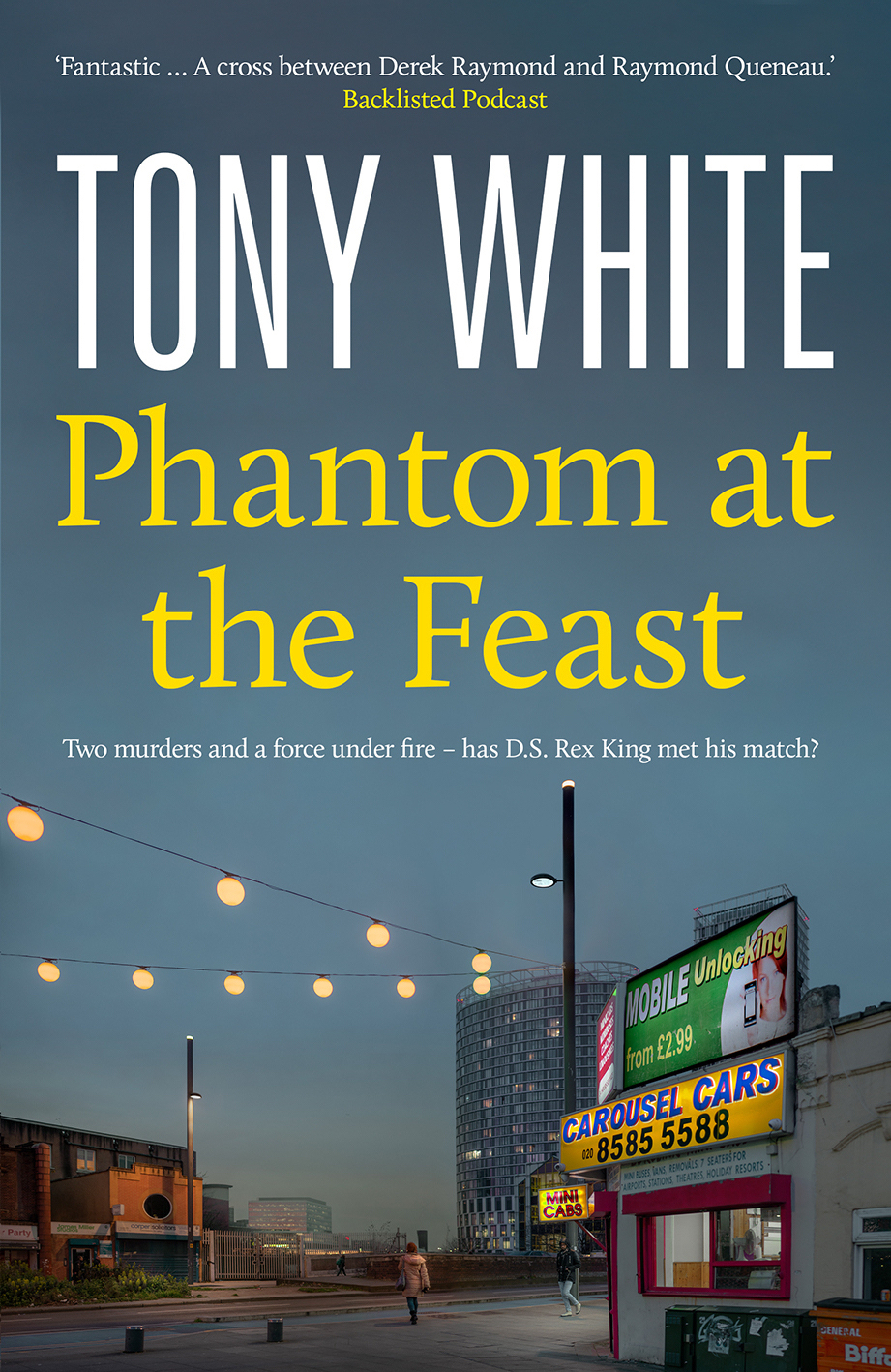
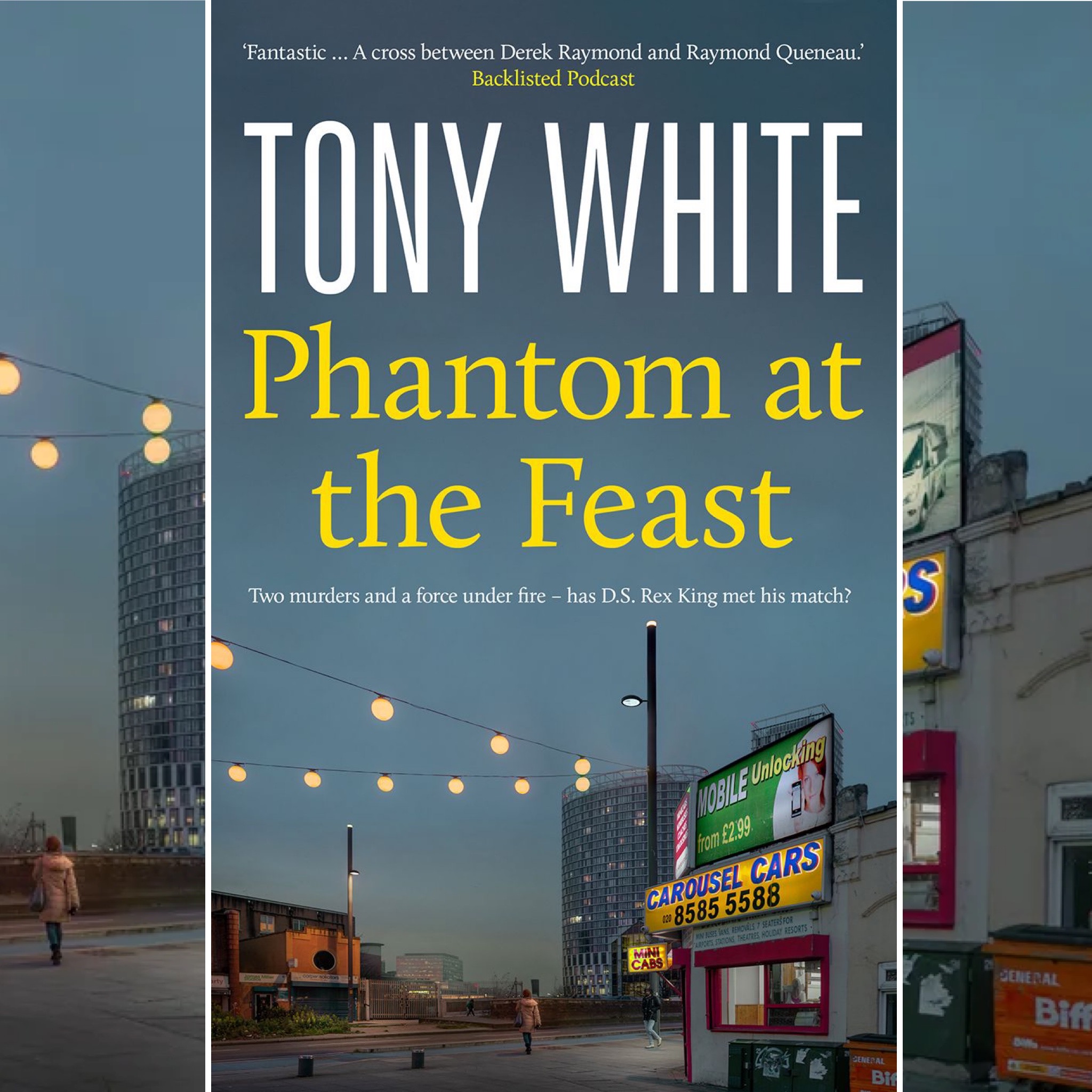
The cover features the incredible London photography of Chris Dorley-Brown, and typography by designer Mark Ecob – what a privilege.
I can’t wait to see how Phantom… looks in the shops. Once it’s out, if you should happen to see it on your travels, do feel free to take a photo and send or share it with me!
Watch this space – or my events and bookings page – for news of gigs, talks, readings and appearances around publication.
I’m pleased to share that I’m joining Chris Simmons (Chair), Harriet Tyce and Laura Wilson on the judging panel for the Crime Writers’ Association Short Story Dagger 2027, the prize awarded to the best crime-focused short story of the year published or broadcast in the UK. The CWA Daggers 2027 opened for submissions yesterday. So UK authors and publishers – whether big five, independent or small press – if you have any crime-focused short story published or being broadcast in the UK this year (i.e. from 1 January 2026 to 31 December 2026 inclusive) do check out your eligibility, entry process, and T&Cs on the CWA site right now.
Having written dozens of stories since the mid-nineties, and published a fair few by others (in anthologies, in magazines or as limited editions on Piece of Paper Press) as well as having taught the short story in UK universities, I know that at bottom I agree with the late great Ursula K Le Guin: each story sets its own rules, you just have to follow them.
But I also know that we write short stories for as many reasons as there are writers. Perhaps to try something out or to find a new approach, to take an idea for a walk, to test a voice or test ourselves, to take risks and to be opportunistic, to contribute-to or collaborate-with, in response to invitations, deadlines, events or ideas, for the fun or the challenge or the love of it, out of rage or shame or ‘I’ll show you’, to hone our craft, or for the pleasure of making something work, to be part of a conversation or a community, to participate in the circulation of ideas, as an intrinsic part of a creative writing course (like the ones I currently teach at Birkbeck University of London, and the University of Essex), or simply to surprise, delight, shock, amuse or confound the reader or the listener. My expectations as a judge on the CWA Short Story Dagger will be informed by these infinite variations and motivations, and by the endless versatility of the short story form; enjoying how at best every author can make it their own.
Short stories are often seen as a hard sell in the book industry, yet they persist as a form. Short stories continue to be written and published, and to have a kind of currency and attraction for writers and readers at any time and at any scale, from entry-point to late work, from the mainstream to the margins, cutting across hierarchies and issues of diversity, status, access and representation. I’m also aware that some of the most adventurous short story publishing in recent years has been done by small presses – and it was from small presses that I got my first breaks in the industry. So I hope that publishing houses large and small as well as individual authors will check their eligibility and consider entering their best crime-focused short stories published this year for the CWA Short Story Dagger 2027. I can’t wait to read the submissions!
*DRUM ROLL* – cover reveal! My new novel Phantom at the Feast, the follow-up to The Fountain in the Forest, is published by No Exit Press on 18 June ’26. It has a stunning cover designed by Mark Ecob, with image by the great London photographer Chris Dorley-Brown. I’m so delighted to share it with you now, along with a pre-order link ahead of publication.
Police stations are outdated, and AI’s make more efficient detectives, or so says a UK Home Office determined to make cuts
When the sole witness in a trafficking case is discovered brutally murdered, a brass horseshoe forced between his teeth, Detective Sergeant Rex King is summoned back to London and into a labyrinth of memory, music, and political unrest. From The Clash’s ragged 1985 busking tour to the fractured legacy of the anti-nuclear movement, Rex follows threads that tug uncomfortably at his own history – echoes he can’t quite place, shadows that refuse to settle.
When Rex’s boss, DCI ‘Lollo’ Lawrence, suddenly disappears, and long-buried papers from the Miners’ Strike surface, he must work alongside a sharp young detective, a seasoned former soul boy, and the National Crime Agency’s unsettlingly brilliant new AI. Yet the deeper he travels, the more he finds the investigation folding back on him: professional loyalties strained, personal relationships tested, and accusations from his undercover past threatening to unmake him.
Two murders, one ‘misper’ and a force under fire – has former ‘spycop’ DS Rex King finally met his match?
I’m excited to be able to share that my new novel PHANTOM AT THE FEAST will be published by No Exit Press (an imprint of Bedford Square Publishers) in June 2026, followed by a reissue on No Exit Press of the previous DS Rex King novel THE FOUNTAIN IN THE FOREST. See the trade announcement in today’s The Bookseller!
With thanks to Chris Dorley-Brown for the new author photos, shot in subterranean Smithfield, London.
Launch info and events to follow in the new year. I can’t wait to see you on the road.
From the press release:
Bedford Square Publishers are delighted to announce the acquisition for their award-winning No Exit Press imprint of Tony White’s new novel PHANTOM AT THE FEAST from Sarah Such at the Sarah Such Literary Agency of UK and Commonwealth rights including Canada, alongside rights to reissue the previous novel in the series featuring DS Rex King THE FOUNTAIN IN THE FOREST, which had been published to much critical acclaim by Faber & Faber. A gripping crime novel with acute social insights into the state of Britain, PHANTOM AT THE FEAST and its companion volume are innovative narratives combining formal innovation with a gritty plot evoking the books of Jake Arnott, Italo Calvino and Paul Auster.
Scheduled for publication in June 2026, Tony White’s series offers a widespread gallery of hardboiled characters and cops of dubious morality with deep roots in the political fabric of British society since the miner’s strike, alongside ingenious metafictional tropes which unveil a compelling new path for the crime novel.
Bedford Square Editor at large Maxim Jakubowski says:
I have long been a fan of Tony White’s utterly unique books and the opportunity to welcome him onto the No Exit list was unmissable. No one combines experimentation so acutely with engineering the most fiendish clockwork cum crossword puzzles since Agatha Christie and John Dickson Carr. Tony is the most spectacular reader I have ever seen perform in public and PHANTOM AT THE FEAST, with echoes of the coming of AI alongside a conspiracy plot worthy of John le Carré, is a crime novel for our times.
You can read Bedford Square’s full press release here…
There are a small number of Faber’s blue-liveried paperbacks of THE FOUNTAIN IN THE FOREST remaining in stock, but these can only be sold by Faber until 19 February 2026 – so if you haven’t already, and wanted to read FOUNTAIN before the release of PHANTOM AT THE FEAST now’s the time! Buy direct from Faber here or order from your favourite local bookshop — thank you!
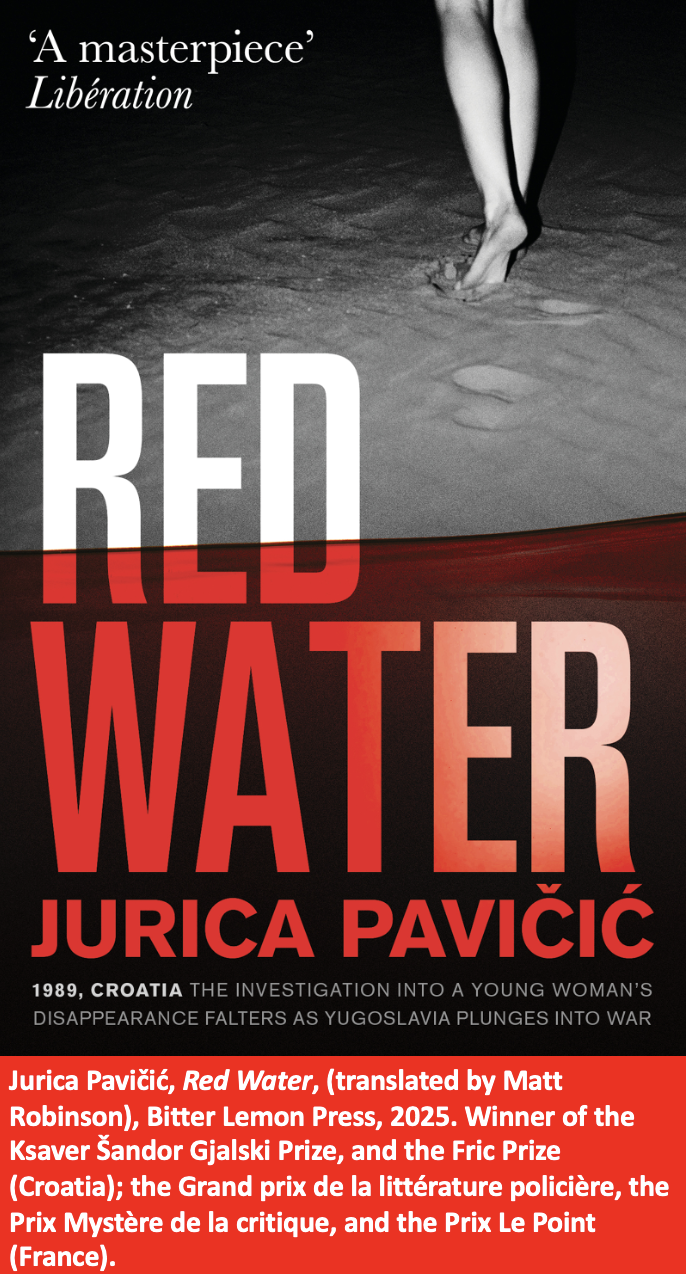
London author Tony White speaks to Croatian novelist and critic Jurica Pavičić during his recent UK visit to promote the publication this year of the English translation of his multi-award-winning novel Red Water
Congratulations! – Red Water is the first of your novels to appear in English translation. What’s it about?
Red Wateris my seventh novel, first published in Croatia in 2017. Compared to my other novels, it’s less a thriller and more a classical whodunnit: a history of the disappearance of a 17-year-old girl from a small coastal community. It’s September 1989, the whole pre-existing universe is collapsing, and everybody is distracted by huge political changes: the fall of socialism, followed by the break-up of Yugoslavia, war, etc. But I wanted all these big events to be in the background, not the main topic. For my characters, their own drama is so big that there is no emotional room for global concerns. But vice versa: since everyone else is focused on massive social upheavals, nobody cares about a missing teenager. From that point, I follow several characters through the next twenty-six years, until the mystery is solved. I wanted to write a novel in which one big event transforms the lives of all the characters involved, propelling them in different directions like billiard balls scattered when you ‘break’ at the start of a game. Inspiration also came from a great ‘cold case’ novel: Blackwater by Kerstin Ekman (my title is a kind of homage).
Does your work as a film critic contribute to your novel-writing?
My film criticism shaped my taste. If you are a film critic you don’t divide ‘high’ and ‘low’ cinema. You are trained to equally appreciate Bergman, Fellini, Hitchcock or Raoul Walsh. As a film critic I like good, intelligent and deep genre cinema. So inevitably I started asking myself: ‘What is the equivalent of this in literature?’ At some point I discovered Le Carré, James Ellroy, Patricia Highsmith… For example, I heard about Highsmith for the first time in an interview the young Slavoj Žižek gave a Zagreb weekly in 1986. He influenced me by promoting the values of good popular fiction. At that time he was a local star but internationally unknown. I thought, ‘He is a clever young Slovenian philosopher, if he says Highsmith is good, then she must be.’
Why write crime fiction?
As a writer I try to give readers all the guilty pleasures, all the reasons we read crime fiction: the suspense, the mystery, the riddle, the uncertainty. I want my books to be page-turners, but I also want them to be rooted in a specific society. It seems wrong somehow to write an American or British-style crime novel that just happens to take place in Croatia. It needs to be a Croatian crime novel, to include a Croatian type of crime, and Croatian models of family, of institutions, attorneys, police, economy, food, dialects, etc. For example in former Yugoslavia the only genre in which police were the main characters was jokes: there was a whole genre of jokes about stupid constables. Also, a good crime novel is almost always a social novel. You could say that crime and thriller fiction stepped into the shoes of the big social novels of the 19th century, as mainstream-literary fiction moved towards psychology, introspection, stream of consciousness. If you want to learn about the US in the thirties, you read hard-boiled crime fiction. If you want to understand Britain after the collapse of the Empire in the fifties and sixties, you read Le Carré. Right now Croatia is a bit like everywhere else, the market is dominated by Anglo-Saxons and Scandi Noir. Jo Nesbo is the top seller.
Is there a home-grown crime writing scene in Croatian literature?
Croatia is a small country (pop. 3.8m) with a small literature. The entire Croatian production is about fifty novels a year. The literary field is relatively elitist, venerating more ‘highbrow’ literature – autofiction, historical novels, family sagas. Nevertheless, there is a crime fiction tradition that started in the late seventies, early eighties, a period when the socialist publishing industry in the proto-capitalist hybrid that was late-communist Yugoslavia was already market-orientated. At that time two bestselling writers started writing genre fiction: Pavao Pavličić and Goran Tribuson. In the early eighties, Tribuson introduced the first recurring investigator, Nikola Banić, who started out as a policeman, then became a private investigator. Today the most celebrated crime writer in Croatia is Drago Hedl, author of a series of inter-connected crime novels set in his home town of Osijek in the north east of the country.
Can you tell us about UPiT?
Udruženje Pisaca Trilera (UPiT) – ‘Association of Thriller Writers’ – is a new crime and thriller writers’ association, announced in January 2025 by author colleagues in Belgrade. It covers the whole of former Yugoslavia. I’m a member. UPiT is based in Belgrade because the genre fiction market is stronger in Serbia than elsewhere in ex-Yugoslavia. It’s the biggest market, and the most commercially-driven. The normal work of the society has been somewhat disturbed by the riots and social upheavals in Serbia over the past ten months. We have founded an annual prize that was awarded for the first time at the inaugural Belgrade ThrillerFest in May of this year, to Polje Meduza (Field of Medusas) by Oto Oltvanji.
This interview first appeared in a slightly different form in Red Herrings (December 2025, Issue 825), the journal of the UK Crime Writers’ Association.
Piece of Paper Press is delighted to have published Obiter Dicta: an accidental conversation between visitors at Frieze London 2025 by Alexa Wright. Obiter Dicta continues Wright’s fascination with human language and how we make meaning. For several years, Wright has been obsessively collecting fragments of conversation overheard on the streets close to where she lives in London. Two previous artist’s books – Beside the Point and Between the Lines (both 2025) – have combined and reordered selections of these disconnected found utterances to create slightly absurd narratives. These texts are presented in juxtaposition with close-up photos of everyday life, many capturing random details of the same streets in which the fragments of conversation were collected. Building on those recent artist’s books, but bringing this writing practice back into the heart of the art world in London, Wright’s book for Piece of Paper Press contains a short, fictional – possibly nonsensical – dialogue-based story compiled from unattributed and otherwise unconnected fragments of conversation overheard at Frieze London 2025 during her visit on 17 October. More than a collection of non-sequiturs, Obiter Dicta creates an evocative glimpse of one of the world’s most influential contemporary art fairs, in the words of a fleeting cross-section of visitors as they experience it.
Alexa Wright is an artist whose practice spans a range of media, including photography, video, interactive installation and book-works. She has often worked in collaboration with medical scientists, and many of her projects have involved working together with people with mental or physical differences or those living with difficult life circumstances. Alexa’sinterest has recently shifted towards an exploration of our relationship with the natural world. Her work has been widely shown internationally, in festivals such as: Kochi Biennale, India; FILE, SESI Art Gallery, Sao Paolo, Brazil; DaDaFest International, Liverpool; International Women Artists’ Biennale, Incheon, Korea; and Athens Photo Festival. Inside Stories, a series of 11 short video diptychs co-created with participants in three UK prisons was shown at Saatchi Gallery, London, in 2023, and in MK Calling 2024, MK Gallery, Milton Keynes.








You must be logged in to post a comment.