A barricade in all but name

The Russian Club Gallery just published my new short story, ‘Auto-destructive Arts Policy’, as a folded A3 pamphlet to accompany the exhibition/project by Rupert Ackroyd and Alison Turnbull, which opened on 30 March. The pamphlet is free and is available from the gallery until the show closes on 7 May, or while stocks last. I am reproducing the full text of my story below, but of course the pamphlet is the real thing. I’ve given away the few spare copies that I had, so I would recommend getting to the Russian Club asap to see the great show by Rupert and Alison and to obtain your free copy.

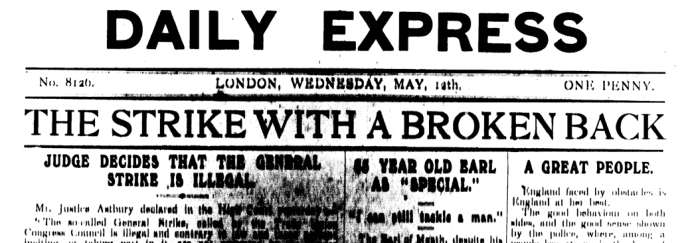
I’ve worked with Alison Turnbull before, contributing a short work of fiction to her artist’s book Spring Snow: A Translation, and publishing her Black Borders: 1994 – 2006 on Piece of Paper Press. I wrote a little about Spring Snow here. The opportunity to write another piece of fiction in relation to Alison’s work seemed too good to miss, so I visited both Rupert Ackroyd’s and her studios on 10 February 2011 to discuss the collaborative project that they were making for the Russian Club show. This was the day of the State of the Arts conference, which was taking place at the RSA on the Strand and which I’d been following on Twitter. Visiting the Russian Club gallery at the end of the day, I noticed what looked like a page of yellowing newsprint among some rubbish — faded prints, cardboard backings and mountings — that had been extracted from junk shop picture frames by the artist and Russian Club gallery director Matt Golden. Looking more closely I discovered that it was an original news broadside published by the Daily Express during the General Strike on 12 May 1926. At the bottom right of the page is a story bearing the headline ‘False News’:

Three men have each been sentenced to 21 days’ hard labour for selling a leaflet called “The Fulham Worker” which stated that the Welsh Guards had been confined to barracks for intimidation.

‘Auto-destructive Arts Policy’ is dedicated to the artist Gustav Metzger and at the heart of the story – as noted also in the story – is a short text produced for satirical purposes by cutting-up his statement, ‘Art Strike 1977-1980′, in Art in Society / Society into Art: Seven German Artists (London: Institute of Contemporary Art, 1974) and Ed Vaizey’s speech at the RSA, ‘The Creative Ecology – Speech at State of the Arts’ (London: DCMS, 2011). The story’s title is of course after Gustav Metzger’s 1st Manifesto: Auto Destructive Art, (single printed sheet) London: the artist, 1959, etc
§

Auto-destructive Arts Policy

For Gustav Metzger

*

Three men and a woman have appeared at Westminster Magistrates Court, Horseferry Road, London, charged under the new legislation with Conspiracy to Exhibit and for distributing a satirical broadside entitled Auto-destructive Arts Policy . This publication includes a text that one of the accused, the author Tony White, allegedly produced by ‘cutting-up’ and ‘re-mixing’ (‘for satirical purposes’, he claims) artist Gustav Metzger’s 1974 call for an ‘Art Strike’ with a speech made at the State of the Arts Conference at the RSA London on 10th February 2011 by the Right Honourable Ed Vaizey MP, Minister for Culture, Communications and Creative Industries.

By such ‘literary’ contrivance was the Minister made to appear to have said that he wanted, ‘to make a case for the use of art for direct social change.’ (Our italics.)

An editorial standfirst asks whether Vaizey and Secretary of State for Culture, Olympics, Media and Sport Jeremy Hunt might not themselves yet succeed where Metzger failed, by actually creating the ‘years without art’.

Tony White’s disputed text continues:

The art world uses art to confuse and divert us. The only way through this horrifying reality is to face the fact that the arts are currently deployed against the interests of the state. That art, the voluntary arts and the amateur arts should be in the service of revolution against the state and capitalism is unsatisfactory. Nevertheless much of the debate about the arts focuses on fighting the system.

Artists can use the same methods of production and distribution as me to talk about lack of money, but I call for a lack of art, for years without art, a period of three years – 2011 to 2014 – when artists will not work, sell work, or permit work to be supported by grant funding. It’s worth reminding people – and some still seem oblivious to this fact – that last year’s settlement took place against the background of the publicity machinery of the art world. Art pretends that it would have been possible for the dealer/museum/publicity complex to continue juggling artists, finance, works and patronage systems.

My view is that our cup is still plentiful but we should refuse collaboration with any part of the art world. National and local government is at best disingenuous: the years without art will see the collapse of many local libraries, local theatres and theatre companies or local arts centres, dance companies as well as diverse arts events and organisations. Institutions handling contemporary art will be severely hit and will have to reduce their staff. Magazines will fold.

Yet the ramifications of inaction would be tough. The last thing a Whitehall Minister needs is the arts demanding changes to every decision they disagree with. I believe that three years is the minimum period required to cripple the Arts Council and create difficulties for artists. Artists should be sufficiently wealthy to live on their own capital. It will be necessary to prevent not just the local library or the local theatre or the local arts centre from exhibiting and publicising art in the future but the entire community. The government is passionately committed to smothering art and the denial of labour is our chief weapon. To bring down the art system it is necessary that people who once practised art never regain their creative spirit; to eradicate it in every corner of the country.

*

The accused are (in alphabetical order): Rupert Ackroyd, a sculptor working from Myddleton Square, Islington; Matt Golden, Gallery Director of the Russian Club Gallery, named after a snooker club that previously occupied the premises on Kingsland Road in London’s East End; Alison Turnbull, a highly-regarded painter latterly of Kentish Town but born Bogotá, Colombia, and; the above-named Tony White, best known for penning a novel set in the contemporary East End but now living in south west London.

Ghoulish Ackroyd – a church crypt is his studio – has exhibited widely in recent years. A typical ‘work’ might be his ‘Large Assemblage’ (2010) which comprised a replica Victorian Gothic church door stood horizontally against a transparent glass or perspex column filled with coffee beans. A hollowed-out, fake oak beam contained a number of cardboard boxes themselves containing multiple ‘stash tins’ – standard tobacco tins painted black and adorned with glittery stickers bearing black and white likenesses of late folk-rock legend Nick Drake, the whole then distressed as by some mechanical sander. This apparent drug-culture reference prompted one elderly gallery visitor to remark, ‘My 59 year old son with a chain of “head shops” and a couple of stalls at Camden Market could have done that.’

Turnbull too, has exhibited extensively in the UK and around the world, most recently at Matt’s Gallery, Copperfield Road, where her installation, Observatory (2010) took as its starting point the ground plans of one such astronomical edifice built by Thomas Jefferson, third President of the United States.

Chief Crown Prosecutor Astbury asked that twenty pages of notes produced by White during apparent ‘studio visits’ to premises rented by Ackroyd and Turnbull respectively be considered for disclosure. These notes, she claimed, recorded heavily coded conversations – also held on Thursday 10 February 2011 – in which Ackroyd talks for example of ‘English vernacular’, of craft, architecture and the ‘heavy, conservative nature of the built world’. He describes journeyman carpenters, air-dried European oak and mortice and tenon joints. Turnbull also speaks of domestic vernaculars; particularly those found in 1960s wallpapers. She talks of lozenge motifs and counterintuitive perceptions of size such as might be created by distance or proximity. White questions whether this might produce a kind of domestic ‘dazzle’. Turnbull repeatedly mentions the Japanese architectural concept of kirei sabi or ‘gorgeous humbleness’.

The Crown Prosecution Service suggested such statements were far from the innocent discussions of art that the accused claim, and attempted to show that the so-called ‘collaborative artwork’ produced by Ackroyd and Turnbull to Golden’s commission is in fact a barricade in all but name. Documents were shown to the court in which art historian Dr Ed Krčma specifically uses the language of class struggle when describing Turnbull’s work as, ‘the result of disciplined labour.’ (Our italics.) He talks of her using ‘…the tools of technical draftsmanship,’ of her ceding to, ‘the painting’s demands,’ through, ‘the jostle and poise of colours [and] incident,’ before concluding that, ‘This disciplined aesthetic constitutes an effective barrier to […] vague poetics.’

The CPS pointed out the current proliferation in the art world of ‘agit-prop’ ‘installations’ comprising sit-ins, workshops and teach-ins, as well as materials including barrels, chains, carts, paving slabs, stones, cobbles, bricks, planks, scaffolding, earth, sandbags, tables, doors, Molotov cocktails, gas masks, motorcycle helmets, fireworks, signs, posters, placards and sundry items that might be instantly repurposed to create a protest or to produce an impromptu barrier to blockade for example a street or public square, or to defend such a barricade.

Expert witness Professor Mark Traugott of the University of California Santa Cruz and author of a new book The Insurgent Barricade (University of California Press) spoke of a ‘barricade consciousness’ when called to explain his ‘preoccupation’. Citing historian and political scientist Charles Tilly, Traugott described a ‘repertoire of collective action’: the spectrum of contemporary approaches, methods and tactics available to protesters.

Structures that were not constructed and defended by civilian insurgents, although perhaps identical in all other respects, are considered here only as a point of contrast with the revolutionary barricade proper. Even one and the same structure, built by insurgents but captured and turned to account by a military force attempting to quell their rebellion, will, from the moment it changes hands, cease to be treated as a barricade under the definition adopted in this study.

In her concluding remarks, Chief Crown Prosecutor Astbury questioned whether given the volatile social and economic situation, all artworks might not be seen as insurrectionary: ‘Might we not,’ she asked the Court, ‘add to Tilly’s “repertoire of collective action” the massive civil disobedience of making things?’

All four were released on bail and will appear at Southwark Crown Court for a plea and case management hearing on 7th May. Father of one Golden was ordered that the Russian Club Gallery premises should remain open to the public until then, from Tuesday to Saturday each week, midday to 5pm.

Daily Express, Wednesday 30 March 2011

© Tony White, 2011
Creative Commons Licence
This work is licensed under a Creative Commons Attribution-NonCommercial-NoDerivs 2.0 UK: England & Wales License.

§
Pioneers in Art and Science: Metzger, (DVD) dir. Ken McMullen, published London: Arts Council England, 2005. Available from Concorde Media.
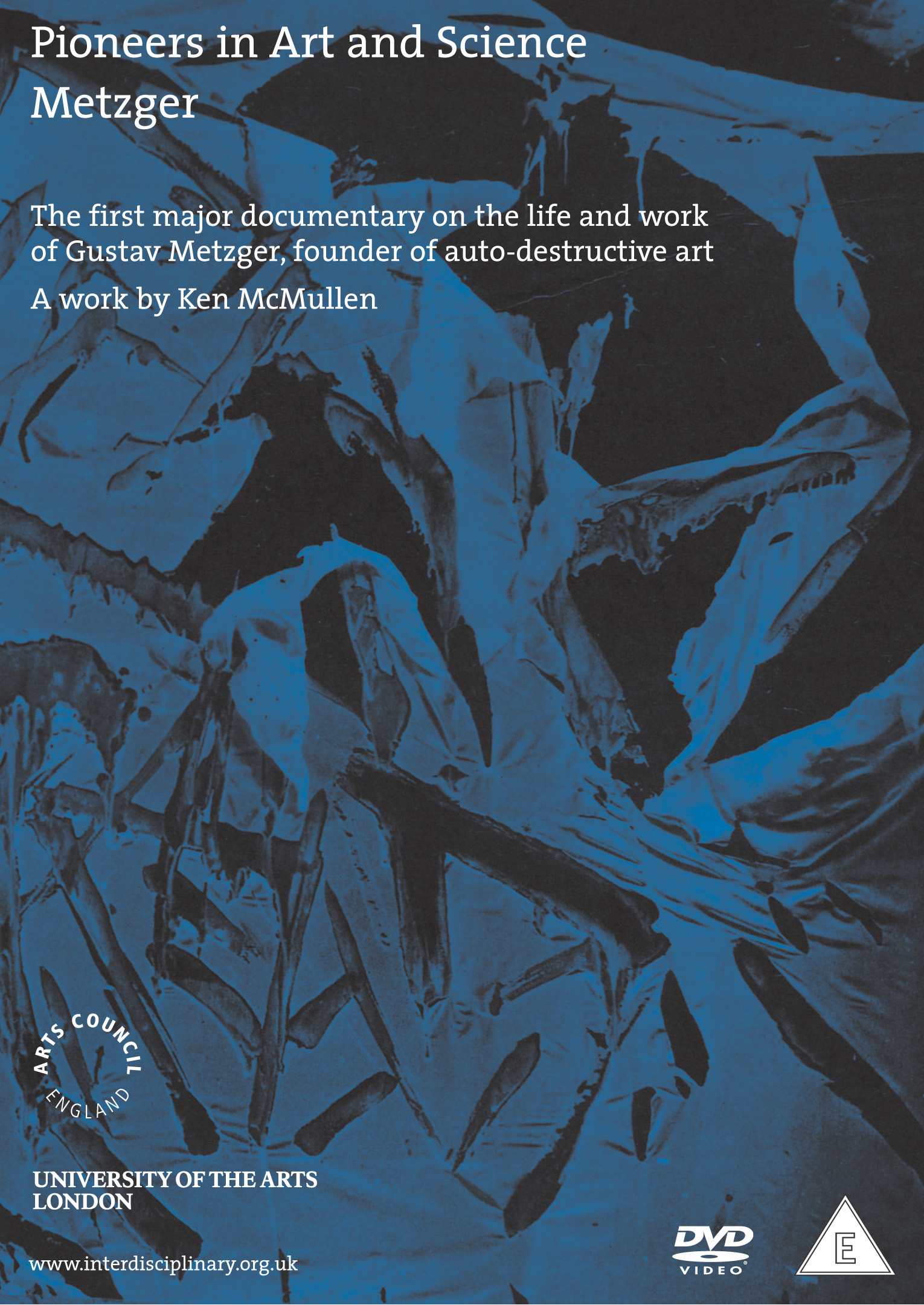
Mark Traugott, The Insurgent Barricade, Berkeley: University of California Press, 2010.

Alison Turnbull, Spring Snow: A Translation, London: Book Works, 2002.

Tony White, ‘Auto-destructive Arts Policy’, in Rupert Ackroyd/Alison Turnbull, London: Russian Club, 2011. Available free from the Russian Club Gallery, 340-344 Kingsland Road, London E8 4DA.

Free MP3 of A Porky Prime Cut live at the NPG

Thanks to Gabriel Thorp at the National Portrait Gallery, London, who grabbed a digital recording off the desk during my Dirty Literature gig with Tim Etchells on 18 March 2011.

Creative Commons Licence
A Porky Prime Cut © Tony White, 2011; Music © Simon Edwards, 2011. This work is licensed under a Creative Commons Attribution-NonCommercial-NoDerivs 2.0 UK: England & Wales License.

Feel free to extract the MP3 from this player (e.g. using the Firefox add-on ‘Download Helper’) if you prefer to listen using your own MP3 software or device.

Electra who put the event together will be putting the recording of the whole gig on their site very soon. Regular readers will know that I’ve been very excited to work with bassist Simon Edwards on this, so I wanted to make the live recording of ‘A Porky Prime Cut’ with Simon’s funk bass accompaniment available as a standalone piece of audio in its own right too. This is also a chance to test out the WordPress audio player for the first time, so as ever feedback is welcome.

You can download ‘A Porky Prime Cut’ as a free ebook courtesy of James Bridle’s excellent Artists’ eBooks site. We’re also hoping to put this recording on to the EPUB file as an extra.

I hope you enjoy it.

§

Acknowledgements: ‘A Porky Prime Cut’ by Tony White is part of Digital Transformations, an arts project using photography, film, sound, mapping, creative writing, web design and exhibition to raise the profile of the communities of Kinson, Townsend and West Howe in Bournemouth. Digital Transformations is coordinated and curated by SCAN with Bournemouth Libraries and Arts, and Bournemouth Adult Learning. It is funded and supported by The Learning Revolution Transformation Fund, Bournemouth Borough Council, SCAN, Bournemouth University, and The National Institute of Adult Continuing Education (NIACE). The collaboration with Simon Edwards was supported by Electra as part of their Dirty Literature programme for the National Portrait Gallery, London.

A Porky Prime Cut


Last week I gave a reading from a new short story entitled ‘A Porky Prime Cut’ at the National Portrait Gallery London, with live musical accompaniment from bass player Simon Edwards. Twitter friend @Alexandra_Wall posted this excellent photo of the gig on Twitpic. Thanks Alex.

It was a very enjoyable evening and I shared the bill with old friend Tim Etchells. All of this was for the launch of Electra’s exciting new Dirty Literature series of talks and readings that runs through until June. Tim read a lovely new piece which is quite hard to describe, but felt like a kind of sit-com in fragmented monologue form that was culled (or collaged) particularly from a series of increasingly unhinged internal memos from an ever smaller group of constables who guarded the Gallery in the early years of the 20th century. There is a plan to get audio and video of the event online, so when it’s up I’ll post a link to Tim’s piece. At present it doesn’t exist as a published text, and I’m not sure if Tim has plans to perform it again, so do have a look at the video when it’s up.

Tim and I have known each other for quite a while now. We met in the late 1980s when I was at art school in Sheffield where Tim’s company Forced Entertainment are based. Here is the Streetview photo of the former Sheffield art school premises on Psalter Lane. The Googlemaps car snapped it just before the college was closed down – hence the banner above the door. I have very happy memories of being at Psalter Lane, so the thought that these buildings have all now been knocked down makes me feel slightly bereft. However, it is still possible to get an arts education in Sheffield. The courses have survived it’s just that they’ve moved out of these mainly purpose-built studio buildings down to other Sheffield Hallam University buildings in the city centre. I was there quite recently. It was good to be back.

Tim was one of the first few people that I invited to do something for Piece of Paper Press when I started the imprint in 1994. He wrote the short story ‘About Lisa: a small bad story in twelve good parts’ in response to the constraints of the format and we published it in the usual edition of 150 in 1995. Here is a slightly murky scan of the front cover!

Tim has blogged about that period in the introduction to a new German language, Swiss edition of his collection Endland Stories, which sadly is out of print in English.

My story for the NPG gig, ‘A Porky Prime Cut’, was commissioned by digital arts agency SCAN in Bournemouth as part of their Digital Transformations project. I first blogged about the project here around a year ago, when I met the two other artists involved, Simon Yuill and Kevin Carter. Then I blogged some more here, here, here, here and here! You may gather that it was a very generative project :-)

The story is kind of a culmination and a condensation of all of that research.

And it was particularly generative not least because it made me confront my own biography even while writing a short story set in and around a town I hardly knew. Or two towns: Bournemouth and Poole. Writing ‘A Porky Prime Cut’ made me look again at some of my own formative experiences, in particular those moments where as a teenager perhaps you might discover that you have some kind of creative agency. All of which made me remember just how contingent my own art education really was.

So it felt quite special having the chance – thanks to Electra and the NPG – to read the story as a 20-minute standalone piece with live music from Simon Edwards in the form of his fantastic 85 bpm funk bass accompaniment. This really is something that both Simon and I are hoping to do again.

I’m also hoping that we can add the MP3 of the performance on to the ebook which you can download for free from James Bridle’s wonderful Artists’ eBooks.

The ebook includes beautiful colour photographs of Turbary Common taken by Bournemouth photographer Diane Humphries. Diane also took this photo of me on my first visit to Turbary Common, one cold, wet and misty March morning a year or so ago. At some point soon ‘A Porky Prime Cut’ will also I think be available via Bournemouth Libraries, both in ebook form and as a special print edition on Piece of Paper Press. I’m hoping there will be an event or two down there, too. I’m looking forward to that very much.

Dirty work, ‘Slang Truth’, Errata

1) Dirty Work

Lots of work behind the scenes in the past week for the inaugural Dirty Literature event that I’m doing with writer Tim Etchells at the National Portrait Gallery on 17 March. I’ve been rehearsing with musician Simon Edwards, who will be providing live musical accompaniment to one of the pieces I’m reading. I’m very excited about this, and I’m hoping we’ll get a good recording of the piece on the night, too, which we can make available after the event.

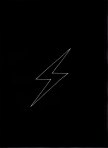
The producers, Electra, sent through a j-peg of one of the slides I’m planning to use during my reading (see left). It is a reversed-out version of my freehand drawing after the Throbbing Gristle flash design that I’ve mentioned in a previous post. I’m planning to use analogue technology in the shape of some Kodak Carousel projectors that are permanently installed in the National Portrait Gallery’s theatre. We’re testing it all out on Wednesday.

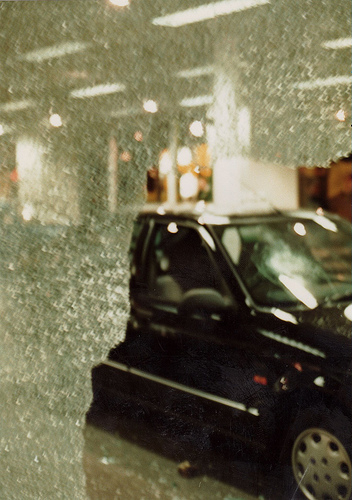
Tim and I last shared a bill at The Story 2010, Matt Locke’s annual conference about contemporary story telling across media and platforms (which just had its 2011 outing). Planning my reading for Dirty Literature I had wanted to respond to the location of the National Portrait Gallery at the southern end of Charing Cross Road, so was looking for creative commons licensed images of the Poll Tax Riots that took place in and around Trafalgar Square 21 years ago in March 1991. I found a couple of great images online — scans of distressed old photographic prints (see right), scratched and covered in finger prints — and funnily enough it turned out they had been taken, all those years ago, by Russell Davies who was the MC at The Story 2010. Russell has generously granted us permission to use them.

The blurb for our event just went to press in a publication that Electra and the National Portrait Gallery are producing to publicise and document the series. Here’s the latest version of what I’ll be doing:

Responding to the ‘Poll Tax riots’ and recent protests in Trafalgar Square, White will read from Charlieunclenorfolktango, his satirical 1999 novel about an alienated police force, before being joined by musician Simon Edwards to preview a new short story commissioned by digital arts agency SCAN for their Digital Transformations project.

The Dirty Literature series at the National Portrait Gallery kicks off with Tim Etchells and I on 17 March at 7.30PM. As noted previously, the event is free, but booking is essential.

§

2) Foxy-T in the Indy

Last Friday the Independent published a feature article by their Deputy Literary Editor Arifa Akbar in their weekly Arts & Books supplement entitled (in the print version) ‘Stories from the Sounds of the Streets’, which includes brief interviews with myself and others about our own work and/or about ‘the vernacular tradition in literary fiction.’

I very much enjoyed chatting with Arifa about all this. A couple of factual errors* about Foxy-T crept in to her final copy, but I guess that is par for the course, and I am amazed and delighted that Foxy-T continues to be written about nearly eight years after publication: most novels having (I’m paraphrasing a long-lost note from Iain Sinclair) ‘the shelf-life of a fruit fly.’

The article is framed by questions of authenticity:

slang narratives continue to raise debate over what is seen, and sometimes claimed, as a more authentic mode of storytelling

The double-page spread of the print version is punctuated with pullquotes from writers Stephen Kelman (‘I felt from the beginning his voice was authentic…’) and Gautam Malkani (‘…I thought wow. It is authentic, but invented authenticity’).

I’m not sure that ‘authenticity’ is the issue, but it reminded me of the line scrawled on the cover of The Fall‘s 1982 LP Room to Live: ‘Undilutable Slang Truth!’

Sarfraz Manzoor writing about Foxy-T and Londonstani in a piece following the publication of Malkani’s novel a few years ago asked whether an unrealistic expectation of authenticity is placed upon writers from Black and Minority Ethnic groups. Maybe so. I think ‘authenticity’ is also used as a kind of critical shorthand that masks more complex questions of power, identity, class, narrative, the reading experience, etc etc. For me writing Foxy-T at the turn of the century, it was precisely the inauthenticity of Bangladeshi rude boys calling each other ‘rasta’ — an observable/audible rupture with the necessary identity politics of Black British language in the second half of the 20th century — that made the novel possible; that the novel set out — amongst other things — to explore.

After the usual ‘street talk scare stories‘ (which I’ve discussed here), Akbar’s wide-ranging and broadly positive article is very welcome. I was and am thrilled to see that Foxy-T is also included in a round-up of ‘The best in “slang” fiction’  alongside how late it was how late, A Clockwork Orange and Trainspotting. Great!

§

3) Errata

*One of the small (but to me, glaring) errors in The Independent article states that Foxy-T was ‘published a year before [Monica] Ali’s Brick Lane and […] was buried beneath the critical acclaim of her book.’ Ouch! Actually, Faber and Faber published my novel one month after Ali’s, but Foxy-T continues to receive plenty of its own ‘critical acclaim’, including recently here in the Indy itself or in this Browser interview with the esteemed Great Hedge of India author Roy Moxham. More press elsewhere on this site, of course.

FYI, the Radio 4 Today Programme interview about Foxy-T that is mentioned in the article is weirdly absent from Today‘s otherwise more or less exhaustive ‘listen again’ archive, so I put it on Youtube:

Taking a story for a walk

Last week I went to The Story 2011, a one-day conference at Conway Hall, London that is devoted to stories and storytelling across all platforms and media. I spoke at last year’s event, so this year it was doubly enjoyable to simply be a punter and soak it all up. Also I was really pleased that the morning session included Matt Adams of Blast Theory talking about Ivy4evr, our interactive SMS drama for Channel 4.

The Story conference came about because, as founder Matt Locke says, ‘There have never been so many stories, never so many ways to tell them.’ Picking up on a conversation had during the day, I’ve just been commissioned to write a longer article about The Story 2011 which will be a good excuse to interview Matt and others about all this; to explore contemporary storytelling in more depth.

Looking through some of the blog coverage of the conference over the weekend, and the #thestory2011 Twitter stream, I was surprised to see this photograph of my boots(!) which had been taken during the morning session. I must have been engrossed to not have noticed the picture being taken at such close quarters. The photographer, digital media consultant Kathryn Corrick, writes:

I arrived late and so ended up sitting on the floor for the first session. I noticed a fabulous pair of brogue boots beside me […] and took a pic of them – sadly I never got the name of their owner, so if you see this set and know who they belong to please let me know. This photo led to an idea and connected in with a project I’d started the week before called Feet on the Overground; that rather than taking people’s faces that day I’d ask to take a pic of their shoes.

I got in touch with Kathryn and asked permission to reproduce her image. Here is her photo essay — The Sole of The Story 2011 — on Flickr. I love the way that from nothing, by taking an idea for a walk, this series of photographs not only tells a lot of new stories about The Story 2011 conference and those attending, to create a whole new layer of knowledge and insight that cuts through the day like a core sample, but also that it so tangibly captures something of the texture and the humour of the day.

I’ll let you know when my article on The Story 2011 comes out, probably in April.

Dirty literature v. dirty tactics

I’m really pleased to be taking part in the opening event on 17 March of the forthcoming Dirty Literature season put together by Fatima Hellberg of the excellent contemporary art agency Electra for the National Portrait Gallery. Doing a project for the NPG has stirred up memories of the Poll Tax Riots; made me think about the regeneration/rebranding of Trafalgar Square and the impact on that of the recent protests. This week has also seen publication of a review by Her Majesty’s Inspectorate of Constabulary on Policing Public Order which includes recommendations on the use of force following the death of Ian Tomlinson and a depressing admission that such recommendations may take years to implement on the ground. More on these related issues below.

All the events in the Dirty Literature series are free but booking is essential. Here is the blurb:

From performative lectures that roam across fact and fabrication to genre-defying plays with storytelling, Dirty Literature brings together artists and writers exploring the boundaries of narrative […] – a form of contaminated literature, unfolding at the edges of coherence. Ephemeral like a rumour, mobile like gossip this is a form of biography that escapes the weight and permanence of the published word and the painted figure alike, a real time portrait.

I’m going to be sharing the event on 17 March with my old friend Tim Etchells, best known for his work with UK experimental theatre company Forced Entertainment but also a prolific and consistently brilliant writer across media. Alongside his writing for and about performance, Tim has also written some great fiction over the last decade or so, including the now sadly ultra rare Endland Stories from 1998 (further background on Endland Stories here, too) and more recently an excellent novel The Broken World.  Another current solo project of Tim’s is entitled Vacuum Days for which he is posting a gloriously downbeat series of graphic and satirical, daily playbills (developing an idea first explored in a brilliant free pamphlet he produced a couple of years ago called Events at the Downturn). Here’s the Vacuum Days playbill from 9 Feb:

My contribution to the Dirty Literature event will be to read from two pieces of fiction. One is a completely new commission, the other is CHARLIEUNCLENORFOLKTANGO, my satirical novel from 1999 (which I’ve blogged about here and here). The novel  was amongst other things a fictional response, through the imbecilic monologue of a uniformed goon in a ‘riot van’, to a police force which by the mid-1990s, more than a decade after the miners’ strike, seemed to have become locked into an alienated cycle of violence and prurient self-justification that was exemplified for me at time of writing by the circumlocutions surrounding the failures of the investigation into the murder of London teenager Stephen Lawrence.

CHARLIEUNCLENORFOLKTANGO is long out of print, following the closure of the novel’s publisher Codex Books getting on for a decade ago, but I’m reading from it at the National Portrait Gallery, because a sequence in the novel riffs (albeit detachedly) on the protests in Trafalgar Square of March 1990 popularly known as the ‘Poll Tax Riots’ and some of the aggressive crowd dispersal techniques — mounted police charges, vehicles driven at speed — that I’d witnessed that afternoon from this same north-east corner of the square and from the elevated area beneath the portico of the National Gallery.

Since the turn of the century, Trafalgar Square has been rebranded via the ‘World Squares for All’ regeneration initiative as a venue for celebration rather than protest. The aim of this was to create ‘a new heart for London’ (a phrase previously used to announce the development of Picadilly Circus tube station in 1928), an ambition that was achieved through major transformations such as road closures and traffic re-directions to create a pedestrian plaza; through rolling, participatory cultural events such as ‘The Fourth Plinth’ sculpture competition; and through regular use of the square for civic and community celebrations such as that which followed the announcement of London’s selection as host city for the 2012 Olympic Games.

The protests of 24 November and 9 December 2010 (the latter I blogged about here) have now displaced the media archive of all that careful work with many thousands of new images that all look eerily familiar, echoing documentation of the Poll Tax riots of March 1990 or the Miners’ Strike, but on a whole new scale. Sites such as Flickr and Youtube host countless photos and videos of the protests and of violent police tactics such as kettling and mounted police charges, and of some now higher-profile incidents involving the use of violence against young people such as Jody McIntyre and Alfie Meadows and the ensuing debates and coverage they provoked.

It is timely then that also published on 9 February is the report from Her Majesty’s Inspectorate of Constabulary (HMIC) on Policing Public Order (link downloads as PDF). The introduction notes:

After a few, relatively quiet years, this is a new period of public order policing – one which is faster moving and more unpredictable. Foreseeing the character of events will prove more difficult and, in some cases, their nature and mood will only become apparent on the day.

What seems evident is a willingness to disrupt the public and test police. Police tactics have to be as adaptable as possible to the circumstances to keep the peace for all of us. [My emphasis: note the corresponding, unspoken invocation of them]

Policing Public Order is subtitled, ‘An overview and review of progress against the recommendations of [previous HMIC reports, both from 2009] Adapting to Protest and Nurturing the British Model of Policing.’

The second of these reports from 2009, Nurturing the British Model…, made a series of recommendations on ‘the use of force’, which are divided into three sections: ‘A. Principles on the use of force; B. Training on the use of force, and C. Planning operations which may involve the use of force.’ (Policing Public Order, ‘Annexe D’, p.41-2)

There are six of these principles, and — importantly — they, ‘reflect the law as it currently stands’, i.e. they do not relate to some future legal landscape or aspiration:

1. Police officers, in carrying out their duties shall as far as possible apply non-violent methods before resorting to any use of force.
2. Police officers should use force only when strictly necessary and where other means remain ineffective or have no realistic chance of achieving the lawful objective.
3.  Any use of force by police officers should be the minimum appropriate in the circumstances.
4.  Police officers should use lethal or potentially lethal force only when absolutely necessary to protect life.
5. Police officers should plan and control operations to minimise, to the greatest extent possible, recourse to lethal force.
6. Individual officers are accountable and responsible for any use of force and must be able to justify their actions in law.

In the same report HMIC recommended that training in these six principles

should not be abstract but should consider the practical application of the use force [sic.] in the public order context, for example, by instructing officers that the use of particular tactics, such as the edge of a shield or a baton strike to the head may constitute potentially lethal force.

However, Policing Public Order this week draws the pessimistic conclusion that, ‘the pace of these changes can be measured in months, if not years.’ The report continues,

These timeframes may not, even then, include the additional time needed to train officers performing the key roles on the front-line, or in command.

This is contrasted specifically with the fact that protesters can, ‘change their focus in minutes [my emphasis] through the use of social media and mobile phones’ [p.4]. A couple of pages later the report then poses the question:

How can police participate effectively in and utilise social media to assist in maintaining the peace?

But the obvious insight that perhaps the police could use social media and mobile phones to train their officers more quickly than ‘months, if not years’ (or to remind them of ‘the law as it currently stands’ in a given situation) is missed.

What Policing Public Order omits to mention is that the tragic death of City newspaper seller Ian Tomlinson on April 1 2009, following this assault by a police officer in the vicinity of the G20 protests was if not the only reason for the commissioning of these reports, at least significant enough that it is highlighted in the opening few sentences of 2009’s Adapting to Protest.

In which case it may seem surprising that as of January 2011, almost two years later, the status of even these key recommendations on the use of force (which reflect ‘the law as it currently stands’) reads:

A position on the use of force has been agreed by ACPO [Association of Chief Police Officers] for public order, but a single overarching set of principles for policing has not yet been adopted. Steps have been taken by individual forces since 2009, but the guidance given to officers in briefings and training centres continues to vary.*

So how long might it take? A press release (opens as PDF) accompanying the review states that HMIC’s recommendations

will be used as the basis for training from Spring 2011. Taking into account the time required to train officers, changes on the ground may take up to two years or more.

§

CHARLIEUNCLENORFOLKTANGO is currently out of print, but a small number of secondhand copies are available.

DIRTY LITERATURE

Featuring: Samuel Dowd, Tim Etchells, Will Holder, Karl Holmqvist, Tom McCarthy,
Francesco Pedraglio, Sue Tompkins, Tony White. Curated by Fatima Hellberg (Electra)

National Portrait Gallery, London — 17th March – 16th June 2011

All events are free, but booking is essential: bookings@electra-productions.com

*Annex B: Status of compliance with recommendations of Nurturing the British Model, Policing Public Order. HMIC (2011), p.37

The Origin of Species*

  1. 20 Jazz Funk Greats
  2. 2nd Annual Report
  3. 3-and-in
  4. A William Burroughs Reader
  5. Acid House
  6. Allen Ginsberg
  7. Arena
  8. Armadillo
  9. Barrett
  10. Bedford van
  11. Brideshead
  12. Burroughs
  13. Cities of the Red Night
  14. common
  15. common
  16. common
  17. conté crayons
  18. Derrida
  19. easier to get hold of these days
  20. Elder
  21. etched
  22. Farnham
  23. Foundation
  24. Francis Bacon
  25. George Peckham a.k.a. Porky
  26. Gravity’s Rainbow
  27. hawthorn
  28. histories
  29. Horses
  30. into the vinyl
  31. Joyce
  32. Land of a Thousand Dances
  33. Laurie Anderson
  34. Leeds
  35. light
  36. Light of the World
  37. Listen to my last words
  38. lodgers
  39. London Underground
  40. masking tape
  41. MG sports car badge
  42. Midnight Express
  43. Monty Python
  44. Mute
  45. Natty Rebel
  46. NME
  47. on telly a couple of months earlier
  48. Patti Smith
  49. Patti Smith
  50. photocopied
  51. Polaroid
  52. pony’s hoof
  53. Pre-Raphaelite
  54. preppy
  55. Psychic TV
  56. record
  57. Rimbaud
  58. routines
  59. screaming popes
  60. Scritti Politti
  61. Siouxsie
  62. skin
  63. smugglers paths
  64. soulboy
  65. suedehead
  66. Super-8 camera
  67. TG
  68. TG graphic: the black square, red bar across the middle, white flash of lightning down the centre
  69. that voice
  70. The Central School
  71. The Gospel Comes to New Guinea
  72. The Observer’s Book of British Wild Flowers
  73. Throbbing Gristle
  74. Triangle
  75. Turbary
  76. UBUWEB
  77. videoed
  78. Wallisdown Road
  79. wedges
  80. West Howe
  81. William S. Burroughs
  82. Wilson Pickett
  83. Winchester

* An alphabetised list of links from the epub version of a forthcoming short story commission (due for publication in February 2011). The story will also be illustrated with photos by Diane Humphries.

A policeman who quits the force out of shame

Sometimes only art will do — a particular book, picture, poem, piece of music. Some people I know can read a book once and then get rid of it, but I never know when I’ll need to go back and look something up.

So it was on the evening of Thursday 9 December 2010. Aghast and increasingly anxious at events unfolding in Westminster, both in Parliament and outside where I knew many friends and colleagues were legitimately protesting against the insultingly perfunctory debate on a transformation of higher education the impact of which can scarcely be guessed at but which will likely be felt by many people for many years, I began scouring the shelves for a particular title, but couldn’t find it by the light of the lamp. I looked again this morning, and found it. Here was a book which had suddenly come to mind for what felt like a whole new aptness in face of the ‘tuition fees vote’, Government ministers’ all-too-believeably crass framing of education as a selfish personal gain that is somehow stolen from the taxpayer rather than a public benefit — let alone a national one, or international — and the kind of baldly choreographed police aggression and provocation that was surely designed to produce the violence or the appearance of violence that it claimed to be a response to but that was reported as if the Battle of Orgreave had never happened. (Then, infamously, BBC News coverage reversed the chronology of footage to incorrectly show ‘shots of miners throwing stones at police before showing mounted officers charging the miners’.)

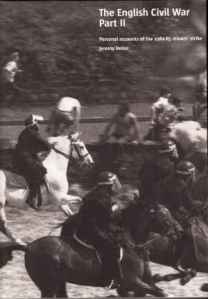
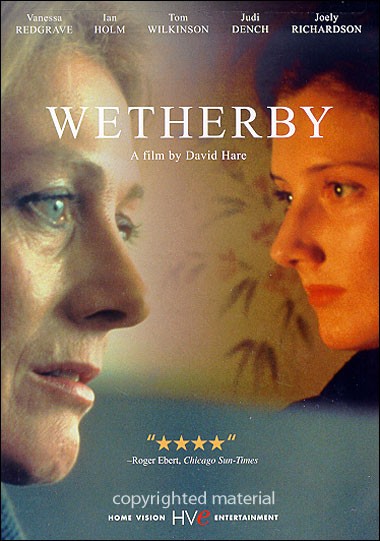
The book I’d been looking for was not artist Jeremy Deller’s The English Civil War Part II — an excellent published collection of, as the subtitle has it, ‘Personal accounts of the 1984-85 miners’ strike’, which was brought out to accompany his 2001 re-enactment of the Battle of Orgreave in Orgreave, an event which I was lucky enough to attend — but the script of the film Wetherby by David Hare. I knew it was there somewhere and I’d wanted to check a line of dialogue that I had (in fact mis-)remembered — if you’ll excuse my paraphrasing — as something like, ‘Right then, those of us who still believe in education, let’s… [something, something, something…]’

If you haven’t seen Wetherby I’d recommend it. It remains one of my favourite films. You might struggle to see it though, because sadly Wetherby doesn’t seem to be currently available on DVD in the UK. The script, too, is out of print although when it seemed that I might not be able to find my own copy I did quickly check to see if any secondhand copies are available online, which they are.

Wetherby is a kind of Thatcher era allegory — from and of the early, mid-1980s — in which an act of unhinged and paranoid Nietzschean violence is visited upon a Yorkshire community as represented by teacher Jean Travers (played by Vanessa Redgrave) and her British Library-worker friend Marcia (Judi Dench). I use the word ‘Nietzschean’ advisedly because the act of violence is tagged as such by several shots of the reading matter of the aggressor, a violent stalker named John Morgan (played by Tim McInnerny). In this much it is such a perfect allegory of the time, of the acts of violence that were perpetrated on communities in Yorkshire and elsewhere during the miners’ strike, that I have to remind myself that given production schedules of course the film must have been written, gone into production even, before the  strike even started. In which case it becomes an act of prophesy. It seems scarcely credible now, but looking at the dates today I see that Wetherby premiered in the same week that the Miners’ Strike ended, at the beginning of March 1985. The script lists the premiere as having taken place at the Curzon West End, London on 8 March, although there was also a Leeds premiere at the Hyde Park Picture House, a beautiful 1914, gas-lit, end-of-terrace cinema which features in the film. I remember this because I lived in Leeds at the time, so somehow it has become bound up — as films, music, works of art can — with my own biography (in ways that are both too slight and too convoluted to describe here), but also with my own writing.

In the mid-1990s I was writing a satirical piece of fiction, a short story about a pre-Macpherson police force that had seemed since the early 1980s — with the policing of the miners’ strike, the Battle of the Beanfield, and later with the institutional racism found by Sir William Macpherson in the aftermath of the murder of London teenager Stephen Lawrence — to be locked into a self-perpetuating cycle of alienated violence and prurient self-justification.

Once I’d started writing though, it was hard to stop and that short story became the novel CHARLIEUNCLENORFOLKTANGO, which was published in 1999 — the same year as ‘The Macpherson Report’ — by the former, now sadly-missed Hove-based publishing house Codex Books. The novel is told in an expletive strewn, phonetic prose style that is structured around a very loose appropriation of the central conceit of Philip K. Dick’s short story ‘The Third Kind’ and features three ‘Retropolitan Police Force’ goons in a riot van whose call-sign is an acronym of my (slightly adapted) phonetic alphabet title. In the period pre- and post-publication I did loads of readings from CHARLIEUNCLENORFOLKTANGO, often with a live, improvised musical accompaniment from James T. Ford, a former Hammond Organ player for The Jam. We performed at the performance art venue Hollywood Leather, at the ICA a couple of times, the Zap, Cabinet Gallery, Vox ‘n’ Roll, and others I can’t remember; then I put the book away for a decade, had other books to promote. Codex went out of business and the book out of print. There are a very small number for sale secondhand, but not many.

The novel is still out of print, but I did a public reading from CHARLIEUNCLENORFOLKTANGO earlier this year at a gig in Shoreditch with the mighty Malcolm Bennett of Brute! fame, which was the first time I’d done so for about ten years. Then again in November at Wordplay’s benefit night for the Cystic Fibrosis Trust, at a great venue called The Good Ship in Kilburn. That was the night before the previous pro-education protest in Westminster, which seemed to give the reading a whole new kind of currency.

The two things — Wetherby and CHARLIEUNCLENORFLKTANGO — are not unrelated. One short passage in my novel was consciously written as a kind of minor homage to Wetherby. It picks up on a fleeting scene in Hare’s film that appears on page 55 of the script. It would take longer to describe what happens on-screen, but in the script, Hare simply writes: ‘In the middle of the road children have lit a bonfire and are playing around it with sticks, and smashing bottles.’ As it happens, CHARLIEUNCLENORFLKTANGO features what (a confessedly irritated) Christopher Tayler in his review of the novel for the LRB called, ‘a tirelessly reiterated opposition of the lights of civilisation and the “dark playsiz”, [and] ow blokes & birds on Erf can keep the dark dark nyte at bay.’ As I was writing those sequences I thought again of that fleeting glimpse of the bonfire in Wetherby, and so in keeping with my prurient police officer narrator’s endless riffing on the light and the dark I used something similar. Near the end of the novel, as the Sarge drives the van back to his own house to inflict some (unseen) act of violence on his own family, he turns off the main road and they drive past ‘sum kidz dan by the garridjiz awl standin round a fyre wot theyv maid owt a sum ole matrissiz & shit […] & there chuckin stix at the cunt.’ I thought of this again when I saw some of the footage being posted on Youtube of Parliament Square, like this short clip by my friend the artist Chris Dorley-Brown.

There is a small nod to Wetherby in my novel Foxy-T as well, but I’ll leave that for now because I don’t want to overload a post that is already too long, and because there is already too much to digest. I am well aware, for one thing, of just how contingent my own engagement with higher education was. Then there are the brutal police tactics used against students and young people in Westminster on 9 December 2010, the innocent people who were kettled on Westminster Bridge until late at night and the odious likes of Michael Gove, the current Secretary of State for Education. I’d initially seen Gove as a kind of comic Dickensian figure, who came on the radio like Tory grotesques of old to try and feed us a burger about this or that, but there was a link floating around this week to a piece he wrote in the Times a few years ago in which he said that pricing education out of people’s reach is ‘all to the good,’ continuing, ‘anyone put off from attending a good university by fear of […] debt doesn’t deserve to be at any university in the first place.’

It was one of those times when only art will do, when nothing else is up to the task, and this was why I was reaching for my battered old Faber and Faber paperback of the script of Wetherby, and why it suddenly seemed such a good and useful fit; something to be immediately consulted.

Here was violence being visited on a community and being brought into people’s homes.

Here was the rejection of education as fake.

Here the violent desire of an aggressor to take everyone down with them and who blows his own brains out in pursuit of that power.

Here, too — in Wetherby at least — was a policeman who quits the force out of shame.

Most of all though, it was that line that I’d been trying to remember, which comes close to the end of the film (and on pages 90-91 of the Faber edition of the script). The teacher Jean Travers (Redgrave) is back in her classroom where she discovers that one of her pupils has quit school to run away with a boy.

‘Anyone else?’ she asks. ‘Anyone else want to go?’

No one does.

‘Right then, for those of us still remaining — us maniacs, assorted oddballs, eccentrics, folk who still feel that school is worthwhile, I suggest we keep trying. All right everyone?’

Pre-aged anonymous future

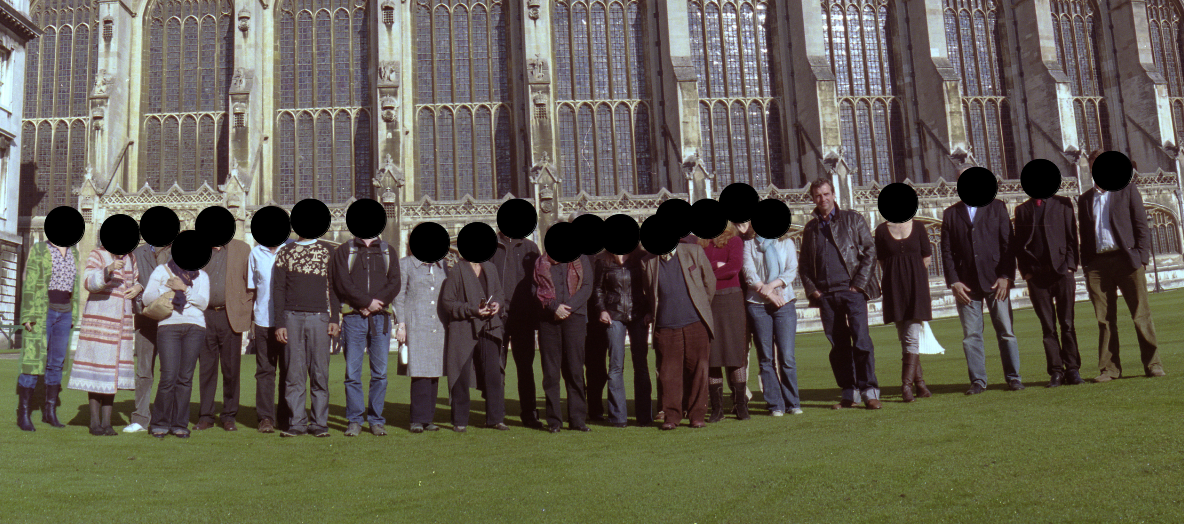
L-R: anonymous, anonymous, anonymous, anonymous, anonymous, anonymous, anonymous, anonymous, anonymous, anonymous, anonymous, anonymous, anonymous, anonymous, anonymous, anonymous, anonymous, anonymous, anonymous, Tony White, anonymous, anonymous, anonymous, anonymous.

Announcements received from or on behalf of the artists Rod Dickinson and Heath Bunting in the past couple of weeks reminded me how much I like each of their work, and that for a while I’ve been meaning to do a post about a short story of mine that features both of them, or which uses each of them as a way of writing about the other. Reason being that the story is set in or after 2011, which when I wrote it seemed sufficiently like ‘the future’ (albeit a very near future) to offer some satirical advantage, so I’ve wanted to quickly mention it before that year is upon us (with the obligatory nod to that great William Gibson story of fictional futures made real, ‘The Gernsback Continuum’).

‘The Lunar House “Re-enactment”‘ was commissioned by King’s College, Cambridge to form part of a report on a series of events called the Arts and the Law seminars which brought people (artists, lawyers, academics etc.) together, ‘to debate and clarify the legal and ethical implications of portraying real people through artistic representation, wider issues of freedom of speech for artists,’ and, ‘how such issues are involved in’ particular art forms: visual arts, theatre, literature etc.

I’ve known about Rod Dickinson’s work for ages, initially via Cabinet Gallery who showed his work in the early 1990s, but hadn’t met him until two or three years ago. For this new work Rod has collaborated with Steve Rushton to produce Who, What, Where, When, Why and How, a video installation which is showing at Alma Enterprises, London, until mid-January. Here is the blurb:

‘two actors deliver a simulated forty five minute press briefing […] composed solely of fragments of speeches and press statements [which] focuses on the way in which similar declarations and political rhetoric have been repeated and reused by numerous governments across continents and ideological divides to justify acts of aggression and state sanctioned violence.’

Heath Bunting‘s work also engages with the production and practice of power, amongst other things, but it is more elusive, low-level and unbounded and it has sort of crept in to my consciousness over the past decade. I think of Bunting’s work like the faint glow of a persistent beacon on the horizon — he works out of Bristol — that seems to relentlessly and doggedly illuminate contemporary practices of politics, power and identity, but which the closer I get to the more resistant to summary it becomes. Bunting is often described as a net.art pioneer, but a project might consist of a real-world action, a collaboration, a book or advice on making a day-planner that will enable you to avoid working. It could be an ‘IT COSTS MORE TO BE POOR‘ poster, or an extensive record of points of engagement (transcripts, legal documents, etc.) between the body(s) or person(s) and any one of the infinity of social, political, geographical, legal multiverses in which we find ourselves to be born and living. In all this teeming beaureaucracy and detail Bunting’s work starts to seem like Borges’s same-scale map of the territory, as if it is identical with his life.

Just so with the work announced by Bunting’s email of 21 November 2010 which — in as far as I am able to locate it, and amongst other things — is just as analytical, botanical, countercultural, dispersed, ethical, fragmented, guarded, honest, idiosyncratic, journalistic, key, labyrinthine, malcontent, networked, open, provocative, questioning, rigourous, satirical, time-consuming, unglossed, volatile, wide-ranging, X-border, yippyish and zealous as ever. The email offers ‘a spare pre-aged anonymous letter box facia’ for sale (pictured left), and lists both secondhand and ‘artist signed’ prices. The email also links to a webpage from 2005, entitled Anonymous Letter Box – Howto, which is at least partly self-explanatory dealing as it does with the siting over long periods of time of anonymous mailboxes in disused street locations around the city. The simple design and the proliferation of texts and pages found here and under the wider Status Project heading is indicative of the approach used elsewhere on the irational website. A new project, slated to run from 2010 to 2020 lists works in the Heath Bunting Collection that are, like the spare pre-aged anonymous letter box facia, available for loan or sale/exchange.

So much for a very limited introduction. With even less to go on and beneath the distracted-looking gaze of E.M. Forster, whose portrait was one of several hanging in the seminar venue, Heath Bunting’s work proved difficult to understand for many of the participants at that Arts and the Law seminar at King’s College, Cambridge. Particularly challenging was a short discussion of Bunting’s arrest in 2001 (documented on irational through a series of documents entitled ‘In defense of the tools of my trade’). In order to explore this further, and to see if fiction might offer a useful approach, I appropriated elements of Rod Dickinson’s practice (thank you Rod) to write a short story which imagined a large-scale work of participatory performance art being convened to mark the tenth anniversary of Bunting’s arrest. That story, ‘The Lunar House “Re-enactment”‘ is downloadable as a free Diffusion ebook pamphlet by clicking on the cover image (right). If you are not familiar with assembling ebooks made using the Diffusion or Bookleteer format, there are some useful how to videos on Vimeo. I have made a number of other short stories available free in this format also, which are all searchable on the Diffusion site, though I haven’t got around to listing them on this website’s Free Beer page.

Also available in the Diffusion format is Heath Bunting’s ‘Single Step Guide to Success — Day Planning’. the introduction to which reminds us that: ‘Rigorously planning your days can minimalise time spent working or waiting and maximise engagement with pleasure, happiness and growth.’

§

Because the Arts and the Law seminar series was conducted according to the so-called Chatham House rule (to encourage openness and the sharing of information within the group at least) I’m apparently bound not to reveal the ‘identity [or] the affiliation of the speaker(s), nor that of any other participant’. So it was initially a bit frustrating when the artist Manu Luksch sent a fantastic panoramic photograph of seminar participants, which I wanted to reproduce at the top of this post. Then I realised that I could comply with the Chatham House rule by anonymising everyone in the spirit of Manu’s excellent surveillance footage sci-fi film of the same year, Faceless.

Middling English and fantasies of exclusion

I travelled to the John Hansard Gallery, Southampton on 23 October to take part in an event around Caroline Bergvall’s exhibition Middling English; result of Caroline’s 3-year fellowship at Southampton University, supported by the AHRC’s former Fellowships in the Creative and Performing Arts programme.  The show was previewed in the Guardian and here’s what it says (/said?) on the ‘current exhibition’ page of the Gallery’s website:

Middling English explores some of the pleasures and complexities of language use, in and through writing. The exhibition brings together multi-sensory elements – spoken pieces, audiophonic compositions, printed broadsides and the strange memory world of pop lyrics – all presented through a stunning architectural installation. […] Middling English pursues [Bergvall’s] interest in speech detail, language histories and politics, verbal eclecticism and inventiveness derived from various kinds of cultural displacement […investigating] modes of writing, from the printed letter to a loose realm of visual, audio, kinetic and perceptual writing and reading environments. Bergvall combines Chaucerian contemporaneity with bilingual audioworks and spatial structures.

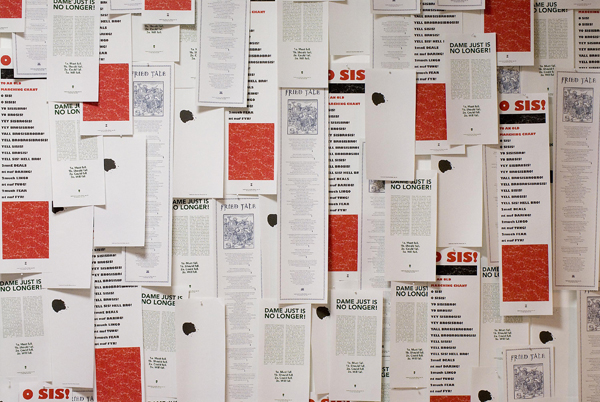
Here (right) is the gallery’s photograph showing a detail of the wall of broadsides that Caroline Bergvall had written and published for the show.

The closing event on  23 October was chaired by Claire MacDonald who also gave a presentation, as did Caroline, Gabriel Gbadamosi and myself.

Claire sent some preparatory thoughts to speakers, which talked about Caroline’s (and our suggested) engagements with the voice and voices through a number of parameters: diversity, the ‘reworking and renewal of the positions from which we speak, the registers and technologies through which we speak, and a cross-fertilization of forms between print, sound and the visual,’ and a questioning of what it means to, ‘push the boundaries of language.’

Presentations were necessarily brief. I chose to pick up some themes that I wrote about on this blog back in July of this year, in relation to my novel Foxy-T and the poetry of Linton Kwesi Johnson. I wanted to link these also to Ivy4Evr, my collaboration with Blast Theory for Channel 4, by focusing on a quite slight yet particular genre of response that emerged in common to all three and which can be described as a projected fantasy of exclusion.

Since notes for a slide show might form a particular mode of writing and a type of ‘reading environment’ in themselves, I wondered if there might be value in sharing those notes in their raw form, as a companion piece to the presentation itself. Here, then, is a quick edit of the notes that I made for my presentation at the John Hansard Gallery, together with screengrabs of some of the slides.

Slide 1

  • 3 key points about Foxy-T? Ephemeral economies; an empty shop unit in a moment of flux (sweatshop, internet shop or gallery); rupture with the identity politics of the 1970s and ’80s.
  • Linton Kwesi Johnson
  • Exemplified: use of the word ‘Rasta’
  • Caroline’s comment about ‘writing that is aware of its history’; the Black Atlantic in London.
  • Read page 1 of Foxy-T
  • Intro audio: excuse quality. R4 Today Programme; A-Level results day 19 August 2004; 08:10 feature on declining standards; interview with David Milliband then brought me on to defend those declining standards?
  • My interview curiously absent from the Today Programme‘s otherwise exhaustive Listen Again archive – here’s a home-made copy from audio cassette.
  • Play audio from 2:35 to 4:05
  • In case you missed that, Ed Stourton just said: ‘Mind you it is important that we all understand it, isn’t it. [reads excerpt] It’s getting quite close to the edge that, where some of us are going to be excluded, excluded from the book because we don’t understand the language.’
  • The voice of a powerful institution — invocation of a normative majority, ‘us’, for whom Ed Stourton was claiming to speak.
  • Reversal of the then current cultural and social policy language of social exclusion.
  • Who is this ‘us’ that is being excluded?

Slide 2

  • Talking of LKJ: interesting echo
  • Play DVD from start of Chapter 4 i.e. 6:49 to 9:09
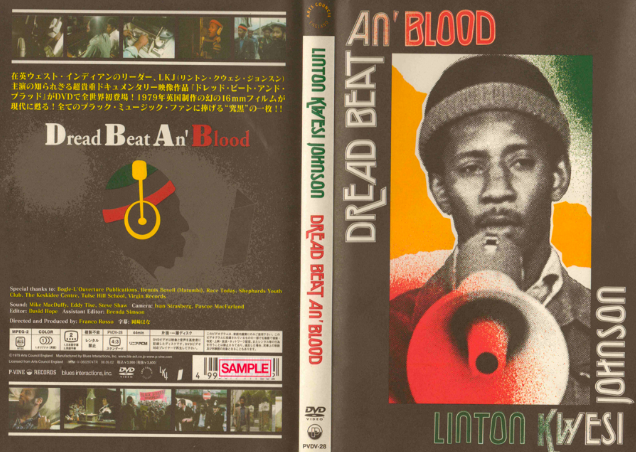
  • Intro over musical interlude/Brixton market scene: An extract of the documentary Dread, Beat an’ Blood, dir. Franco Rosso for the Arts Council (Arts Council Film Collection).
  • This is from a Japanese DVD but you can get this bundled as a DVD extra in some editions of Rosso’s 1980 feature film Babylon. Well worth getting hold of.
  • Radio studio reading into interview.
  • In case you didn’t hear that: ‘It’s not really for my ears, is it?’
  • N.B. Relationship between poetry/writing and activism — as Caroline said, ‘music as a form of resistance’ — what LKJ called BASS CULTURE (B.A.S.S.)

Slide 3

  • Ivy4Evr — interactive SMS drama for Channel 4 — Blast Theory — written by me.
  • PILOT transmitted October 2010 — ran through one week in REAL TIME.
  • Reasons for SMS: young people no smart phones, rubbish phones but always on.
  • NOT in so-called text speak “L8r” etc/ despite press clichés. Because our research showed that young people don’t use it.
  • BUT use: compression, different registers, tones of voice, colour, rhetorical devices, habitual misspellings — plus some hacker/web slang e.g. LOL — carried over into the script as a PATINA of typo’s and abbreviations.

Slide 4

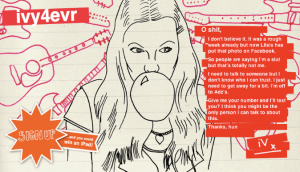
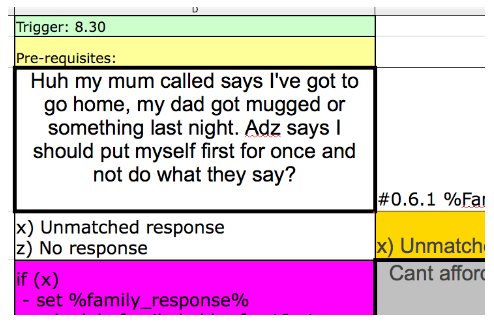
  • Quick few screengrabs from Ivy4Evr script illustrating some of this texture.
  • Again we saw projections of exclusion.
  • e.g. in the week before broadcast a single message went out as a trail, and tech blogger Topfife tweeted: ‘Just got an odd text message, then realised I signed up for C4’s SMS drama IVY4EVR. Very yoof.’
  • ‘Very yoof’? The offending msg? Not very ‘yoof’ at all —->

Slide 5

  • Ewan McLeod in Mobile Industry Review wrote, ‘The site explains that Ivy has left home because “Lilsis” (is that “Little Sister” or somebody else, who knows? I’m over 30) has “done the dirty on her”…’ [actually that’s not my writing but a phrase that emerged in early drafts of press releases etc and stuck, though it’s probably more archaic than contemporary?] ‘Again,’ McLeod continues, ‘forgive me for not quite knowing that definition […] I only point that out because I’m 30+ And I imagine you are too…’
  • So again, slight but unmistakeable (as with Ed Stourton on the Today Programme talking about Foxy-T, and the unnamed radio interviewer on Franco Rosso’s Dread, Beat an’ Blood): a projected fantasy of exclusion and a call to — or suggested complicity with — some imaginary majority. In this case those of us over 30.
  • Here are a few links —
  • Thank you —

§

Caroline Bergvall’s Middling English exhibition was both generous and generative, as were the closing events at John Hansard Gallery.  The conversations continued through the evening, of course, and on the train for those of us who travelled back together. An exhibition publication is promised and I’ll link to this when it becomes available; and similarly if further events emerge from these conversations.