Knowledge Commons #5 – If you can’t find it online, draw it

I’ve been working on a new short story commission which will be published in both ebook and print formats in early 2011, about which more information in due course.

For reasons that will become clear later, I’ve been trying to source a particular kind of lightning flash graphic which for something so familiar and — as I thought — ubiquitous was proving quite a challenge. I even found myself going to the laborious lengths of grabbing, flipping and rotating various dingbats and ‘special characters’ only to find that they were simply not quite right, not to mention that the results were too low-res to be of any real use.

It was only when I’d wasted loads of time on these fruitless attempts to approximate something digitally that I thought, well maybe I should simply try and draw it.

This scan is of my first attempt, which is a bit wonky here and there because the wood grain of the kitchen table showed through the paper that I was leaning on, but it’s still far better than anything I could find online or adapt from any existing image or font resource. It is also certainly good enough to reduce and use as an ornament in the print edition.

‘If you can’t find it online, draw it,’ I thought, without quite realising until later that the reason this formulation sounded slightly familiar was that I was paraphrasing the title of a track from Laurie Anderson‘s 1983 performance of United States I-IV: a piece — I just looked it up — for tape and cartoons dedicated to Ludwig Wittgenstein and called ‘If You Can’t Talk About It, Point To It.’

Not so obscure as it sounds. Those performances were quite a big deal at the time. Anderson had just had a huge hit in the UK with ‘O Superman’, and her epic performances over two nights of the 8-hour United States I-IV were promoted by the ICA at the Dominion Theatre, London in February 1983. I went along. Here is a scan of the programme. It has probably survived the years so relatively unscathed because I stored it inside a record sleeve.

There was a great kind of home-made quality to Anderson’s work up to and including this period, even when she was using or ‘talking about’ technology (in as far as she ever really talked ‘about’ anything directly, which would be almost never; prefering as she did to tell oblique stories). This home-made quality very quickly disappeared though as her studio recordings went mainstream, only to be replaced for a while with what felt, feels, to me like an instantly kitsch, almost generic NY arthouse hi-life style; cue what seemed at the time to be the inevitable Adrian Belew guitar solo (impossible to better after this highpoint). Via the music- and art-press interviews and features accompanying her hit single ‘O Superman’ and those performances of United States I-IV, it had been Anderson’s references that had switched my teenaged self on to writers like Gertrude Stein and Thomas Pynchon, but by the time she returned to the Dominion Theatre in 1990 for the ‘Empty Places tour’ it seemed that the same old anecdotes were being trotted out in every interview (albeit to audiences that were never anything less than appreciative). Strange to say perhaps, since the recitation of anecdotes was a big part of her work, but it all started to feel a bit repetitive.

If you don’t know it, ‘If You Can’t Talk About It, Point To It’ is a short and very slight instrumental — almost like a sketchbook piece, which I mean in a good way — in which a small number of taped voice ‘samples’ are effectively sequenced to form a few seconds of shrugging, breathy funk which has both the reduced range and the percussive quality of an instrument like an mbira. It is odd to be reminded of and writing about a piece of music that was insubstantial even 30 years ago, but since I am, I suppose it is worth registering that the title is also an obvious Wittgenstein gag i.e. you don’t have to pass over in silence what you can’t talk about, you can also point to it.

Maybe I am also picking up on some media traffic following Anderson’s use of an appearance on US TV show Letterman a couple of weeks ago precisely to point at something, in this case the Gulf oil spill disaster, through a topical rewrite of her recent song ‘Only An Expert’. (Something that a number of UK artists have been doing recently too, by contrasting, for example, BP’s activities in the Gulf of Mexico with the company’s domestic sponsorship of the arts, particularly through the Liberate Tate movement.)

A .png of the Art Not Oil website

There is a nice quote in the programme accompanying those 1983 United States I-IV performances. ‘In this work,’ Anderson writes:

‘I have tried to make a distinction between art and ideas. Because ideas have a direct line to the brain; but art sneaks in through the senses. It drifts in. So there isn’t time to analyze it…’

It is a bit of dialectical whimsy which seems to fall somewhere along the same spectrum as her distinction after Wittgenstein between talking about something and pointing to it.

It is interesting looking at a significant and monumental art work like United States I-IV across the digital event horizon; looking back to those pre-internet, analogue days. There’s a prophetic line in her Burroughs homage, the song ‘Language is a Virus’ (or at least there is in the the United States I-IV-era live version of the song; it is missing from the overproduced and nonsensically cheery version on her album Home of the Brave). In the former Anderson tells of attending a science lecture. ‘So I walked in,’ she writes, ‘and there were all these salesmen and a big pile of electronics […] And they were singing: We’re gonna link you up […] We’ve got your number.’ Which, I suppose, they did and they have.

‘Picture a Christmas tree,’ they tell her, ‘with lots of little sparkly lights.’

So now that we are all ‘sort of hanging off the same wire‘ and I often find that even when I’m working, writing stories, much of my time is spent doing little more than simply pointing at stuff (albeit sometimes clicking, too), does that distinction between talking about it or pointing to it, between ideas and art, still hold? Or does the pervasiveness and the myriad ubiquity of information and media mean that it is ideas and information that sneak in ‘through the senses’, while art has the more direct line? It certainly felt that way when out of exasperation I drew this lightning flash and a couple of others for the cover of a forthcoming short story.


Foxy-T archive #3 – ‘street talk’ scare stories

Earlier this week Andrew Gallix of 3am Magazine tweeted the Guardian‘s coverage of a pamphlet published by right-wing thinktank the Centre for Policy Studies on literacy in primary education, written by Miriam Gross, backed by the current Conservative Mayor of London Boris Johnson and called So Why Can’t They Read? Coverage in the Guardian hinges — as their headline suggests — on the supposed finding that ‘street’ talk is, brace yourself, breeding illiteracy (my italics).

Aside from the questionable vocabulary of that headline, the wider story rang a bell for obvious reasons. Not least that when my novel Foxy-T was published by Faber and Faber in 2003 it was criticised for using the language that I was hearing all around me in east London at the time—what a few years later would become known as Multicultural London English, or MLE—where white, Asian and other mainly (but not exclusively) young people were adopting or hybridising Black British language and in so doing were disrupting what had been the very necessary identity politics of the preceding decades: a disruption typified for me by young Bangladeshi rudeboys calling each other ‘Rasta’ and most easily illustrated by the fact that it became impossible to determine the ethnicity of an unseen speaker (e.g. someone sitting behind you on the bus) by the sound of their voice. It had seemed to me that if with Foxy-T I was trying to map the ephemeral economies of Cannon Street Road, London E1, then this most ephemeral economy — spoken language – would need to be central to that. It would have been impossible to write the novel in any other way.

Where those identity politics of the 1970s intersect most productively with literature is in the poetry of Linton Kwesi Johnson, the importance of whose work cannot I think be overestimated.

A couple of years ago I was invited to Goldsmiths for an event called African Consciousness, Reggae and the Diaspora, which was to be a conversation illustrated — if that is the word — with music; a conversation between the influential critic and theorist Paul Gilroy and Linton Kwesi Johnson. (I notice that there is a more recent solo Lecture by LKJ on African Consciousness in Reggae Music, to which these are the opening notes.) That evening at Goldsmiths got off to a great start but after what could only have been about 15 minutes the alarm went off, as well it might if Gross’s pamphlet is anything to go by because it seems that this is still dangerous stuff. We all had to shuffle back out into the autumn dark, which took a while because the place was absolutely rammed. You might think that whichever University authority it was would have been able to simply turn the alarm off and then invite us back in again to continue with this all-too-rare opportunity to hear both Gilroy and LKJ speaking relatively informally and in intimate surroundings, but for whatever reason this wasn’t possible.

There is a telling scene near the beginning of Franco Rosso’s excellent 1978 Arts Council documentary about LKJ (which a few years ago was released on DVD in Japan and seems to also come bundled with some DVD editions of Rosso’s more well-known feature Babylon). About 8-minutes in, he is being interviewed by a young female radio journalist who responds to a short recitation by telling him (in the received pronunciation of the time which would of course have been essential for any woman wanting to work in broadcasting and which now sounds more anachronistic than particularly posh or patronising): ‘I started to understand that about halfway through, but it’s not really for my ears, is it.’

It is strange to see such exercisings of power being rehearsed again now though. Or perhaps given the certain Tory tendency for stigmatisation of marginal and disempowered groups it’s simply to be expected. It is strange, too, having to get used to a new generation of obnoxious Tory ministers getting on the Today programme and trying to ‘feed us a burger‘ about this or that.

Maybe I was reading this a bit too closely but I don’t think so. I couldn’t be sure, initially, whether it was the Guardian or the CPS that had made the poor decision to attribute (and pejoratively) the anthropomorphic action of ‘breeding’ to what is after all a linguistic abstraction, and to do so within a discussion about the impacts of migration. In fact I was slightly relieved to see that the word occurs neither in the press release or the pamphlet. Boris Johnson’s introduction describes an ‘epidemic’ of illiteracy among Londoners, while Gross’s own use of language is more measured.

But just because the Guardian‘s headline arguably made the story sound more racist than it is, doesn’t mean that it is not a strange and to me slightly odious piece of work. Any young person or parent who has endured SATS and league tables will groan to read Gross’s bizarre (indeed her main) recommendation of a spectacle that would corral teachers and pupils into some vast annual reading competition designed with the sole purpose – it would seem –  of proving ‘once and for all’ (and year after year, depending which bit you read) that her preferred ‘Synthetic Phonics’ system is the best for the teaching of reading skills.

It would be hard to conceive a more monumental and coercive waste of time.

The pamphlet has a familiar and authoritative journalistic (i.e. unscientific) tone. Gross cites various anonymous sources throughout, such as ‘a young graduate’, ‘one experienced teacher’, or ‘many teachers’. While ‘anecdotal evidence’ is invoked to support generalisations such as this one on page 6: ‘the proportion of school leavers who can’t form sentences coherently is alarmingly high.’

Named sources cited extensively include Shahed Ahmed, the head teacher of Elmhurst Primary School of Forest Gate, London E7, and Avril Newman, head teacher of the Sir William Burroughs [sic.] primary school… Huh? Do they teach ‘the cut-up technique‘ there, I wonder?

I love the fact that such a glaring typo (and one that is so easy to fact-check and proof) as this supposed ‘William Burroughs’ Primary School should occur three times in a document from a Tory thinktank about falling standards of literacy. Is ‘street’ talk perhaps undermining the standards of proofreading, too?

Surprisingly, given that e.g. Guardian coverage of Gross’s pamphlet has focused on this assertion about ‘street talk’ producing illiteracy, the subject takes up little space in the book, forming as it does the tail-end of a poorly organised chapter entitled ‘Immigration’ (poorly organised not least because it includes a discussion of dyslexia that doesn’t relate to immigration at all and might have more logically been included in the previous chapter). The chapter peters out with an unpleasant and particularly unnecessary stigmatisation of what Gross calls ‘Barbadian patois’ before finally giving up the ghost when she adopts a gratingly sympathetic tone to speak for ‘these pupils’ (whoever ‘they’ are):

There is another language issue which is rarely mentioned: “Street” English, the argot in which children – both white and non-white – who live in the poorer areas of inner cities often speak to each other. This language contains a mix of various ethnic influences – Caribbean, Cockney, Afro-American, Indian and others. Like dialects and slang in other countries, “Street” has its own grammar, its own vocabulary and its own pronunciation.

[Primary school teachers] encourage children to read poems and stories written in ethnic dialects – in Barbadian patois for example – which is fine, but they omit to point out that there are linguistic discrepancies.

Only later, when they get to secondary school, do these pupils discover that “Street” is not acceptable in their written work. Understandably, they find this both confusing and discouraging.

So, clearly, in the absence as it is presented here of any evidence whatsoever to back it up, Gross’s assertion reads like opinion presented as fact. However, the very absence of references or qualifications to break them up makes these few sentences more easily reproducible (and thus perhaps more conducive to press coverage) than other parts of the text. Almost incredibly, Daily Hate coverage (which I am not linking to) ignores the provocation altogether.

Actually of course the spectre of mass illiteracy and falling standards is raised every summer, ‘street talk’ scare story or not, because August brings with it the GCSE and A-level results.

Back in 2004, when the paperback of Foxy-T was published, I had a call from Radio 4’s Today programme, or actually a fax: they tracked me down to a hotel room in Tallinn, Estonia where I was attending the ISEA 2004 digital arts and electronic media festival (festival programme here). As part of their coverage of the next day’s A-level results they would be interviewing the then Schools Minister David Milliband and others about supposed falling standards in secondary education, after which they would turn to me to talk about Foxy-T. Great. During the interview, the co-anchor Ed Stourton gamely read a section of my novel aloud before asking whether by using such contemporary language I was in fact excluding ‘some of us’.

For some reason the Today programme’s sound archive which includes every programme broadcast since 2003, is missing this section, which is listed here at 08:20 on 19 August 2004. However I do own a low quality cassette recording of the interview which I have digitised and am making available now (with only mild apologies for the background noise and hiss) since part of the purpose of this site is to make archive materials available, and a poor quality recording is generally preferable to no recording at all.

The first two minutes or so of the segment feature writer Alec Hamilton talking about Henry W. Fowler of Fowler’s Modern Usage fame. Around 47-seconds in you will hear a slight rattle as might be produced for example if a china coffee cup were set down in some immediately regretted moment of absent-mindedness onto a glass-topped coffee table in a former Soviet sphere Baltic hotel room. There is one small victory in there too, in that I was able to say, uncontested, on the Today programme that Linton Kwesi Johnson is one of the most important British writers of the last 40 years. I still don’t know quite why I said that, because I think he is possibly the most important British writer of the last 50.

Two sevens clash

Five years ago today I was due to meet a then colleague at Paddington Station by 09:00 and travel by train to Swindon for a meeting. When I got to Waterloo and made my way down the escalator to the Bakerloo Line I discovered that it was ‘down’; not working. I think it was the Bakerloo Line. One of them wasn’t working. What would I have done? I’d have thought about walking to the Jubilee Line platforms, picking up a Stanmore train there and changing to a west-bound Hammersmith and City or Circle Line train when I hit Baker Street, but it probably would have seemed too long a walk so what I did was hop on a northbound Northern Line and instead of going straight up to Warren Street and then switching via that short walk at street level to the Circle Line at Euston Square I got off at Embankment and changed platforms to pick up a clockwise Circle Line train that would take me slowly but surely to Paddington via South Ken. Such are the instant computations and adjustments made by any tube traveller; decisions made almost beneath the threshold of conscious thought. At 08:50 the train stopped in the tunnel some distance short of Bayswater tube station. A few minutes later there was an announcement blaming an electrical surge elsewhere on the network for the delay.

Because we were underground there was no mobile signal, so no communication in or out. Minutes ticked by and I missed my friend, my train and my meeting. One hour passed; people were very calm and just chatted or read their books and newspapers. Two hours. There may have been one or two further announcements, but no new information until getting on for 11:00 when we were told that we would have to leave the train – I think they said that we would be ‘de-trained’ one carriage at a time – and be led along the tracks to the nearest station, Bayswater.

Soon it was the turn of our carriage and as our single file of passengers neared the train driver’s cab through which we were due to exit, I remembered that my then still new-ish mobile phone had a simple video camera and enough memory to shoot a few second’s worth of video at a time. ‘How cool! What are the chances?’ I thought, realising that I would be able to get rare footage of our walk along the Circle Line’s tunnel, through which — as with many of the shallower, cut-and-cover style tunnels around the London Underground network — run both the clockwise and anticlockwise tracks. I shot as many bursts of video as I could, the first of which was logged on the phone as being taken at 11:13, or two hours and twenty-three minutes after the train had been halted in the tunnel. At one point we emerged into the daylight of the brick-sided Moscow Road cutting.

Here is the video. I don’t think I even showed it to anyone for about a year. We’d been out of harm’s way after all and such images had become instantly commonplace, but then recently I needed to migrate photo and video files off that old phone so thought I should edit it together.

When we reached street level and were in range of a mobile signal once more I found a new SMS in my phone’s inbox. It was from S asking if I was OK. How strange, I thought, when she could have had no way of knowing that I had been stuck in a tunnel for nearly two and a half hours!

I remember a fleeting impression of a science fiction-style scene of abandoned or stationary buses parked on a Queensway that was curiously free of motor traffic. Puzzled, I went into a shop where I was told the still only partially correct news that there were bombs on buses.

More voicemail and SMS messages came through much later, including from my friend who had reached Paddington before 08:50 when the first bombs had gone off at Aldgate and — more relevant to us — Edgware Road stations, and safely caught the train to Swindon before the lockdown of travel to and from London rail terminals.

Mobile networks were down, too, by this time, overloaded or jammed, so like everyone else — everyone, that is, apart from the four bombers, the 52 innocent people they killed and the nearly 800 injured — I continued walking, in the direction of home.

Creative Commons License
Circle Line, London by Tony White is licensed under a Creative Commons Attribution-NonCommercial-ShareAlike 3.0 Unported License.

Book Club Boutique

© Gaynor Perry, 2010

I was very pleased to be asked to do another reading for the Book Club Boutique at the weekend. I didn’t need much persuading. Since this regular Soho literary night was founded by poet Salena Godden and editor Rachel Rayner at the beginning of 2009 it seems to have gone from strength to strength.

Where many in the book trade seem to use Twitter to spam followers with witless promo dressed up as reader competitions and the like, the Book Club Boutique set a standard early on for using social networks (especially Facebook and Twitter) to create a real community around their events. Last summer they worked with James Bridle and Newspaper Club to produce a Book Club Boutique freesheet to give away at festivals through the summer. There’s always a great kind of energy around what they do, and there are always big audiences with a real appetite for literature; as I suppose is symbolised by the gaping mouth of their logo.

I last read for them back in the spring of 2009, when I invited a number of writers (Lana Citron, Matthew De Abaitua, Mark Waugh and Will Ashon – who has just released the story he read on that night as an ebook) to join me for a London Short Story Night. It was great fun.

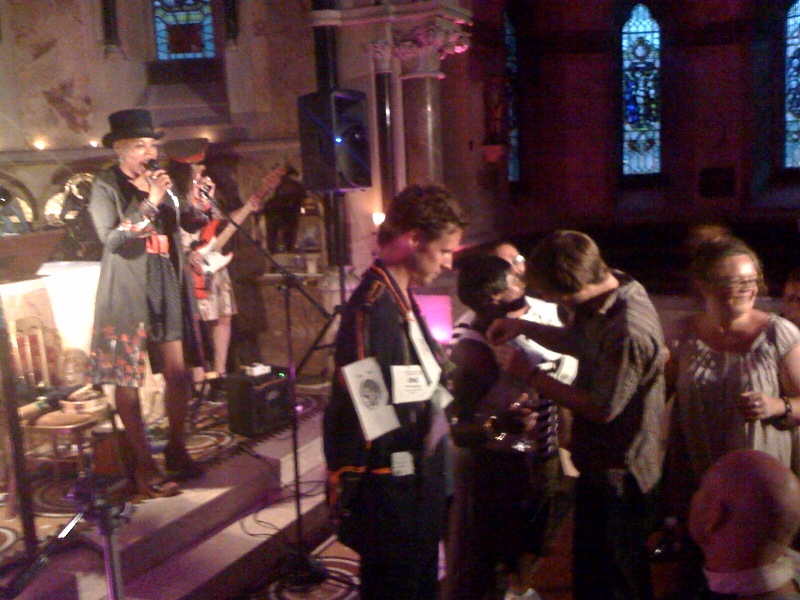
This latest event, held in the church adjacent to pop-up members club Quintessentially Soho at the House of St Barnabas in Greek Street, was billed (like the Book Club Boutique itself) as the marriage of books, booze and boogie woogie. Other readers included Melissa Mann, the mighty Malcolm Bennett, Stuart Evers and many more. MC Salena Godden was in Generalissimo guise to preside over a mock wedding between books, booze etc, or their proxies i.e. volunteers from the audience, including Graffiti My Soul author Niven Govinden as ‘books’. Here is a typically artless picture that I took with my mobile during the ‘service’ as singer Lisa Lore serenaded the happy trio and audience members queued to pin ‘money’ to them.

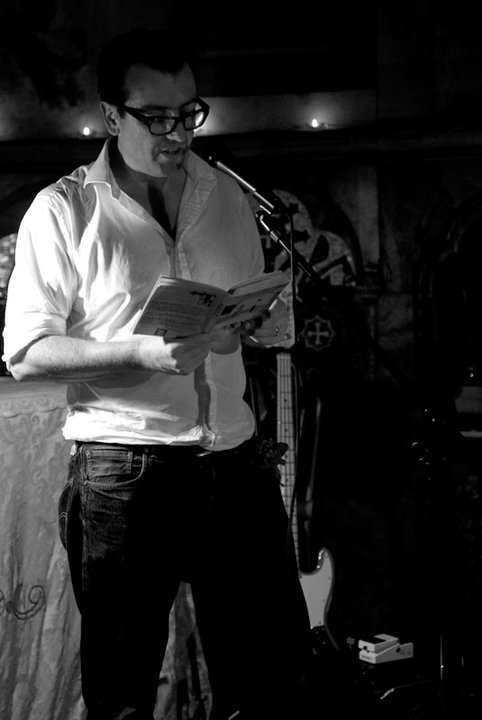
Luckily, the photographer Gaynor Perry was also there. Gaynor took some great shots of various writers in action on the night, which she has added to the Boutique’s photo album on Facebook. A couple of them are of me, including this rather good B&W which she has kindly allowed me to reproduce here. Thank you Gaynor.

Free University #2

This improvised sign was the doorstep of the Artist Liaison office (i.e. Portakabin) and backstage door for bands performing on The Park stage at Glastonbury festival. It made me think of the artist Bob and Roberta Smith.

On the train down to Castle Cary I’d read John Harris’s excellent article on Ian Hunter’s Diary of Mott the Hoople in the Guardian Review (which I’d recommend), so maybe I was primed to enjoy a bit of backstage scruffiness.

I was there to do a ‘lecture’ at the Free University of Glastonbury, ‘the festival’s very own literary tent’ as the blurb said, which was put together by our affable-unflappable host Mathew Clayton ably assisted by the equally unflappable Kal. It was great fun and I’m really pleased that I was invited to participate. Other speakers included Idler editor Tom Hodgkinson, Matthew De Abaitua, Peter Hook and Rob Chapman, author of this summer’s brilliant Syd Barrett: A Very Irregular Head.

Also sharing the bill with me on Sunday was Hamish Skermer, who this year was piloting a sustainable, well designed and user-friendly composting toilet design at various locations around the festival. Hamish had only recently returned from Haiti where he’s been working on similar initiatives to replace an infrastructure that was strained even before the terrible recent earthquake. Hamish has been teaching people to rebuild more sustainable sanitary facilities for the more than two million internally displaced people forced to live in improvised settlements across the country. He is an inspiring man who can and does talk about shit for hours, here is a link to his website Natural Event.

My presentation included a reading from ‘Albertopolis Disparu’, a story that I wrote for the Science Museum during my stint as writer in residence, and which they published as a free give away last year on their vintage imprint A Science Museum Booklet which we had resurrected for the purpose.

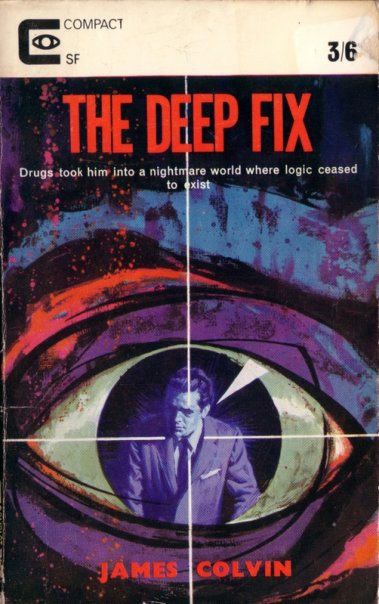
‘Albertopolis Disparu’ uses the science fiction and fantasy staple of the found manuscript to invoke an apparently lost work by Michael Moorcock pseudonym James Colvin called Terminal Session. The story riffs on Moorcock’s work with legendary space rock band Hawkwind, particularly the Moorcock-penned spoken word civil defence parody ‘Sonic Attack’. It’s the latest in a series of (authorised) stories I’ve been writing since around 1999 which create a kind of commentary or correspondence-by-fiction with Michael Moorcock and his works.

I was down at Glastonbury with my 18 year old son, and the night before my gig for the Free University he stumbled upon Nick Turner’s Space Ritual setting up for their gig in the intimate Rabbit Hole stage. I’m glad he did because it was this stage rather than the Pyramid which seemed to be the psychic centre of this year’s festival running as it was a series of acts that reflected the festival’s 40 year history.

Space Ritual was by far the best gig I saw all weekend, and I’d imagine that the other hundred or so people in the Rabbit Hole would agree. J and I had been watching George Clinton with Parliament/Funkadelic (as the billing put it) on one of the larger outdoor stages, where their energy was dissipating slightly, so the idea of catching a good Space Ritual line up was enough to see us abandoning the last half of Clinton’s set with a shrug and racing back to the Rabbit Hole as fast as we could. But from Clinton’s opener Maggot Brain to Nick Turner’s Brain Storm does seem like a logical psychedelic progression: space funk to space rock.

Space Ritual members vary but the line up for this Rabbit Hole gig was the principal members listed on wikipedia (so apart from Jerry Richards, Chris Purdon and Miss Angel, if you’d seen Hawkwind at Glastonbury in 1970 you’d have seen this lot):

  • Nik Turner – vocals, sax, flute (Hawkwind 1969-77, 1982-84)
  • Mick Slattery – lead guitar, vocals (Hawkwind 1969-70)
  • Thomas Crimble – keyboards (Hawkwind 1970-71)
  • Jerry Richards – bass guitar (Hawkwind guitarist 1995-2001)
  • Terry Ollis – drums, percussion (Hawkwind 1969-72)
  • Chris Purdon (a.k.a. Chris Mekon) – audio generators, FX, analogue synths
  • Miss Angel – Dancer

I should have tried to get hold of the set list to reproduce here, but it included various Moorcock era tracks including ‘Sonic Attack’, also ‘Ritual of the Ravaged Earth’, ‘Otherworld’, ‘Walking Backwards’, ‘Brain Storm’, ‘Sonic Savages’ and many more. The gig was energising, exhilarating and an absolute tour de force, and if on that other stage Parliament/Funkadelic were struggling slightly to invoke the Mothership, Space Ritual drove that mother into the ground.

To be continued…


Free University of Glastonbury

I’ll performing be at the Free University of Glastonbury at 12:15 this coming Sunday lunchtime. Here is the blurb and a link to information about the excellent line-up, location, times etc:

The Free University of Glastonbury, the Festival’s very own literary tent, returns for a second year after making its debut in 2009. Based in HMS Sweet Charity in the Park it throws opens it doors again for a mind expanding series of lunchtime talks featuring some of the UK’s leading writers and free thinkers.

There’s a Facebook group (as you might expect), and I just saw this great new image on there which could be a banner or a bumper sticker or both :-)

There have been other Free Universities of course. The artist Joseph Beuys founded the Free International University from his studio in 1973 (or 1972), while much more recently London’s Resonance 104.4 FM offered a Free University of the Airwaves through the summer of 2008. Many of the specially commissioned programmes that were part of that Free University of the Airwaves are still available as podcasts.

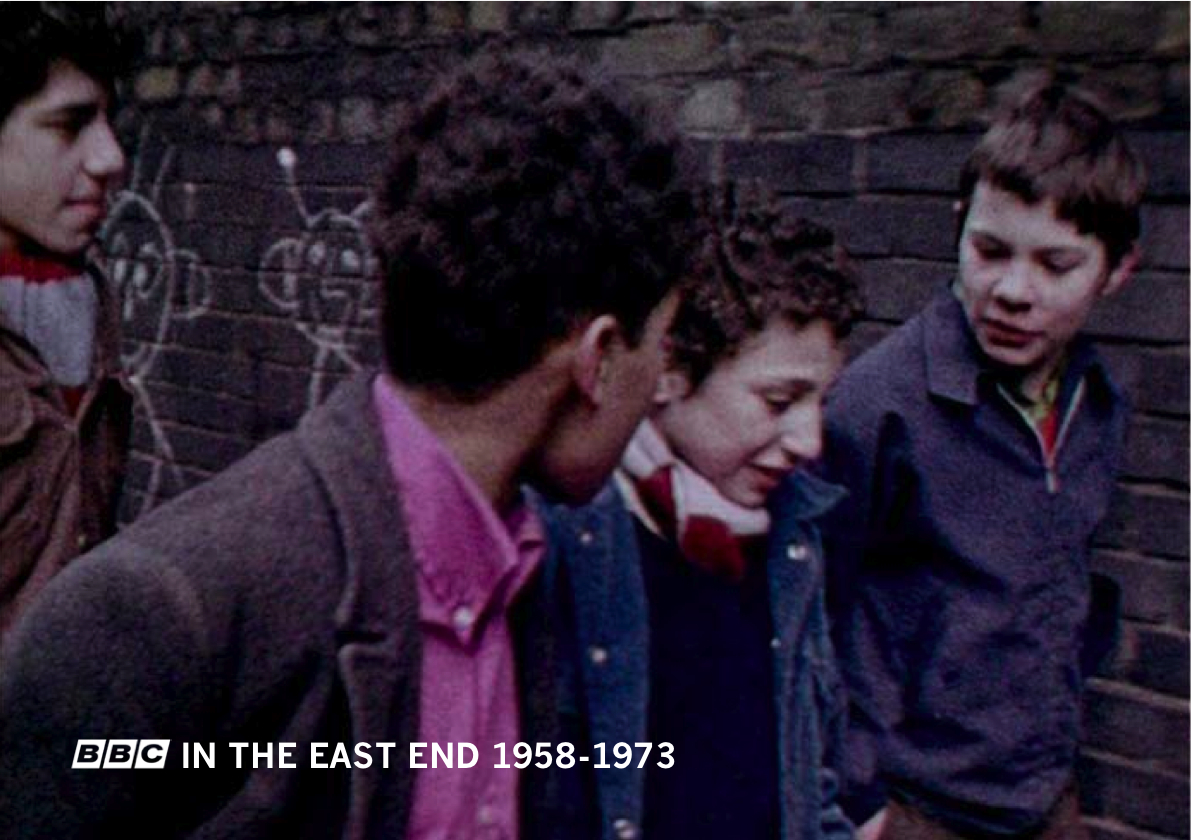
Chris Dorley-Brown’s excellent 2007 project BBC in the East End (reviewed here for Frieze by Michael Bracewell) uncovered some amazing BBC news footage of the Anti-University that was set up at 49 Rivington Street, London in 1968, by Allen Krebs, David Cooper and others. The Anti-University was located directly over the road from a very dingy-looking but instantly recognisable Bricklayers Arms, and the footage includes John Latham and others.

I can’t offer a Youtube link, but the Anti-University news report is available to watch free on the truly amazing BBC in the East End 2-DVD set that is available for free loan at Whitechapel Idea Store, London E1. I can’t stress highly enough that this is absolutely recommended viewing for anyone looking for ultra rare footage of the capital.

I should declare a two-fold interest in that I collaborated with colleagues at the BBC, the Arts Council and the BFI to set up Chris’s residency in the BBC Archives and, secondly, I don’t know if there are any copies left but when this DVD was launched library users who borrowed it got a free-to-keep copy of an illustrated BBC in the East End booklet to which I had contributed a short work of prose. There’s very much more to say about Chris’s project, but I’ll keep it to a plug for the Anti-University footage for now… See you at Glastonbury.

Books and the City

Stewart Home, Blood Rites of the Bourgeoisie, p.62 (invitation reverse).

Happy Bloomsday.

A few days after J.G.Ballard’s archive was given to the British Library, I went to the excellent Cafe Oto in Dalston for the launch of the three latest titles in the Semina series that’s been edited for Book Works by Stewart Home.

I’m still partway through and enjoying Stewart’s own contribution to the series, Blood Rites of the Bourgeoisie (read more about the book here) but I also liked the fact that invitations to the Cafe Oto event were stamped on to leaves torn from the book. I received pages 61-62.

Sections of the book seem to have been produced by appropriating text from spam emails about things like penis enlargement and substituting the ‘generic references to girls, women and ladies’ therein with the names of women artists. The passage reproduced on page 62 here ‘explains’ such a process.

And actually this kind of substitution is a literary strategy that I would usually describe as Ballardian, refering readers to a prime example of it in Ballard’s short story ‘Jane Fonda’s Augmentation Mammoplasty’ which was published in the 1989 anthology Semiotext(e) SF.

So from a writer, Ballard, who as this New Statesman review from 2001 puts it ‘examined the impact of technology on human desire’, to Stewart Home’s exploration of the role of women in the art world and of the impact of technology on writing, to the rather more prosaic topic of the day in publishing circles, the impact of technology on books and publishing. Stewart and I contributed to this ongoing discussion by taking part in a public event at Westminster Reference Library a couple of weeks ago, together with Gavin Everall of Book Works.

Gavin and I had stepped in at short notice because someone else dropped out. The event was called ‘Literature 2.0: Book Now For the Future‘ and the conversation was interesting and well-attended. We should have recorded it, but didn’t.

I started things off with a quick reading from my novel Foxy-T to give people who haven’t read it an idea of what I do. A few minutes earlier as we’d waited for the audience to settle in to their seats, I asked Stewart if he was going to read from Blood Rites…, and he said, ‘No, I haven’t really memorised it yet.’ (For those who haven’t been to any of Stewart Home’s readings they are a tour de force and notable for not being ‘readings’ at all; rather Stewart speaks the passages in question entirely from memory, without reference-to or presence-of a book. As happened this week at Cafe Oto, in fact.)

Westminster Reference Library is just off Leicester Square, and the timing of our event coincided with the televised mass media production surrounding the UK premiere of the shockingly bad film Sex and the City 2. Because it was a warm evening, the windows of the Library’s first floor event space were flung open so that our discussions about technology, free distribution, the Google book agreement or the finer points of publishing contracts were accompanied by the incessant screams and cheers of the several thousand Sex and the City fans gathered below. The sound rose and fell like waves crashing on to a beach.

The way that Sex and the City 2 choreographs its four central characters does not seem so different to the Ballardian substitution strategy deployed by Stewart Home in Blood Rites… In places it feels as if the names ‘Carrie’, ‘Miranda’, ‘Samantha’ and ‘Charlotte’ have been dropped in to a series of situations (including the UK sit-com and soap opera staple of the works outing or cast holiday) where little is demanded of them but the repetition of a very limited number of character-specific tics and a prolonged and infantilised cooing at any of the numerous displays of wealth and ostentation: overdubs must have been excruciating.

As is the film. Almost anything that was ever good, interesting or witty about the original HBO sit-com seems to have been stripped out and replaced by an endless posing of the question, ‘What shall we spend the money on?’

By the time our event in the Reference Library finished so had the one outside. The red carpet was gone. Stars and fans had been replaced by street sweepers and litter pickers. Crowd control barriers were being stacked on to lorries while technicians dismantled the various stages: the movie premiere’s industrial and class underpinnings were exposed.

Thinking about Ballard again and the film studios, airports and motorways that surround London, and thinking too about those Dalston streets around Cafe Oto, I remember that last year we were lucky enough to visit the set of Eastenders at the Elstree Studios complex. It was a private visit rather than a writing gig of any kind, and very exciting. In retrospect the timing was perfect. It should have come as no surprise, but I was still amazed by the extraordinary attention to detail that is brought to bear on that little maze of slightly smaller-than-life streets. One literary example: Pasted to a wall opposite the street entrance to the fictional Walford tube station — which at the time of our visit was shrouded in scaffolding and tarpaulin just like the stations of the real East London Line during its recent refurbishment — was a flyposter for the very real and then still quite recent event Hackney Adventures which featured Iain Sinclair and others. There was another poster for an event involving the artist Bob and Roberta Smith.

Since it is June 16, I will also say that at the time of our visit to the set, I noticed that one Eastenders character’s bookshelf contained not quite a copy of Ulysses itself, but of Clive Hart and David Hayman’s 1977 University of California publication James Joyce’s Ulysses: Critical Essays. Since I am writing this on Bloomsday that is close enough.

Visit over, we emerged and set off through the suburban streets that lay ‘in the shadow of the film studios’ (as Ballard says of Shepperton in this 1990 interview). Looking around and still feeling that slight psychic jolt where fiction meets reality, I remarked that after the hyper-real simulation of Walford, the town of Borehamwood didn’t look very realistic. It was a day-to-day observation that only felt uncanny later, when we got home and read the first news of J.G. Ballard’s death.

Blood Rites of the Bourgeoisie, by Stewart Home (2010) ISBN 978 1 906012 23 6—Price £8.00

Knowledge Commons #4: Trees were planted roots uppermost

In my recent research around accounts of the Inclosure movement in the Bournemouth and Poole area as part of the Digital Transformations project with artists Kevin Carter and Simon Yuill (which I have written about under this same ‘Knowledge Commons’ category elsewhere on the blog) I found a passage* which describes the practical, agricultural knowledge of those who were given many of the former commons to cultivate as being so poor that, ‘many of the trees were planted roots uppermost.’
Flailing Trees

It is a great image. I was reminded of this when I learned from artist Gustav Metzger at the weekend that what I’ve been referring to as his ‘trees piece’ — in fact, Flailing Trees, a public art work first seen in Manchester as part of that city’s festival during 2009 — is to be shown in Munich. Here’s some information about Flailing Trees from the Manchester Festival website (where there is also a short video):

Flailing Trees comprises 21 inverted willows, a subversion of the natural order that brings nature and the environment into sharp focus. With flourishing branches replaced by dying roots, the sculpture is both a plea for reflection and a plaintive cry for change, and is sure to provide a catalyst for debate.

I had been thinking of Gustav Metzger, Auto-destructive Art and the 1966 Destruction in Art Symposium while blogging about Anne Bean and Paul Burwell’s project for The Final Academy in 1982 in the previous post, where Anne discussed setting light to the sheets of paper bearing their/Paul’s poem ‘Adventures in the House of Memory’ during the performance of the piece.

After working with Gustav Metzger and UK director Ken McMullen on the Pioneers in Art and Science: Metzger DVD a few years ago I tracked down a second edition of Metzger’s 1965 publication AUTO-DESTRUCTIVE ART: Metzger at AA. Unlike the first edition, this 2nd printing from October 1965 is illustrated and includes a supplementary section entitled ‘Manifesto World’. The listing also mentioned that some additional papers were included.

Among these, pressed inside the back cover of the book, was the following document (below), an advanced notice of the Destruction in Art Symposium which was subsequently held in London in September 1966. This document seems to be a kind of press release or flyer, but it is expressly addressed to artists and potential participants, and constitutes an invitation from the DIAS Honorary Committee, ‘to all artists who have used actual destruction of materials as part of their technique.’ All such artists are invited to submit proposals or documentation for exhibition. It also invites ‘writers, psychologists, sociologists and others’ to propose 20-minute papers.

‘DIAS aims,’ the invitation continues, ‘to assemble the maximum amount of information on these new art forms and related topics, and to make this information freely available.’

Continuing this ethos, I am posting the document here:

DIAS flyer, from the collection of the author.

It may not be entirely clear from this scan, but the lower portion of the foolscap (I think, rather than A4) page upon which it is printed is missing. I can’t be sure what this portion of the page comprised, but the paper has been carefully torn along a dotted line. I’d be interested to know if any intact copies of this flyer/release still exist, and if so, what was beyond the dotted line?

*The Inclosure-era text I mention above is called Farmer West and Muscliffe Farm. It was written by ‘Christopher King as reported by the son of William West, tenant of Muscliffe during 1801-1804’. It was published as an appendix to William Mate’s Then & Now in 1883. A reference copy, in the form of local studies booklet No.612, is available in the Heritage Zone of Bournemouth Library. More on the local studies booklet series here.

Photograph of Flailing Trees © Spinneyhead 2009 on Flickr, licensed with Creative Commons Attribution-Non-commercial-Share-alike Generic 2.0.

Pioneers in Art and Science: Metzger (DVD, 2004, dir. Ken McMullen), is distributed by Concord Media and available for sale from their website £15.00.

CHARLIEUNCLENORFOLKTANGO archive #1

I just realised that it is about ten years since I last gave a reading in London from my novel CHARLIEUNCLENORFOLKTANGO, which was published by former Hove-based publisher Codex in 1999. I’ll be reading from the novel this week in the event I’m doing with Malcolm Bennett of Brute.

CHARLIEUNCLENORFOLKTANGO cover design Peter Pavement

The back cover blurb of the beautifully designed and published Codex edition describes CHARLIEUNCLE… (for short) as ‘a “stream-of-sentience” alien-abduction cop novel’. It grew out of a short story that I’d initially written for Stewart Home‘s Suspect Device anthology. By the time Stewart got back in touch to say that the story was a bit out of kilter with the rest of the collection, I’d written another 10 or so chapters: the story had become a novel.

From 1997 through publication and on to about 2000 or so I was reading from the novel quite regularly, often with a live, improvised musical accompaniment from keyboard player James T. Ford. A former Hammond organist to The Jam no less, Jamie would accompany the reading in the manner of a pianist at a silent movie, responding to the story on the hoof: it was great fun to do. We played various venues including Christopher Hewitt’s underground performance art venue Hollywood Leather, the ICA, Clerkenwell Literature Festival, the Zap Club in Brighton, Vox’n’Roll at Filthy McNasty’s and more. Jamie also accompanied my reading for the book launch in October 1999 at Cabinet, London.

Pre-publication, Codex had celebrated their list with an event at Sussex Arts Club, Brighton on 28 July 1999, where I was to join Steve Beard, Stewart Home and Billy Childish reading from our various forthcoming titles. The invite lists James T.Ford as my accompanist, but for some reason Jamie couldn’t make it so I did the reading with live improvised percussion from Billy Childish’s regular collaborator and Buff Medways drummer Wolf Howard.

During soundchecks Billy sat down and scribbled furiously, stopping only to chew his pencil or to ask me about replacement words used for particular letters in the radio-telephony ‘spelling alphabet’ that I’d used for the title of my novel.

During his set that evening, Billy announced a tribute to CHARLIEUNCLENORFOLKTANGO, which he duly performed before presenting me with the full text. Here is a scan (click on the title above to see the post and this image full-width):

'On the Buses: Tony White Tribute' © Billy Childish, 1999

Later that year I collaborated with another percussionist on a reading from CHARLIEUNCLE… This time it was the late, great and very sadly missed Paul Burwell, a co-founder of London Musicians’ Collective and of post-industrial noisescape and pyrotechnic artists Bow Gamelan.

Arriving at the venue (the former Penny Black pub on the corner of Exmouth Market), and thinking of how it had gone with Wolf, I suggested to Paul over a pint that he might want to start the accompaniment gently with some brushes on a snare drum and then take a lead from me so he could pick up the pace as the chapter, and the reading, progressed.

That was the plan anyway.

Paul lasted about 30 seconds with his brushes, if that, before chucking them away and pulling a mallet out of one pocket and a couple of drum sticks from the other then playing the function room’s walls, floor, fixtures and fittings at such a furious pace and volume that I had no choice but to follow, raising voice and tempo until it felt as if I was chasing him around the room. It was an exhilarating ride and my ten minute reading was over in about five, but I wouldn’t have had it any other way.

My reading on Wednesday will be unaccompanied :-)

§

‘And the book meets the table’*

Looking for some footage of Paul Burwell in action I found instead this rather beautiful live recording of ‘Hull Air’ a posthumous birthday tribute by Corona Smith et al, which sets to a new composition some archive recording of Paul’s drumming and an extract of a poem called *’Adventures in the House of Memory’ which I’ve seen credited to both Paul singly and Paul Burwell and Anne Bean jointly.

I emailed Anne to find out more about ‘Adventures in the House of Memory.’ At time of writing Anne is in Utrecht so was unable to check details, but she replies:

‘Adventures’ was a part of many improvisations Paul and I were trying out before William Burroughs Final Academy at [Brixton] Ritzy, 1982.  I improvised words and unusually for us, Paul suggested writing them down. He began from my improvisation but wrote most himself and pulled it into shape. We then wrote the words on huge pieces of paper which we burnt as they were sung. It was printed in the publication for the event.

(Screengrab taken from Brian E. Schottlaender’s fantastically comprehensive, 121 page, 2010-published Anything But Routine: A Selectively Annotated Bibliography of William S. Burroughs v.2.0)

CHARLIEUNCLENORFOLKTANGO is currently out of print but some copies are available from Abe Books.

I’m reading with Malcolm Bennett of Brute! on Wednesday 26 May, 7:00 pm, at 3 Blind Mice, Ravey Street, London EC2 (opposite the Griffin pub).

Anne Bean is currently working on a project for Matt’s Gallery, London for September 2010 which will include ‘much live work, that is neither a tribute nor a retrospective but a vibrant series of events and installations that highlight the times, ethos and context within which Paul [Burwell] worked.’

Half-naked and drunk out of their minds

I’m really pleased to see that Mark Eitzel and Simon Stephens‘ collaboration Marine Parade is having its world premiere as part of the Brighton Festival next week. Marine Parade is ‘a play with music’ set in a Brighton sea front B&B. There is more info on the Festival website here, including some free music and a concisely soapy blurb (‘…Claire needs more money than she’s ever owned. Christopher needs to see her one more time…’ etc.).

The play takes place ‘over the course of 24 hours at the edge of England at the start of its final century.’

That’s a nice line.

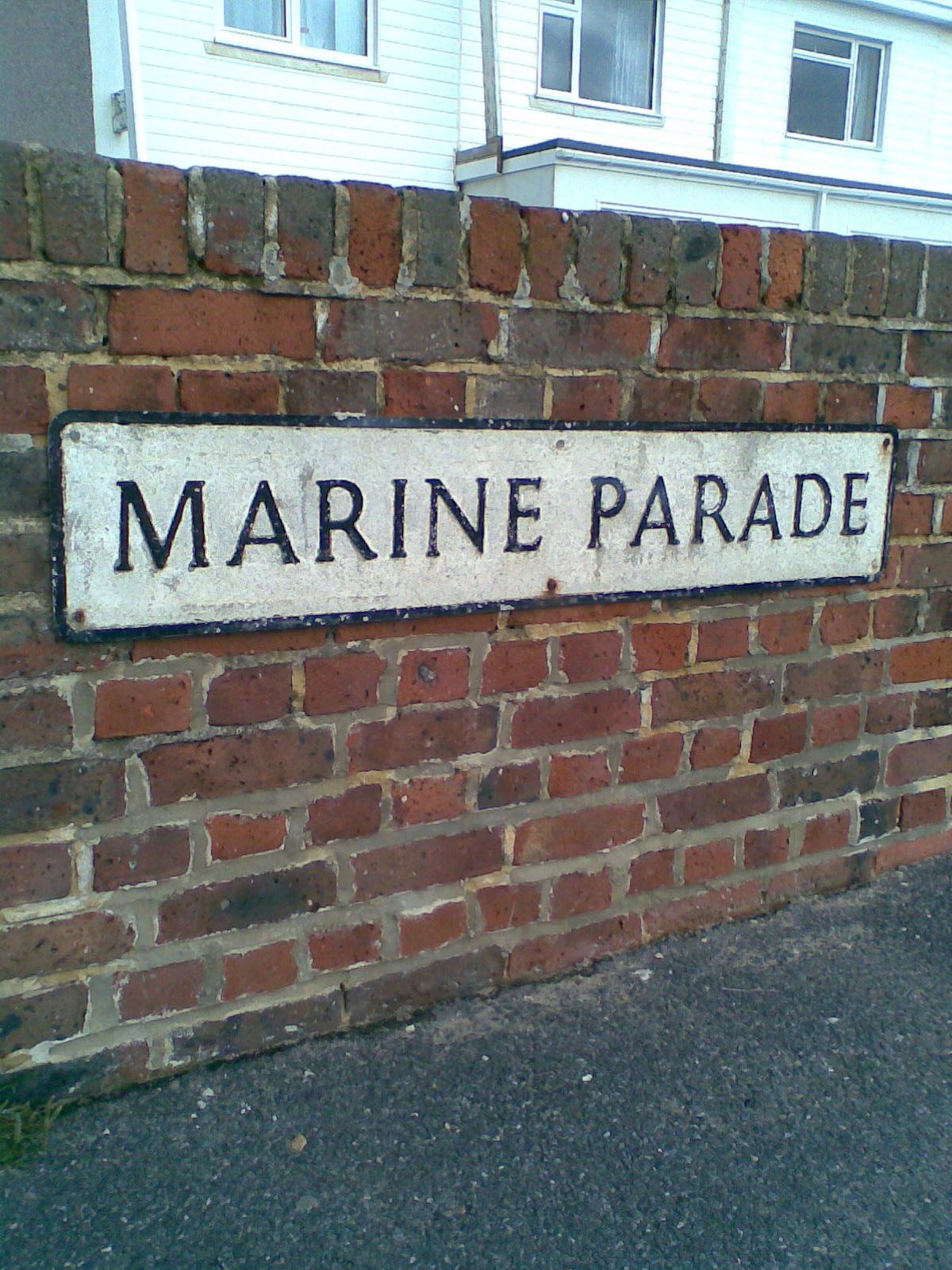
Another Marine Parade, this one in Seaford, East Sussex

I saw an early workshop version of Marine Parade a while ago while Mark Eitzel was in the UK and I’d just intereviewed him for the Idler. That showing was put together in a rehearsal space which was so shitty and rundown that its very survival in the heart of the west end gave me a kind of hope. I’ve been absent-mindedly following the play’s progress since then, via another batch of rehearsals and occasional catch-ups.

I’m a sucker for Mark’s music, whether with American Music Club or his solo stuff, so I could sit and watch this all night long, but Simon Stephens is also a brilliant playwright and I think that together they’ve done something really exciting.

At this point I’d love to put in a link to David Benedict’s rave review of Simon Stephens’ play Harper Regan for Variety, but their registration process is crap. If you can be bothered and you’re happy for a magazine to have all that personal data about you in return for fuck all the link is here, otherwise, google it and look at the cached version.

The title I ended up using for that Idler interview (see below) came from a nice line of Mark’s on late night Brighton and the ‘hen party girls with their matching outfits, stumbling around half-naked in the middle of the night and drunk out of their minds.’

Click the image to see the interview on Exact Editions (p.s. I'm not Idler lit ed any more).

Talking of which, a new Idler launched last week – you can buy it here or from your local bookshop. I’m really looking forward to reading it. Doubly so because I don’t have to wonder what is going to be in the next one.

As with issue 42 before it, this latest Idler takes the form of a beautifully designed and printed cloth-bound book, typeset by Christian Brett of Bracket Press, who does frankly amazing things with typesetting and print.

It’s impossible for digital editions to compete with that kind of quality, but ‘Beautiful and Anarchic and Crazy and Great’ is also online (at time of writing) as part of a free sample of Idler issue 41 offered by Exact Editions: the browser-based magazine subscription site. Or you can download a standalone PDF of the interview here: Eitzel Interview – Idler 41 May08.

Booking info for Marine Parade here.


Postscript – Saturday 15 May 2010

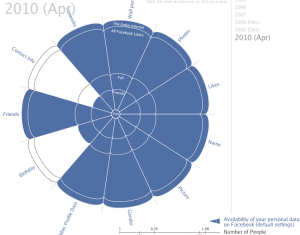
Who can see your personal data? Everyone.

Since posting this two days ago, Matt McKeon’s graphic illustration of Facebook’s gradual erosion of its users’ privacy (see screengrab and link, left) has been getting a lot of coverage. The discussion about Facebook and privacy has been going on for a while now, and it’s renewed with each new set of byzantine changes to the default settings. As McKeon’s graphics show, each change reduces the security of users’ information.

There was another good story doing the rounds yesterday, including on the Register here, about Facebook founder Mark Zuckerberg apparently once calling its users ‘dumb fucks’ for trusting him with their data.

This reminds me that a couple of years ago Bracket Press published Idler ed. Tom Hodgkinson’s anti-Facebook pamphlet We Want Everyone: Facebook and The New American Right, an adaptation of an earlier guardian article by Tom which explored this apparent ongoing data grab and Facebook’s business models. We Want Everyone is available to buy from the Bracket Press site. It’s a great read.

Unlike Tom I still have a Facebook account. A few months ago, tired of endless Farmville updates from Facebook friends who seemed to endlessly be collecting eggs or whatever, I paraphrased Baudrillard with this gently satirical tweet:

Farmville is presented as imaginary in order to make us believe that Facebook is real  http://bit.ly/biioHD

But actually of course Facebook is real and it’s most likely not grownups playing Farmville that is the valuable data on there. Like Danah Boyd I find myself alarmed by the naivety of younger Facebook users. Among the young people I know (and more importantly many that I actually don’t know, but who happen to be friends-of-friends of those I do), there are many who seem to want not only to document all their let’s say ‘recreational’ activities, but also to post those photos in order to share them with their friends. I’m for ever hitting the ‘hide’ button as yet another photo album announces itself on my wall and every saucer-eyed moment of every weekend from make-up to come-down is posted and tagged; shared, in other words, not only with friends and – duh! – parents, but also of course with absolutely anybody or any agency or business that this might be of interest or useful to or who can pay for it for ever.

You’d think they’d never read Burroughs…

Fifty-plus years ago it was only Allen Ginsberg who could watch ‘the best minds of [his] generation […] starving, hysterical, naked.’ Now from a lack of understanding or education about what the internet is, coupled with an excess of trust in Burroughs’ ‘all powerful boards and syndicates of the earth’, it seems that every ‘Angel-headed hipster’ is making their ‘ancient heavenly connection’ in public: ‘For all to see, in Times Square, in Picadilly.’