Chervil

For thirty days this year and every year, you can read my latest novel The Fountain in the Forest in synch with the French Republican Calendar. Conversion between the Republican and Gregorian Calendars is imprecise, but by common reckoning today’s date 8 March 2020 converts to Nonidi 19 Ventôse CCXXVIII in the Revolutionary Calendar. Factoring in Fabre d’Eglantine’s system of everyday rural imagery, 19 Ventôse 228 and Chapter 7 of the novel are dedicated to Chervil, a herb sometimes known as ‘French parsley’.

Fresh Chervil is not so easy to get hold of in the UK, so you might be better off buying seeds and growing your own, and it seems that March is a good time to start sowing. I’m tempted to give it a go.

Illustration: Prof. Dr. Otto Wilhelm Thomé, Flora von Deutschland, Österreich und der Schweiz. Vol3, plate 381, 1888, Gera, Germany

While you’re waiting for them to grow, you might like to read ‘Into Day One of the Revolutionary Period: a Conversation’ by Sanja Perovic and Tony White [Opens as PDF], an edited transcript of a discussion from 2013 between Perovic and me with the artists Stuart Brisley and Maya Balcioglu, in which we discuss Brisley’s use of the Republican Calendar in a number of his performance works dating back to the late 1960s.

‘Into Day One of the Revolutionary Period: a Conversation’ by Sanja Perovic and Tony White was published by Domobaal editions in Stuart Brisley – Before the Mast (2013) (ISBN 9781905957507) on the occasion of Stuart Brisley’s exhibition at Domobaal – 04.10.13 to 30.11.13 and at Mummery + Schnelle – 16.10.13 to 30.11.13.

§
Buy chervil seeds from Marshalls

 Buy ‘INTO DAY ONE OF THE REVOLUTIONARY PERIOD: A CONVERSATION’ by Sanja Perovic and Tony White in ISBN 9781905957507 Stuart Brisley – Before the Mast (2013) direct from Domobaal, £8 (or £45 for the full set of 7 titles plus p&p)

Buy The Fountain in the Forest from the Waterstones site, to ‘click and collect’ from your local branch

Pimpernel

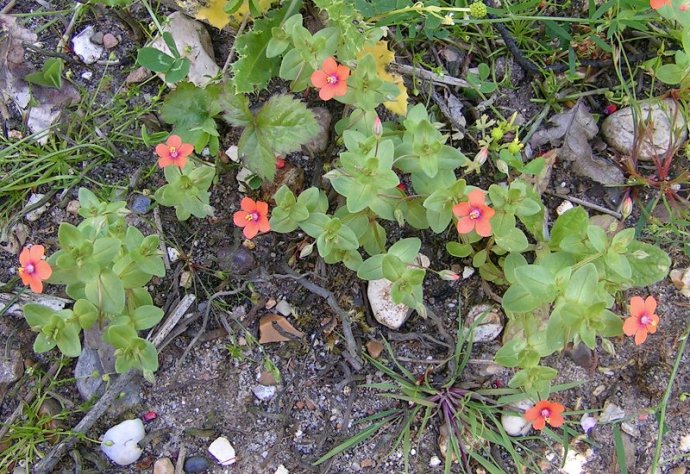
For thirty days this year and every year, you can read my latest novel The Fountain in the Forest in synch with the French Republican Calendar. Conversion between the Republican and Gregorian Calendars is imprecise, but by common reckoning today’s date 7 March 2020 converts to Octidi 18 Ventôse CCXXVIII in the Revolutionary Calendar. Factoring in Fabre d’Eglantine’s system of everyday rural imagery, 18 Ventôse 228 and Chapter 6 of the novel are dedicated to the Pimpernel (Anagallis arvensis), a weed that is toxic to many animals and livestock but traditionally had several applications in folk medicine.

By Sannse, CC BY-SA 3.0

The pimpernel is best known in popular culture for its use as the signature calling card of Sir Percy Blakeney in the Scarlet Pimpernel play (1903) and series of novels (1905 onwards) by Baroness Emmuska Orczy de Orci, which are set in the era of the French Revolution.

§

Read the Project Gutenberg ebook of The Scarlet Pimpernel by Baroness Emmuska Orczy de Orci

Buy The Fountain in the Forest from the Waterstones site, to ‘click and collect’ from your local branch

Leopard’s bane

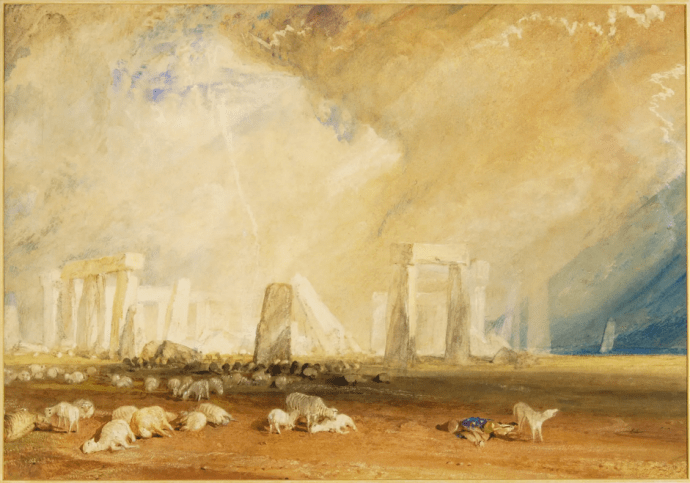
JMW Turner’s Stonehenge. Photograph: The Salisbury Museum

For thirty days this year and every year, you can read my latest novel The Fountain in the Forest in synch with the French Republican Calendar. We are now on Chapter 5, part of which takes place at the last Stonehenge Free Festival of June 1984.

Conversion between the Republican and Gregorian Calendars is imprecise, but by common reckoning today’s date 6 March 2020 converts to Septidi 17 Ventôse CCXXVIII in the Revolutionary Calendar. Factoring in Fabre d’Eglantine’s system of everyday rural imagery, 17 Ventôse CCXXVIII and Chapter 5 of the novel are dedicated to Doronicum or Leopard’s bane – a member of the sunflower family and ‘the earliest-blooming of the daisies’.

§

Readers may not be aware that the future of the Stonehenge UNESCO World Heritage Site currently hangs in the balance, with a final decision of the Government’s road widening and tunnel project due (at time of writing) any day now.

Not only would a tunnel irreparably damage the historical landscape and both existing and undiscovered archeological remains, but taking the road underground would remove a view of the stones from the road that has been free to all for millennia, and which has inspired artists and writers across the centuries, from JMW Turner and John Cowper Powys to me!

Visit the Stonehenge Alliance website, to find out what steps you can take to add your voice to this campaign today.

An urgent request: write to the Chancellor of the Exchequer TODAY

An urgent request: sign the petition TODAY

Photo: Włodzimierz Wysocki – CC BY-SA 3.0

§

Buy The Fountain in the Forest direct from publisher Faber and Faber 

The Fountain in the Forest was a Guardian ‘Book of the Day’ – read Sukhdev Sandhu’s review

Sign up to receive news and invites to Tony White’s book launches and events

Spinach

Over the coming weeks you can read The Fountain in the Forest in synch with the French Republican Calendar, as each of the novel’s thirty chapters correspond to a day in the Republican Calendar. I started posting daily updates here and on Twitter on Monday 2 March, and these will continue for the next twenty-six days.

Conversion between the Republican and Gregorian Calendars is imprecise, but by common reckoning, today’s date Thursday 5 March 2020 converts to Sextidi 16 Ventôse CCXXVIII in the Revolutionary Calendar.

The French Republican Calendar is secular and non-hierarchical, and – as many readers will know – instead of each day being dedicated to a particular saint or to a religious or royal holiday, or named after an ancient god, the Republican Calendar dedicates each of 360 days of the year to an item of everyday rural life, thus 16 Ventôse CCXXVIII and Chapter 4 of the novel are dedicated to spinach.

If you want to celebrate the day of spinach in style, I can think of few things finer than a homemade saag aloo – potato and spinach – with some rice or chapati, and some spicy mango pickle on the side.

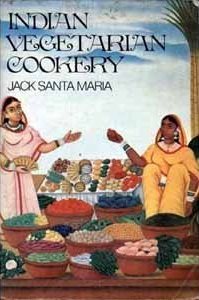
The recipe I’ve been using since forever (Sheffield, mid-1980s) is from a battered paperback of Jack Santa Maria’s pretty dependable Indian Vegetarian Cookery, that a good friend of mine recommended many years ago, and which is still available for Kindle. To give you a rough idea, Santa Maria’s Saag Aloo uses approximately a pound each (500g) of potatoes and spinach, so you’d need a large, heavy pan. He suggests beginning by frying chopped onion, garlic and ginger in ghee, before adding turmeric, chilli, and ground coriander (other recipes also include cumin and mustard seeds) and salt, and then the roughly chopped potatoes, which he suggests you fry until half-cooked – you may want to it leave a little longer – before adding the spinach and cooking until tender – add a splash of water if necessary to loosen things up – then garnishing with a sprinkle of garam masala. Vary the amounts to your own taste of course. And there are plenty of alternative recipes available online.

Good luck. If you try it, let me know – either here or on Twitter.

§

ICYMI The Fountain in the Forest is published by Faber and Faber, and now out in paperback, with Luke Bird’s striking, blue-liveried cover. Here’s the blurb:

When a brutally murdered man is found hanging in a Covent Garden theatre, Detective Sergeant Rex King becomes obsessed with the case. But as Rex explores the crime scene further, he finds himself confronting his own secret history instead. Who, more importantly, is Rex King?

§

Buy The Fountain in the Forest direct from publisher Faber and Faber 

The Fountain in the Forest was a Guardian ‘Book of the Day’ – read Sukhdev Sandhu’s review

Sign up to receive news and invites to Tony White’s book launches and events

Goat

Right now you can read The Fountain in the Forest in synch with the French Republican Calendar. I started posting daily updates here and on Twitter on Monday 2 March, and these will continue for the next twenty-seven days.

Conversion between the Republican and Gregorian Calendars is imprecise, but by common reckoning (i.e. Charles-Gilbert Romme’s rule for calculating leap years) today’s date 4 March 2020 converts to Quintidi 15 Ventôse CCXXVIII in the Revolutionary Calendar. Factoring in Fabre d’Eglantine’s system of everyday rural imagery, 15 Ventôse CCXXVIII and Chapter 3 of the novel are dedicated to the goat.

To celebrate here are two versions of the great Larry Marshall’s rocksteady and reggae classic ‘Nanny Goat’.

The original 1968 Studio One 7″:

A 1977 12″ version by Larry Marshall & Trinity:

§

Buy The Fountain in the Forest from the Waterstones site, to ‘click and collect’ from your local branch

Hedge Mustard

Right now – this year and every year – it’s possible to read my latest novel The Fountain in the Forest in synch with the French Republican Calendar.

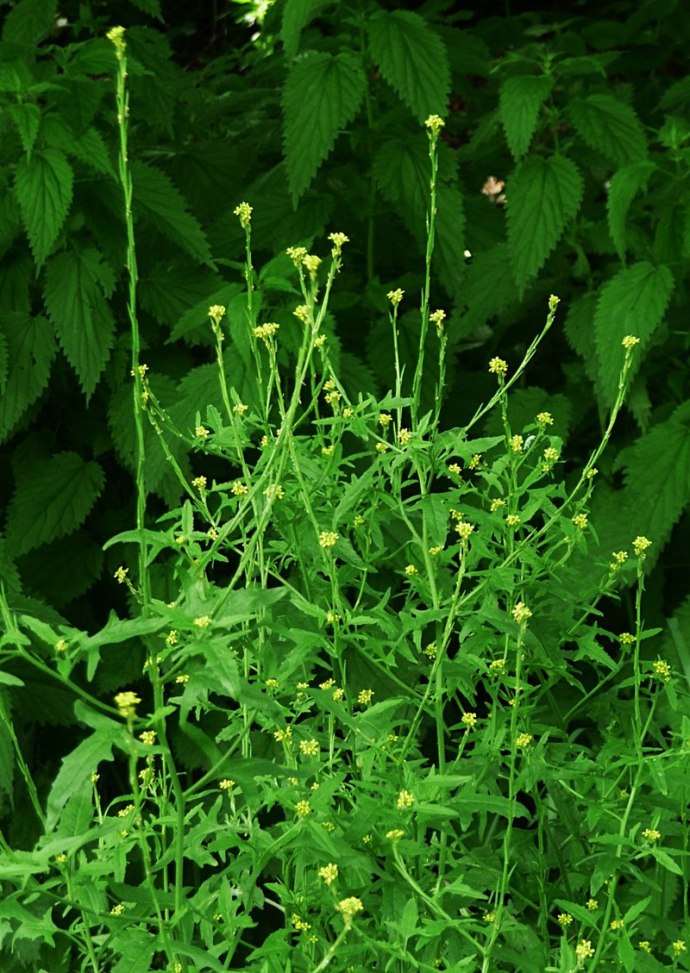
Today’s date* Quartidi 14 Ventôse CCXXVIII and Chapter 2 of the novel are dedicated to Hedge Mustard.

You can buy Hedge Mustard seeds from Nicky’s Nursery in time to sow in early May.

P.S. Watch out for more The Fountain in the Forest / French Republican Calendar posts over the next 28 days.

*According to Charles-Gilbert Romme’s rule for calculating leap years.

§

Buy The Fountain in the Forest direct from publisher Faber and Faber 

The Fountain in the Forest was a Guardian ‘Book of the Day’ – read Sukhdev Sandhu’s review

Sign up to receive news and invites to Tony White’s book launches and events

Common Fumitory

Should anyone wish to read The Fountain in the Forest in synch with the French Republican Calendar – which features in the novel – today’s date and Chapter 1 of the novel are (according to certain reliable authorities) dedicated to Fumeterre, the Common Fumitory.

Having spoken about the French Republican Calendar alongside many wonderful and inspiring performances by an amazing group of artists, writers and musicians at David Collard’s ‘A Leap in the Dark’ literary shindig on Saturday 29 February, it occurred to me that this may be of interest ;)

While conversions between the Gregorian and Republican Calendars are imprecise (or as some would say ‘speculative’), according to those Gregorian-to-Republican Calendar converters which privilege Charles-Gilbert Romme’s prefered method for calculating leap years, today’s date Monday 2 March is Tridi 13 Ventôse 228, and the day is dedicated to the Common Fumitory; and so on. By the same calculation, Chapter 30 of the novel corresponds with 12 Germinal 193, and is dedicated to the Hornbeam.

Luke Bird’s cover design for both Trade and B-Format paperbacks of The Fountain in the Forest, uses an engraving by Louis Lafitte, an artist of the Revolutionary period, which despite appearances is not a picture of Leda and the Swan, but is in fact an allegory of the Revolutionary month of Thermidor, from an edition of the Revolutionary Calendar that Lafitte illustrated.

Photo Isidre Blanc — CC BY-SA 4.0

§

Buy The Fountain in the Forest direct from publisher Faber and Faber 

Sign up to receive news and invites to Tony White’s book launches and events

Essex Book Festival, 15 March 2020

I’m delighted to be joining Philip Terry at Firstsite, Colchester on 15 March for readings and conversation at the Essex Book Festival launch of his The Penguin Book of Oulipo, which I reviewed for the Guardian recently.

Here’s the blurb:

The Penguin Book of Oulipo book launch. This is the first collection in English to bring together 100 pieces of “Oulipo” writing. Editor and translator Philip Terry will be joined by novelist Tony White to read and discuss selections from the book, as well as some of their own writing inspired by the group.

I’ll be reading from The Fountain in the Forest, plus one or two gems from Philip’s wonderful anthology.

  • 15 March 2020, 4:00–5:00pm.
  • Essex Book Festival, Studio 1, Firstsite, Lewis Gardens, High Street, Colchester, Essex, CO1 1JH.
  • Tickets: 27 years and under: £5.00 | Standard: £7.00. Info and bookings.

A yearlong reading of Gertrude Stein

Live from the domestic-underground! Photos from (around the edges of) last Saturday’s group reading/performance of They are all of them themselves and they repeat it and I hear it: a yearlong reading of Gertrude Stein’s The Making of Americans (1925). With thanks to instigators Irene Revell and Anna Barham for the invitation to participate.