Panel beating #9 — Polar Museum

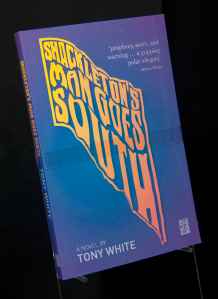
I am delighted to be giving a reading from my Science Museum novel Shackleton’s Man Goes South and taking part in a panel discussion for Ways of Knowing the Polar Regions: Past, Present and Future, at the Polar Museum in Cambridge on 15 September. Here’s the blurb:

shackleton book 512x512pxThe Arctic and Antarctic have long claimed a strong hold on the western imagination, but climate change has given these regions new prominence and meaning. How much do we know about future scenarios for these sensitive regions, and how should we tell those stories today in a way that might change the future for the better? Is the future the next frontier for explorers and storytellers?

This free public event will explore these themes with contributions from climate modeller Tamsin Edwards (Open University), oceanographer Mark Brandon (Open University), Cambridge Polar Museum curator Charlotte Connelly, poet Nick Drake (author of Arctic-themed poem cycle ‘The Farewell Glacier’) and writer Tony White (former Science Museum writer in residence and author of the Science Museum published climate change novel Shackleton’s Man Goes South). Broadcaster and writer Dallas Campbell (presenter of BBC’s Bang Goes the Theory and City in the Sky) will introduce and chair the event. It is co-organised by the University of Cambridge Polar Museum and The Mediating Change Group, which is based jointly at the Open University Geography Department and the University of Sheffield School of Architecture.

§

Ways of Knowing the Polar Regions: Past, Present and Future — The Polar Museum, Scott Polar Research Institute, University of Cambridge, Lensfield Road, Cambridge CB2 1ER. Thursday, 15 September, 18:00 to 20:30. FREE but booking essential.

You can still download a free PDF of Shackleton’s Man Goes South from the Science Museum website.

Sign up to receive occasional invites to my book launches and events, from me and my publishers and producers

Hope to see you there

If you would like to receive invites to future book launches and special events, to find out about limited editions or to come and see me live, you can sign up to my Tiny Letter mailing list. I have some exciting events lining up for the autumn, including A Place Free of Judgement by Blast Theory and Tony White, and readings at the Scott Polar Research Institute, Cambridge and the Estuary Festival (in the incredible Tilbury Cruise Terminal), plus more yet to be announced. If you would like to receive invites from me and my publishers and producers to these and other forthcoming readings, book launches and other special events and limited editions, do please feel free to sign up here.

Tony White reading at Beaconsfield, London. Photo © Marianne Magnin, 2015

Tony White reading at Beaconsfield, London. Photo © Marianne Magnin, 2015

§

Listen to ‘High-Lands’, Tony White’s short story for radio, commissioned by London Fieldworks and Resonance 104.4fm for Remote Performances and broadcast live from the Outlandia Studio on the slopes of Glen Nevis, Scotland in August 2014, with live accompaniment from Johny Brown

Sign up to receive occasional invites to my book launches and events from me and my publishers and producers

Shorelines programme released

Estuary Festival has just released the programme for Shorelines, its Literature festival weekend in September.

Talks, events, exhibition, performance & boats with 70 writers, artists and filmmakers responding to the Thames Estuary. Including walks, family activities and tours of the Port of Tilbury. Shorelines Literature Festival has been curated by acclaimed author Rachel Lichtenstein and includes talks and readings by Deborah Levy, Horatio Clare, Rose George, Patrick Wright, archaeologists, artists, writers, film makers and even a prince to explore the unexpected history, people and geography of the Thames Estuary and wider global waterways.

shackleton book 512x512pxI am delighted to be a part of this great festival, and to be reading from my Science Museum novel Shackleton’s Man Goes South in the Departures Lounge of Tilbury Cruise Terminal at 12:00 noon on Saturday 17.

Here is my own personal selection of just some of the Shorelines weekend’s highlights. (SEE THE FULL PROGRAMME HERE.)

Saturday 17 September 2016

SHORELINES MAIN AUDITORIUM  (Departures Lounge, Tilbury Cruise Terminal)

2.303.10pm: Sea Forts of the Estuary

Acclaimed writer, Rachel Lichtenstein (Estuary: Out from London to the Sea, 2016 Hamish Hamilton) brings together Prince Michael of Sealand with artists Stephen Turner and Chloe Dewe Mathews to talk about filming, being in residence, a Declaration of Independence from the UK, pirates, kidnap, government plots and other adventures on the Principality of Sealand and other Sea Forts in the outer reaches of the Thames Estuary.

3.203.40pm: An Unfathomable Ship? Uwe Johnson’s view of the Richard Mongomery

Professor of Literature and Visual & Material Culture at King’s College London, Patrick Wright considers the view across the Estuary from the window of the East German novelist who lived at 26 Marine Parade, Sheerness on the Isle of Sheppey from 1974 until 1984, culminating in the masts of the Richard Montgomery.

4.305pm: Arrivals and Departures

For nearly 300 years, the London docks were the busiest in Europe, trading goods from across the world, as well as a point of arrival for immigrants from the colonies and beyond.

Writer on architecture, landscape and public policy, Ken Worpole draws on the memories of those who worked in the dockyards, as well as those for whom landfall in London was the beginning of a new life in a new country. His talk will draw on the photographs of Mike Seaborne and Jason Orton, with whom he has collaborated on books about the landscape and history of the Thames and Essex coastline.

4-4.30pm: Vulgar Things

Author Lee Rourke reads from his novel Vulgar Things, (2014 Fourth Estate) described as part mystery, part romance, part odyssey, and discusses myths and landscapes. N.B. This event is in the SHORELINES SALON (Wren Suite, Tilbury Cruise Terminal)

SHORE_RachelLichtenstein_Brum2_PH_SimonFowler1

Sunday 18 September 2016

LOWER LANDING STAGE (Tilbury Cruise Terminal)

6am  Raga Dawn

Performance at sunrise by acclaimed vocal performance artist, Caroline Bergvall, with singer Peyee Chen in a unique composition by Gavin Bryars and a site-specific sound design by Sam Grant. Followed by a communal breakfast.

Performance starts at 6.38am – the official moment of Sunrise that day.

Tickets are free, Booking is essential – BOOK HERE

13237739_497192377147724_929006424828310394_n

SHORELINES MAIN AUDITORIUM  (Departures Lounge, Tilbury Cruise Terminal)

1111.25am: Seawitches and Sirens: Echoes of past lives in the Estuary

Mystery writer Syd Moore shares her research into the myths surrounding the Estuary, including Sarah Moore, the seawitch of Leigh, and the lost continent of Doggerland.

11.3011.55am: Black Mariners on C18th Estuary

Author, curator, lecturer and researcher in multi-ethnic and military histories Steve Martin provides an overview of the Black presence in South Essex and North Kent and its centuries-long seafaring connections.

1212.25pm: Wrecked on the Intertidal Zone

Artist, Graham Harwood presents YoHa’s ongoing enquiry into the Thames Estuary that uses art to stir up the murky, muddy world of South Essex, preoccupied by the genealogical, ecological and political complexity of the Thames.

3.10-3:40pm: Public Record: Estuary

Essex-based, US writer, Justin Hopper’s audio poetry project explores the land and seascape of Leigh-on-Sea, creating poetry from 19th-century newspaper reports of minor shipwrecks and calamities.

13238897_497192330481062_3862063152924813017_n4.204.50pm: To the Lighthouse

Booker shortlisted author Deborah Levy (Swimming Home, Faber & Faber, 2012) discusses Virginia Woolf’s seminal novel, To The Lighthouse.

55.30pm: The Sea Is an Edge and an Ending.

Writer and artist Lavinia Greenlaw introduces her Estuary 2016 artwork.  Set along the coast, this short film is a study of the impact of dementia on our sense of time and place, drawing on Shakespeare’s Tempest focusing on what it means for your sense of self to come loose, for the past to float free, and to exist increasingly in the present tense.

Stranger on the Shore (triptych) – 90min

Michael Smith and Maxy Bianco

It’s different by the sea. A bit strange even. Literally, at the edges, the coast has always been a site of myth, eccentricity, transgression and romance. Stranger On The Shore is a cycle of short films exploring these threshold places. the first explores the hinterlands of the Thames Estuary, the second, Hastings and the third, the north-eastern seaside town of Whitby.

Maybe see you there ;)

§

Find out more about the Estuary Festival

Sign up to receive invites to my book launches and events from me and my publishers and producers

Listen to free audiobook extracts of Shackleton’s Man Goes South

Download Shackleton’s Man Goes South as a free PDF direct from publisher the Science Museum

The road to Cannon Street

Many thanks to Tower Hamlets Local History Library & Archives for drawing my attention to this extract of Morden and Lea’s map of London from c. 1700, showing the area south of Whitechapel in East London. The reader may readily recognise the lie of the land, with White Chapel and the Tower of London the most obvious landmarks. What is here called White Horse Street and White Horse Lane will become Commercial Road. Similarly ‘Knock Fergus’ may be better known to contemporary readers as Cable Street, etc. The path of what will become Fieldgate Street is marked by a dotted line running across the fields; hence the name.

Reproduced with permission of Tower Hamlets Local History Library & Archives

Reproduced with permission of Tower Hamlets Local History Library & Archives

Other significant landmarks are absent. Dating as it does from around 1690 or 1700, this map does not show Hawksmoor’s church of St George in the East, which was not yet built; construction would begin in 1714.

FoxyTpbk_frontI was particularly interested to see a Cannon Street on Morden and Lea’s map (south of Knock Fergus, roughly in the centre of the lower right-hand quarter of the map) running down the west side of the plot that St George in the East would come to occupy. Here perhaps is the origin of the current and oddly named Cannon Street Road, i.e. the road to Cannon Street. If you continue the line of Morden and Lea’s Cannon Street north across the fields to Whitehorse Lane/Commercial Road you will get an idea of its current location, intersecting as it does with Commercial Road roughly in the area of the word ‘White’, on the north edge of the field numbered ‘16’.

foxy-t_unused_map_detail

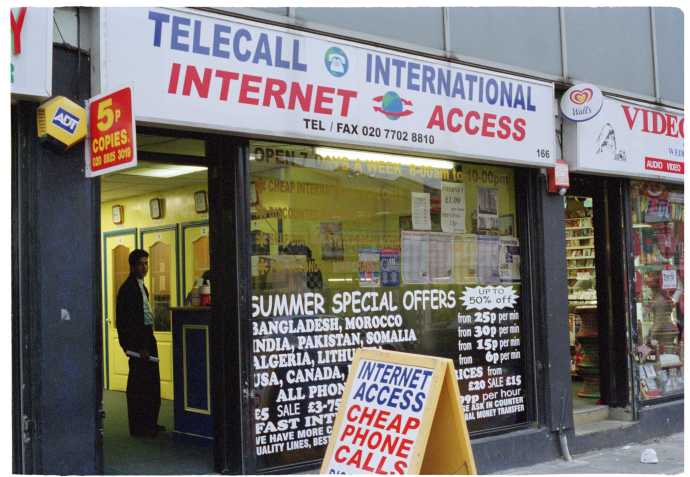
The reason for my particular interest of course is that Cannon Street Road forms the location for my 2003 novel Foxy-T, which is set in a fictional internet shop, roughly where the ‘1’ is marked on this sketch (which was drawn in case a map was needed for the Croatian edition of the novel, but never used).

The numbered locations from the novel are as follows:

  1. E-Z CALL
  2. SHADWELL DLR STATION
  3. SHABBAZ’S FATHER’S RAILWAY ARCH
  4. GOLDEN LION SOCIAL CLUB
  5. TAYYABS RESTAURANT AND TAKEAWAY
  6. WHITECHAPEL MOSQUE
  7. WHITECHAPEL UNDERGROUND STATION
  8. KEEN STUDENT CENTRE
  9. HSBC BANK
  10. DERELICT FLATS

Foxy-T was written in what has subsequently become known and studied as Multicultural London English (MLE), and the novel was recently included in the grammar text book Mastering Practical Grammar by Sara Thorne (Palgrave).

You can read more about Foxy-T and Cannon Street Road in this article on publisher Faber and Faber’s blog, which was published on the tenth anniversary of publication.

I understand that parts of Tower Hamlets Local History Library & Archives are currently closed for building renovation, but you can browse their catalogue here. They are also on Twitter, where in recent weeks they have been posting recently digitised archive photographs from the 1960s and 1970s, which are equally fascinating.

A ‘zoomable’ (though less detailed) later edition of Morden and Lea’s entire map is available to view on the British Library website.

Cannon Street Road © Daniel Wootton, 2005

Cannon Street Road © Daniel Wootton, 2005

§

The website of Tower Hamlets Local History Library & Archives

Tower Hamlets Archives on Twitter

Selected press about Foxy-T

Buy Foxy-T direct from publisher Faber and Faber

Sign up to receive invites to book launches and events from me and my publishers and producers

Remain in Light

On the eve of the EU Referendum in the UK, I hope it is not too late to be saying this, sharing this, but I love Alana Lake’s pro-EU ‘Pink Innit’ graphic, which I saw someone share on Facebook yesterday, and now reproduce here. You can download and share the image from the brilliant EU-UK site here.

innit_pink

I love Lake’s graphic because it’s pro-Remain, but also because it uses a defining feature of what Jenny Cheshire, Sue Fox, Paul Kerswill & Eivind Torgersen in 2008 ‘dubbed “Multicultural London English” (MLE)’ in their journal article ‘Ethnicity, friendship network and social practices as the motor of dialect change: linguistic innovation in London’, which you can read in full on the Lancaster University website.

Amongst other things, Cheshire et al suggest—I think—that it is the size and diversity of friendship groups in London that has driven the linguistic innovation of Multicultural London English, and that ‘all speakers draw on a range of linguistic forms that cannot necessarily, or at least can no longer, be attributed to specific ethnic groups’.

I love this Screen Shot 2016-06-22 at 10.43.14idea of diversity driving innovation.

When I first learned of the emergence of the term ‘Multicultural London English’, it was music to my ears, because this was the language that I had been hearing all around me in the East End where I had been living for many years. It was the language in which my novel Foxy-T had been written a few years earlier, and now at last that language had a name. If you haven’t read it, Foxy-T is set in and around Cannon Street Road, London E1. Here’s a quick extract of something I said at an event at Whitechapel library marking the tenth anniversary of publication, which was subsequently published on the Faber and Faber blog:

I wanted to use fiction to map these more ephemeral economies of Cannon Street Road, whether that was the re-purposing of the empty Megna Cars building, the comings-and-goings of a local wedding caterer, or the posting of a club night flyer. Of course, I was thinking of ‘economies’ in the loosest, non-technical sense, as systefoxy-t_unused_map_detailms of value and exchange. One such system being spoken language, and at that time – particularly in the East End – something seemed to be happening around Black British language, which was now being valued and used by other communities.

Chatting at the time I used to say that you could hear someone talking behind you on the bus and no longer be able to connect voice and ethnicity. Here were young Bangladeshi rude boys in Shadwell calling each other ‘Rasta’. It might sound slight, but that cultural disconnect represented a huge break with the politics of identity that had been fought for in the preceding decades, in every walk of life, including in literature, and this shift seemed worthy of note. More than that, it was obvious that a novel set in London E1 at that time would need to engage with this change head on, rather than constraining it in the kinds of apostrophised contortions that would be necessary to represent this use of language in standard English.

Here’s the opening page of Foxy-T:

Foxy-T page 1

As you can see, I chose to spell MLE’s defining ‘tag question’—technical term ;)—with one ‘n’ rather than the now more usual two: ‘init’ rather than ‘innit’. But then at the time Multicultural London English had not yet been formalised or named. It was something I was hearing rather than something I was reading, or reading about. But it was an innovation that I wanted to reflect in my novel.

innit_pinkThis is why I love Alana Lake’s ‘pink innit’ so much, just as I love the pro-EU posters that Wolfgang Tillmans has been producing, and the #artists4eu campaigning by Bob and Roberta Smith. I love it because it speaks to the diversity of life in the UK, to ideas of exchange, openness and innovation and to the importance of diverse friendship networks. And these ideas—exchange, openness, innovation, friendship and diversity—are qualities that I also associate with being a part of Europe at its best; part of an international community. But I also love Lake’s graphic because having celebrated London’s linguistic diversity for many years and having done so in a novel, I also take it personally.

Just as I take it personally when far right politicians stand against these positive ideas.

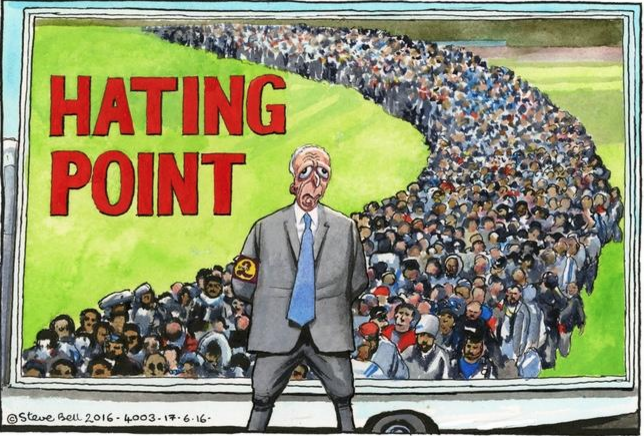
This is why I was relieved when UKIP’s disgustingly racist Leave Campaign poster—so similar, as many have pointed out, to images from Nazi propaganda—was rightly greeted with almost universal revulsion when it was unveiled at a photo op by UKIP’s Nigel Farage.

10727-1a0i9s8

Steve Bell in the Guardian newspaper made this connection even more explicit, with his ‘Hating Point’ parody.
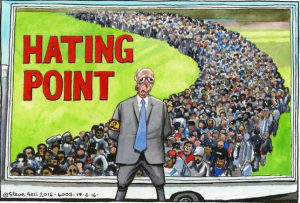
SBell30Never mind ‘breaking point’, I hope that the vile UKIP poster was actually a turning point in the EU Referendum campaigns, because it showed exactly what we are up against. Give them enough rope, I thought, and the far right will eventually show themselves for what they are.

Coincidentally, just a few yards—a stone’s throw—from where Foxy-T is set, just beyond the viaduct which carries the DLR between Bank or Tower Gateway and Shadwell Stations, is a place where Londoners had to make a stand once before against the far right. Crossing Cannon Street Road near Hawksmoor’s church of St George in the East, and running from Royal Mint Street and the Tower of London in the west to Butcher Row and Limehouse in the east, is Cable Street. 49039
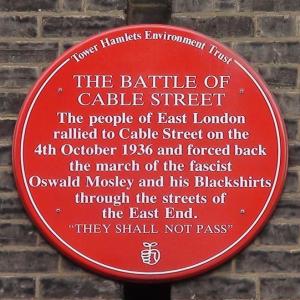
This is where in 1936 the diverse communities of London came together to prevent Mosley’s Blackshirts from marching through the East End.

There is a mural commemorating the battle, which is painted on the side of St George’s Town Hall at 236 Cable Street. This is just a short walk west from Shadwell London Underground and DLR stations, if you haven’t seen it but would like to take a look. Started by Dave Binnington in 1979, work was interrupted when the mural was defaced by far right slogans in 1982. The mural was completed by Paul Butler, Ray Walker and Desmond Rochfort, and officially unveiled in May 1983. According to wikipedia, ‘The mural has been vandalised and restored several times, and was restored again by Butler for the 75th anniversary of the Battle of Cable Street in October 2011.’ These are ideas, in other words, that it is still necessary to protect.

By jo-marshall (was Jo-h), Creative Commons licence: CC BY 2.0

By jo-marshall (was Jo-h), Creative Commons licence: CC BY 2.0

This year, the year of the UK’s EU Referendum, marks the 80th anniversary of the Battle of Cable Street, and I hope that those people who are able to vote on 23 June 2016 will make a similar stand.

I hope that people will see through the empty promises and the racism that has been emerging from parts of the Leave campaign, and that millions of us will use our votes to stand against hatred, insularity, homogeneity, blind nostalgia and selfishness. That millions of us will make a stand for friendship, openness, diversity, innovation and exchange.

I hope that we will vote to remain in the EU.

§

TalkingHeadsRemaininLightJenny Cheshire, Sue Fox, Paul Kerswill & Eivind Torgersen, ‘Ethnicity, friendship network and social practices as the motor of dialect change: linguistic innovation in London’ (Opens as PDF)

Download Alana Lake’s ‘Pink Innit’

Buy Foxy-T direct from publisher Faber and Faber

Sign up to receive invites from me and my publishers and producers

Find out more about Talking Heads 1980 LP Remain in Light
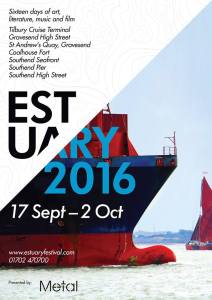
Estuary 2016

13237739_497192377147724_929006424828310394_nI am delighted to be taking part in Estuary 2016, which takes place over 17 days in September and October 2016 at venues including Tilbury Cruise Terminal, Coalhouse Fort; various venues in Gravesend; Chalkwell Hall and Park, The Seafront, Focal Point Gallery and the Worlds Longest Pier in Southend-on-Sea. I’ll be on as part of the Shorelines programme on 17–18 September.

There are some great artists and writers taking part—including John Akomfrah, Rachel Lichtenstein (curator of Shorelines), Caroline Bergvall, Lee Rourke, Lavinia Greenlaw, Jem Finer, Ken Worpole and many more—so I am thrilled to be sharing a bill with them.

Here is the blurb:

Estuary is a new, biennial arts festival curated in response to the spectacular Thames Estuary and presented in culturally significant and historic venues along the Essex and Kent shorelines. An exciting mix of new and existing works will pull together powerful themes resonant to the place, its history, landscape and communities in an ambitious programme of contemporary art, literature, film and music.

The Thames Estuary is an ‘edgeland’. It is a place of transition – one of arrivals and departures – a gateway that connects the UK to the rest of the world. It has been the front line for the defence of the realm as well as the first port of welcome for migrants and visitors from around the world. Industrial heartland and logistics sit alongside wild habitats, ancient monuments and concrete commuter towns. Echoes from the birthplace of early punk, noisy seaside fun, brent geese, fog horns and cargo ships create an unmistakable soundscape. It has long provided an endless source of fascination, inspiration and mystery for both artists and audiences.

13238897_497192330481062_3862063152924813017_n

§

ESTUARY 2016, 17 September – 2 October 2016

Sign up to receive invites from me and my publishers and producers

I am always happy to hear from anyone about a reading or a talk. See my events page for a word about bookings

The Holborn Cenotaph—live audio

On May 7th I gave a reading of ‘The Holborn Cenotaph’ for the Speakers’ Corner programme at London Radical Bookfair, which this year was held at Goldsmiths, University of London.

Here is live audio of that performance, which was published on my Soundcloud page today. Feel free, as ever, to download this audio to listen on your own device or player.

Creative Commons License
This work is licensed under a Creative Commons Attribution-NonCommercial-NoDerivs 3.0 Unported License.

§

What is ‘The Holborn Cenotaph’?

Sign up to receive invites from me and my publishers and producers

I am always happy to hear from anyone about a reading or a talk. See my events page for a word about bookings

Stage

Ch2lT4-WkAUmsJp

Thanks to Kit Caless of the brilliant Influx Press for posting this photo of me reading ‘The Holborn Cenotaph’ on the Speakers’ Corner stage at London Radical Bookfair at Goldsmiths on Saturday.

I love this rudimentary stage—a carpet, a brolly and a battery-powered PA—created by Speakers’ Corner programmer Vicky Samuels. It did the job, providing a focus for the crowds that gathered outside the fair, and it was great to share this platform with speakers including Helen Corry of the #bursaryorbust campaign, and others.

If you missed the London Radical Bookfair this time around, follow them on Twitter and make a date for next year ;)

§

Sign up to receive invites from me and my publishers and producers

I am always happy to hear from anyone about a reading or a talk. See my events page for a word about bookings

This Saturday: London Radical Bookfair

photo(10)I am delighted to be joining one-hundred or more book and zine publishers and a great range of speakers taking part in the London Radical Book Fair at Goldsmiths on Saturday 7 May.

Come and find me, I will be on at 1pm sharp as part of the ‘Speakers’ Corner’ programme, reading ‘The Holborn Cenotaph’.

I’ll bring along some copies of the new and updated A5 pamphlet edition of the story, which was published for last Friday’s Creativeworks London Festival at King’s College London.

‘Speakers’ Corner’ will be just outside the main entrance, so we’ll be easy to find. Last year ‘Speakers’ Corner’ consisted of a carpet, a mic-stand and a PA, so look out for a similarly unceremonial set-up!

Here is the line-up:THCcoverCWLFESTpamphlet

1pm – Tony White
Novelist, writer and editor. He is also Chair of the arts and cultural radio station Resonance 104.4fm. Tony will be performing his short story The Holborn Cenotaph, ‘which leads audiences into an act of radical remembrance and witness.’ Tony performed this last year to a rapt audience.

1.30pm – Different Skies
Publish bold experiments in creative non-fiction, criticism and poetry, alongside holding regular writers’ meetings & events. Alistair will be reading some of his selected works.

2pm – Helen Corry from Bursary or Bust
For the campaign against the NHS bursary cuts. Nursing student and activist who is involved in the bursary campaign and has been published in the guardian.

2.30pm – Ich Binn Finn
Finn D’albert is a songwriter and music journalist, and is Editor in Chief at Raw Meat magazine. She will be performing her sweet solo tunes.

3pm – Maggs Dewhurst from the IWGB Couriers and Logistics Branch
Chair of the IWGBCLB, who have been campaigning for the London Living Wage for couriers across London since February last year. Recent victories include taking City Sprint and eCourier to court, and winning both cases for fairer wages.

3.30pm – Dan Goss from Move Your Money
Move Your Money UK is a national campaign for a banking system that helps to build and support a sustainable society, and provides information on the ethical banking sector.

4pm – Dave Briggs
Dave Briggs produces small press comics, as well as being a singer-songwriter. He will be performing acoustic folk/psych songs for us.

4.30pm – Michael Chessum, From Another Europe is Possible
Michael has campaigned widely for the National Campaign against fees and cuts, was president of the ULU Student Union, and is currently campaigning for Another Europe is Possible and Momentum.

5pm – Travis Elborough
Travis Elborough is a writer, broadcaster and cultural commentator. He is a regular contributor to the Observer and the Guardian and frequently appears on BBC Radio 4 and Five Live. He will be speaking around the subject of his newest book A Walk in the Park: A Life and Times of a People’s Institution.

Photo: Peter Clark

Photo: Peter Clark

Besides the ‘Speakers’ Corner’ readings and performances, there will be plenty more to see, including shortlisted authors from the Bread and Roses Award for Radical Publishing, shortlisted authors from the Little Rebels Children’s Book Award, and in solidarity with the Goldsmiths Cut The Rent students, currently engaged in a rent strike at Goldsmiths, as well as with those rent striking at other universities, there we will be a series of talks and workshops looking at different aspects of the housing struggle – hosted by Brick Lane Debates.

LRBF2016poster

§

Sign up to receive invites from me and my publishers and producers

No spoilers in this video extract of ‘The Holborn Cenotaph’ at Sylvia Plath Fan Club, 5 November 2015

I am always happy to hear from anyone about a reading or a talk. See my events page for a word about bookings