At the end of 2009 I collaborated with James Bridle to publish three new short stories in the EPUB format via James’s new electronic publishing project www.artistsebooks.org

Include Me Out, artistsebooks 2009
I discussed these in my presen- tation at the London Libraries Ebook Market- place Seminar at Swiss Cottage Library on Monday 22nd February. It was an interesting event, with librarians and colleagues from publishers and suppliers including Bloomsbury, Exact Editions, Credo, WF Howes, BBC Audiobooks etc.
I’d also read from one of the stories ‘Include Me Out’ a couple of days earlier at Matt Lock’s The Story conference (yes I know, I liked the ‘DePo Masthead’ theme Matt used for The Story’s blog) at Conway Hall on 19 February 2010. So I thought I’d link to them here, now, too.
These ebooks were funded by the Leverhulme Trust. The stories are part of my Balkanising Bloomsbury series and are an outcome of a residency that I’d had at the UCL School of Slavonic and East European Studies (SSEES) which was supported by the Leverhulme Trust. They were published as part of a mini-festival that I co-directed with Dr Wendy Bracewell at SSEES, called Destination London.
I was delighted to work with James as I’ve been following his booktwo blog for a while where he has been exploring the future of publishing with more intelligence than most. In other words he has avoided many of the platitudes, received wisdoms and knee-jerk angsting about piracy etc, that often bedevils serious discussion of the subject. See Mssv take apart some howlers in Jason Epstein’s piece in the current NYRB. And sorry but I’m worried by Danuta Kean’s uncritical embrace of Peter Mandelson’s ‘three strikes’ proposal to deny web access without trial for unspecified periods of time and at ministerial discretion; ‘three strikes’ is frankly more alarming than the supposed problem, i.e. the cure is more damaging than the disease.
I’m not trying to say anything new by noting that most artists and writers operate in a mixed economy where they make pragmatic decisions about giving stuff away all the time. Some we all know have been making a positive virtue of the fact for years. Others actively make work about the law, copyright or issues like piracy; work that involves testing the boundaries of such concepts – I may come back to this in another blog. Quite prosaically, too, though, most of the published writers I know have given stories away or written stories that were always designed to be free, to be out there, with motivations ranging from wanting to take part in a great project like Barbara Campbell’s 1001 nights cast to my giving a story to 3am Magazine because I liked what they were doing. Conversely every writer knows (from experience) that there are well-known magazines that promise to pay but never do.
I’ve been convinced of the value of giving stuff away for ages though. It’s what I’ve been doing with Piece of Paper Press since the early 1990s. I was also involved in the groundbreaking CODE conference nearly ten years ago, commissioning a series of accompanying essays from Matt Locke, Stewart Home, Joe Banks of Disinformation, Steve Beard and others, back in the days when James Boyle, Lawrence Lessig and co were discussing and sharing the conceptual groundwork for Creative Commons, which I have now used to licence these latest EPUB stories. Those CODE essays were published in an early version of the Diffusion eBook developed by Proboscis, which I’ve also used for some other stories in this series. I’ll link to those another time.
I’d been wanting to do something with the EPUB format for a while. I liked the sound of it because it is nonproprietory and doesn’t tie you to a particular device or OS; because it offers a way to publish things for free; because I saw people I knew, people who read books, wandering around with iPhones that had great ebook reading capability but not much to read on them; and because it’s important as a writer to actually experiment and see what this stuff can do.
So that’s what these are; an experiment. When I was writer in residence at the Science Museum, London in summer 2008, Hannah Redler who directs Science Museum Arts Projects, borrowed some engineering jargon to described such experiments as ‘rapid prototyping’, which is a good way of putting it. At that time I was working with the Museum looking for a way to publish a short story ‘Albertopolis Disparu’ that I’d given them (non-exclusively) as an outcome of my short residency there in summer 2008. Another experiment.
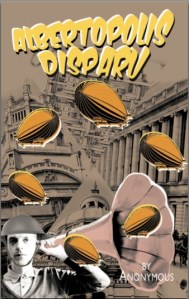
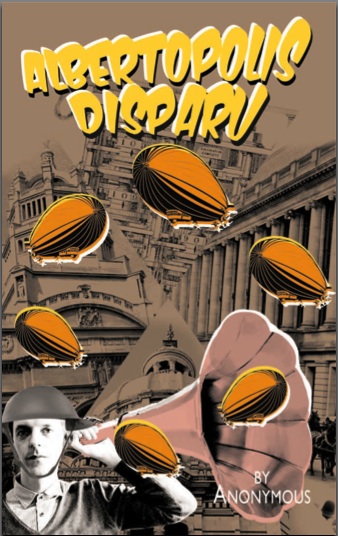
Albertopolis Disparu, A Science Museum Booklet 2009
Plans for a print edition of ‘Albertopolis Disparu’ centred around our revival of their grand old ‘shilling monograph’ imprint A Science Museum Booklet, which I’d discovered in the archive. (Note for geeks: our design also mirrored exactly the format of the Aloes Books chapbook edition of the Thomas Pynchon short story ‘Low-Lands’.) The Museum workshops built a specially-commissioned display that was to be sited outside the lifts on the first floor. They gave away thousands of them. ‘Albertopolis Disparu’ also, I was delighted to hear, passed the ‘litter test’ that generally applies to free print that is given away in those vast halls: they didn’t find any copies of the book discarded in the stair wells. Copies of ‘Albertopolis Disparu’ were also available free to cab drivers from the Cabmen’s Shelter on Thurloe Place in South Ken, reviving the old tradition whereby local publishers gave free books and newspapers to the Shelters.
We also wanted to make ‘Albertopolis…’ available free online, and to publish some great stories that had been produced by participants including Sophie Hope and Al Robertson in a free writing workshop that I ran at the museum in 2008. However at this time in early 2009 EPUB still hadn’t had its possibly iPhone-driven ‘VHS moment’, so we had to resort to using downloadable PDFs on my residency webpage. So this was all still very much in keeping with the unspoken ‘free as in freedom AND free as in free beer’ ethos that (with apologies to the free software movement) I’d adopted for my residency, but felt a bit clunky and outdated. If we’d had EPUB then it would have been great.
A matter of months later, though, and James and I met up for coffee at Maison Bertaux and plotted using EPUB for these Balkanising Bloomsbury stories out of my Leverhulme Trust residency at SSEES. We got talking about artists books and giving stuff away, and it kind of synched up with what he was thinking about for artistsebooks.org
So three new short stories, free to download. They are a kind of rapid prototyping experiment in EPUB. I’m including them in my live events at the moment, and all of them are also available in print formats e.g. here. These EPUB versions should work with iphone, ipodtouch, android, BeBook, Nook, Stanza, eBookPro, SonyReader and Aldiko etc. Comments and feedback are positively encouraged by James and artistsebooks.org and more titles are in the pipeline so it’s definitely worth bookmarking http://www.artistsebooks.org
The stories are:
Bring Me Sunshine
How We Made ‘An American Legend’ Part 1
Include Me Out




 Piece of Paper Press & tonywhite.london
You must be logged in to post a comment.