18 June is the anniversary of the Battle of Orgreave – a pivotal moment in the Miners’ Strike of 1984–85, and perhaps in UK policing and society generally, too.
The Guardian newspaper published a useful timeline of the day last year:
In the early summer of 1984, 8,000 miners and supporters gathered to picket a coke works in South Yorkshire. They were met by a force of 6,000 police officers
The Battle of Orgreave features in my new novel Phantom at the Feast which is published by No Exit Press on 18 June.
To mark the anniversary, and on publication day, here are five books about the strike that I can wholeheartedly recommend if you want to find out more, including maybe one surprise!
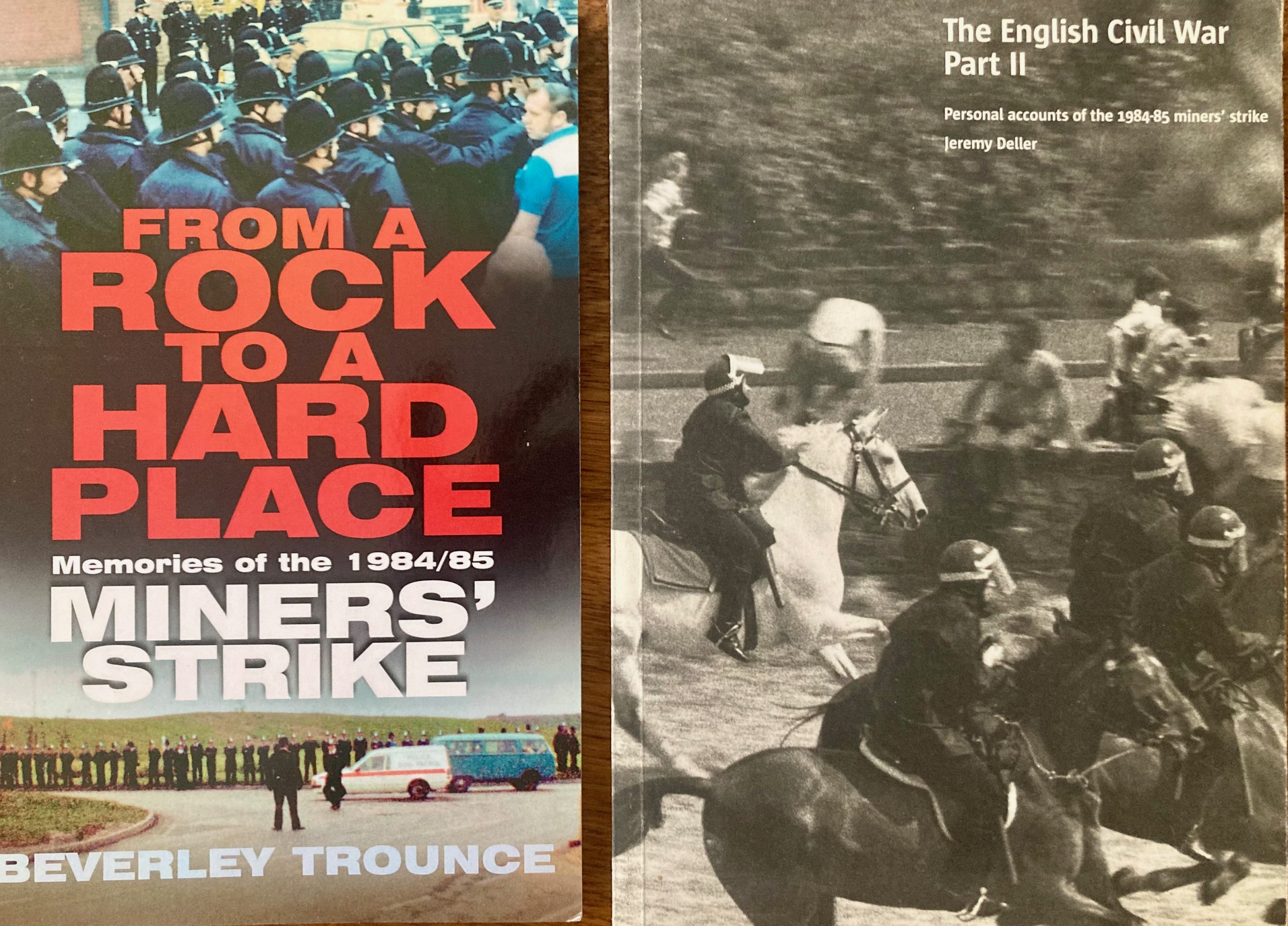
From a Rock to a Hard Place: Memories of the 1984/85 Miners’ Strike, by Beverley Trounce
Trounce was a librarian in a mining town, and it shows. She pulls together illuminating stories from striking miners, women’s action groups, the children of miners, and Orgreave photographer John Harris, whose iconic photo of a mounted policeman came to symbolise not just the Battle of Orgreave but the Strike: ‘The cop on horseback was coming towards them, baton raised, so I click-clicked. That was it.’ Harris is also frank on the risks, from both sides, of being identified with a mistrusted media.
From a Rock to a Hard Place, Beverley Trounce (History Press, £14.99)
GB84, by David Peace
This propulsive and poetic novel is the logical extension to Peace’s ground-breaking Red Riding Quartet, recasting the Miners’ Strike as a Gothic, Yorkshire noir. Peace uses his forceful, incantatory, dub-influenced style to map webs of corruption and secret state surveillance, all threaded through with a rhythmic beat and subliminal echoes of post-punk, industrial music and the pop charts.
GB84, David Peace, (Faber and Faber, £10.99)
Backbone of the Nation: Mining Communities and the Great Strike of 1984-85, by Robert Gildea
An exceptional work of oral history, Gildea gathers dozens of intelligent and informative accounts from miners and their families from every one of the UK’s former coal fields. Together their voices build a complex picture of the strike, its impact, and historical background from a time when, astonishingly, at the coal industry’s peak in 1913, ‘one in every ten of the country’s male workers was a miner.’
Backbone of the Nation, Robert Gildea (Yale University Press, £11.99)
English Civil War Part II: Personal accounts of the 1984–85 miners’ strike, by Jeremy Deller
Published to accompany artist Jeremy Deller’s bold 2001 in-situ re-enactment of the Battle of Orgreave with a cast of hundreds of original participants and Sealed Knot societies. Deller’s richly illustrated digest of papers, clippings, photos, badges and ephemera is also worth seeking out for its many insightful accounts, including this on strike-breaking strategies: ‘Every pit had a pit idiot, so the Coal Board started with them.’
English Civil War Part II, Jeremy Deller (Artangel, second-hand price varies)
Freak Out the Squares: Life in a Band Named Pulp, by Russell Senior
Senior joined Pulp in 1983, making music on the margins of the Sheffield scene in the so-called ‘People’s Republic of South Yorkshire’ at a moment when creativity and conflict converged. His memoir evokes a time when Peel sessions, politics, flyposting pub gigs – and joining the picket lines at Orgreave – were simply part of a radical and committed daily life.
Freak Out the Squares, Russell Senior (Aurum, prices and formats vary)


You must be logged in to post a comment.