I am pleased to be part of the new 5 Books from Croatia project which launched today at this year’s London Book Fair. I gave an interview to the author Andrea Pisac, vice-president of the Croatian Writers’ Association, who is leading the Croatian team at LBF this year. According to the blurb, 5 Books from Croatia is
a new push to promote Croatian literature in a more methodical and transparent way. ‘Small’ literatures have always been less visible in the English-speaking world, trailing behind translations from German,French and Spanish. To date, English editions of Croatian authors have been the result of individual endeavours and the passion of a small number of translators and publishers with a special interest in translated literature. But while ‘big’ languages have a tradition of systematically promoting books, such as the leading publications 10 Books from Holland and New Books in German, Croatian literature is still terra incognita to most publishers, editors and the broad reading public. This is hardly surprising because well-translated, representative excerpts from the best Croatian titles are neither cheap nor easy to come by. That is why we have decided to launch 5 Books from Croatia – a publication with a clear editorial conception that once per year will present four contemporary authors and one classic, a ‘forgotten gem’.
I was pleased to see that my interview on ‘the social life of translated literature’ has been subtitled ‘the vital role of collaborations, literary friendships and informal conversations while queueing for coffee.’
;)
5 Books from Croatia also includes useful information about the various Croatian literature festivals. I just had a first sight of the book, and it looks great, so if you are going to the book fair—LBF—do look out for Andrea and the Croatian team on stand 5C131, and get yourself a copy.
This extraordinary space is the venue that the story was originally written for back in October 2014, so I am very excited that after a couple of dozen gigs around the country and incredible feedback from audiences wherever it has gone, ‘The Holborn Cenotaph’ is coming home.
Festival registration is required, but there is no need to book. I will be giving two performances in the chapel—at 14:00 and at 16:30 on Friday 29 April 2016—but please note that latecomers will not be admitted.
(Festival registration also gets you in to the many other fascinating events and panels that are going on through the day, see the Creativeworks London Festival programme for any booking information for these.)
Here is the blurb:
‘The Holborn Cenotaph’ by London author Tony White is a short story in the tradition of Swift’s ‘A Modest Proposal’. White uses the language and performance of contemporary law enforcement and policy to devastating effect, delivering a satirical proposition that the high-rise tower of Holborn Police Station in central London is to be decommissioned and converted into ‘a new Holborn Cenotaph, a 50-metre high, networked memorial’, the purpose of which is not immediately revealed. When the true nature and purpose of this digital memorial becomes apparent, the effect has been described by one audience member as ‘jaw-dropping’.
‘The Holborn Cenotaph’ was first performed in the Renaissance Revival chapel of King’s College London for King’s Arts and Humanities Festival 2014, as part of a collaboration with the artists Stuart Brisley and Maya Balcioglu, and Dr Sanja Perovic of King’s. At the time, White was Creative Entrepreneur-in-Residence in the French Department at King’s, funded by Creativeworks London. Since then White has taken ‘The Holborn Cenotaph’ to audiences around the UK at venues ranging from the British Library to Turner Contemporary, Margate, London Radical Book Fair and many live literature events and programmes. Following each reading, a pamphlet edition of the full text is distributed free.
‘Super dry, dark and funny…Glasnost for UK cops’ Tim Etchells
The following is draft back cover copy for a new edition of my short story ‘The Holborn Cenotaph’ that will be published to coincide with a reading at King’s College London for the Creativeworks London Festival on 29 April 2016.
At once a satirical performance, a protest and an act of radical remembrance—a memorial built in the mind—‘The Holborn Cenotaph’ is a short story by Tony White, that was inspired by artists Stuart Brisley and Maya Balcioglu’s ‘The Cenotaph Project’ (1987-1991). ‘The Holborn Cenotaph’ was originally written for and first performed by White at ‘The Cenotaph Project & the public sphere’ in the chapel at King’s College London, an event produced in collaboration with Balcioglu, Brisley and Dr. Sanja Perovic of King’s for Underground: Arts & Humanities Festival 2014. That event and the loose collaboration with Brisley et al that preceded it were made possible by White’s residency at King’s College London, funded by Creativeworks London.
Presented in the tradition of a Swiftian ‘modest proposal’, ‘The Holborn Cenotaph’ uses the language and performance of contemporary law enforcement and policy to frame a satirical proposition: that the high-rise tower of Holborn Police Station be decommissioned and converted into ‘a new Holborn Cenotaph, a 50-metre high, networked memorial’ the purpose of which is not immediately revealed. When the true nature and purpose of this digital memorial becomes apparent, the effect has been described by one audience member as ‘jaw-dropping’.
Since October 2014, White has given many readings of ‘The Holborn Cenotaph’, appearing at events and venues including London Radical Book Fair, Brixton Book Jam, Lit Crawl London 2015, The Contemporary Small Press Book Fair, London, In Yer Ear #10 and #15, The MAC in Belfast (with Brisley et al), Richard Strange’s ‘Cabaret Futura’, The Cornelius Foundation’s ART of Conversation supper club, Venice Agendas 15 at Turner Contemporary, Margate, Reading and Being Read at The British Library, and more.
A pamphlet edition of the full original text was first published by Piece of Paper Press for free distribution at readings through 2014-15, but is now out of print. This new, revised and more easily updateable script edition has been developed for the Creativeworks London Festival 2016.
I’ll also be giving a rare reading of ‘Apocryphal Fragment from the Lives of the Conquistadors’—my psychedelic parable of Hernán Cortés via Carlos Castañeda—to the musical accompaniment by Gibby Haynes that was specially commissioned to go with the story by artist Steven Hull for Glow: Santa Monica and for the vinyl LP A Puppet Show.
In his comprehensive sleeve notes for the LP, Christopher Schnieders notes that Haynes’s piece — ‘Maigizo ya Bandia’ — ‘synchronizes remarkably with Tony White’s story.’ He’s right. It does. A fact which is all the more remarkable since, as Schnieders tells us, ‘Haynes admits, “I intentionally did not read the story then was shocked to find out how much the writing inspired the sounds.”’
Wow.
This Easter Rising event has been put together by my old friend and co-conspirator Bronac Ferran. Here’s the blurb from her site:
Fantastic guests from Brazil and England and Ireland. Brazilian songwriter and singer Leandro Maia with guitarist Thiago Colombo and special guest CM Jarrão Capoeira (berimbau). Tony White reading The Holborn Cenotaph—‘Super dry, dark and funny. Glasnost for UK cops’ (Tim Etchells)—and his incantatory performance reading of Apocryphal Fragment from the Lives of the Conquistadors. Luciana Haill’s Dreamachine and light projections. Liam Ryan’s Cosmic Easter Eggs
A free edition of the full text of ‘The Holborn Cenotaph’ is usually given away following live readings of the story. However the fourth edition of ‘The Holborn Cenotaph’ is now completely out of print; the last few copies were given away at February’s British Library gig.
Sadly—as you will know if you have seen any of the many readings of ‘The Holborn Cenotaph’ that I have given since first performing it as part of ‘The Cenotaph Project and the public sphere’ back in October 2014—frequent updates to the text are a tragic necessity. Consequently there will be no further impressions of the Piece of Paper Press edition; I simply can’t produce them quickly enough to keep up. Instead, I am now working on a completely revised edition of the story and exploring more easily updateable formats. These are planned for publication in conjunction with some exciting events that are coming up through the rest of the year. (Sign up for my mailing list if you want to be sure not to miss these.)
After this Easter Rising gig, the next reading of ‘The Holborn Cenotaph’ will be back at King’s College London on 29 April, as part of the CreativeWorks London Festival—follow the link for registration. More info on precise venue and timings for that will be available shortly.
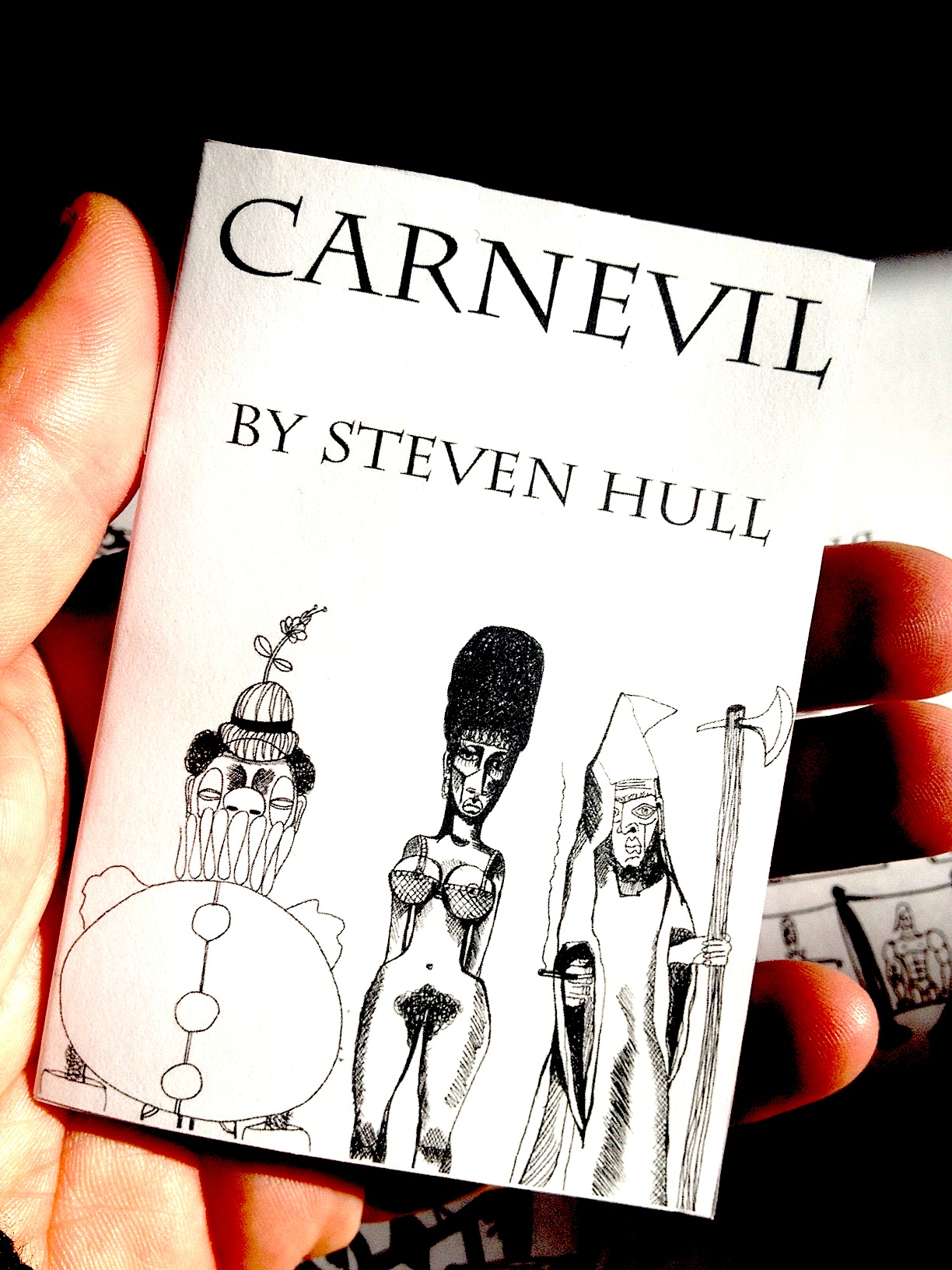
The thirtieth title from Piece of Paper Press is CARNEVIL by Los Angeles-based artist Steven Hull, which has been produced in a limited edition of 200 numbered copies.
In 2014 Hull made the Circus of Death for actor Jack Black’s Festival Supreme at the Shrine Auditorium in Los Angeles. The dark and humorous circus—described by the LA Times as an ‘an art installation like no other [an] artist-designed theme park’—included a spooky train ride that carried passengers through artist-made fantastical worlds such as The Iceberg of Torment, Monster Windmill and Marionette Castle. The circus also featured a handmade monster merry-go-round, creepy puppet shows, large-scale video projections, sculptures and freak-show characters. The selected drawings in CARNEVIL were made in preparation for Circus of Death, and have been re-imagined for this book.
‘Psychologically prickly … its raucous abundance here mostly mixes incoherent chaos with psychedelic fun … The cacophony of opposing artistic styles, from Expressionist vitality to Constructivist logic and Dada subversion, gives Hull’s revelry its punch.’—Christopher Knight, Los Angeles Times
Steven Hull was born in 1967. He lives and works in Los Angeles. Hull has shown internationally and is represented by Rosamund Felsen Gallery, Los Angeles. Hull Is known for book and music projects where he enlists large numbers of artists to work together to create a final art piece. For many years he has run the publishing company Nothing Moments Press and, for three years the non-profit space Las Cienegas Projects in Culver City.
Accompanying the 30th title from Piece of Paper Press is an index of all titles published by the project since its inception in 1994. Printed in an unnumbered limited edition of 200, on 100% recycled, 80gsm, uncoated paper using a Gestetner 320 stencil duplicator from hand-drawn and manually typed stencils, ‘Titles 1994-2015’ is embellished with a stencilled detail from Steven Hull’s CARNEVIL. ‘Titles 1994-2015’ was produced in collaboration with James Pennington of legendary underground publisher Aloes Books at a secret location on the Lower Seven Sisters Road.
Tony White and Steven Hull have collaborated before. Hull’s monumental A Puppet Show commission for the one-night-only digital arts triennial Glow: Santa Monica in 2013 was based on Tony White’s short story ‘A Fragment from the Lives of the Conquistadors’. A vinyl LP by Hull, featuring White’s story with sounds and music by Hull, Gibby Haynes, Petra Haden, Tanya Haden and Anna Huff was released on Nothing Moments in 2014. White also contributed short stories to Hull’s Ab Ovo project in 2005-6, Nothing Moments in 2007 and the 2009 group show Landscape Memory Revisited at Las Cienegas Projects.
I spent an interesting day at the British Library, where I was speaking at Reading and Being Read: Readers, Writers, Publishers, an event put together by the BL in association with the Insitute for Modern and Contemporary Culture at the University of Westminster.
I was the final speaker and opened my presentation with a reading of my short story ‘The Holborn Cenotaph’, before speaking in more detail about Piece of Paper Press, the artists’ book project that I started in 1994. It felt a great honour to have been able to take ‘The Holborn Cenotaph’—and the people that it calls upon readers and audiences to remember—into an institution as august as the British Library, to have been able to present it under their aegis, as it were. I am grateful to the many audience members who took photographs during the reading— including this one from my book trade colleague Sheila Bounford—and to those who tweeted during and after the reading. Here are a couple of those (more tweeted reviews of the story are collected here):
My presentation followed what had been a number of fascinating presentations, by author Susie Nott-Bower and publisher Lynn Michell of Linen Press, by author Alex Pheby and publisher Sam Jordison of Galley Beggar. There were also some very well-handled demonstrations of innovative publishing projects from students of the London College of Communication, who were introduced by Frania Hall of LCC.
As well as being asked to speak about Piece of Paper Press, I was invited to wrap up the day. There was even the suggestion that in so doing it might be possible to engage the audience in some sort of collaborative act of publication. Unsure if that was even possible in fifteen minutes, I suggested that if so it would need to be quick and punky; about ideas rather than craft.
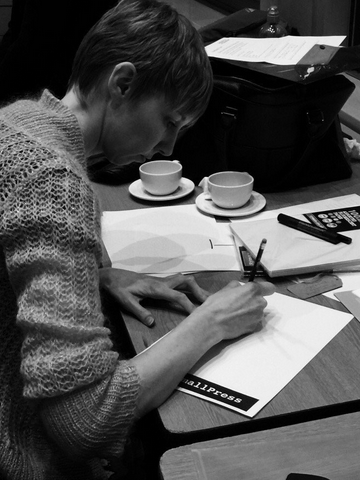
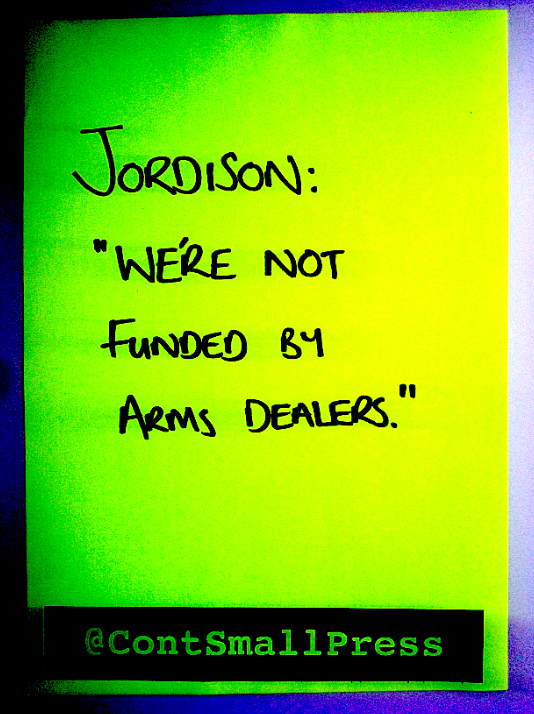
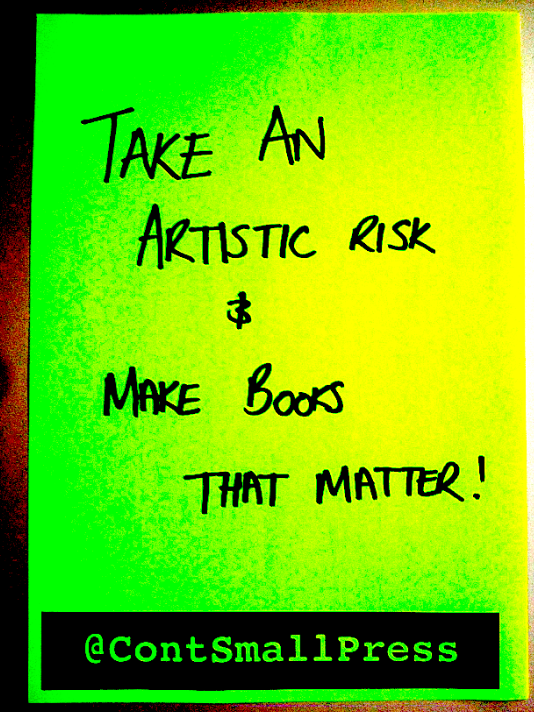
A quick survey of the audience at the British Library revealed that a number had been making notes. Had anyone, I asked, underlined something, or put a ring around it? Had anyone made a special note of something that had been said? I was grateful to Sally Willow of the University of Westminster for acting as a note-taker herself during this session. We gathered the audience’s choicest notes and quotes, and held a quick vote to select the four most memorable lines. Sally then rendered these in the style of newspaper hoardings, which were immediately run off in editions of fifty for people to take home. Here are my copies.
If you don’t already receive invites from me and/or my publishers and producers to my book and project launches, special gigs and events, but you would like to, then please consider signing up to my mailing list.It doesn’t cost a thing.
There are some exciting projects and titles coming up through 2016, so now might be a good time ;)
I recently interviewed the poet Paul Hawkins for The Quietus about Place Waste Dissent, his new book for Influx Press. Place Waste Dissent is a fascinating and visually striking new book of poetry collage documenting the squat culture and M11 protests of the early 1990s that centred on Claremont Road in Leytonstone, East London. I knew several people who lived on Claremont Road. One such resident was the pioneering UK video artist and filmmaker Ian Bourn, who I knew through his friend and one-time collaborator the late Helen Chadwick who was a friend and neighbour of mine in Beck Road—another community of artists living in ‘Acme houses’, as they were known—where I lived at the time.
I loved Hawkins’ book. The lo-fi, analogue, cut and paste of word and image is richly redolent of that early ’90s squat and crusty culture. As I mention in the article, this was a scene that I also quickly turned around in my own fiction, writing a deliberately loose and libidinised version of the M11 protests in what became my debut novel, the ‘avant-pulp’ Road Rage! which was published in 1997. Paul Hawkins has taken rather longer in reporting from Claremont Road, but in doing so he has perhaps been truer to the troubled textures of the time, and both more generous and more critical than I had cared to be with my own more immediate fictional responses.
The interview is now up. Here’s a taster:
TW: Among the extensive and very evocative contemporary documents and ephemera that you’ve used in PLACE WASTE DISSENT … is a very interesting photocopied who’s who, an updated list of occupants and state of repair of all the Claremont Road houses: ‘15: Mick, squatted … 32: Dolly’, etc. Some of the houses had evidently gone through this cycle of destruction several times. Number 16, for example, reads: ‘TRASHED SQUATTED TRASHED SQUATTED’. It’s only a matter of time, you get the feeling, before that would have been crossed out again. A lot of these papers are from your own collection. How on earth did you keep hold of all this stuff?
PH: Whenever anybody got served legal papers, eviction papers, they would be photocopied and circulated. There was a solicitor involved who had people looking at these materials, and everyone passed the papers around. I started keeping a folder, a big ring-binder with all these plastic sleeves full of magazine articles, notes, posters from benefit gigs, letters, everything. It seems bizarre because at that time in my life things were getting a bit messy around the edges, but somehow whatever else happened I managed to keep it all safe.
Years later, when I was putting the book together, I was also able to refer to a huge archive of No M11 Campaign materials held at the Museum of London which included local, national and international newspaper coverage. A curator there called Beverley Cook was very helpful. I made an appointment to view this, taking copious notes. There were all these ’zines and magazines, a local broadsheet called The East Ender. Around the late ’80s and early ’90s there were a lot of crusty, traveller, eco-campaigners. There were squat bands, anarchist bands. This was the tail-end of the rave scene and the beginning of things like Reclaim the Streets.
TW: This really was a kind of front line at the time.
PH: Yes, and with other protest groups, other proposed motorways, at Newbury, the Dongas at Twyford Down, the M77 and Pollok Free State and the Anti-Criminal Justice Bill protests.These and other groups were not cohesive but there were means of contact, which grew in strength. The increasing media awareness both helped and hindered. [READ MORE …]
I was pleased to see my old friend the artist Ian Bourn making an appearance in Place Waste Dissent, too. At one point, Hawkins reports standing out in the cold one night to see HOUSEWATCH, a cinematic public art spectacular projected onto the windows of number 8 Claremont Road, from the inside:
‘we blink / stars around the sky / as window cine-film / loops the world … breath steaming to frost.’
This idea of projecting onto windows from the inside, for the benefit of passing pedestrians, has been taken up by new generations of artists and curators. A couple of years ago, for example, Peer and Animate Projects commissioned four animators to make works for Peer’s windows on Hoxton Street for the Out of Site project. (You can download a PDF pamphlet edition of my short story ‘Animate Me’—which was commissioned as part of Out of Site—here.) And I recently bumped into Ian Bourn and others on Essex Road in Islington, North London, where a crowd had gathered for a programme of film screenings called Essex Road II that also perhaps owed much to Housewatch. These screenings had been put on by the gallery Tintype, who had commissioned eight artists—Jordan Baseman, Helen Benigson, Sebastian Buerkner, Jem Cohen, Ruth Maclennan, Melanie Manchot, Uriel Orlow, John Smith—to make ‘short films in response to the mile-long road. The gallery’s large window becomes a public screen for six weeks over Christmas and New Year.’
Essex Road II – opening event 1, 2015. Photo: Tintype
Among the artists projecting new film works onto Tintype’s windows in December 2015 was John Smith, another Claremont Road veteran. On the Place Waste Dissent website, Paul Hawkins links to Smith’s film Blight, which was made in collaboration with composer Jocelyn Pook for a short-lived BBC2 commissioning strand called Sound on Film in 1997. Blight is an apt title, and like Hawkins’ book, Smith and Pook’s collaboration is another evocative document of the Claremont Road demolitions.

 ch and Spanish. To date, English editions of Croatian authors have been the result of individual endeavours and the passion of a small number of translators and publishers with a special interest in translated literature. But while ‘big’ languages have a tradition of systematically promoting books, such as the leading publications 10 Books from Holland and New Books in German, Croatian literature is still terra incognita to most publishers, editors and the broad reading public. This is hardly surprising because well-translated, representative excerpts from the best Croatian titles are neither cheap nor easy to come by. That is why we have decided to launch 5 Books from Croatia – a publication with a clear editorial conception that once per year will present four contemporary authors and one classic, a ‘forgotten gem’.

 ‘The Holborn Cenotaph’ was first performed in the Renaissance Revival chapel of King’s College London for King’s Arts and Humanities Festival 2014, as part of a collaboration with the artists Stuart Brisley and Maya Balcioglu, and Dr Sanja Perovic of King’s. At the time, White was Creative Entrepreneur-in-Residence in the French Department at King’s, funded by Creativeworks London. Since then White has taken ‘The Holborn Cenotaph’ to audiences around the UK at venues ranging from the British Library to Turner Contemporary, Margate, London Radical Book Fair and many live literature events and programmes. Following each reading, a pamphlet edition of the full text is distributed free.
 Since October 2014, White has given many readings of ‘The Holborn Cenotaph’, appearing at events and venues including London Radical Book Fair, Brixton Book Jam, Lit Crawl London 2015, The Contemporary Small Press Book Fair, London, In Yer Ear #10 and #15, The MAC in Belfast (with Brisley et al), Richard Strange’s ‘Cabaret Futura’, The Cornelius Foundation’s ART of Conversation supper club, Venice Agendas 15 at Turner Contemporary, Margate, Reading and Being Read at The British Library, and more.








 Piece of Paper Press & tonywhite.london
You must be logged in to post a comment.