Sign-up here to receive my irregular newsletter containing news and invites to forthcoming events, launches, publications etc.
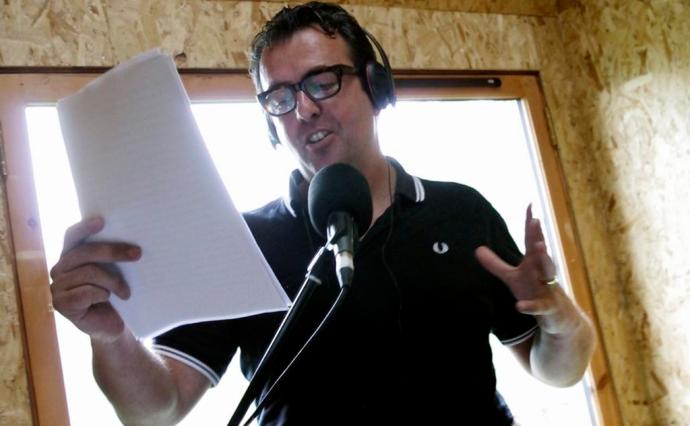
Video still © Inga Tillere, 2014
Visit https://tinyletter.com/Tony_White for more information.
Sign-up here to receive my irregular newsletter containing news and invites to forthcoming events, launches, publications etc.
Video still © Inga Tillere, 2014
Visit https://tinyletter.com/Tony_White for more information.
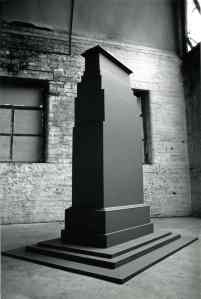
Stuart Brisley, The Cenotaph Project, 1987-91, Installation (with Maya Balcioglu). Image: Maya Balcioglu.
On 26 March I will be in Belfast to take part in a panel discussion revisiting Stuart Brisley and Maya Balcioglu’s Cenotaph Project (1987-91). I will be speaking and reading alongside Brisley and Balcioglu, Dr Sanja Perovic of King’s College London, and Dr Colin Darke. A previous event on this theme was held at King’s in London as part of their Arts & Humanities Festival 2014. This time we are speaking at The MAC Live in Belfast, where Stuart Brisley is currently exhibiting. Here is the blurb for the MAC event:
The British painter, sculptor and performance artist Stuart Brisley is widely regarded as a key figure in British art. Along with his frequent collaborator, Maya Balcioglu, he has unflinchingly probed the political, cultural and social mores of his time in a career now spanning six decades.
The word ‘cenotaph’ literally means an ‘empty tomb’ (from the Greek ‘kenos’, empty and ‘taphos’, tomb). It both conceals remains that are lost or buried elsewhere and serves as a powerful signifier of military and state power. It thus raises questions about the relation between what is ‘above ground’, state-sanctioned, revealed and what remains underground, buried and concealed.
For this project the artists exhibited models of the Whitehall Cenotaph, scaled down to match the typical height of a council flat ceiling, in six locations across the UK. From a mute signifier of ‘official history’ the various, smaller cenotaphs opened a space for a critique of history and the possibility of change.
This event will include presentations from the artists Stuart Brisley and Maya Balcioglu, writer and academic Dr Sanja Perovic, and Belfast-based artist and writer Dr Colin Darke, followed by an open discussion amongst the speakers and audience.
The event will conclude with a reading by London-based author Tony White, of a satirical short story entitled The Holborn Cenotaph, written in response to Brisley and Balcioglu’s project, in the tradition of Jonathan Swift’s A Modest Proposal.
Additionally, I hear from the MAC that a new bookwork, Stuart Brisley – Performing the Political Body and Eating Shit, commissioned by the MAC on the occasion of the exhibition Stuart Brisley: Headwinds will also be launched during this evening. The author of this comprehensive text on Brisley’s performance practice, Michael Newman, will be in attendance.
§
I am looking forward to taking part in a panel discussion about climate change and literature with Mirko Bonné and Chris Rapley. The event is on 17 March at the Goethe-Institut, London and is organised by the Free Word Centre and the Goethe-Institut. Here is the blurb:
Assessing the current political temperature and social climate, Weather Stations is an international project that places literature and storytelling at the heart of conversations about climate change. As the debate around communicating the issue of climate science rages, and the imperative of alerting the world to the impact of our changing climate becomes even more urgent, Chris Rapley, Professor of Climate Science at UCL, reminds us, ‘The whole point about climate change is that it is not really about the science. It is about the sort of world we want to live in and what kind of future we want to create.’
Hear Weather Stations Writer-in-Residence Mirko Bonné in discussion with Tony White, author and former writer-in-residence at the Science Museum, and Chris Rapley, Professor of Climate Science at University College London, previously Director of the Science Museum. The evening will be chaired by Jay Griffiths, the author of A Love Letter from a Stray Moon, and takes place at the Goethe-Institut.
§
Tuesday, 17 March 2015, 6.30pm doors open, 7pm Event starts
Goethe-Institut London
Admission free, booking essential
Registration: +44 20 75964000
This is a PDF of the cover layout that went to print for my 2013 Science Museum novel Shackleton’s Man Goes South. (The various ‘paste-up’ marks visible here don’t show in the finished print.) The front cover components had been discussed at length and comprise: the background colour gradient, Jake Tilson’s ‘melting’ Shackleton’s Man Goes South logotype, the Science Museum logo, my name, a clear message that this is a novel (an unusual proposition for a book published by the Science Museum), and Marina Warner’s advance quote. 
The Museum designed this as a ‘cover kit’ rather than a single, fixed-format image. The idea was that these components could be adapted to different online situations, being easily reconfigured to generate cover images that would be compatible with letterbox, square and other default profile pic and thumbnail formats. The colour gradations, of course, suggest warming.
§
Download a free copy of Shackleton’s Man Goes South in formats compatible with all ebook readers
Press about Shackleton’s Man Goes South
An exhibition accompanying the Science Museum’s publication of Shackleton’s Man Goes South is on show in the Museum’s Atmosphere Gallery until at least 24 April 2015. Science Museum, Exhibition Road, London SW7 2DD. Nearest tube: South Kensington. Open seven days a week, 10.00-18.00. Entry to the Museum is free.
Read about publication of Shackleton’s Man Goes South on Publishing Perspectives
Subscribe to my irregular newsletter for invites and news about forthcoming books and events

The cover of Low Life Books’ paperback of Road Rage! featured Dave McCairley’s photograph of a fire artist. The picture had been taken in 1996, during a demonstration outside Hackney Town Hall against evictions from ‘The Spikey Thing With Curves’, which was the name of a large squat in a former Salvation Army building and Methodist Hall opposite the Hackney Empire on Mare Street.
§
 This week is the annual fundraiser for London’s arts community radio station, Resonance 104.4fm. The annual fundraiser is vital to keeping the station on the air. Here is the message from the Resonance 104.4fm Fundraising Week page on Facebook:
Last year, we raised nearly £30,000 – which allowed us to replace our transmitter, complete a second studio, and cover the increased rent on our broadcast antenna. This year, our target is £50,000 and we want to trial a DAB service, entirely overhaul our website, and increase the range of our FM broadcast beyond central London. If every listener gave £1, we’d have secured this remarkable radio station’s future for the next decade. Resonance provides a radical alternative to mainstream broadcasting; it is a mainstay of and influential force within the global arts community; and it is an invaluable charitable resource which operates on a local, national and global level. If Resonance speaks to you, please support us by attending one of our events, bidding in our online auction, or making a donation of any size. Visit this fundraising site for all events and updates.
I love what Resonance 104.4fm do. I am honoured to chair the station’s board of directors and to support the station’s staff, programme makers and volunteers and the important work that they do. Last year I made an announcement about Resonance 104.4fm’s major commitment to books coverage, so here are just a few of the books-related items to be bid for in the fundraising auction:
All My Puny Sorrows by Miriam Toews (Faber)
Dept. of Speculation by Jenny Offill (Granta)
Dust by Yvonne Adhiambo Owuor (Granta)
Family Life by Akhil Sharma (Faber)
How to Be Both by Ali Smith (Hamish Hamilton)
Nora Webster by Colm Tóibín (Viking)
Outline by Rachel Cusk (Faber)
 Rich and varied, with writers originating from North America, the UK, Ireland, Kenya and India, the shortlist comprises a wide range of international voices. Familiar prize-winning names – Ali Smith and Colm Tóibín – are joined by critically-acclaimed newer voices such as Ben Lerner and Yvonne Adhiambo Owuor. A number of these books are explicitly engaged with the process of writing itself, with each in its own way triumphantly affirming the unique role storytelling plays in making sense of our complex world. With thanks to The Folio Prize and FMcM.
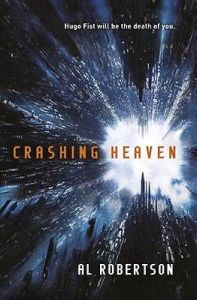 Gollancz have generously donated a bound proof bundle of three of the best forthcoming science fiction and fantasy novels. They are:
The Death House by Sarah Pinborough. A heart-breaking, heart-stopping tale of love, live and death which will take your breath away.
Something Coming Through by Paul McAuley. One of our finest SF writers moves closer to home. London is devastated. New worlds are being explored. And the aliens have arrived…
Crashing Heaven by Al Robertson. Meet Hugo Fist, the most terrifying and enticing AI to grace SF since the works of Al Reynolds and Hannu Rajeniemi.
 Twelve-year-old Henry ‘Hank’ Zipzer is smart, resourceful, and he has dyslexia. When problems arise at school he deals with them in unconventional ways, putting him on a direct collision course with his teachers. But Hank always remains positive and convinced that the next big plan will deliver — after all, tomorrow is another day! The Hank Zipzer series draws upon Henry Winkler’s own experiences of growing up with dyslexia. It is now a popular television series with CBBC, and Henry Winkler stars as music teacher Mr Rock. www.hankzipzer.co.uk
Generously donated by Walker Books Ltd.
 Goodbye to Soho and Dirty White Boy by Clayton Littlewood
London Calling and The Long Weekend by Clare Lydon
Repercussions by Catherine Hall
Fairytales for Lost Children by Diriye Osman
I Am Nobody’s Nigger by Dean Atta
These eight signed books have been kindly donated by the team behind the Out In South London programme and contributors.
§
There is plenty more to bid for, too, from Abba Treasures to some beautiful Billy Childish prints, from a rare Liliane Lijn artists book from 1972, to singing lessons with a mezzo-soprano or a tape-loop workshop with Robin the Fog. There are some incredible theatre tickets from The Curtain Up Show, records, rarities, meals-for-two and much, much more besides.
Here is comedian Stewart Lee on why he loves Resonance 104.4fm.
 I’ll be joining colleagues and pals including Carol Watts, Peter Hughes, Toby Litt, Robert Hampson, Jennifer Cooke, Nicholas Royle, Amy Cutler, Rod Mengham, and Michael Nath, for The Contemporary Small Press symposium and book fair at the University of Westminster on 20 February. Come and join us too. Here’s the blurb:
The last decade has witnessed a turn to considering the legacies of modernism prevalent and operative within contemporary literature and culture. Within the scholarly discourses surrounding this shift, there has been little discussion of the status of the small press in the twenty-first century, and its vital role in the dissemination of avant-garde writing. This symposium seeks to address the role and status of the small press in the UK as a field of academic enquiry. We aim to offer a forum that will bring together a number of small presses, and facilitate productive dialogue between the diverse publishers working with contemporary innovative writers and poets.
The day symposium consists of three panels of scholars, publishers, writers, and poets, which will explore the history of the small press, literary politics and the relationship between the small press and the mainstream, and take up issues surrounding materialities of the text and small press publishing. The Contemporary Small Press Book Fair following the symposium will showcase and market the rich and varied work currently being published by small presses.
Participating presses include Oystercatcher Press, Reality Street, Route, Veer Books, Comma Press, and Equipage.
A collection of new writing by writers and poets taking part in the symposium, outLINES: from the Small Press, published in collaboration with Oystercatcher Press, will be available on the day.
§
Friday 20th February 2015, University of Westminster, 309 Regent Street, London W1
The Contemporary Small Press: A Symposium — 10:00-17:00, Book Fair and readings — 18:00-21:00
The symposium is free to all but booking is essential
Dom is obviously not around to confirm this, very sadly, but Gaz would back me up that he swore us to secrecy and like I say I’m absolutely 100% that he’d known this would happen and that was why he’d done it. It was part of the plan and anyone who remembers Dom will not be surprised when I say this or that he did not leave it there.
That wasn’t Dom’s style. Unfortunately he didn’t really go for half-measures.
A few days later (and thinking about it now it must have taken him that long just to prepare everything) he went back more properly equipped and did a whole TG graphic: the black square, red bar across the middle, white flash of lightning down the centre. He put a smaller TG in bold white capitals at the five o’clock position. He was a great artist Dom, and a perfectionist, so he made a really good job of it, painting the whole square white first the way any artist would do, to give himself a good ground to work on for even cover and to get perfect whites in the finished piece. He used stencils and got that slightly off-register look which made it really stand out. Then he took a Polaroid of the finished article which he gave me the next day and I’ve still got, somewhere.
I don’t know who they thought was doing this, but one of their own, evidently, because during the weeks that followed as spring turned to summer the Trouble Gang’s ‘new’ graphic identity really caught on and variations on that black and red square, the lightning flash, the T and the G, started appearing around the place, further afield than just that particular wall over Turbary. You’d see home made stickers on bus stops or lamp posts, that kind of thing.
Trouble Gang.
The lightning flash.
‘Oh, aye-aye,’ Gaz would say.
From the short story ‘A Porky Prime Cut’.
Listen to Tony White’s reading of ‘A Porky Prime Cut’ with music from UK Acid House pioneer Richard Norris, as performed at the Free University of Glastonbury and the October Gallery, London.
§
 Get your FREE Artists’ eBooks edition of ‘A Porky Prime Cut’
Subscribe to my irregular newsletter for invites and news about forthcoming books and events
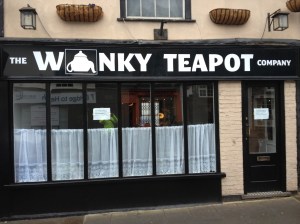 Hello. If you are coming to my site because you have ‘liked’, shared, tweeted or
  retweeted my photo of Uxbridge’s newest cafe in the past day or so — or seen it in the various newspapers (e.g. Metro, The Mirror) and other websites where the photo has been posted — then I think you might also enjoy my London novel Foxy-T, which is published by Faber and Faber ;-)
Foxy-T is also set in a small shop — the E-Z Call, a fictional internet shop in Whitechapel, London, rather than a tea shop in Uxbridge. Author and critic Toby Litt described Foxy-T as his ‘favourite British novel from the past ten years’. Here’s what else he said:
Foxy T is mostly set in the E-Z Call shop on Cannon Street Road. It’s written in a style that I can only describe as 100% Pure London, meaning a mix of here, there and everywhere. It tells the story of Foxy-T and Ruji-Babes, two very streetwise girls who are not without their troubles. Although not a big book in terms of length, Foxy-T encapsulates an astonishing amount of now – and it does it funnily, honestly, sexily and tenderly. Toby Litt, Guardian
I’ve been amazed by the response to the photo that I tweeted of this little Uxbridge tea shop (maybe I will share some of the incredible stats here another time). I am delighted to know that I wasn’t the only one who did a double take. That is what makes me think that if you ‘liked’ The W*nky Teapot, then you’ll LOVE Foxy-T.
§
Subscribe to my irregular newsletter for invites and news about forthcoming books and events.
Join the official Foxy-T page on Facebook





You must be logged in to post a comment.