It is no surprise that the launch of a new Assessment Report by the UN Intergovernmental Panel on Climate Change or IPCC should be a major news event. Here after all is an international, scientific and political effort, involving many thousands of people, that began with the formation of the IPCC by the United Nations in 1988, and which since 1990’s First Assessment Report (or ‘FAR’) has seen the successive publication of further vast and authoritative reports that each, surveying the science of their time, have presented evidence that shows, with increasing certainty, that the global climate is at risk from man-made greenhouse gases and is changing as a result.
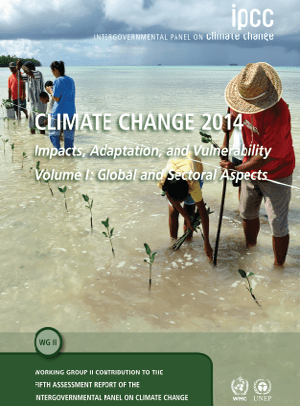 That work has continued this year with the release of the various constituent parts of the Fifth Assessment Report (AR5) by each of the IPCC’s three working groups. Publication is staggered, and began with the release in Stockholm last September of Climate Change 2013: The Physical Science Basis (also known as The Working Group I contribution to the IPCC Fifth Assessment Report, or WGI AR5 for short). This has been followed, in the past few weeks – with launch events in Yokohama and Berlin respectively – by Climate Change 2014: Impacts, Adaptation, and Vulnerability (WGII AR5) and Climate Change 2014: Mitigation of Climate Change (WGIII AR5). A final Synthesis Report is due to be launched in Copenhagen in late October 2014.
 Anyone with access to media will probably either have followed or been aware of the news coverage attendant upon the launches of these latest reports, at least for the few days that they were on the television or in the newspapers, but I wonder how many people have read the reports for themselves, or even been tempted to dip in? Here, in effect, is a great collective work of non-fiction that attempts to communicate with more urgency than ever before what may be the greatest threat that human civilisation has ever faced; and all of this not – it seems – at some far future point, but this century and within the next few generations. If carbon and other greenhouse gas (GHG) emissions are not curtailed, then the children and grandchildren of today’s generations are likely to have their lives altered – or ended — by the impacts of the climate change those greenhouse gases cause. Furthermore, it is likely that dangerous levels of warming and ocean acidification are already locked-in to the system and would continue to manifest even if most GHG emissions were stopped tomorrow.
All of which is, frankly, terrifying. So why aren’t we all poring over every paragraph and treating these IPCC reports as a kind of must-read, instruction manual for the future? Admittedly, the cumbersome bureaucratic language, the multiple volumes and the endless acronyms may not help, but then, IPCC reports are not aimed at a general or non-specialist readership. Even the summaries, the idiot-guides, are aimed at policy-makers – so, civil servants and politicians, rather than the people that elect the politicians – hence the title: Summaries for Policy Makers, or SPMs for short.
To an interested non-policy maker, WGII AR5 feels like it might be the most accessible IPCC report yet. It is illustrated with various graphics, the simplest of which – though ‘simple’ is an adjective I use advisedly here – use colour or a distribution of icons on world maps to show actual and projected degrees of warming, ocean acidification, impacts on fisheries etc.. Elsewhere, and much less easy to read, are multi-axis graphs or visual models showing, say, the maximum speed at which various living species can move habitat (in km per decade) mapped against average ‘climate velocity’, meaning the ‘speeds at which temperatures are projected to move across landscapes’ (Fig. SPM.5), or the progressive increase in the inter-annual variability of crop yields (Fig. SPM.7). I was surprised, in the days immediately following publication, to see people tweeting some of these diagrams, even though the size and the levels of resolution afforded to pictures on Twitter seemed only to compound their near-illegibility.

© 2014, IPCC
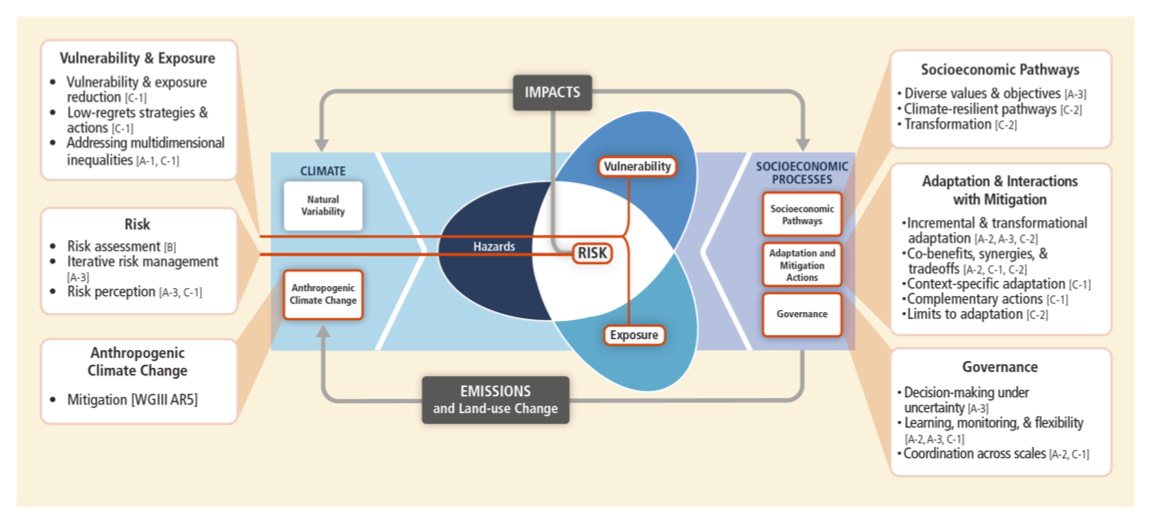
Most enigmatic of all may be ‘Fig. SPM.8: The solution space’ (left), which at first glance resembles a slightly retro-futuristic, winged atom, with ‘risk’ as its nucleus. A central, three-lobed, Venn-like figure shows not the orbits of sub-atomic particles, but – I think – that both risk and impacts are created by the interplay of hazards, vulnerabilities and exposure, all of which are squeezed by climate on the one side and socio-economic processes on the other, with impacts then causing further feedback to both sides (climate and socio-economic process), while the emissions and land-use changes caused by the socio-economic processes immediately affect the degree of anthropogenic warming.
Incidentally, the IPCC authors’ own explanation of this diagram as being one of ‘core concepts … overlapping entry points and … key considerations’ is practically meaningless. (Also, FWIW, the similarity is superficial, but I was reminded of sculptor Dušan Džamonja’s 1967 Monument to the Revolution of the people of Moslavina at Podgarić, Croatia.)
 In spite of moves towards accessibility then, IPCC reports are manifestly designed more to be agreed point-by-point and signed-up-to, than to be widely read in and of themselves. In effect this means that the IPCC is simultaneously over-reliant upon the news media (which must act both as translator and primary channel) and strangely indifferent to the wider readership that can be reached thereby. Does this mean that a couple of days or a week of news coverage – with all the vagaries that entails – is the best that can be hoped for, before responsibility is humbly handed back to the policy makers? Not that every UN Member country has one, but don’t electorates, where they do exist, need to be galvanised into some sort of awareness, if not action, in order to hold those same policy makers to account?
One advantage of the fact that the IPCC’s publication process is spread over several months is that this has usefully highlighted — lent momentum to — a number of other climate change-related events. At the end of February the UK’s Royal Society and the US National Academy of Sciences published their own joint report Climate Change: Evidence & Causes (link opens as PDF) which although it is also aimed at ‘decision makers, policy makers, educators’ does acknowledge ‘other individuals seeking authoritative answers about the current state of climate-change science’ among its potential readership. Written clearly and with matter-of-fact educational sections – ‘Learn about the ice ages’ – to address likely knowledge gaps, the report opens with an extensive Q&A section. Questions such as, ‘Does the recent slowdown of warming mean that climate change is no longer happening?’ prompt simple, one paragraph answers. (‘No’, apparently, if you were wondering.)
 In the meantime, on the same day that the IPCC launched WGII AR5, the giant US oil corporation ExxonMobil released two reports to shareholders on managing climate risk (satirically summarised by Steve Kretzmann of clean energy campaign group Oil Change International as ‘Exxon to World: Drop Dead’) which baldly state that climate change will not prevent it exploiting all proved hydrocarbon reserves, a definition broad enough to even include some ‘that are not yet classified as proved reserves’.
It is probably not a coincidence that ExxonMobil’s reports were released on the same day as the IPCC’s report on the impacts of climate change, so it is interesting to note superficial similarities in tone that are created by the occasional quotation of IPCC graphics, and by the language used. The words ‘impact’ or ‘impacts’ feature prominently in Exxon’s reports to shareholders too, although these are almost all (83% by my calculation) statements about impacts of policies to mitigate climate change, not the impacts of climate change itself (e.g. ‘the damaging impact to accessible, reliable and affordable energy resulting from the policy changes’, on p.22 of Energy and Carbon: Managing the Risks, or ‘the cumulative impact of such policies’, on p.21, etc.). If the stakes were not so high, ExxonMobil’s détournement of the language of climate science, together with the vagueness that is created by their combination of business flannel and necessary disclaimers, might be almost laughable. ‘We do not project overall atmospheric GHG concentration, nor do we model global average temperature impacts’, they say (on p.5 of the same report), because, ‘These would require data inputs that are well beyond our company’s ability to reasonably measure or verify’.
In such contexts the term ‘business as usual’ has become shorthand for inaction, and thus almost synonymous with runaway climate change. As Karl Mathieson put it, during the Guardian’s live blog coverage of the launch of WGIII AR5: ‘A business-as-usual scenario will lead to 3.7C to 4.8C rise in temperature before 2100.’ Business as usual in the ExxonMobil model presents inertia as if it were a proactive strategy. It means that ‘none of [their] hydrocarbon reserves are now or will become “stranded.”’ (p.1).
 ExxonMobil ‘envision’ a world of continued economic growth and rising living standards, in which energy needs will continue to increase and will best (or ‘especially’) be met by oil and natural gas. In this euphemistic and topsy-turvy vision of the future – an iron fist in a velvet glove if ever there was one – ‘the “low carbon scenario” advocated by some’, (i.e. the attempt to keep global warming below an average 2°C as agreed by all countries who are signatories to the United Nations Framework Convention on Climate Change) will not arise, because the associated costs and ‘the damaging impact’ of such policy changes would not be fair on ‘the world’s poorest and most vulnerable’ (p.22).
During this period of what may in fact be a heightened awareness of the issue, media coverage of climate change in the UK even became the subject of that same media’s own scrutiny, after MPs criticised the BBC for presenting a ‘false balance’ in discussions of the subject, by giving political opinions and those of lobbyists for the fossil fuel industry equal weight with scientific fact. The comments followed an appearance on 13 February 2014 by former UK Chancellor of the Exchequer and prominent climate change sceptic Lord Lawson of Blaby on BBC Radio 4’s Today Programme, to be questioned alongside leading scientist Sir Brian Hoskins on whether the extreme weather that Britain was experiencing during the winter of 2013-14 might have had anything to do with climate change. It is worth listening to the audio of the programme, which the BBC have made available, in order to hear how Lawson, the seasoned politician, is able to dominate the interview. It should be required listening for any climate scientist contemplating a media appearance. Lawson feeds reasonable-sounding lines to Today presenter Justin Webb, some of which Webb repeats uncritically: ‘Lord Lawson was saying though, there’s been a pause […] that is the case, isn’t it?’
 Hoskins’ response, that warming is being absorbed by the oceans, is then expertly interrupted by Lawson, who speaks over him with repetitive and authoritative, commonsensical-sounding bluster: ‘That is pure speculation.’
‘No it’s not,’ a bemused-sounding Hoskins tries to assert. ‘It’s a measurement.’
‘Well, it’s a combination of the two, isn’t it,’ says Webb, managing to neatly encapsulate the problem of false balance in one sentence. ‘As is this whole discussion.’
In March, the current UK government’s Chief Scientific Advisor, Sir Martin Walport set out on a lecture tour of science centres around the country. I attended the London date, which was held at the Science Museum and had been pitched as an opportunity to
join in the discussion on how science informs our government’s response. How can we best mitigate climate change? What needs to be done to adapt to inevitable changes? And how can we respond to human suffering caused by climate impacts?’
All in all, then, in Sir Martin’s disarming opening words, ‘a pretty important topic.’
It was an interesting talk – illustrated with slides – in which Walport spoke about the value of the IPCC’s meta-analytical process and how decadal averaging shows that ‘the warming of the climate is unequivocal’, before he robustly dismissed the flat-earthers’ favourite: ‘Really, there’s no evidence of a pause.’ While it went unattributed, a sentiment very similar to the current UK Environment Secretary Owen Paterson’s disingenuous canard about warming being good for UK crops was then also summarily rejected. I learned, for example, too – via Walport’s recommendation of the University of Southampton’s GridCarbon app, which tracks the carbon intensity of UK power generation in real time – that thirty years after the Miners’ Strike, coal is still the largest source of power generation in this country; forming 37.3% of the ‘generation mix’ at time of writing.
 But Walport’s largely fascinating lecture was not without its surprises, too. ‘Oil companies are not the source of fossil fuels,’ he insisted at one point, with pointless geological accuracy. He also overturned current scientific understanding (summarised by Professor Paul Bates of the Royal Society as, ‘climate-related hazards hit those living in poverty the hardest’) by suggesting that advanced societies are less resilient to climate change because they have more to lose. A later suggestion – perhaps intended as symbolic of the carbon emissions-reducing, day-to-day choices we might make – that turning the heating down and wearing a woolly jumper was a serious climate change mitigation strategy, prompted me to write ‘Blimey – shades of Protect and Survive!’ in my notebook. There was also an amusing, political Freudian slip when Sir Martin, interacting with one of his slides, said, ‘… that takes us to the far right— I mean the top right of the current graph.’
During the Q&A session that followed, one of the few rather gentle questions seeking clarifications of this or that point, was greeted with a testy response: ‘No,’ he said, ‘I made it perfectly clear that—’ And here I was so surprised by his tone that I forgot to note down what the question had been, but the inadequacy of the answer was striking (as was the self-evident contradiction at its heart: if the point really had been made so clearly it might not have needed clarification).
There is a certain movement in climate science which says that scientists shouldn’t get involved in policy at all. This echoes or amplifies the IPCC’s own recognition that their work is ‘policy-relevant and yet policy-neutral, never policy-prescriptive’. Does this arm’s-length approach also extend to communication? The idea that taking any message to a wider public is simply not part of their remit, or that it strays too close to a policy intervention? Certainly, Sir Martin Walport has stated in the past that, ‘The job of scientists is to undertake the scientific work and to advise politicians on science – and it is to them that we must turn for the final decisions.’ (My italics.)
Later I wondered if this short lecture tour (even if it had been to largely sympathetic audiences, such as the one at the Science Museum) had felt to Walport like taking the issue to the masses; as if he was going out and slaying lions. The image (from literature) that came to mind was an unexpected one. Perhaps, like the rose in Antoine de Saint-Exupéry’s fable The Little Prince, some scientists might also be a little vain, ‘naïve. They reassure themselves as best they can. They believe that their thorns are terrible weapons…’
‘“Let the tigers come with their claws!”’
 Perhaps in any case the subject is too vast and complex for any real clarity to be possible or accessible to the layperson: another example of what the late Rebecca West in her book Black Lamb and Grey Falcon once called ‘the calamity of our modern life’, that ‘we cannot know all the things which it is necessary for our survival that we should know.’ And yet we can all pick up a novel like Moby Dick and suddenly have summoned in our imaginations – to the extent that we feel we are immersed in, and even that we understand – the most complex, arcane and horizonless of worlds.
One lesson of wider application here may be that if you wanted to publish truly compelling stories about the complexities of climate change, which communicated such ideas and experiences richly and empathically, and in ways that implicated the reader, you wouldn’t ask committees of scientists and bureaucrats to write them. (There is a reason, after all, why the term ‘written-by-committee’ is not generally used as a compliment). So where might such stories come from?
At the beginning of April I attended the launch in Oxford, UK, of another more modest report on climate change impacts, this time from the Climate Outreach and Information Network, or COIN. For while WGII AR5 contains an extensive and useful chapter on migration (and includes the important reflection that migration itself can be seen as a form of adaptation to climate change), the voices and testimonies of the people and communities around the world who have already been put in that position are of course notably absent from the scientific literature. COIN’s new report Moving Stories: The voices of people who move in the context of environmental change is designed to address this silence, and to ‘give a human voice to this complex and controversial issue.’
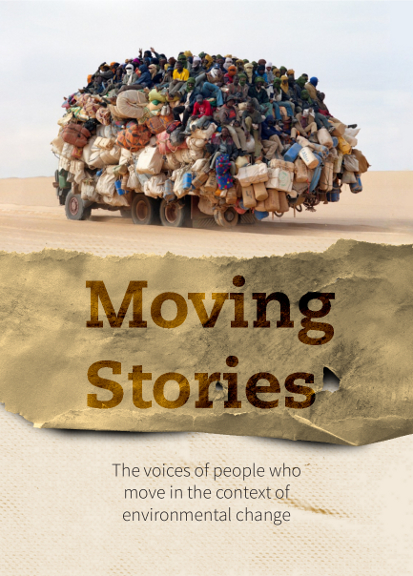 ‘The water came at night,’ says an unnamed survivor of the 2010 floods in Pakistan, with more eloquence and concision than might be found in a dozen pages of WGII AR5, ‘and we didn’t have time to save our belongings; we had to choose whether to save our children and ourselves or our property and assets, so we chose to save our kids. We left everything and ran to save our lives.’
Case-by-case, and region-by-region, Moving Stories presents direct and affecting testimony of this kind from people in Latin America, from The Sahel, the Pacific Islands, Bangladesh, etc., who are or have already been forced to move by climate change. For each region there is also a short contextual report outlining particular geographical, political and socio-economic vulnerabilities. Further analysis, which is not part of the report but was discussed by co-authors Alex Randall and Jo Salsbury at the launch, identifies four distinct types of climate- or environment-forced movement, which are worth summarising here:
- Planned relocation. This has been happening for several years already in the low-lying Carteret Islands, a series of atolls to the north east of Papua New Guinea. Entire communities have been moved to PNG as sea-level rises have made the islands uninhabitable.
- Displacement. Movement forced by extreme weather events is usually internal, say COIN, i.e. people move from one part of a country to another, as happened with Hurricane Katrina in the USA.
- Migration. For COIN this covers a range of deliberate movements – ‘migration with some agency’ is how they put it – from a contemporary form of pastoralism where people move to a different region or country for part of the year, to the wider drift from rural to urban living, to family members relocating permanently or semi-permanently to live and work in wealthier countries, and sending remittances home. The contributions of such remittances to the economies and the resilience of these more vulnerable home countries or regions is thought to be significant.
- The fourth category proposed by COIN is perhaps the most surprising and worrying. In many parts of the world, they suggest, climate change may force not movement at all, but immobility. There was talk not just of ‘slow onset climate change’, but also of ‘slow onset poverty’, and a suggestion that however hostile to human life environmental conditions could become, the populations of less resilient countries or regions will simply be too poor to escape or adapt.
 In drawing attention to, and in drawing together these voices – and presenting their analysis – COIN have performed a valuable service. This is necessary work that reinforces – in blunt, everyday language – the message that climate change is already happening, and begins to fill some human-scale gaps in the IPCC literature. However, looking around a full-ish Friends Meeting House, I wondered again who the audience was for this work. Was it the kind of people who attended the launch, who after all were already interested enough in the subject to turn out on an actual wet Wednesday evening? Or was it aimed at the general public, and if so, how could COIN reach them? Or was Moving Stories, too, aimed primarily at policy makers?
As I followed the IPCC, COIN and just some of the myriad other climate change agencies and activists that have social media presences on Twitter, I still found myself longing for more narrative, for stories that might help to reconcile these still relatively few isolated voices of climate migrants with day-to-day life here in the UK, say, and with the experiences of the hundreds of thousands – millions – of refugees and others who are currently being forced to move by other circumstances – by conflict or persecution, say – across these same regions. The people who are being trafficked, who are dying at sea, or who regardless of status are being stigmatised as ‘illegal’ and detained (in some cases indefinitely – or fatally). How might the types of climate-forced migration that continue to be predicted in IPCC reports, that are captured in the testimonies gathered by COIN, differ or be differentiated – or not – from the migration, and the attitudes and policies towards migration, that we already see around the world today?
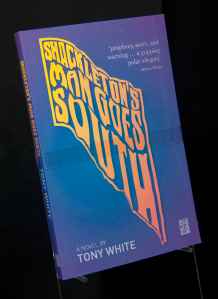
Image: Science Museum
It was a similar question, when I was writer in residence at the Science Museum, that prompted me to wonder if fiction could do what the scientific literature was failing to. Having discovered (by accident) a hitherto overlooked science fiction short story about ‘climate change’ written in Antarctica in 1911 by Captain Robert Falcon Scott’s surviving meteorologist George Simpson, and remembering that even the word ‘scenario’ comes from the arts, from the early days of opera, I looked for a way to combine the then most up-to-date science of the Intergovernmental Panel with the gripping Edwardian melodramas of the Scott and Shackleton era. This literary experiment became my novel Shackleton’s Man Goes South, which was published by the Science Museum last year – the first novel they have ever published.
Shackleton’s Man Goes South tells the story of Emily and daughter Jenny, who are travelling south to safety and a reunion with John who has gone ahead to find work. They travel with Browning, a sailor who has already saved their lives more than once. In the slang of their post-melt world, Emily and Jenny are refugees known as ‘mangoes’, a corruption of the saying ‘man go south’. One of the things I learned in writing the novel was to question whether the ways that society responds to change now might provide insight into what future change will look like. I have called this ‘Convey’s Law’ (after the contemporary Antarctic scientist of that name, from whom it is adapted): to understand climate change futures, look at how we are responding to change right now.
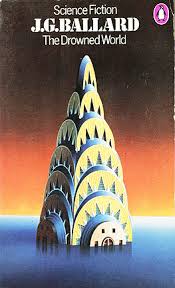 Together with novels by writers as diverse – and perhaps indifferent (or, sadly, dead) – as J.G. Ballard, Ian McEwan, Barbara Kingsolver, Margaret Atwood and others, Shackleton’s Man Goes South has been retrospectively bracketed as an example of ‘cli-fi’ (short for ‘climate fiction’), a new sci-fi soundalike term coined by Taiwan-based US journalist Dan Bloom, who is convinced that literature can play a vital part in raising awareness of climate change and, by enabling readers to think-through its implications, act as a spur to action against it. Bloom’s new genre has taken off in recent months, with international press coverage, with a dedicated fansite, with a branch of Foyles bookshop in London creating a ‘cli-fi’ section, with a number of emerging ‘indie’ (i.e. self-published) authors describing themselves as ‘cli-fi’ writers, and with the subject now being taught at the University of Oregon, where course leader Professor Stephanie LeMenager is clear about her ambitions for the course and for literature, telling Richard Pérez-Peña of the New York Times that, ‘We want to apply our humanities skills pragmatically to this problem.’
What international discussion of ‘cli-fi’ might have missed is that works such as Ian McEwan’s novel Solar also owe something to public-funding of the arts in the UK. McEwan was one of a group of artists and scientists who participated in a 2005 fieldwork expedition to the Arctic that had been organised by the cultural agency Cape Farewell, and the experience contributed to his writing of the novel. Cape Farewell was founded by artist David Buckland in 2001. Since then, with funding from NESTA and Arts Council England among others, Cape Farewell has pioneered what they call a ‘cultural response to climate change’. Initially this involved taking groups of often high-profile artists – including McEwan, Rachel Whiteread and Jarvis Cocker – on voyages to the far north so they could witness retreating Arctic ice firsthand and then in some cases use their celebrity to leverage media coverage of this. Latterly Cape Farewell’s work has developed into a more complex series of exchanges: international projects, publications and exhibitions that have travelled around the world, from the Natural History Museum, London, to the Central Academy of Fine Arts in Beijing. Alongside their UK base, Cape Farewell now also have a North American presence with their Toronto-based Cape Farewell Foundation. On their website, Buckland describes Cape Farewell’s intention, ‘to communicate through art works our understanding of the changing climate on a human scale, so that our individual lives can have meaning in what is a global problem.’ What Cape Farewell also do very effectively is take such human scale thinking to large audiences.
 Slightly lower-profile and less celebrity-driven than Cape Farewell, but also based in the UK and with some crossover of personnel, TippingPoint – all one word – have for the past nine years also been working to ‘connect the worlds of art and science in the fields of climate change, by engaging artists of all kinds with scientists at the forefront of the subject.’ TippingPoint’s forthcoming events – including one at London’s Free Word Centre in June 2014 – will see a shift towards ‘working with stories, because they offer a popular and engaging route into thinking about the past and present and imagining possible futures, and also because stories, narratives and narration are concepts that everybody can gather around.’ What stories might emerge from this work remains to be seen, but TippingPoint’s idea of the attractiveness of stories, their function as conceptual campfires, things to be gathered-around, is itself quite an attractive concept. Looked at in this way, perhaps literature can do more than simply raise awareness, rather it might constitute a form of collective action in its own right.
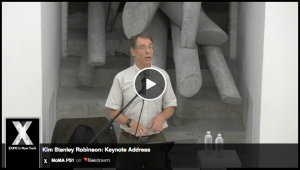
During an inspirational and insightful talk at MOMA/PS1 in New York in 2013, and now online, US novelist Kim Stanley Robinson speaks eloquently about the value of science fiction (‘Read enough science fiction and you’ve read everything from the worst catastrophe to the best utopia and everything in between, and your sense of the future is strengthened thereby’) and about the need for a grand cultural and scientific project that might enable a collective response to the threat of climate change in a world – in our world, now – where inaction, business as usual, is tantamount to catastrophe.
In face of the threat from climate change, Stan – as he signs himself – notes that Utopia goes from being ‘a minor literary genre […] to being an actual escape and survival plan for all of humanity. It’s Utopia or nothing.’ When asked the slightly abstract question of what science fiction and the future are ‘for’, his response is fascinating: ‘The future is for cognitive mapping,’ he says. ‘We think about the future in order to figure out what we do right now.’
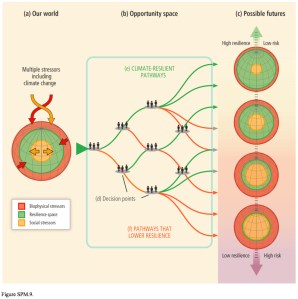
© 2014, IPCC
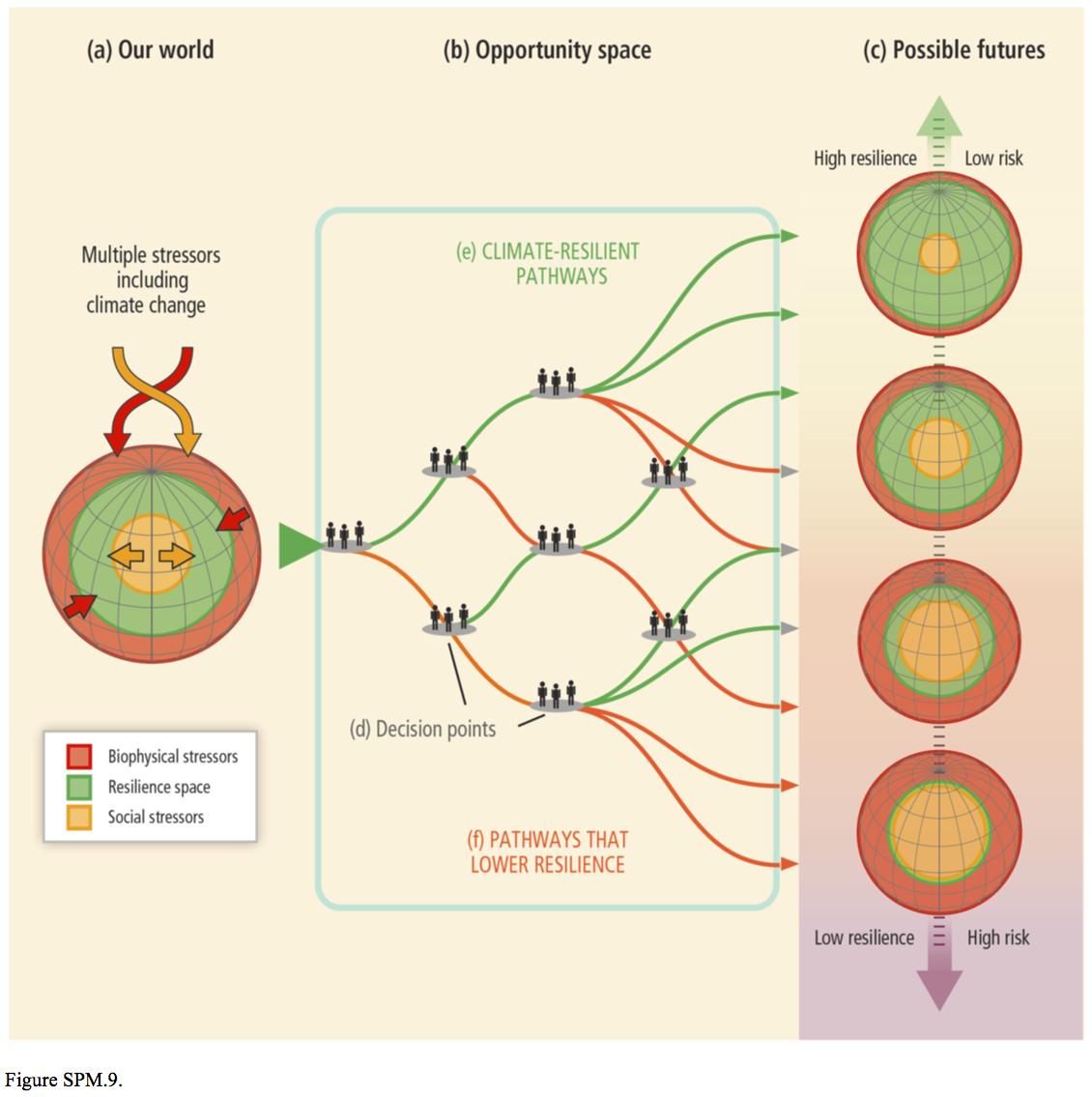
Interestingly, perhaps the most legible diagram in the IPCC’s WGII AR5 is one that maps this same interface, between the present and the future, and thus has the clearest narrative dimension of all the current crop of IPCC AR5 graphics. It is to be found on the final page of the Summary for Policy Makers. ‘Fig. SPM.9 Opportunity space and climate-resilient pathways’ – as it is called – uses a triptych structure to outline and populate a space between ‘our world’ now and our ‘possible futures’. In this ‘opportunity space’ (bear with me), ‘climate-resilient pathways’ and ‘pathways that lower resilience’ link and move through a simplified network of what are labelled as ‘decision points’. These are gatherings – symbolically populated by stickmen – or perhaps moments of human agency, which cumulatively lead either up, towards a high resilience, low risk future, or down, towards a low resilience, high risk one.
So what are these ‘decision points’? Presumably the decisive moments within this ‘opportunity space’ can occur at a variety of scales. From massive, international treaty gatherings, such as the forthcoming Twentieth session of the Conference of the Parties to the Kyoto Protocol, or COP20, which is to be held in Lima, Peru, in December of this year, to more personal actions: Sir Martin Walport’s ‘woolly jumper’, perhaps.
Or, look at it this way. One ‘decision point’ might relate to the publication of WGII AR5 itself, along with the rest of the IPCC’s Fifth Assessment Report, another to ExxonMobil’s reports to shareholders — a snake to the IPCC’s ladder. If so, I am grateful to the Pakistani flood survivor quoted in COIN’s Moving Stories report for framing the decision — the choice between these two approaches — in much starker terms still: ‘whether to save our children and ourselves or our property and assets’.
§
Download Shackleton’s Man Goes South free and DRM-free from the Science Museum website or from the touchscreen ebook dispenser that is part of the exhibition accompanying the novel in the Science Museum’s Atmosphere Gallery.
Watch Kim Stanley Robinson: Keynote Address – on Livestream.com
Download Moving Stories: The voices of people who move in the context of environmental change (opens as PDF).
 I am delighted to be part of Remote Performances, a forthcoming collaboration between artists London Fieldworks and Resonance 104.4fm (the world’s first art radio station). A number of new artworks will be made for radio and broadcast live from Outlandia: August 4 -9 2014















You must be logged in to post a comment.