 In recent days, both the UK Border Agency’s Yarl’s Wood Immigration Removal Centre (IRC), and the Australian Department of Immigration and Citizenship’s offshore detention centres — and the elaboration of Australian policies toward asylum seekers associated with these, the so-called ‘Operation Sovereign Borders’ — have been in the news.
Last week author Zadie Smith lent her support to the campaign against the detention of asylum-seeking women in Yarl’s Wood that has been mounted by Women for Refugee Women. Petitioning current UK Home Secretary Theresa May, campaigner Meltem Avcil (herself a former child detainee at Yarl’s Wood), writes:
If a woman has already experienced rape, torture, imprisonment in her home country, then it is really hard for her to be locked up here. Women become depressed and suicidal in detention.
Furthermore, following an unannounced inspection of Yarl’s Wood, Her Majesties Inspector of Prisons released a report (that has been picked up by diverse UK news sources, including the Guardian, the Independent and Sky News) that noted there had been sexual abuse of detained women at Yarl’s Wood. The Inspector of Prisons describes such incidents as ‘something that can never be less than abusive given the vulnerability of the detained population’.
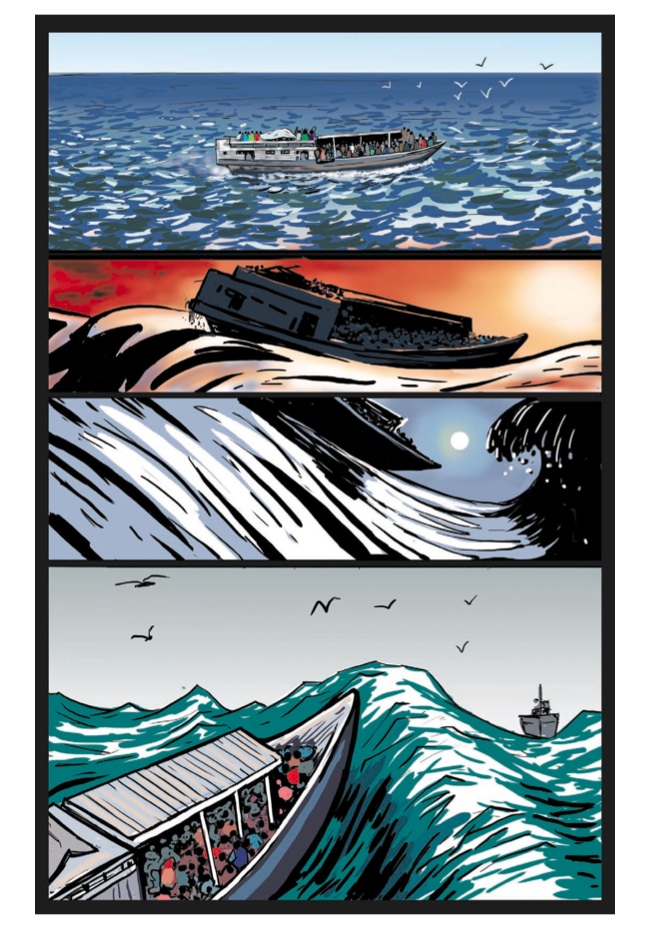
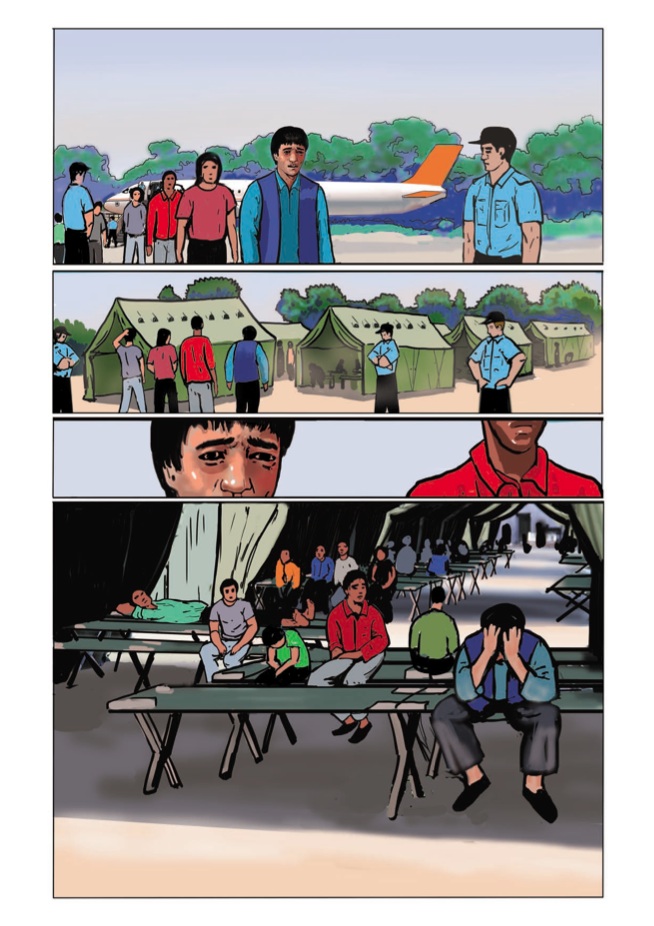
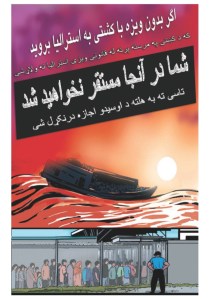 At the same time, poor conditions and harsh treatment in Australia’s offshore detention facilities have been the subject of a bizarre comic book that has been published by the Australian Government with the apparent aim of dissuading potential Afghan asylum seekers, but which has the unfortunate side-effect of seeming to aggrandise and promote Australia’s anti-humanitarian policies; while reducing all refugees to the status of economic migrants, and sanitising the real conditions in Australian detention facilities. The comic is still currently available online from the Australian Government (where it is starkly saved as ‘Storyboard Afghanistan’, so let us call it that). It is a picture book that wordlessly shows a young man paying traffickers to take him to Australia via Pakistan and Indonesia. (Of course, since it is wordless, one could use it to tell other stories, too.) This is a journey that is thwarted by the Australian navy, and which ends in desperation and limbo in a tent-based detention centre, resembling those on Manus Island or Nauru.
In recent weeks the Australian navy have been involved in further controversy after revelations that asylum seekers were taken off their own boat only to be placed in one of a number expensive hi-tech lifeboats purchased from China by the Australian government, and then towed towards Indonesian waters. When one such lifeboat finally reached land, the refugees on board faced a hazardous cross-country journey, through jungle terrain, that three of the party did not survive.
Elsewhere a number of asylum seekers taken into Indonesian territorial waters by the Australian navy had severe burns that were consistent with their claims that they had been told by navy personnel to ‘hold on to parts of a hot engine [while their boat was being] towed back to Indonesia’.
 In the last few days violence in the detention centre on Manus has left one person dead (a twenty-four-year-old man named Reza Berati*) and 77 injured, 12 of them seriously. Reports have suggested that guards funded by the Australian government — including a feared paramilitary police unit known as PNG mobile squad — have been involved in the attacks. This is not the first time that the PNG mobile squad have been involved in violence on Manus.
At the same time, RISE — an acronym of ‘Refugees, Survivors and Ex-Detainees’ — have launched a campaign against Transfield, the company that currently holds the government contract to run the offshore detention centre on Nauru, and has also recently won a further contract for Manus. Transfield are the main sponsors of the Sydney Biennale, and RISE’s campaign recalls that of Liberate Tate who campaign against oil industry sponsorship of the arts in the UK (and who have just been shortlisted for ‘Best artistic response’ in The Climate Week Awards).
In their open letter RISE state:
RISE supports a complete boycott of the 19th Sydney Biennale as Transfield, a major sponsor and partner of this event, receives income from the operation of Australia’s deadly offshore internment camps for refugees and asylum seekers.
[…] Transfield’s income from these operations (as of February 2014) is over 300 million dollars, and they have now won yet another contract to run “welfare services” on both Nauru and Manus Island. At the same time, there are shocking reports of mistreatment and abuse in these camps including eye-witness accounts from medical staff, welfare officers and other former detention staff. […]
In 2011, RISE made submission to an Australian parliamentary enquiry predicting that unchecked expansion of Australia’s privatised detention network would lead to a US-style private prison industrial complex where immigration policy would be shaped by corporations who profit from misery. Our predictions have unfortunately come true: a report released in 2013 by the US based Sentencing Project, stated that Australia has the largest private prison population in the world thanks to its asylum seeker policy.
Participation in the Sydney Biennale sponsored by Transfield makes artists partners in a system that silences the voices of refugees and asylum seekers and profits from their misery.
Events at Yarl’s Wood in the UK, and in the Australian offshore detention facilities — as well as the images in the Storyboard Afghanistan comic — have been sadly redolent of the world of my climate change novel Shackleton’s Man Goes South. The connection might seem unlikely given that my novel was inspired by a science fiction story about climate change written in Antarctica in 1911 by British atmospheric scientist George Clarke Simpson (1878-1965) for a ship-board journal of which Sir Ernest Shackleton (1874-1922) had been founding editor, called the South Polar Times. However, in a satirical reversal of Shackleton’s heroic escape from Antarctica, the novel tells of a woman and her daughter who are travelling south in a small boat toward the apparent safety that the continent now offers. In the slang of their post-melt world, Emily and Jenny are refugees known as ‘mangoes’, a corruption of the saying ‘man go south’.
 Parts of Shackleton’s Man Goes South are set in a fictional offshore detention facility, ‘CBCP Endurance’, staffed by paramilitaries, that is based upon physical descriptions of Australia’s Christmas Island detention centre and the UK Border Agency’s Yarl’s Wood IRC, reflecting the so-called ‘Detained Fast Track’ procedures operating at Yarl’s Wood and Harmondsworth in the UK. (Incidentally, for very insightful reporting on such ‘Fast Track’ deportation procedures in action, see ‘Planespotting’ by James Bridle.)
 Within the novel I coin the term ‘Convey’s Law’, after contemporary scientist Dr Peter Convey of the British Antarctic Survey. Convey’s area of study is the terrestrial ecosystem of the Antarctica Peninsula. It is, he says, ‘a very simple ecosystem […] consisting of lichens, mainly, one type of grass and one tiny rockery plant’. Convey suggests that ‘if you want to understand change in the future, you have to look at how things are responding to change now’. By ‘things’ he means these few plants and lichens, but this deceptively simple rubric is robust enough that with a slight shift of focus it can be applied to people, to institutions, governments or industries, and asked in relation to different types of change, whether social, political or economic: how are we responding to change now? This gives us what I call ‘Convey’s Law’: To imagine climate change futures we need to look at how we are responding to change right now.
Parts of my novel also trace continuities between the emergence of increasingly racist contemporary immigration policies and the pseudo-scientific and racist theories about links between climate change and Human evolution — and corresponding policy interventions — that were developed in the first half of the twentieth century by George Clarke Simpson’s fellow South Polar Times contributor, the Australian former Antarctic explorer Thomas Griffith Taylor (1880-1963) and the US-based Elsworth Huntington (1876-1947), with whom the meteorologist Simpson was also briefly associated, if only by publication.
I’m not the only one making a connection between racist migration policies such as Operation Sovereign Borders and climate change. In his opinion piece for Melbourne newspaper The Age, Bruce Haigh berates Australian Immigration Minister Scott Morrison both for events on Manus and for taking Australian relations with Indonesia to their ‘lowest point since the mid-1980s’, then suggests that Australian Prime Minister Tony Abbot and Morrison
have created a vacuum in Australian foreign policy in the region. It should have been Abbott in Jakarta talking about climate change rather than US Secretary of State John Kerry.
 If you have read Shackleton’s Man Goes South, you may recall that the book is dedicated to the 48 people thought to have died when their boat was wrecked on the rocks of Christmas Island in the Indian Ocean on 15 December 2010 as they tried to reach the Australian Government’s infamous off-shore Immigration Reception and Processing Centre that is located there. At the time, the death of nearly fifty refugees (50 is now the official estimate) in a single incident, and in full sight of onlookers, seemed to me to be a defining moment, and one so grave that I wondered if it might provoke not only a more a humanitarian response to sea-borne migration, but a decision to prevent any further deaths on that scale, what the Border Crossing Observatory project has described as a necessary shifting of ‘the debate about contemporary border controls towards the acceptance of a more mobility-tolerant future.’ (A similar project, Watch the Med, was set up in 2012 to monitor the deaths and violations of migrants’ rights at the maritime borders of the EU.)
Sadly, with Operation Sovereign Borders the reverse seems to be true.
Further, according to the Border Crossing Observatory’s Australian Border Deaths Database, since the Christmas Island disaster of December 2010, a further eight-hundred-and-fourteen (814) refugees have died in incidents associated with Australia’s borders. This figure brings the total of known deaths since 2000 to one-thousand-four-hundred-and-ninety-three (1,493).
At time of writing, the most recent addition to this terrible and growing list is Reza Berati, the 24-year-old man who was killed on Manus a couple of days ago. The Border Crossing Observatory suggest that their project ‘seeks to account for, rather than merely count, border-related deaths.’ At the moment there are few ways to account for Reza Berati, but at least — unlike the Christmas Island fifty — we know his name, even if there are no photographs of Reza Berati appearing in the media, nor any biographical information about him. Perhaps these will emerge soon, so that his death can (as the Border Crossing Observatory suggest) be accounted for rather than merely counted.
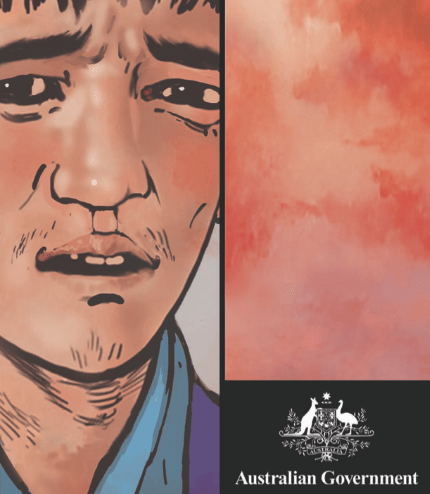
In absence of such materials, might I suggest that for the moment at least, and notwithstanding his differing country of origin, we could imagine Berati as being not dissimilar in age and appearance to the young man in Storyboard Afghanistan, and so co-opt the comic to this purpose; in other words, subvert it (as others have done). Transformed by this simple act of re-attribution the comic now ends not in a mosquito-ridden limbo oveseen by benignly short-sleeved Australian guards, but with the freeze-frame above, which is followed by an unseen death at the hands of some militiaman or persons (as yet) unknown; an unnecessary outcome that — seen in this light — bears the seal, at bottom right, of the Australian Government.
§
Shackleton’s Man Goes South by Tony White is available free and DRM-free from the Science Museum website in formats compatible with most devices. A limited edition paperback is available exclusively from the Science Museum shop.
Press about Shackleton’s Man Goes South.
*Many news reports give the name of the man killed on Manus Island this week as ‘Faili Kurd’, a mistake which I reproduced here when I first posted this blog a couple of hours ago. I am grateful to RISE for pointing this out and letting me know that his name is Reza Berati: ‘Ethnicity of Reza Berati who died is Kurdish (language: Faili, stateless i.e. no citizenship.)’
 Parts of the account feel strangely redolent of the world of Shackleton’s Man Goes South, in particular Chapters 12 and 13 of my novel which are set in the ‘CBCP Endurance’, a fictional migrant detention centre on South Georgia. (Chapter 13 is in fact entitled ‘T-shirt and Flip-flops’.)







You must be logged in to post a comment.