Casual prejudice vs perpetual privilege

Casual and/or stupid class-based prejudice should not come as a surprise when there is a Tory government tossing its hatreds around so freely, but still I was slightly surprised on Saturday morning as I listened to the radio while making the coffee. My trusty Roberts R900 was tuned to Radio 4 rather than its usual Resonance 104.4fm, and I couldn’t quite believe my ears when presenter Richard Coles — interviewing the journalist and author Caitlin Moran — said something about growing up in a council house in Wolverhampton being an unusual background for a writer, and that for Moran then, writing was more than just a pastime.

What? I wondered if I could possibly have heard him correctly. It reminded me of the bizarre and thoughtless assertion made by Granta’s outgoing editor John Freeman a couple of weeks ago that ‘Best of Young British’ author Sunjeev Sahota’s life in Leeds was ‘completely out of the literary world’, an apparent geographical deficiency that seemed in Freeman’s opinion to be compounded  by the fact that Sahota had ‘studied Maths’. Whatever next?

I had to go back to the BBC iPlayer to listen to the Caitlin Moran interview again and see if I had got the wrong end of the stick. Here is what (an admittedly rather tongue-tied) Richard Coles actually said:

The the writing thing, to get back to that, I mean, I think, one of the reasons I wondered if, that you are so productive, so fecund if I may say so, with writing, is that you write almost for your life, and I wonder if that came as, ’cause you grew up in, er, a background which is unusual for a writer. You grew up, grew up in a council house in Wolverhampton with lots of siblings, I think seven other siblings knocking around, and, er, and that would suggest for many people, that would suggest that your opportunities in later life are rather limited, but not for you. I mean, you kind of wrote your way into the life you have now. And I wonder if that means that writing for you is more than simply just a pastime, or a means of earning a living, but it is actually something fundamental to who you are.

What do you think? Moran more or less ignores Coles’s question, good for her, and he claws back some ground with the more agreeable proposition that writing is fundamental to her identity, but I’m still struggling to understand the bit about council houses and pastimes. Which writers is he comparing her to, and which background, I wonder, might he consider as being usual for a writer? A childhood spent somewhere other than Wolverhampton? Is that enough, or would growing up in private rented accommodation have been more conducive than in a council house. Or does a literary talent depend on having parents who are home owners? Perhaps writers can be thought unusual if their parents ‘bought their own furniture’?

Similarly, I wonder what kind of life John Freeman thinks would demonstrate that a first-time published author such as Sahota was part of the literary world — whatever that is? A life not lived in Leeds, or one that didn’t involve needing to earn a living? Does he really think you have to have studied literature to be a writer? Do you need to have already been a part of Freeman’s (imaginary) literary world before you are published, in order to satisfy some received idea of what a writer is?

Both statements seem to reinforce an idiotic assumption that writing takes place within some kind of metropolitan insiders’ club, and that the writer’s life is ‘always already’ — as the poets say — one of perpetual privilege.

§

More on this or related themes by Tony White:

Who has the right to write in the UK right now?

Knowledge commons #1

Science Museum shelf-talkers

Alongside publication by the Science Museum of my novel Shackleton’s Man Goes South, I’ve worked with the Science Museum shop to do an ‘author recommends’-style promotion of some other titles that are either climate change related, or connect in some other way with my own novel.

Here are the titles that I’m recommending:

  • John Berger, Hold Everything Dear: Dispatches on Survival and Resistance (Verso)
  • Jeremy Hardin, Border Vigils: Keeping Migrants Out of the Rich World (Verso)
  • Robert Henson, The Rough Guide to Climate Change (Rough Guides)
  • Peter Linebaugh and Marcus Rediker, The Many-headed Hydra: The Hidden History of the Revolutionary Atlantic (Verso)
  • James Lovelock, The Vanishing Face of Gaia: A Final Warning (Penguin)
  • James Marriott and Mika Minio-Paluello, The Oil Road: Journeys from the Caspian Sea to the City of London (Verso)
  • Michael Moorcock, London Peculiar: And Other Nonfiction (Green Print/PM Press)
  • Gregory Norminton (Editor), Beacons: Stories for our not so distant future (Oneworld)
  • Georges Perec, W or the Memory of Childhood (Vintage Classics)

And one DVD:

  • Frank Hurley (Director), South: Sir Ernest Shackleton’s Glorious Epic of the Antarctic (BFI)

The Museum have produced a series of bellybands and ‘shelf-talkers’ printed with my short reviews of each title. There has been a good response to the promotion, and the bellybands in particular, so the Museum Shop are now thinking of using this promotional device more often. Here are a few of my ‘shelf-talkers’.

The Oil RoadMany-headed HydraLondon Peculiar
AuthorRecs

Science Museum display

installation longshotinstallation shot
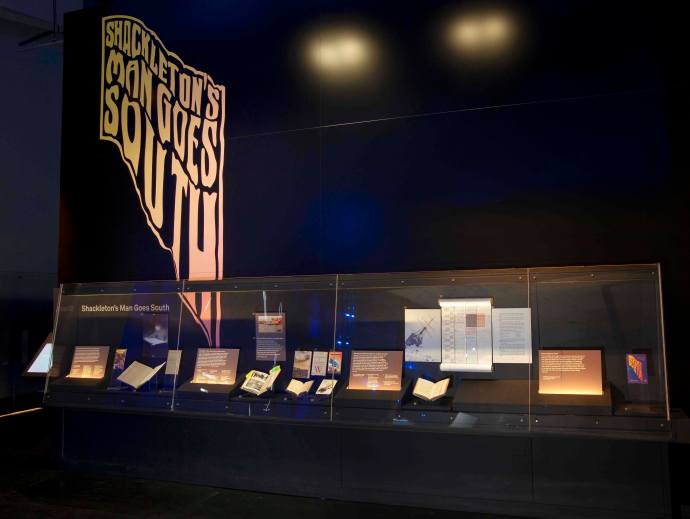
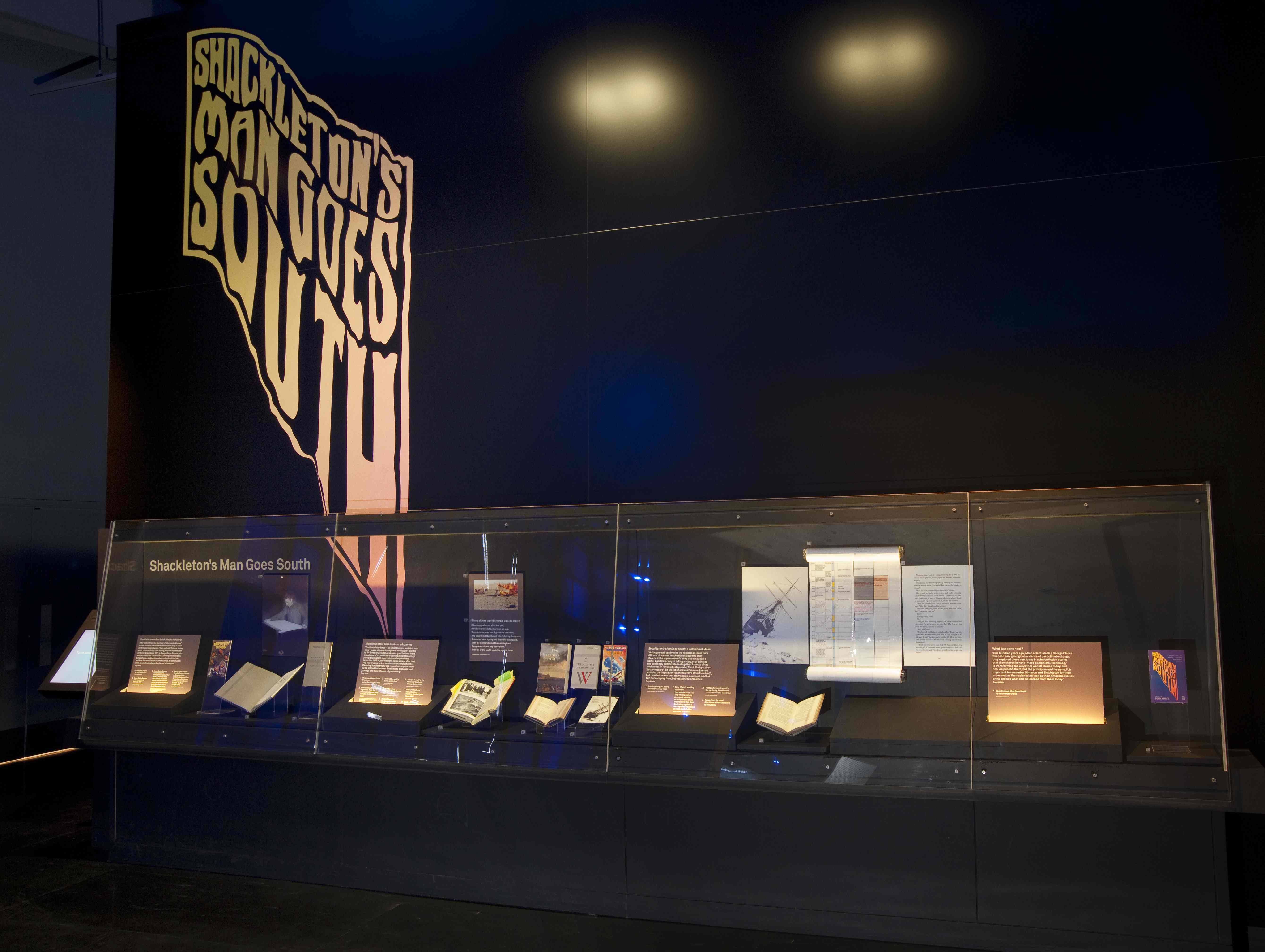
Not great pictures, just a few shots taken on my phone as the Science Museum was closing yesterday afternoon. I wanted to share some glimpses of my exhibition, which opened last night. Actually, in Museum parlance, this is ‘a display.’ Anyway, thrillingly, it is up for a year, so you have plenty of time to see it. And the Museum and I have plenty of time to get some proper photos taken.

It is not quite finished. We still have to tweak the lighting, but getting this far by the end of yesterday involved masses of hard work by lots of very committed and talented people, and we ran out of time. But it is very nearly there.

So pending the production of some proper photos of the final, finished state, here at least are a few snaps.

First a long-shot showing the fantastic, clear sight-line across the Atmosphere Gallery to Jake Tilson’s wonderful 20-foot tall logotype. This is the same logotype as appears on the cover of the book. As you might not be able to make out from my hopeless photo, this is not only visible but also clearly legible from about 100 yards away as you enter the space.

The medium shot below shows both the logotype and the beautiful, custom-built display cabinet, which contains books, papers and ephemera relating to the novel.

Installation detailThe close-up shows just three of the books that I have included in the display.

I’m thrilled also to say that thanks to the wonderful Folio Society, I have been able to include a beautiful facsmile of the South Polar Times, showing the weird ‘climate change’ short story written by George Clarke Simpson in 1911 that was part of the inspiration for my novel. I am very grateful to them for their support of this project.

A few hours after I got these snaps, the Atmosphere Gallery was heaving with the thousands of people who had come to a climate science-themed Science Museum Lates.

I’m very excited about the novel, and about the innovative way that the Science Museum is publishing it.

A dedicated touchscreen (visible at the left-hand side of the beautiful, custom-built case) enables visitors to email themselves a free and DRM-free copy of my novel Shackleton’s Man Goes South.

The apparent simplicity of this interactivity is deceptive. It has taken a lot of work by a lot of people to make it possible. At one point it looked as if this defining functionality, a central aspect of our publishing experiment, might not be technically possible. Thankfully, that hurdle was overcome.

All of which means that I’m doubly delighted to report that the technology works!

Last night, visitors to the Atmosphere Gallery — some of whom had just come to the novel’s launch event and already bought a copy of the limited edition paperback — were emailing themselves the book and opening it seconds later to read on their phone or tablet. I was slightly kicking myself that we didn’t have a ‘cutting the ribbon’ photo-opp, where some celebrity might have been the first person to email themselves a book via the display. But actually that is not what this is about. It is about finding ways — as the square-footage of the book trade vanishes — to go where readers are, and to learn from what readers do (and I include myself in that group). Sometimes this means collaborating with institutions outside or alongside the book trade, to develop new ways to put books and readers together — in this case using digital technology in a new way.

And it works.

Amazing.

Screen Shot 2013-04-25 at 12.53.31

Here’s a screengrab of a nice tweet from my friend and colleague the novelist and critic Nicholas Blincoe.

Night at the Science Museum

Shackleton's Man Goes South, logotype installationI went behind the scenes at an otherwise deserted Science Museum last night, for the get-in of my display in the Atmosphere Gallery. By the time I left, the specially commissioned display case was almost finished, and Jake Tilson’s amazing logotype had been installed on a newly black-clad wall. Finishes will be happening today, before the various objects and papers, and their labels, go into the case ready for the opening tomorrow evening — which coincides with a climate science-themed Science Museum Lates.

I can’t wait for the temporary hoardings to come down, so that I can share this with everyone. This is the culmination of a few year’s work, so I’m really looking forward to hearing what people think.

On Wednesday evening I’ll be talking about the novel with chair Siân Ede, novelist Simon Ings and climate change adaptation expert Dr Emma Tompkins. I’ll post the invite later, although I understand that RSVPs have now had to close as the response has been — in the words of the museum — ‘overwhelming’, which is a good sign.

The exhibition is up for a year, so there is plenty of time to see it, though if you want to get hold of the book you might need to move more quickly. A limited print edition of the novel will be on sale exclusively from the Science Museum shop, while DRM-free ebooks compatible with all/most current devices will be available on the Museum website from 24 April until 24 July.

For the next year, until 24 April 2014, visitors to the Atmosphere Gallery will be able to email themselves a free and DRM-free copy of the ebook from a dedicated touch-screen that is part of the display.

Patience Camp: audiobook extract #1

The Science Museum have just released the first of three free audiobook extracts from my novel Shackleton’s Man Goes South. The extract is now up on the Museum’s SoundCloud page, and can also be downloaded for off-screen listening, on your phone or MP3 player. I was pleased to work once again with Jamie Telford, who composed the ‘Going South Theme’ that is used to frame the audiobook extract.

Shackleton’s Man Goes South is the Science Museum’s 2013 Atmosphere commission, published as part of the Contemporary Arts Programme. Visitors to the atmosphere gallery and the Museum’s website will be able to download a free e-book of the novel from 24 April 2013.

Here is the handy SoundCloud widget that links to the page:

Working collaboratively?

The Writing Platform logoWhen The Writing Platform commissioned me to write an article discussing how working collaboratively – as I do from time to time – might have influenced my writing process, I wasn’t immediately sure.

[…] Working collaboratively? Of course much of being a writer and of the publishing process is collaborative even if it is not usually called that. Research and work done with other writers or with agents, commissioning editors, copy-editors, typesetters, proof-readers, designers, photographers, all the way down the line to readers; all of these can perhaps be thought of as collaborations of one sort or another. If you are starting out as a writer and think that you don’t like collaborating with other people, then you probably need to have a rethink and get to like it, as it is a fact of life even in what – to borrow a term from particle physics – might be called ‘standard model’ trade publishing. But in publishing as in physics the standard model is no longer the whole story. The book trade is changing fast, as are the ways that people read and engage with writing, and the book trade is not the only place where such changes – economic as much as technological – are being felt.

It was useful to have a space to think through some of the actual activities and processes that ‘collaboration’ might entail, whether in my work with Blast Theory on Ivy4evr or working on Missorts, my permanent soundwork for the city of Bristol.  Read the whole piece here.

Speaking at Writing Britain: Bristol Writing

© 2012 Max McClure, courtesy Situations

© 2012 Max McClure, courtesy Situations

I briefly wanted to share info about the event I’m doing at Bristol Central library on the evening of Friday 12 April. I have been asked to talk about Missorts, my new, permanent public artwork for Bristol inspired by the city’s radical literary heritage, and also to talk about writing for new digital platforms, including my work with Blast Theory.

Missorts is a GPS-triggered work of fiction that is accessed as a permanent soundwork in the Redcliffe area of Bristol. Missorts features new and interconnected short stories by the writers Sara Bowler, Holly Corfield-Carr, Thomas Darby, Jack Ewing, Katrina Plumb, Jess Rotas, Hannah Still, Helen Thornhill, Isabel de Vasconcellos and Sacha Waldron. The stories are accompanied by Portwall Preludes, a series of striking new musical works specially commissioned from composer Jamie Telford for St Mary Redcliffe’s Harrison and Harrison organ in its centenary year. There is no ‘armchair version’ of the soundwork, you have to be there to experience it, but you can download Jamie Telford’s amazing music on MP3.

Missorts, screen simulationI’ll be in conversation with Claire Doherty, director of Situations (producers of Missorts) who will discuss new approaches to commissioning public artworks.

Download Missorts Volume II, free and DRM-free at www.missorts.comThe event is part of Writing Britain: Bristol Writing a new exhibition at Bristol Central Library until April 30th, exploring the city’s literary heritage and held in partnership with the British Library. This sounds like a great exhibition so I’m doubly looking forward to the visit.

You can book a FREE place at my talk by visiting any Bristol library or by ringing 0117 9037250. Don’t forget that if you are in Bristol but haven’t had a chance to ‘do’ Missorts yet, and would like to have a go before you come to the talk, the app is free to download from www.missorts.com.

Don’t worry if you don’t have an iPhone or Android phone. You can borrow phones preloaded with the app from Bristol’s Central and Bedminster Libraries using your library card.

My companion novella Missorts Volume II is available for free and DRM-free download in formats that are compatible with most devices. You can also get that from the Missorts website.

I have blogged some of the background to Missorts here, here and here.

§

Missorts: Literature Reinvented

Tony White in conversation with Claire Doherty
Bristol Central Library
12 April 2013
7:00 PM – 8:15 PM
Bookings at any Bristol library or ring the Central Library on 0117 903 7250.

Contents page

The Science Museum is publishing my latest novel Shackleton’s Man Goes South on April 24. It is the Museum’s Atmosphere commission 2013, published as part of their Contemporary Arts Programme. More information nearer the time, of course, and a novel that I can’t wait for people to read — ideas to discuss — but this being the Science Museum (which I was describing to The Writing Platform the other day as an entity of about the size and population of a small town) we are also experimenting with opening up new ways for readers and Museum visitors to get hold of the book. I’m looking forward to sharing that with everyone soon. In the meantime, last week I blogged about the ‘cover kit’ and Jake Tilson’s logotype, and now here is a sneak preview of the contents page of the print edition.

Shackleton’s Man Goes South by Tony White, contents page


Cover story

Shackleton’s Man Goes South, cover jpegShackleton’s Man Goes South, square thumbnail

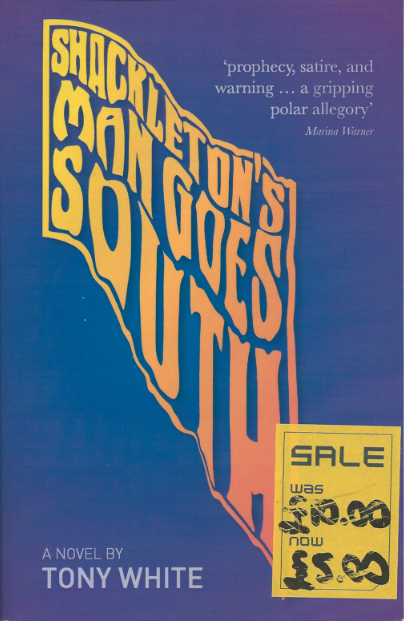
I wanted to quickly share the cover of my latest novel Shackleton’s Man Goes South, which is published by the Science Museum on 24 April as their Atmosphere Gallery commission for 2013 (replacing David Shrigley’s ‘House of Cards’). The cover has been beautifully designed by the Museum’s Design Studio, with a central title by the brilliant Jake Tilson. I love Jake’s work and can’t think of anyone better at producing a dynamic logotype. Maybe I will try and find a way to write more about our collaboration in due course.

It used to be that a cover was a cover was a cover — one fixed and portrait-format rectangle — but not any more. What seems to be needed these days is a ‘cover kit’ that can be adapted for the multitude of differently proportioned screens, formats and files required, so that the cover can tell its story clearly across platforms, rather than forever being awkwardly cropped and shoe-horned into wrong-sized or shaped windows.

ProofIn this case the ‘kit’ comprises Jake Tilson’s dynamic graphic device, a couple of simple colour-gradients, my name, the Science Museum logo, and an advance quote. In the Science Museum context there is an additional imperative to be clear that this is a work of fiction. All recognisably framed by the Museum’s house style, and all designed to be adjusted for B-format paperback, audiobook/MP3 thumbnail, the differently proportioned ebook covers, Twitter or Facebook profile photos, etc.

Finished copies are due back very soon, but I met with Charles Boyle a week or so ago to give the imposition proof a once-over, over a quick and tasty lunch at Shepherd’s Bush’s finest, the Abu Zaad on Uxbridge Road. So here, while Charles and I wait for some of the tastiest shish in town, is a still-life with mint tea and printer’s proof.