In case of emergency

February 4 is National Libraries Day: ‘a free-to-join gathering of people who believe in the importance of libraries.’

Well, count me in, because libraries of one kind or another are places in which I seem to spend a lot of time, although my use of them has changed over the years. When I was a child I went to the library to borrow books, and I’ve encouraged the same as a parent. Now when I go to libraries it is most often as part of the process of writing them, because of course there is more to libraries than the lending and borrowing of books, vitally important though that is.

Libraries can also be both a repository for and a gateway to archives of all kinds, many of which are simply unavailable anywhere else. For example, I was researching for a forthcoming fiction title among bound archive copies of the now defunct alternative news weekly Leeds Other Paper in Leeds Central Library recently. Most UK newspapers are held in the British Library’s Newspaper Collection in Colindale, London, but not the Leeds Other Paper. These copies of the LOP in Leeds Central Library may well constitute the only complete collection that exists of this important alternative newspaper.

While waiting to access the LOP archive I also happened across the Leodis project, a fantastic photographic archive of the city that was established by Leeds Library & Information Service as part of a Yorkshire-wide Lottery-funded photography archive digitization project in 2003. The Leodis site is a bit clunky in many ways, but not bad for something that launched in 2003. Back then, even now-familiar approaches to copyright and licensing and the ways that we access and interact with content online like Creative Commons were still more or less part of a creative, legal and publishing avant garde, so e.g. there is no obvious notice on the Leodis site about whether, how or under what terms one can use the photos, beyond the options to leave comments or (and I’m resisting the urge to put an exclamation mark at the end of this sentence) to buy a print.

It is well worth digging around — well, wading through — the Leodis site however as there is some really great material on there, not least of which for a bibliophile are the many pictures of the Library itself, which has gone through various transformations over the years including the recent excavation of a magnificent tiled hall, originally the reading room and now a visually stunning cafe. Browsing through the photos, I found myself particularly drawn to some images of the Music Library, the very shelves and false ceiling of which it was in fact that had needed to be removed to reveal the spectacular tiled hall beneath. The Music Library still exists, it has simply been moved upstairs.

In light of popular myths about the supposedly recent so-called ‘dumbing down’ of libraries to accommodate music, DVDs and other media, it was interesting to read in the text accompanying this great image that

The [Leeds] Music Library was started in 1950, as part of policy to establish subject departments, rather than keeping all stock as a vast collection. Originally music scores and books were available, in 1957 a record lending library service began. This cost £2,500 for which 1,837 records were purchased.

The work of fiction that I was in Leeds to research is set in the city in the mid-1980s. Many of the LPs in the Music Library’s loan collections at that time could well have been purchased as part of that same late-1950s job lot, but they were still in good condition and still being loaned out nearly thirty years later. The Music Library’s vinyl loan collection is now long gone of course, but I was pleased when trawling some secondhand dealers recently to find for sale one mint vinyl copy of an LP that had been a Music Library favourite when I lived in Leeds, and which now I thought about it I was keen to hear again: Follow the Drinking Gourd by Alex Foster and Michel Larue.

Foster and Larue’s album was released in 1958 by a New York record label called Counterpoint who up until the previous year had traded as Esoteric Records, a willfully obscure jazz and art-house label started by Jerry Newman which operated out of 75 Greenwich Avenue (now the Bar-B-Que restaurant). As a student in the early 1940s, Newman had cut live recordings of jazz gigs direct to disc. He set up the label after WWII, in part at least to release those early bebop recordings. Newman’s interest in live recording continued, too. For a fantastic example of this, see the Ghostcapital music blog, which has a great rip of Newman’s live recording of the Toraia Orchestra of Algiers that was released on Esoteric in 1952, plus high quality scans of cover art, record labels etc.

According to Bill Morgan’s The Beat Generation in New York: A Walking Tour of Jack Kerouac’s City (City Lights Books, 1997), Kerouac hung out in the back room of Esoteric because a school mate worked for Newman. Supposedly he cut some recordings in Newman’s studio, but a 1955 plan to record On the Road with live accompaniment from saxophonist Allen Eager never happened.

In a foreword on the back cover of their 1958 long-player for Newman, Michel Larue and Alex Foster suggest that ‘American Negro Folk Music has been too long neglected […] Here is music created years ago, yet [it] is the source of the present American trend in music.’  According to a short biographical note,  their ‘new approach in Folk Music’ was the result of Foster and Larue wanting to collaborate and perform in night clubs, not just for the theatre and concert hall audiences to whom they’d each been playing up to that point.

I don’t know how many copies of Michel Larue and Alex Foster’s vinyl LP are still floating around, but — and I can’t say this clearly enough — if you see it, buy it. The production of Foster and Larue’s sparse arrangements is clear and spacious, and there’s a stagey kind of rockabilly-funk to their percussion-and-bass-propelled versions of Blues, gospel and folk standards that include a masterful and probably definitive ‘John Henry’.

If you can’t get hold of the vinyl, the record has also recently been reissued for CD and MP3 (albeit under another name — ‘American Negro Slave Music’ — and with a slightly reduced track listing) by the Essential Media Group label. Here is their page on the Myspace player.

The title-track of Foster and Larue’s original vinyl release — Follow the Drinking Gourd — is of course a folk classic in its own right, with a long and complex if not to say contested heritage. See the website of Joel Bresler’s fascinating Follow the Drinking Gourd: A Cultural History project for more on this. Bresler reveals that Foster and Larue were the first Black artists to record the song, but among the numerous versions of ‘Follow the Drinking Gourd’ that are collated and discussed in his wide-ranging commentary I was particularly delighted to see one by the Welsh folk and country act Triban, who recorded the song in both Welsh (as ‘Dilyn y Sêr‘) and English languages.

Regular readers may recall that I’ve written about Triban here before, in connection with the destruction over the past decade of the former Redgrave Theatre in Farnham, Surrey (a connection that is both too slight and too convoluted to repeat here). However, that single emblematic act of cultural vandalism pales in comparison with what could be about to happen to public libraries all over the country: a century or more of work for education, literacy and the public good swept away with no thought for the consequences.

The bad news in this new cultural and educational emergency is that there is of course no one simple way to raise the alarm.

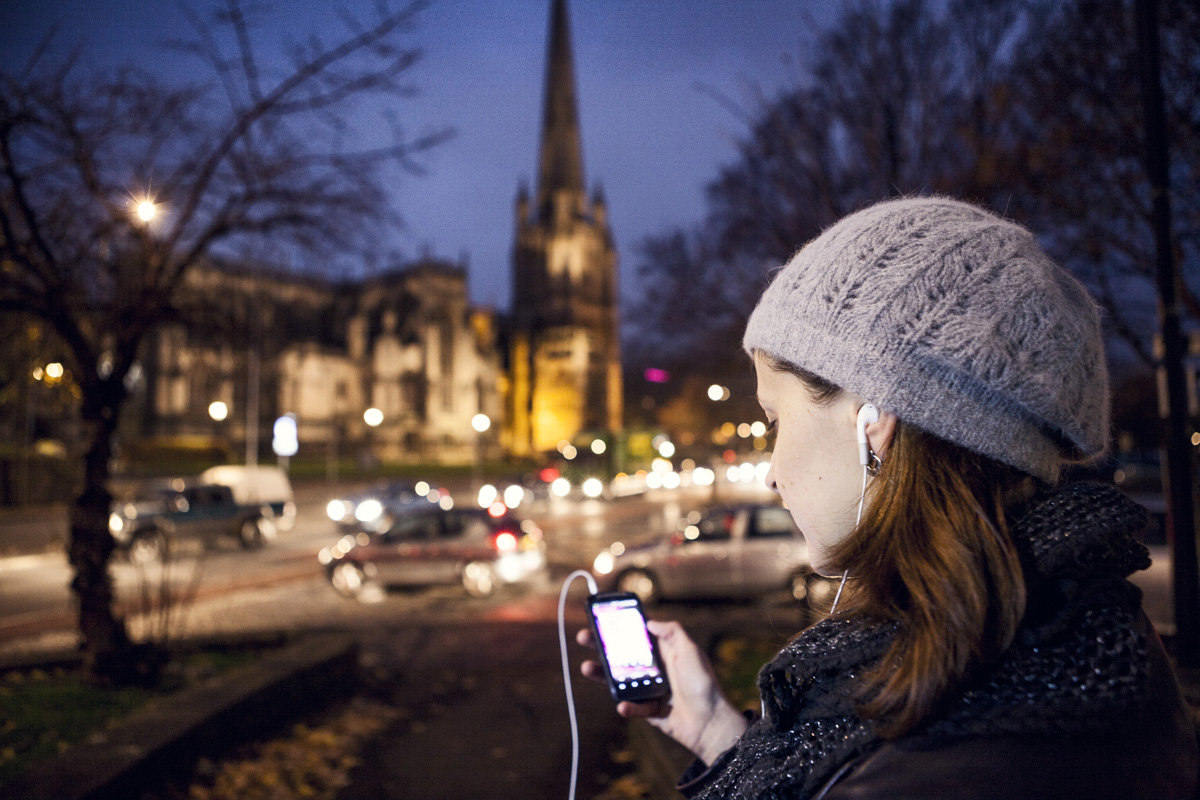
Tim Etchells, ‘Emergency Phone’, 2012.

§

National Libraries Day, Saturday 4 February 2012:

See the activities map and other resources on the National Libraries Day website for information about events happening on the day.

If you are on Twitter, follow @NatLibrariesDay and the hashtag #NLD12.

Further listening:

Alex Foster and Michel Larue, American Negro Slave Songs (Digitally Remastered), Essential Media Group, 2009. (Possibly MP3 only), £7.49

Michel Larue, Songs of the American Negro Slaves, Folkways/Smithsonian Institute, 2009 (Original Release Date: 1 Jan 1960). CD £21.59, MP3 £5.99.

Triban, Harmony: Y Casgliad/The Collection, 1968-1978, Sain Records, 2011. SAIN SCD 2637 CD bocs set £16.99 (also available as 64-track MP3 download)

Forthcoming fiction:

Tony White, DICKY STAR AND THE GARDEN RULE, Forma Arts and Media Limited, publication date: 26 April 2012, 49pp, size: 210 x 148 mm. ISBN 978-0-9548288-6-8 Price: £5.00

Radiation information

I will be in Dundee, Scotland this weekend to do a live reading from, and to talk about my forthcoming work of fiction Dicky Star and the garden rule. I will also be attending the opening of the exhibition by the artists Jane and Louise Wilson. The two things are connected, and not only because both will be taking place at Dundee Contemporary Arts.

Jane and Louise Wilson’s works were commissioned by Forma Arts and Media to coincide with the anniversary of the world’s worst nuclear disaster, at the Chernobyl Nuclear Power Plant in the Ukrainian Soviet Socialist Republic of the former Soviet Union on 26 April 1986. I was commissioned by Forma in turn to respond to all of this in a work of fiction that could be published as a standalone edition alongside this DCA show and at subsequent exhibitions of Jane and Louise’s work, notably at the Whitworth Art Gallery, University of Manchester in September of this year, as well as for general sale.

Dicky Star and the garden rule will be published on the anniversary of the disaster on 26 April, when it will be launched with events in London and (I hope) Leeds — and there are some exciting plans afoot for Manchester — but some early pre-publication copies will be available on Saturday and then from DCA throughout Jane and Louise Wilson’s show, which runs until 25 March. Review copies will be going out in February.*

My DCA gig is this coming Saturday 21 January at 2pm. It is free, but booking is recommended — see info below.

I have blogged some background during the research process: here and here. Dicky Star and the garden rule is set in Leeds, where I was living in 1986, but I wanted to draw on new research rather than old stories: new research which took in amongst other things the archive of alternative news weekly Leeds Other Paper, home of the extraordinary headline above, from their cover for 9 May 1986 (right). These blog-posts were then partly a means of thinking aloud about the project, but also a way of divesting myself of — or throwing off — some of my existing stories about the period; ridding myself of biographical anecdotes. I wanted to be able to start from scratch: to respond both to Jane and Louise Wilson’s work, and to the Chernobyl disaster itself in a completely new way.

Here (left) is a shot of the front cover design, and the following is an extract of the back cover blurb:

Dicky Star and the garden rule follows Laura Morris and her boyfriend Jeremy through the turbulent days at the end of April 1986 when the world’s worst nuclear accident occurred at the Chernobyl Nuclear Power Plant in the Ukrainian Soviet Socialist Republic of the former Soviet Union.

Dicky Star and the garden rule is published to accompany Atomgrad (Nature Abhors a Vacuum) by the artists Jane and Louise Wilson, a series of works that were commissioned to coincide with the 25th anniversary of the Chernobyl disaster. Novelist Tony White reveals Jeremy and Laura’s story in vivid daily chapters that follow the disaster’s impact in the UK, but are also each determined by their own quixotic puzzle…

More on all of this in Dundee on Saturday, and on here and elsewhere anon. In the meantime, I’ll paste in the booking info for this Saturday’s event at DCA below. If you can get to Dundee it would be great to see you there.

*N.B. If you are a book blogger and not already on my press list but you would like a review copy of Dicky Star and the garden rule, please message me your contacts and a link to your blog on tonywhite [dot] popp [at] gmail [dot] com and we’ll do what we can – thank you!

§

Tony White reading from Dicky Star and the garden rule and other works

Dundee Contemporary Arts

Saturday 21 January 2012, 2pm

Free but please book in advance on 01382 909 900

Jane & Louise Wilson are at Dundee Contemporary Arts from 21 January – 25 March 2012

Reclaim the ‘Occupy the Moon’ meme

My new short story ‘Occupy the Moon’ is now live on The Arts Catalyst website. The story was commissioned to accompany their group exhibition Republic of the Moon at (and co-curated with) FACT in Liverpool. The show opens tonight and then in 2012 it tours, first to the AV Festival and then to further venues yet to be confirmed. Here is the blurb:

As the players in the new 21st century race for the Moon line up – the USA rejoining China, India and Russia and jostling with private corporations interested in exploiting the Moon’s resources – a group of artists are declaring a Republic of the Moon: a ‘micronation’ for alternative visions of lunar life. Republic of the Moon challenges utilitarian plans of lunar mines and military bases with artists’ imaginings and interventions. Combining beguiling fantasies, personal encounters, and playful appropriations of space habitats and scientific technologies, Republic of the Moon reclaims the Moon for artists, idealists, and dreamers. The last race to the Moon was driven by the political impulses of the Cold War, but shaped by extraordinary visions of space created by writers, film-makers, and artists, from Jules Verne, Lucien Rudaux, and Vasily Levshin, to HG Wells, Stanislav Lem and Stanley Kubrick. Can artists’ quixotic visions reconcile our romantic notions of the Moon with its colonised future, and help us to reimagine our relationship with our natural satellite in the new space age?

Republic of the Moon includes work by artists including Agnes Meyer-Brandis, WE COLONISED THE MOON and Liliane Lijn (about whom see my previous blogs here, here and here).

Liliane’s work for the exhibition is called ‘moonmeme’ and it explores the possibility of projecting a word on to the lunar surface that might be read from the Earth. It is an evocative idea — ‘celestial signage, interplanetary publication’ — that I put at the centre of my story. While I was writing the piece I needed to check a few technical matters with Liliane, and she sent me over a couple of beautiful napkin sketches (as in, they were drawn over lunch) thinking around this projection idea. I’ve reproduced one here with permission.

Talking of moon-related memes, though, it is interesting to see that an ‘Occupy the Moon’ meme — unconnected with my story — has been proliferating in the form of rightish-leaning and barely satirical spoilers of other Occupy-generated or related web-based material. In that context it is a reductive one-liner and a fairly toothless joke: a Facebook group with no friends, a kind of lame, ‘we’re-the-99.99999%-who-haven’t-been-to-space’ schtick.

The work in the Republic of the Moon show is the opposite: subversive, generative and illuminating.

I’m particularly looking forward to seeing Agnes Meyer-Brandis’ ‘The Moon Goose Analogue: Lunar Migration Bird Facility’. Meyer-Brandis’ work has a charm and wit that belies its thoroughness and rigour. ‘The Moon Goose Analogue…’ is inspired by a late 16th, early 17th century work of science fiction entitled The Man in the Moone, that was written by the English Bishop Francis Godwin and published posthumously. A new edition of Godwin’s extraordinary text was recently put together by William Poole, and published by Broadview Editions. In Godwin’s story, which includes the first descriptions of weightlessness in space, a traveller named Domingo Gonsales harnesses a flock of migratory geese to make the journey. An idea which reappears of course in Antoine de Saint-Exupéry’s The Little Prince.

The Arts Catalyst have recently posted an excellent short video interview with Agnes Meyer-Brandis about her project and the flock of Moon Geese that she, just like the fictional Domingo Gonsales, has raised from the egg for the purpose.

The Moon Goose Analogue, Agnes Meyer-Brandis in conversation from The Arts Catalyst on Vimeo.

§

Read my story ‘Occupy the Moon’ on The Arts Catalyst website now.

Style, wit and narrative drive – not falling, but crawling

Research in the newspaper archives for a short story that I’m writing for publication next year to accompany exhibitions by the artists Jane and Louise Wilson is turning up some very rich material, including interesting ephemera, such as a launch ad from 1986 for ‘Paladin Fiction’ (see detail below), a new paperback list from one of the then Grafton Books paperback imprints (all long ago subsumed into the modern Harper Collins).

The 1986 Paladin launch list of four titles included books by Jonathan Meades, Thomas M. Disch and Don Bloch, and the ad promised that new Paladin Fiction titles would be published monthly.

The most exciting book on the list by far, though, is Kathy Acker’s Don Quixote. The figure (right) who appears at the foot of the ad is not Joan of Arc, but a female Quixote, extracted in fact from the front cover illustration.

I’d been thinking about Kathy Acker, because a week or two ago Ubuweb tweeted a link to the fantastic Kathy Acker audio archive that they host. This is really well worth exploring: I can’t recommend it highly enough. Among the gems on offer are audio files of her collaboration with The Mekons on Pussy, King of the Pirates, which was recorded in Leeds and Chicago in 1995. Mekon co-founder (and former Three John) Jon Langford, describes Pussy… as being,

like a short story version of the book put to music — very interesting for us, musically. It was one of the best things we’d done in a long time. But it was dismissed [by the rock press] as a knocked-off thing — because people couldn’t handle it. A lot of male rock journalists could not deal with Kathy Acker.

One thing that is striking about this mid-’80s book advertisement is that a Kathy Acker novel is being marketed at all, let alone that — called ‘exciting’ — it is being published on a literary list by a mainstream, mass-market publisher, and that she is being described as a writer ‘with style, wit and narrative drive.’ All of which is absolutely true, amongst other things, but even if Paladin were still an extant paperback imprint, it is almost impossible to imagine the same thing happening today in a mainstream that often seems obsessed rather with ubiquitous celebrity and/or proximity to power.

Perhaps it is just as well that a host, or (to quote Charles Boyle in the progamme of the recent Free Verse poetry fair in Exmouth Market), ‘a disarray’ of small publishers is emerging, who may be better equipped to survive than were many of the small and independent publishers active when I first started finding readers for my fiction in the mid-late-1990s.

The Free Verse fair was put together by Charles Boyle of the excellent CB editions (or CBe for short). Charles is a poet and novelist, and a former in-house editor at Faber and Faber where in fact he brilliantly copy-edited my novel Foxy-T. He writes a very entertaining and informative blog about the contemporary challenges of being a small publisher: ‘We can work around rather than within the system […] I never set out to be a dissident, but it seems it comes with the job.’

Back when CB editions were launched, Guardian paperback reviewer Nicholas Lezard wrote an influential review of  Boyle’s pseudonymously-published first novel, the charming and intelligent 24 for 3 by ‘Jenny Walker’. CBe, he suggested, had been set up to support, ‘works which might otherwise fall through the cracks between the big publishers.’

I recently blogged Hugo Glendinning’s great photo of contributors to my Britpulp! anthology of 1999. Writing about the collection in an unpublished note, a speculative cover quote, Iain Sinclair (who himself edited the Paladin Poetry list for a while) said:

britpulp! is urban, nervy, agressive. Fast-twitch prose that fizzes and spits.  Narrative with a kick. Jump-cuts that hurt like a knuckle in the eye. Here are the improper (and therefore reliable) tales of the city. Here are stars who glory in their anonymity. Here too, in Michael Moorcock, Ted Lewis and Jack Trevor Story, are the best of the reforgotten (they’ve never gone away, although it has taken someone with Tony White’s sharp eye for history to acknowledge a proper debt). Pulp has always been a secret. Read by millions, remembered by few. There is no room for prima donnas in a world where gaudy-covered shockers have the lifespan of a fruitfly. There is only one rule: keep the pages turning. Get your retaliation in early, and often. Let this book read you.

With hindsight, I think Sinclair got something wrong here: it was no longer titles that had ‘the lifespan of a fruitfly,’ nor the writers who were ‘reforgotten,’ but the publishers, who were struggling at best to get coverage in the broadsheet review sections, hard-pressed to get books in to the bigger shops and unable to survive the closure of destination independents like Compendium in Camden Town. Small publishers such as Pulp Books, Low Life, Codex and Attack, to name only a few — just the ones that published me — are all long gone; ancient history, like Paladin.

In an interview I did recently with Matt Locke for Arts Council England, he stressed the importance of networks and, ‘relationships with audiences that are more than just the accidental monopoly of a big distribution infrastructure.’ Matt was talking about challenges facing arts venues, museums and galleries, and the kinds of ‘call and response’ relationships and the spaces and opportunities for emotional engagement that have been created by things like Twitter — issues that apply just as much, of course, to publishers and to the book trade.

Among Boyle’s contemporary ‘disarray’ of small publishers emerging in this past year — in precisely those ‘cracks between the big publishers’ — it has been interesting to see former-Idler colleague Dan Kieran and friends’ Unbound, which uses social networks and crowd-funding to pre-fund new titles by writers including — funnily enough, a quarter of a century later — Jonathan Meades, again. Of course it is not just small independent publishers using such strategies to create a connection with their readers, but an interesting aspect of something like Twitter is its leveling function (which I first noticed when I was writer in residence at the Science Museum two or three years ago, when a blog like the Londonist was tweeting London news and cultural stories with more authority and a clearer London-based identity than the Evening Standard), and that larger organisations have been slower to use it effectively, often mistaking Twitter, in Matt Locke’s words, ‘for a broadcast medium’ rather than a conversation among effective equals.

Meanwhile, And Other Stories have developed their own stylishly subversive and boutique variation of the subscription model. Depending how you look at it, And Other Stories‘ offer of four books a year for thirty-odd-quid may represent slightly better value for the reader than Unbound’s scale of support. Like Unbound it offers subscribers a printed thank you in the pages of the books they support, but while And Other… subscribers can participate in acquisition and other meetings, the ultimate editorial say-so is wielded, the website says, by the publisher, rather than a per-title subscriber threshold being reached.

But whither Paladin’s 1986 promise of style and wit? I recently went along to the Large Glass Gallery in London, for And Other Stories’ launch of Swimming Home, the immensely, yes, stylish and witty new novel by Deborah Levy, which opens with a very narrative drive — too fast on a mountain road in the South of France at midnight.

Maybe we can turn to Kathy Acker again for a preemptive answer to Nicholas Lezard’s anxiety about works falling through the cracks, or one that turns it slightly on its head. Maybe the cracks are the place to be. Not falling through them, but crawling! In a good way. ‘The whole rotten world come down and break,’ as Kathy Acker puts it, in the brilliantly scatological and anthemic, ‘Ange’s Song After She Crawled Through London’, track two of the musical version of Pussy, King of the Pirates. If you don’t know ‘Ange’s Song…’ I would urge you to listen to it here, but be warned, it is also a gloriously revolutionary and obscene earworm, a song that I guarantee you’ll be singing for days.

Ivy4evr at the BIMAs

Great news that Ivy4evr, the interactive SMS drama for young people that I wrote with Blast Theory for Channel Four, which piloted at the end of 2010, is nominated for a BIMA award tonight, from the British Interactive Media Association.

Matt Adams of Blast Theory presented Ivy4evr at both at The Story 2011 in London earlier this year, and at the Childrens’ Media Conference, Sheffield in July, where it received this amazing review:

Stop and think about this for a second. How would you tell a story by SMS? How would you engage in one-to-one dialogue at scale?

[Ivy4evr] was an exploration: a project that genuinely sought to use new technology for an entirely new storytelling experience.

While the program was surely a creative success, its limited pilot nature meant that it only reached 5,000 kids. But that’s beside the point. So often, our tendency is to use new technology to do the same old thing in a slightly different format. We use electronic “folders” instead of manila ones, read ebooks that look identical to the ones on paper, and watch television on-demand that is indistinguishable from broadcast. The folks at Blast Theory and Channel 4 deserve a round of applause for being brave enough to truly push the boundaries of digital storytelling, to ask themselves how new media creates an opportunity for interaction that simply didn’t exist before. [Read the whole review here]

It’s all a good excuse to post Ju Row-Farr of Blast Theory’s brilliant drawing of Ivy (right).

Matt and Nick from Blast Theory are currently in Taipei doing a Mandarin translation of A Machine to See With, their Sundance commission from this year, but a bunch of us will be going along to the BIMAs tonight.

In the context of various future-publishing-type conversations that I have been involved in recently (including my conversations with Matt Locke for the Arts Council and with Kate Pullinger for this blog, and last year’s event with Stewart Home for Westminster Libraries, etc) it will be interesting to dodge the canapes and try to get a flavour of some of the other work being showcased, especially as most of the projects on the various BIMA shortlists are unfamiliar and not from the worlds of literature and publishing that I’m most in touch with. I’m hoping there will be some gems amongst the bigger-budget corporate stuff, and as ever I’ll be keeping a particular eye out for good writing.

Panoramic pulp

Panoramic Britpulp! shoot © Hugo Glendinning 1999
Michael Moorcock happened to be visiting the UK in the May or June of 1999, shortly before publication of my Britpulp! short story anthology for Sceptre. He had contributed a new Jerry Cornelius story called ‘The Spencer Inheritance’ to the collection, and had also made available some beautiful and never-before-published writing by the legendary Jack Trevor Story. Mike’s presence in the UK seemed a good excuse to pull together a photo shoot of as many of the other, living contributors as I could assemble in one place. We shot some interviews for Channel 4’s then late night TV book show Pulped in the Golden Hart on Commercial Street and then walked around the corner to the Brick Lane entrance of the lower levels of the old Bishopsgate Goods Yard (now demolished) where I’d arranged an hour or two’s access to this incredible space. A few of the writers just couldn’t make it, including Victor Headley and Simon Lewis, who I think must both have been out of the country. Photographer and friend Hugo Glendinning did the honours, producing this amazing panoramic shot, here newly digitized from 35mm slide, and which as far as I know never appeared in print at the time, except as reportage in Iain Sinclair’s review of Moorcock’s King of the City for the LRB. ‘When he makes one of his brief returns to England,’ Sinclair writes:

he is treated like a privileged ghost, a convalescent. Younger writers, attached to a sentimental notion of the heroic age of pulp, rumours of mass-market readership, have elected Moorcock as their King of the May (like Allen Ginsberg in dark ages Prague). A Prince of Thieves. It’s a courtesy title: see Moorcock, in the publicity shot for the collection britpulp!, on his throne under the railway arches, a scarfed and hatted Fagin surrounded by smooth-cheeked, bare-headed acolytes – Tony White, Stewart Home, Steve Aylett, Steve Beard, China Mieville. What you are getting is a frame from Moorcock’s comic strip, The Metatemporal Detective, showing a traditional ‘hell’s kitchen’ where ‘Old Man Smith’, the piratical ruler of the underworld, lounges on a raised chair to receive his tributes. Only in the labyrinth of fiction is Moorcock recognised as king of the city.

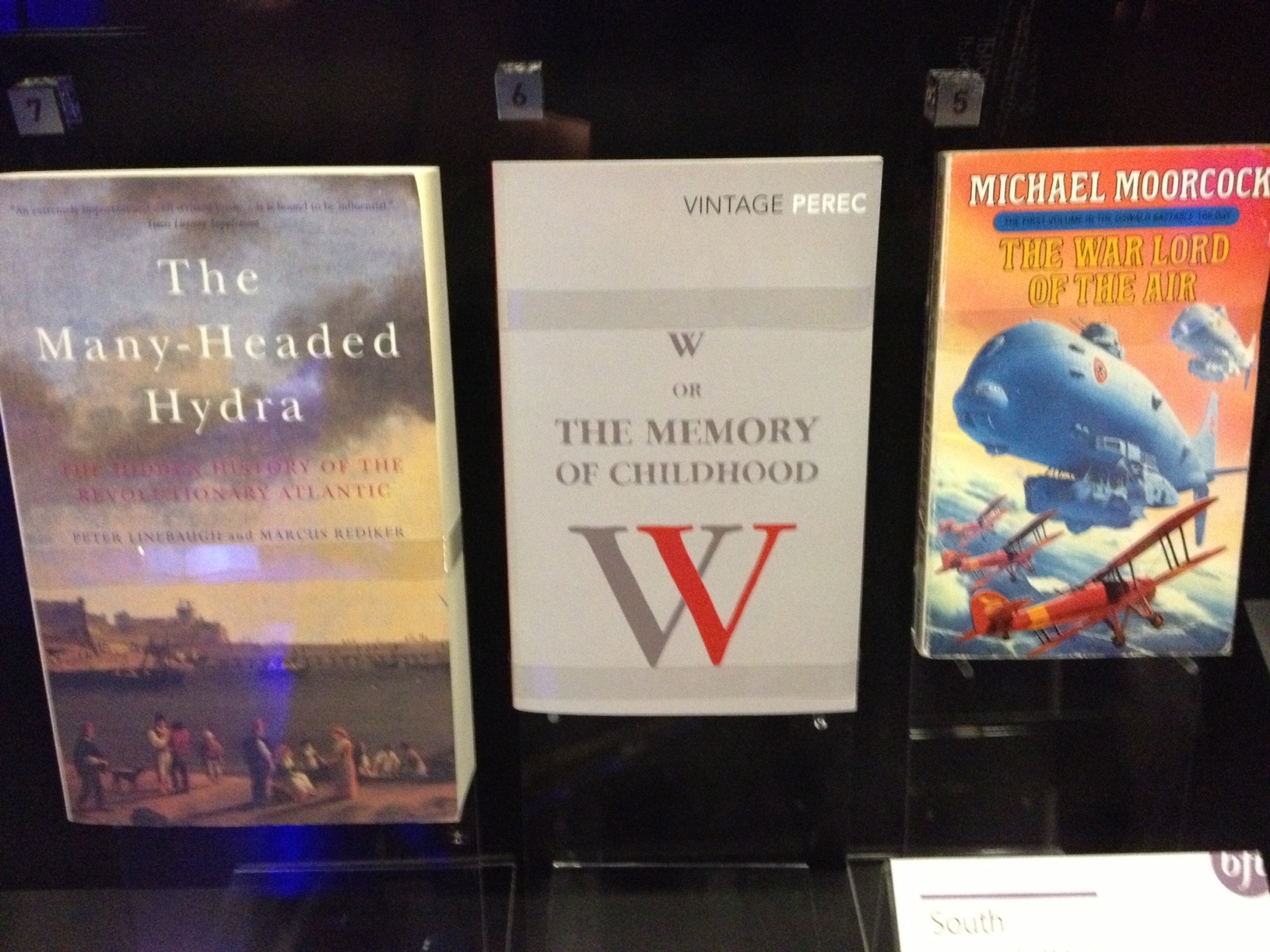
L-R: Stewart Home, Steve Aylett, J.J.Connolly, Nicholas Blincoe, Stella Duffy, Michael Moorcock, Steve Beard, Tim Etchells, Billy Childish, Jenny Knight, China Miéville, me, Darren Francis.

Nothing short of a slight return


Research for a new work of fiction* commissioned for publication in 2012 to accompany forthcoming exhibitions by the artists Jane and Louise Wilson took me back to Leeds in September. I lived there for a couple of years in the mid-1980s, so it was good to have an excuse to visit now, even for a day. The nature of the research in question was consulting the archives of Leeds Other Paper, or LOP for short, an independent journal that was published in the city (first monthly, then fortnightly and finally weekly), by an evolving collective that itself took several forms, from 1974 until — after a final name-change — it closed down in 1994.

Former ‘Lopper’ Tony Harcup’s short but fascinating and comprehensive book, A Northern Star: Leeds Other Paper and the Alternative Press 1974-1994, quotes an introductory editorial from the first issue:

Leeds Other Paper exists to provide an alternative newspaper in Leeds, i.e. a newspaper not controlled by big business and other vested interests. It is our intention to support all groups active in industry and elsewhere for greater control of their own lives.

LOP is classified as a ‘serial/periodical’ by the British Library, so is not held in Colindale with the national newspaper archive proper, nor according to the British Library’s Integrated Catalogue do they hold any issues from the period that I wanted to look at. Hence my visit, and the pile of bound issues (right) that awaited my attention in Leeds Central Library’s local and family history section.

This scan of a photocopy from the original (above right) is a detail of a typical Leeds Other Paper cover and gives a good flavour of the design although it doesn’t quite do justice to the print quality that was achieved on very limited means. Another reason for reproducing this particular cover here is that having heard Ted Chippington on the John Peel show, a couple of us went along to the LOP benefit concert advertised. After Chippington’s set I bought a copy of the record that he’s holding in the photo and asked him to sign it. ‘Cheers Tony,’ he wrote in felt-tipped pen on the label of side one. ‘Ted.’

A short piece in the following week’s LOP thanks ‘top performer’ Chippington, as well as artists including Ginger John, Olulu Olulu, The Shee Hees and others. None of whom, apart from Ted, I’m sorry to say, I have any recollection of at all. Sixty pounds was raised on the night after costs had been covered, so the benefit was deemed ‘a success’. I may have misremembered, since he is not thanked here, but I’m pretty sure Seething Wells made a brief appearance on stage at the Trades Club that night, too. I could be wrong or maybe it was another time, and just because I remember it doesn’t mean it happened, but I would swear that I saw Swells doing his ‘Tetley Bittermen’ routine on stage there.

If you’re unfamiliar with Ted Chippington’s relatively small body of work, there’s a nice film about the influence of his contrarian stand-up routines that was made by comedian Stewart Lee for BBC TV’s The Culture Show a few years ago.

(Coincidentally, Stewart Lee is hosting and headlining a benefit for London community radio station Resonance 104.4fm at the Bloomsbury Theatre on 1st November 2011. I was going to give the benefit a late plug here, but it is now sold out!)

It is not quite the period that I went to Leeds to research, but these few editions of the Leeds Other Paper are a reminder that the spring and summer of 1985 was an eventful time in the UK, and not just in the north of England. The miners’ strike had only finished a month or two earlier in March of the same year, and the Conservative government of the time already seemed to be looking for another ‘enemy within’. It didn’t take them long to find one; another load of heads to crack. The same issue of LOP that reported on the takings at the Trades Club benefit carried an anonymous and eloquent ‘eye-witness account’ of what would later become known as the Battle of the Beanfield but here is referred to simply as ‘The Battle of Stonehenge June 1st 1985’ (click on the image for a larger version).

The riot police were unleashed on sleepy Wiltshire on Saturday 1st June, in a co-ordinated attempt to prevent the Stonehenge Free Festival from taking place. Bearing the brunt of the police assault was The Convoy — a travelling community who are frequently pilloried in the media.

Right into this interregnum between the Miners’ Strike and the Battle of the Beanfield, and either blithely missing the point or maybe kind of nailing it, or both, limped some other — unlikely — travellers in the form of the final, indeed terminal line-up of The Clash. There was no Mick Jones or Topper Headon. Instead Joe Strummer and Paul Simonon were joined by drummer Pete Howard, ex-Cortina Nick Sheppard and Vince White.

If this is referred to at all it is usually called ‘The Clash busking tour’, although that seems like a bit of an overstatement because even by the media standards of the time this ‘tour’ was a low-key affair. There were no ads in the music press or the broadsheets, no announcements, no press releases or friendly music journalists tagging along with their photographers. There were no publicity campaigns or photo-ops and no daytime TV coverage. Neither were there tour T-shirts, posters or merchandise of any kind. On May 3 1985, the band set off from London to Nottingham on modes of transport that vary according to who is telling the story, and didn’t go back home for a fortnight. During this time they played up to about thirty-four more or less impromptu and almost all undocumented gigs of varying length in locations around Nottingham, Leeds, York, Sunderland, Newcastle, Gateshead, Edinburgh, Glasgow and possibly Manchester.

I saw two of their Leeds gigs; one by chance, the other not. The first was a short set they played for a couple of dozen people in the garden of the Royal Park Pub on 6 May. My own story of that afternoon — which involves me and a couple of friends, a late night watching Eek-A-Mouse at the Cosmo Club and a hair of the dog in the May sunshine the next day while The Clash play ‘La Bamba’ a few feet away — is no better or worse than any other of the handful of accounts posted on the Black Market Clash site. But I have been amazed, recently, to see this really great colour photo of the gig, [UPDATE: image archived here] and not least because it must have been taken from just a couple of feet to the right of where we were sitting.

There are a few other pictures of the tour on the Black Market Clash site, including this one (left) which is supposedly of their gig at The Station, Gateshead, but something about it looks naggingly familiar and I’m sure that this, too, is the garden of the Royal Park.

It’s odd to see these pictures. I don’t even remember one person among the handful of us at the Royal Park taking photos, let alone two. But there must have been, because just visible over Paul Simonon’s shoulder in the colour photo I’ve linked to above there is a man or woman (see detail, right) who is looking through their own single lens reflex camera. And this is where it gets complicated, uncanny even, because not only is she/he (let’s say) pointing the camera almost directly at the man taking the colour photo and therefore looking out at us who are looking at the photograph now, but she/he is also looking directly at us then.

I also saw The Clash play on the steps of the Leeds University Student Union the following day (photo on Vincent White’s site here). I don’t know where Black Market Clash got this set list from though. According to them: ‘The band played Cool Under Heat, Movers and Shakers, White Riot and Clash City Rockers to more than 500 fans.’ I would say five hundred to a thousand people, but that set list is wrong.

Blimey, what’s that saying about old punks becoming postmen? Perhaps it should be that the scantness of the archive forces them to become pedants: arguing the toss over ephemeral scraps, contesting the uncontested. More ‘slight return’ than ‘total war’, and frankly who cares? Today there would be no disputing something as simple as a set list, because a dozen videos of a gig like that would be tweeted in close to real time, or posted on Youtube within the hour, but in that almost unrecognisable media landscape of the mid-1980s all that’s left are a couple of photos and the stories that some of the people who were there have told and retold; my own version of events probably no less contingent than any other. If you asked me, though, I would tell you that they opened with a blinding version of Toots and the Maytals’ ‘Pressure Drop’, then went into ‘Garageland’. They might well have done ‘White Riot’, but I’m pretty certain they also did ‘Police on my Back’ and a cover of ‘Johnny Too Bad’ by The Slickers. The gig was broken up after just a few songs, and most people trudged around the corner to the Faversham pub, where they played a longer set. We thought about it, but figured that the Royal Park gig — a handful of us chancing upon The Clash in our local and then following them outside to watch them play live on a balmy May afternoon — would be a hard one to beat and we went home.

Here (right) is how the gig on the Union steps was reported in the Leeds Other Paper a week or so later.

No-one seems to have posted a set list for the Royal Park gig. I could be wrong, but the way I always told it is that they played around half a dozen songs which included ‘Stepping Stone’, ‘Jimmy Jazz’, ‘Brand New Cadillac’, ‘La Bamba’ and — most memorably — ‘Straight to Hell’.

There are a couple of recordings of ‘Straight to Hell’ from the busking tour, but this one (click on the player above) from Gateshead on 11 May seems to pick up Pete Howard’s fantastic drumstick work better than the more guitar-heavy York bootleg. One thing: I’m sticking to my guns here, but the fact that ‘La Bamba’ doesn’t appear on any other set lists nor the two live bootlegs from the tour does make me wonder if I completely imagined that. I’m sure they played a couple of crowd pleasers, too — ‘Bank Robber’? ‘I fought the Law’? — but just because it happened doesn’t mean I remember it.

I was right about the photo though.

That is definitely the garden of the Royal Park pub.

In the background of the picture between Nick Sheppard and Joe Strummer — as a quick cut-n-paste from Googlemaps Street View which matches perfectly shows — is the familiar, two-windowed gable-end of a Leeds back-to-back terrace, in this case the southern end of Elizabeth and John Streets, which is visible beyond a minicab parking lot that (unlike the garden, which has been built over) is there to this day; cars still parked on a triangle of wasteland on the opposite side of Royal Park Road.

UPDATE April 2019

* In fact this body of research contributed to two works of fiction. First the novella Dicky Star and the Garden Rule (Forma, 2012), which is set in Leeds during April and May 1986 and was commissioned to mark the 25th anniversary of the Chernobyl disaster of that year, and published to accompany Jane and Louise Wilson’s touring exhibition Nature Ahbors a Vacuum. ‘Dicky Star…’ (for short) which was written using an Oulipo-inspired ‘mandated vocabulary’ turned out to be a test piece for my latest novel The Fountain in the Forest (Faber and Faber, 2018), the first in a trilogy of novels that explore the legacy of that 90-day interregnum between the end of the Miners’ Strike and the Battle of the Beanfield on 1 June 1985.

The Fountain in the Forest by Tony White, out now in Faber paperback

When a brutally murdered man is found hanging in a Covent Garden theatre, Detective Sergeant Rex King becomes obsessed with the case. Who is this anonymous corpse, and why has he been ritually mutilated? But as Rex explores the crime scene further, the mystery deepens, and he finds himself confronting his own secret history instead. Who, more importantly, is Rex King?

Shifting between Holborn Police Station, an abandoned village in rural 1980s France, and the Battle of the Beanfield at Stonehenge, The Fountain in the Forest transforms the traditional crime narrative into something dizzyingly unique. At once an avant-garde linguistic experiment, thrilling police procedural, philosophical meditation on liberty, and counter-culture bildungsroman, this is an iconoclastic novel of unparalleled ambition.

Buy The Fountain in the Forest direct from publisher Faber and Faber

Read Sukhdev Sandhu’s review in The Guardian

‘Feeling the heat of the audience’ – a conversation with Matt Locke

Matt Locke is the founder of The Story conference. He has been commissioning work at the technological cutting edge of mass media and participation since the 1990s, initially for arts organisations like Huddersfield Media Centre, then as Head of Innovation for BBC New Media and for Channel 4, where after an influential spell as Commissioning Editor for Channel 4 Education he was until recently Acting Head of Cross-Platform for the station. Now he runs a new company called Storythings, and yesterday the first batch of early bird tickets for the third conference in the series, The Story 2012, sold out within minutes of going on sale.

I interviewed Matt for Arts Council England back in the spring, and I’m pleased to say that my article based on that conversation has now been published on the Arts Council website where you can access it as a downloadable PDF or Word Document.

Matt brings some fascinating and provocative insights to what turned out to be a very wide-ranging discussion. At one point he talks about how games are now often released as

a minimum viable product, so when you launch a new game it has about 20% of the total feature set of the game, just enough to get people interested, and then they’ll continually iterate features for the rest of that game’s life. And that’s a really fascinating way of looking at culture – you know rather than think about the finished product. What would the minimum viable product for a novel be? In some genres you can do that more obviously: look at feedback, see how a game is working on line, look at the stats and the tweets and change it. If you’re doing drama or film it’s really difficult, but it’s not about having the shortest possible iterative cycle, it’s understanding what that cycle is and how you can be creative with the results that you’re hearing from the audience.’ He turns the question back on me, ‘Do you think you’ll ever get to the point where you’d release a 2nd or 3rd version of a novel?’

You can download the article here (opens as PDF).

See also: a related interview with novelist and future publishing researcher Kate Pullinger.

‘A real reconfiguration’ – an interview with the writer Kate Pullinger

I went to the British Library the other day for a workshop — a small, invited group discussion — about digital transformations in and of literature and the publishing industry. The event was convened by novelist Kate Pullinger (whose 2009 novel, The Mistress of Nothing won the Governor General’s Literary Award in Canada) together with Professor Janis Jefferies and Dr Sarah Kember, both of Goldsmiths. The workshop might lead to further conversations and research, which would be great because while there are currently quite a lot of events discussing these types of issues, the panels are almost always weighted towards publishers and it is not so often that writers are actually invited to speak, something that Kate herself has blogged about recently. This always feels like an oversight because writers can be quite active in exploring the kinds of innovation that new publishing models offer and some are pushing just as hard at boundaries of platform and format and engagements with readers to explore and shape what the futures of storytelling and publishing might be.

Maybe it is my experience of working at the Arts Council which has taught me that it is often artists – in the broadest sense – who lead the way in discovering and exploring the possibilities and implications of new media, and that it is a fundamental challenge for the slower-moving organisations and agencies, whether publishers or funders, to try to keep up. As a writer myself I’ve also been aware that although one might sign over ebook rights in a novel this doesn’t mean a publisher can or will do anything with those rights, and that one needs to use any opportunity to experiment with new ways of reaching readers. You can’t just sit back and wait for the next book to come out and see what a publisher might do for you at that point, as if it is something in which you have no agency yourself.

I met up with Kate Pullinger back in the spring to discuss some of these ideas. We’d both just been to The Story conference at London’s Conway Hall, so I started off by asking what impressions Kate had taken away from the event…

§

‘I guess I came away with that it was a good day, because it goes in so many directions at the same time. And also unlike Book Camp and a huge number of these day-long conferences I go to, it was about story, it wasn’t about publishing, which I suppose they so often are. But also it was a slightly frustrating day, which I suppose is inevitable: there are bits that you want more of and bits that you want less of, and that’s quite subjective. I suppose the two talks that have lingered with me for the longest is the Adam Curtis which wound everybody up, but in an interesting way.’

For the benefit of readers who weren’t at The Story conference, Curtis had been previewing some of the ideas from his then still forthcoming documentary series All Watched Over by Machines of Loving Grace, subsequently broadcast on TV in the UK by BBC 2 in May 2011. His suggestion in Conway Hall, that we’re all unaware of the power structures behind the internet, social media and the web 2.0, or that artists are somehow failing to deal with this, was treated as a revelation by some and as incredibly naïve by others; myself included. Speak for yourself, mate! I’d thought. Where have you been for the past two decades? Haven’t you heard of Heath Bunting?

‘It definitely provoked a divided response,’ says Kate. ‘But his work always makes me feel both those things. I always think, “Oh you’re a total lunatic,” but also I think, “Oh you’re absolutely right!” And then the other presentation that I thought was really revealing was Phil Gyford’s talk about his The Diary of Samuel Pepys online project, because of the extraordinary, multi-platform delivery that he’s gone for with that. And I was really interested in the whole business of the tweeting and all these people around the world tweeting back to him in character. Did you hear that one? And it’s been going on for years, and it’s got all these people passionately involved with it, which is extremely difficult to achieve. And I think he has done that in this slow methodical way but also that he’s been very clever in the way he’s added new platforms and new aspects to the project from it’s humble beginnings as a web-site, and he has taken his audience with him and found new audiences at the same time. Because I do think that that is the hardest thing to do. You know, you can attract a lot of attention by making a big splash, but then to actually keep it and keep it growing in a way that isn’t flashy is a real achievement.’

The network of relationships and conversations that have built up around The Diary of Samuel Pepys reflects something that’s also happened in a really big way with Inanimate Alice, a transmedia project, a kind of digital novel, that Kate and co-writer Chris Joseph have written for creator and producer Ian Harper. Kate tells me that the fourth and last episode of Inanimate Alice was published in around 2008, but that since then people have been making their own follow-ups.

‘This is largely pedagogically driven,’ she suggests. ‘Which was not anticipated, but there are the four episodes that we’ve published and then there is this absolute plethora of episode fives that have been created all over the world, usually in educational settings, but those settings range from primary secondary to higher education, as well as lots of people using it with learning disabled kids. So Inanimate Alice has got this very active life of its own which was definitely unanticipated initially, but from fairly early on while we were creating the episodes it became apparent that teachers were using it. And early on, sort of around the episode two stage, Ian commissioned a colleague of mine at De Montfort University to create some lesson plans that could be used in classrooms and were freely available to download, and which turned out to be exactly what teachers wanted. So that little bit of encouragement has led on to this really very large and active pedagogical community growing up around the project. The Facebook page and the twitter feed are just remarkable!’

So apart from that initial small investment in the lesson plans to support the work, this is all happening without additional funding? People are putting their own enthusiasms and passions into it?

‘Yes, exactly! At the moment there’s a librarian in the US called Lara Fleming who is very active in promoting it as a tool for digital literacy, and there are a couple of teachers in Scotland and a couple of educationalists in Australia and they’ve sort of formed a bit of an ad hoc team, and again with no funding, and that’s been very fascinating.’

There is a pause while one of Kate’s children texts her: ‘If they’re asking me a question I’d better answer.’ Then: ‘I wished I’d been at the first Story conference,’ she says, ‘because were there any writers this year?’

Well, there was Graham Linehan talking about his writing process. And Matt Adams of Blast Theory opened with the presentation about Ivy4evr, the interactive SMS drama we’d made for Channel 4 and which I’d written, but no you’re right, last year there was Tim Etchells, Cory Doctorow and myself on stage, so there were fewer writers in that sense.

‘Oh yeah, Matt explained Ivy4evr really well,’ says Kate. ‘The “story ladder” idea – which is a great term for that type of storytelling. He explained it really clearly.’

I always joke that I’m more intelligent when I’m in the same room as Blast Theory, but the collaboration really forced me to look at writing more closely and in a different way than I had before, and actually the kinds of notation that we had to develop to understand and work with the forms of interactivity at the heart of the project really were mind-expanding! Also fascinating were the huge amounts of data and feedback that were generated and we are able to access and draw upon at every stage of every exchange between the players and ‘Ivy’.

‘We were sitting there listening,’ says Kate, ‘Sue Thomas and I, and saying, “There has to be some kind of AI [artificial intelligence] here,” but Matt didn’t really discuss that aspect of the project.’

Maybe you’re right, I say, because thinking about it I noticed that people reviewing the presentation – who hadn’t played Ivy4evr – were saying things like, ‘Ivy4evr looks like it runs on rails‘, and I was thinking NO it doesn’t! It’s so interactive, that’s why it took so bloody long to write. You know, the script was this vast spreadsheet of different fields and fragments and possibilities – all of it completely automated – and what it absolutely was not was simply a succession of decision points that led you down different, branching pathways like those old style, ‘now-turn-to-page-36′, so-called interactive novels. Sometimes the interactivity might come from the engine/’Ivy’, remembering profile data about you, or remembering something that you’d said a few messages back, but mostly it was from the engine reading and parsing and understanding what you were saying back to her! And the script had to be open enough to accommodate the assemblage of messages composed from many different sources but which each still needed to feel like a ‘discrete’ unit of communication. However it was composed, each message had to function and be understood as a single, coherent text message of 160 characters that had been written by one person, by Ivy, in response to the user’s last message.

‘Is that project still “live”?’ Kate asks. ‘Will it have new iterations?’

Well, I would love it if it did, because it was so interesting for me as a writer: having the chance to test every sentence, you know, almost every word, with these ever larger user groups against all kinds of criteria: to test, rewrite, test, rewrite, and also to learn from the kinds of language that the players we were testing with were using. Matt Locke who commissioned Ivy4evr for Channel 4 talks about ‘call and response cycles’ in new kinds of storytelling, and what was amazing with Ivy… or certainly a revelation for me as a writer was that we were able to build that call and response not just into the way the finished work functions, but also into the actual development of the writing. So I think that next time I start a new novel — I’m just finishing a novel at the moment which I started before Ivy4evr — I’m really going to miss, you know, being able to test each paragraph on readers at such an early stage.

But also it’s interesting because Ivy4evr is a text message conversation. This means that each player writes half of their version of the story themselves, with the messages they send to Ivy, which is fascinating in terms of where you think any actual story is located, and as a writer setting up something like that it is not just about laying out tracks.

‘No, no,’ Kate quickly agrees, ‘it’s a much more meaningful form of interactivity.’

It’s about people having a direct engagement that sneaks in under the radar, and producing the work themselves in a way, which is a difficult thing to fit into a traditional idea of what publishing is.

‘Absolutely! It’s not difficult for you and I.’

Or for the people who are playing it!

‘But it is very difficult indeed,’ Kate picks up the thread, ‘for anyone in traditional publishing to get their head around. There are a lot of challenges. I think that when I first started working on digital fiction projects nearly a decade ago I had this assumption that these two worlds that I was inhabiting you know digital fiction and print – for want of a better term for it – were going to merge, and to me that seemed not only possible but desirable. But it’s not happening. It’s not really happening. And the ways in which the publishing industry think that it is happening are in fact false, so the whole business of the digitisation of publishing, from the digitisation of work-flow all the way through to the rapid rise of the ebook, and all the other stuff, you know, the enhanced versions of ebooks etc. that’s all still completely about traditional publishing, even though it’s digital. And the idea that I had, that people who were interested in writing and interested in stories, and interested in finding audiences and readers for stories, would be interested in using these new technologies to explore new ways of telling stories is not true, it’s just not true. And that’s because, there’s a lot of reasons for it I think one of them is that the publishing industry is an old industry and it’s about selling books, and for them to deviate from that in any way is a big thing. But there has been a real reconfiguration of the relationship that writers and readers can have, through social media, through book clubs and online versions of book clubs. I do think that is really happening, I mean you just have to look at someone like Ian Rankin or Margaret Atwood to see how they use those social media tools really effectively to communicate really directly.’

And some publishers, I say, like Faber, who have been quite quick to recognise that all of these other kinds of conversations which happen around the book, things like writing classes and retreats, archives (the courses that novelist Anna Davis is leading for the literary agency Curtis Brown is another example) can be commodified…

‘Curated and utilised in a commercial sense? Absolutely! I think that there are lots of clever things happening like that. I think World Book Night was an example of that. But when it comes to new forms, it is not happening. And whether or not it will I really have no clear idea about. I think I feel more pessimistic about it than I used to. But also I’m questioning whether or not it is actually a desirable thing to bring the two things together! Maybe I’ve just been misguided for the last decade, even thinking that was a good idea.’

So that old distinction between the writer working in print and the writer working in digital media still holds. From what you’re saying that is still very much the situation.

‘Yes and, say, the huge audience that Inanimate Alice has grown and which has remained loyal to it, has no interest to a traditional publisher, and that has continued to baffle me. And I think the other side of the story is that most writers aren’t driving it. Most writers aren’t interested in it either. Most writers in the traditional sense of a writer who writes books, they’re not interested. They’re fearful of it. Don’t you think that’s true?’

Well, a writer friend of mine who is otherwise very very engaged with the web and has been for the past decade, also keeps surprising me by coming out with ideas about piracy which are based on the same old ‘Home taping is killing music‘-type of arguments. But if traditional writers in the main are suspicious of the possibilities or the challenges that digital media presents to their understanding of what writing is and how writing functions and how they can earn their living as a writer and all of those things, then who are the people who are going to be telling the stories that rise to the challenge. Where is innovation coming from, Kate, as far as you see it?

‘I think it’s coming from a number of different directions really. I think there are lots of interesting writers who work in the digital realm who have nothing to do with book publishing. Maybe not lots and lots of them, but it’s definitely an emerging field and with emerging business models as well. Which has been the thing that has lagged but is now happening because of the App Store and things like that. It’s just simpler to sell stuff now than it used to be. And I think these people come from different directions. It’s quite common for them to come from a film background or the art world, with the cross over of net art and digital arts. But I think those people see themselves as entirely separate from the book publishing world. And then of course there’s a whole lot of people who are interesting in trying to get in to that realm who come from games and web design. The most successful are people like Six to Start and Enhanced Editions. And certainly in the UK at the moment there does seem to be a field that’s kind of bubbling at the moment and they seem to either not need writers or simply to find a writer if they need one. Probably using a model like you working with Blast Theory. Those kind of hybrid organisations seem to be doing really interesting things.’

Kate is currently Reader in Creative Writing and New Media at De Montfort University, Leicester, so I ask what she thinks are some of the challenges that young artists, young writers, face with this kind of fragmentation of traditional book publishing, and where the infrastructure that it depends upon is shrinking and changing. You know, the amount of retail space available for books on the high street shrinking so rapidly. How if at all does she see young people, students, responding to the challenge?

‘I do think that it is finding new ways of publishing. I’m using the word publishing in a very broad sense and I’m reluctant to use the term “self-publishing” because of all the connotations that it brings with it, because it is what it is. Because that’s what Inanimate Alice is. Inanimate Alice is self-published, but to use the term “self-published” or even worse, a journalist I did an interview with in Canada last week described it as “fiction for free”!’

Free in a bad way?

‘Yeah, in the worst possible way. So side-stepping the connotations of those phrases, finding ways to publish that are meaningful and that work with what they’re trying to publish. And again I think I’ve been so interested to see for example there’s this poet called Jörg Piringer who has been on the digital poetry scene for a long time and he’s started publishing his work as apps. He recently published this very beautiful kind of poem-game that is called abcdefgall the way to z; one word. And it costs like $1.99 and as of Christmas 2010 he’d sold 30,000 copies. So I think that those kinds of ways of collectively publishing or new ways of publishing are the things that that generation and younger are going to be looking at. Except you can’t just stick it out there, you have to have the networks to support it, don’t you. You have to be part of a complex network of connections in order for it to work. Which is why it worked for Jörg, through his being active in the e-poetry world.’

Which is not new.

‘No, that’s not new, Tony, no. It’s been like that for centuries.’

I tell Kate that I do occasional bits of teaching too, and that I often find students really hung up on the idea that, ‘I will get myself an agent and I will get myself a publisher’ and that’s what being a writer is, you know. That is the only model: novel, agent, publisher. So I’m always saying to them, you know, yes, maybe that will happen, yes maybe it will but don’t wait. If you can find a community now by doing open mic nights, live literature events, getting a short story published in a magazine, or selling a pamphlet or giving a pamphlet away or whatever suits your work, finding or building a community of interest around what you do, then you’re beginning to build a relationship with readers and that’s the key thing, to create spaces for those kinds of engagements.

‘Absolutely, and as you say there’s nothing new about it at all. I also think there’s something I often used to say that the book was an obstacle that prevented people thinking about the future of storytelling because people are so in love with the book, but I think that’s changing. But I also think that people are in love with the idea of the solitary author, the lone author in ‘his’ garret, and that all these kinds of projects that we’re talking about don’t fit with that model at all. They’re much more to do with collaborative networks and communities and it’s a kind of psychological barrier in a way you’ve got this object of the book and the person alone in there.’

So how do you see that changing, Kate, or do you think that’s too deeply ingrained?

‘I don’t know. I’ve just been trying to think about that lately but I haven’t come to any conclusions, because it does still exist as well: the lone artist in their garret who produces their first book and it turns out to be a huge best seller. It happens!’

Yeah, and that’s a great story in itself! People never get tired of hearing that… Zooming out slightly now: for a short story commission I’m working on at the moment I’ve been looking at photos that the artists Jane and Louise Wilson have been taking in Pripyat, the deserted town in the exclusion zone around the Chernobyl nuclear power station in Ukraine. One interesting thing, to me, is that in these photos everything of any value, whether it’s floor boards, wiring, everything, has been stripped out of every building, everything with any scrap value, apart from books. So all the school rooms still have all the books on the shelves that were there when the town was evacuated. And I love this this idea of books being the things that have lasted there and the ambivalence of that. Does it say something about the persistence of books or does it say that they have absolutely no value? Or both things at once? Is that a useful metaphor?

‘I saw or read yesterday, someone was re-tweeting this story about one of the towns on the northern coast of Japan, a town that following the earth quake and the tsunami and the nuclear disaster at Fukushima has absolutely no infrastructure left, and how the local newspaper has been creating hand-written, hand-made copies of the paper, like four or five handmade copies that are posted in strategic places in the town.’

That sounds familiar. I just wrote a story for the Russian Club Gallery and while I was there I found a discarded copy of a one-page broadside edition of the Daily Express from the third day of the UK General Strike in 1926. And it is such a reduced idea of what a newspaper is — simply one foolscap page, printed on one side — and yet it still functioned. This one was printed on card, I guess so that it could be stuck on the wall in a pub. Similarly a few months ago I was writing about the Cartonera publishers, the really innovative street publishing movement that started during the economic crash in Argentina of 2003 and which has now spread to almost every major South American city. These are all developments in publishing that have nothing to do with technology but everything to do with the future.

‘Yeah, well, that’s why I was so interested and it was so appropriate that that tweet about the newspaper in Japan had come from Margaret Atwood, because that’s one of the things that she bangs on about, you know, that digital is completely fine with her, but what happens when the grid fails? — being the dystopian writer that she is. And so the Cartonera movement, or this example of these hand-written newspapers in Japan, is absolutely an example of just that: publishing when the grid fails.’

Actually I think that is a really optimistic note to end on!

§

Kate Pullinger, The Mistress of Nothing, is published by Serpent’s Tail, £7.99

Ksenija Bilbija and Paloma Celis Carbajal (eds), Akademia Cartonera: A Primer of Latin American Cartonera Publishers, is published by Parallel Press/University of Wisconsin-Madison Libraries, $40.00

As in free speech

Just back from a very enjoyable weekend of performing and compering at the Free University of Glastonbury. Here are a few photos…

On Friday I read from the satirical stream of filth consciousness sentience that is my novel CHARLIEUNCLENORFOLKTANGO.


Compering on Saturday I had a very interesting conversation with Dorian Lynskey about 33 Revolutions per Minute, his fascinating history of protest songs.


Also on the Saturday programme were Bad Science author Ben Goldacre, comedy writer Emma Kennedy, as well as comedian Marcus Brigstocke who spoke about his new book, but the highlight was interviewing the one and only Suggs for a heaving tentful of Madness fans.

Suggs is a lovely bloke and a great raconteur, so his forthcoming one-man show should be a blast. Keep your ears open for news of this in the autumn. Like me he is also a big fan of Resonance 104.4 fm and gave it a plug or two during our chat.

What I’d been looking forward to the most was performing my recently published short story ‘A Porky Prime Cut’, with live accompaniment from UK acid house pioneer Richard Norris on the Saturday evening. We didn’t get any photos of that, sadly, but it went so well that we’re going to do a studio version at some point very soon. More news on that as and when. In the meantime…

…to underline the Free University of Glastonbury’s belief in both freedom of speech AND free beer, we also gave away copies of a strictly limited print edition of ‘A Porky Prime Cut’. I’ve got a few spares of this to give away, so message me if you would like to lay your hands on one.