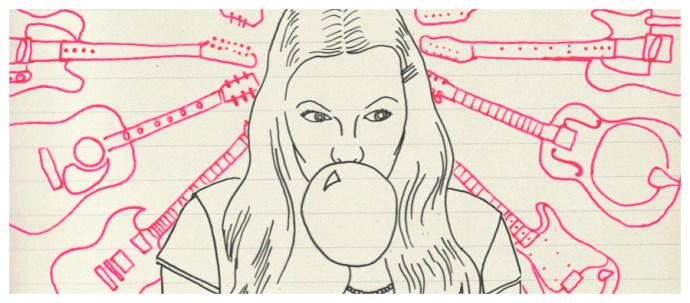
Pre-aged anonymous future

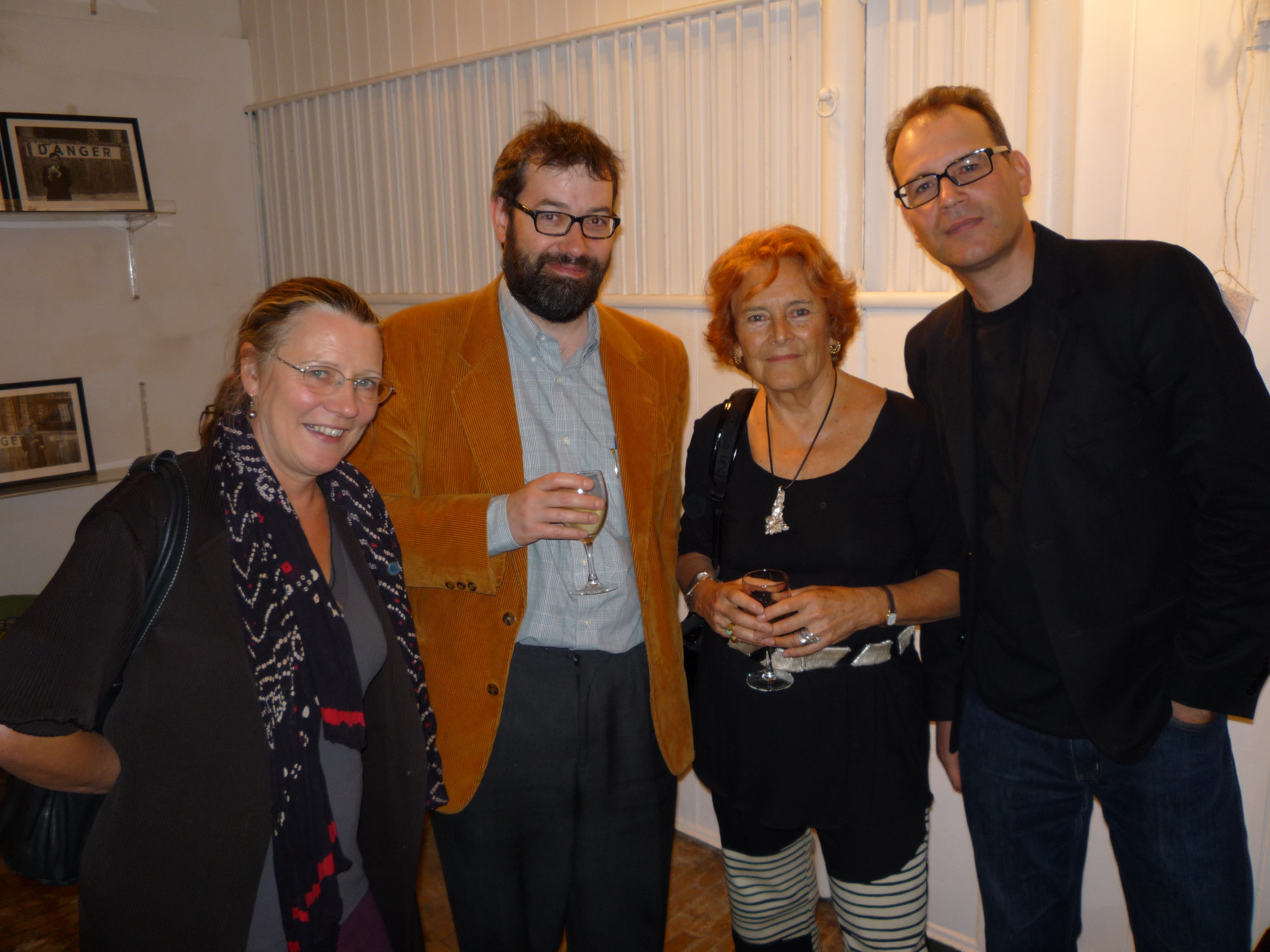
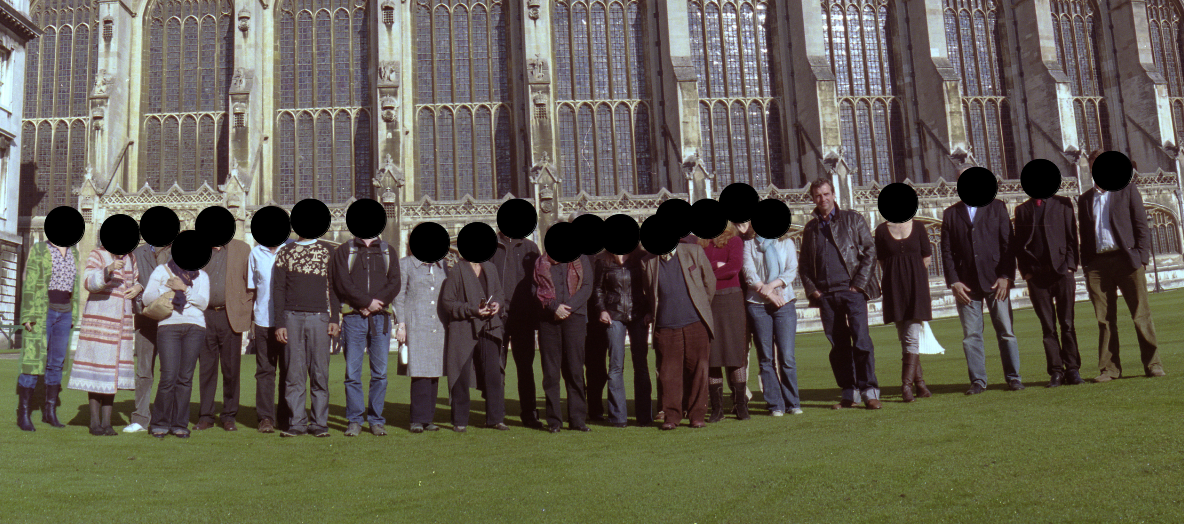
L-R: anonymous, anonymous, anonymous, anonymous, anonymous, anonymous, anonymous, anonymous, anonymous, anonymous, anonymous, anonymous, anonymous, anonymous, anonymous, anonymous, anonymous, anonymous, anonymous, Tony White, anonymous, anonymous, anonymous, anonymous.

Announcements received from or on behalf of the artists Rod Dickinson and Heath Bunting in the past couple of weeks reminded me how much I like each of their work, and that for a while I’ve been meaning to do a post about a short story of mine that features both of them, or which uses each of them as a way of writing about the other. Reason being that the story is set in or after 2011, which when I wrote it seemed sufficiently like ‘the future’ (albeit a very near future) to offer some satirical advantage, so I’ve wanted to quickly mention it before that year is upon us (with the obligatory nod to that great William Gibson story of fictional futures made real, ‘The Gernsback Continuum’).

‘The Lunar House “Re-enactment”‘ was commissioned by King’s College, Cambridge to form part of a report on a series of events called the Arts and the Law seminars which brought people (artists, lawyers, academics etc.) together, ‘to debate and clarify the legal and ethical implications of portraying real people through artistic representation, wider issues of freedom of speech for artists,’ and, ‘how such issues are involved in’ particular art forms: visual arts, theatre, literature etc.

I’ve known about Rod Dickinson’s work for ages, initially via Cabinet Gallery who showed his work in the early 1990s, but hadn’t met him until two or three years ago. For this new work Rod has collaborated with Steve Rushton to produce Who, What, Where, When, Why and How, a video installation which is showing at Alma Enterprises, London, until mid-January. Here is the blurb:

‘two actors deliver a simulated forty five minute press briefing […] composed solely of fragments of speeches and press statements [which] focuses on the way in which similar declarations and political rhetoric have been repeated and reused by numerous governments across continents and ideological divides to justify acts of aggression and state sanctioned violence.’

Heath Bunting‘s work also engages with the production and practice of power, amongst other things, but it is more elusive, low-level and unbounded and it has sort of crept in to my consciousness over the past decade. I think of Bunting’s work like the faint glow of a persistent beacon on the horizon — he works out of Bristol — that seems to relentlessly and doggedly illuminate contemporary practices of politics, power and identity, but which the closer I get to the more resistant to summary it becomes. Bunting is often described as a net.art pioneer, but a project might consist of a real-world action, a collaboration, a book or advice on making a day-planner that will enable you to avoid working. It could be an ‘IT COSTS MORE TO BE POOR‘ poster, or an extensive record of points of engagement (transcripts, legal documents, etc.) between the body(s) or person(s) and any one of the infinity of social, political, geographical, legal multiverses in which we find ourselves to be born and living. In all this teeming beaureaucracy and detail Bunting’s work starts to seem like Borges’s same-scale map of the territory, as if it is identical with his life.

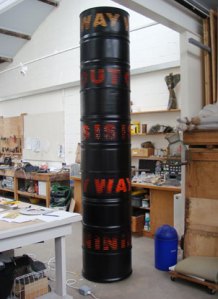
Just so with the work announced by Bunting’s email of 21 November 2010 which — in as far as I am able to locate it, and amongst other things — is just as analytical, botanical, countercultural, dispersed, ethical, fragmented, guarded, honest, idiosyncratic, journalistic, key, labyrinthine, malcontent, networked, open, provocative, questioning, rigourous, satirical, time-consuming, unglossed, volatile, wide-ranging, X-border, yippyish and zealous as ever. The email offers ‘a spare pre-aged anonymous letter box facia’ for sale (pictured left), and lists both secondhand and ‘artist signed’ prices. The email also links to a webpage from 2005, entitled Anonymous Letter Box – Howto, which is at least partly self-explanatory dealing as it does with the siting over long periods of time of anonymous mailboxes in disused street locations around the city. The simple design and the proliferation of texts and pages found here and under the wider Status Project heading is indicative of the approach used elsewhere on the irational website. A new project, slated to run from 2010 to 2020 lists works in the Heath Bunting Collection that are, like the spare pre-aged anonymous letter box facia, available for loan or sale/exchange.

So much for a very limited introduction. With even less to go on and beneath the distracted-looking gaze of E.M. Forster, whose portrait was one of several hanging in the seminar venue, Heath Bunting’s work proved difficult to understand for many of the participants at that Arts and the Law seminar at King’s College, Cambridge. Particularly challenging was a short discussion of Bunting’s arrest in 2001 (documented on irational through a series of documents entitled ‘In defense of the tools of my trade’). In order to explore this further, and to see if fiction might offer a useful approach, I appropriated elements of Rod Dickinson’s practice (thank you Rod) to write a short story which imagined a large-scale work of participatory performance art being convened to mark the tenth anniversary of Bunting’s arrest. That story, ‘The Lunar House “Re-enactment”‘ is downloadable as a free Diffusion ebook pamphlet by clicking on the cover image (right). If you are not familiar with assembling ebooks made using the Diffusion or Bookleteer format, there are some useful how to videos on Vimeo. I have made a number of other short stories available free in this format also, which are all searchable on the Diffusion site, though I haven’t got around to listing them on this website’s Free Beer page.

Also available in the Diffusion format is Heath Bunting’s ‘Single Step Guide to Success — Day Planning’. the introduction to which reminds us that: ‘Rigorously planning your days can minimalise time spent working or waiting and maximise engagement with pleasure, happiness and growth.’

§

Because the Arts and the Law seminar series was conducted according to the so-called Chatham House rule (to encourage openness and the sharing of information within the group at least) I’m apparently bound not to reveal the ‘identity [or] the affiliation of the speaker(s), nor that of any other participant’. So it was initially a bit frustrating when the artist Manu Luksch sent a fantastic panoramic photograph of seminar participants, which I wanted to reproduce at the top of this post. Then I realised that I could comply with the Chatham House rule by anonymising everyone in the spirit of Manu’s excellent surveillance footage sci-fi film of the same year, Faceless.
Middling English and fantasies of exclusion

I travelled to the John Hansard Gallery, Southampton on 23 October to take part in an event around Caroline Bergvall’s exhibition Middling English; result of Caroline’s 3-year fellowship at Southampton University, supported by the AHRC’s former Fellowships in the Creative and Performing Arts programme.  The show was previewed in the Guardian and here’s what it says (/said?) on the ‘current exhibition’ page of the Gallery’s website:

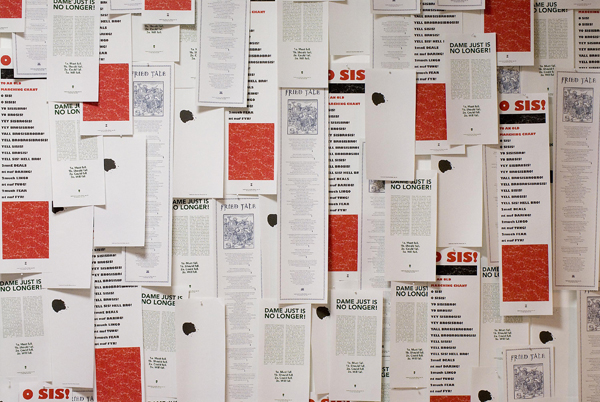
Middling English explores some of the pleasures and complexities of language use, in and through writing. The exhibition brings together multi-sensory elements – spoken pieces, audiophonic compositions, printed broadsides and the strange memory world of pop lyrics – all presented through a stunning architectural installation. […] Middling English pursues [Bergvall’s] interest in speech detail, language histories and politics, verbal eclecticism and inventiveness derived from various kinds of cultural displacement […investigating] modes of writing, from the printed letter to a loose realm of visual, audio, kinetic and perceptual writing and reading environments. Bergvall combines Chaucerian contemporaneity with bilingual audioworks and spatial structures.

Here (right) is the gallery’s photograph showing a detail of the wall of broadsides that Caroline Bergvall had written and published for the show.

The closing event on  23 October was chaired by Claire MacDonald who also gave a presentation, as did Caroline, Gabriel Gbadamosi and myself.

Claire sent some preparatory thoughts to speakers, which talked about Caroline’s (and our suggested) engagements with the voice and voices through a number of parameters: diversity, the ‘reworking and renewal of the positions from which we speak, the registers and technologies through which we speak, and a cross-fertilization of forms between print, sound and the visual,’ and a questioning of what it means to, ‘push the boundaries of language.’

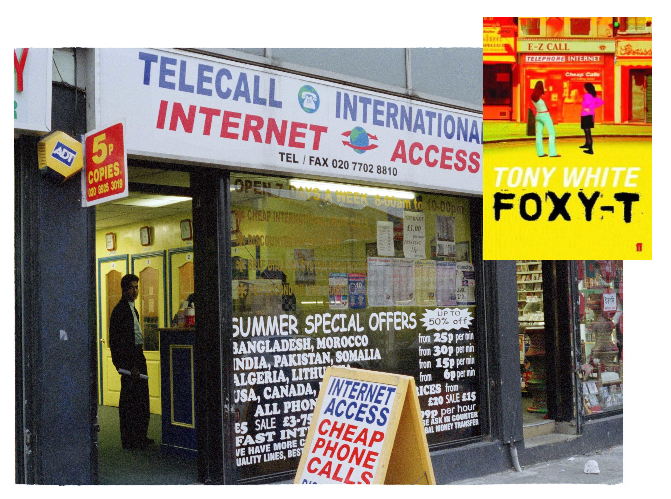
Presentations were necessarily brief. I chose to pick up some themes that I wrote about on this blog back in July of this year, in relation to my novel Foxy-T and the poetry of Linton Kwesi Johnson. I wanted to link these also to Ivy4Evr, my collaboration with Blast Theory for Channel 4, by focusing on a quite slight yet particular genre of response that emerged in common to all three and which can be described as a projected fantasy of exclusion.

Since notes for a slide show might form a particular mode of writing and a type of ‘reading environment’ in themselves, I wondered if there might be value in sharing those notes in their raw form, as a companion piece to the presentation itself. Here, then, is a quick edit of the notes that I made for my presentation at the John Hansard Gallery, together with screengrabs of some of the slides.

Slide 1

  • 3 key points about Foxy-T? Ephemeral economies; an empty shop unit in a moment of flux (sweatshop, internet shop or gallery); rupture with the identity politics of the 1970s and ’80s.
  • Linton Kwesi Johnson
  • Exemplified: use of the word ‘Rasta’
  • Caroline’s comment about ‘writing that is aware of its history’; the Black Atlantic in London.
  • Read page 1 of Foxy-T
  • Intro audio: excuse quality. R4 Today Programme; A-Level results day 19 August 2004; 08:10 feature on declining standards; interview with David Milliband then brought me on to defend those declining standards?
  • My interview curiously absent from the Today Programme‘s otherwise exhaustive Listen Again archive – here’s a home-made copy from audio cassette.
  • Play audio from 2:35 to 4:05
  • In case you missed that, Ed Stourton just said: ‘Mind you it is important that we all understand it, isn’t it. [reads excerpt] It’s getting quite close to the edge that, where some of us are going to be excluded, excluded from the book because we don’t understand the language.’
  • The voice of a powerful institution — invocation of a normative majority, ‘us’, for whom Ed Stourton was claiming to speak.
  • Reversal of the then current cultural and social policy language of social exclusion.
  • Who is this ‘us’ that is being excluded?

Slide 2

  • Talking of LKJ: interesting echo
  • Play DVD from start of Chapter 4 i.e. 6:49 to 9:09
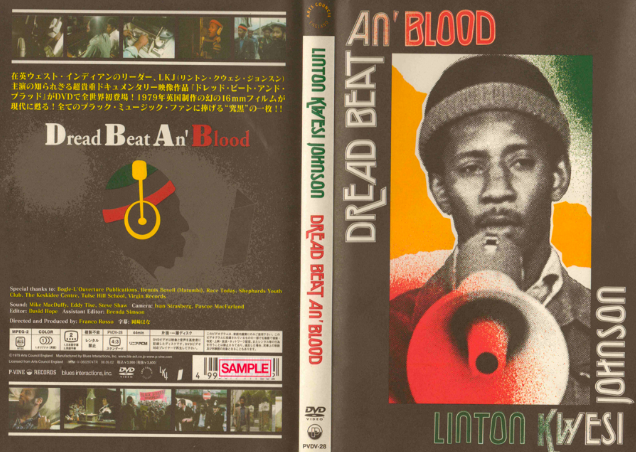
  • Intro over musical interlude/Brixton market scene: An extract of the documentary Dread, Beat an’ Blood, dir. Franco Rosso for the Arts Council (Arts Council Film Collection).
  • This is from a Japanese DVD but you can get this bundled as a DVD extra in some editions of Rosso’s 1980 feature film Babylon. Well worth getting hold of.
  • Radio studio reading into interview.
  • In case you didn’t hear that: ‘It’s not really for my ears, is it?’
  • N.B. Relationship between poetry/writing and activism — as Caroline said, ‘music as a form of resistance’ — what LKJ called BASS CULTURE (B.A.S.S.)

Slide 3

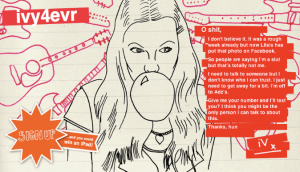
  • Ivy4Evr — interactive SMS drama for Channel 4 — Blast Theory — written by me.
  • PILOT transmitted October 2010 — ran through one week in REAL TIME.
  • Reasons for SMS: young people no smart phones, rubbish phones but always on.
  • NOT in so-called text speak “L8r” etc/ despite press clichés. Because our research showed that young people don’t use it.
  • BUT use: compression, different registers, tones of voice, colour, rhetorical devices, habitual misspellings — plus some hacker/web slang e.g. LOL — carried over into the script as a PATINA of typo’s and abbreviations.

Slide 4

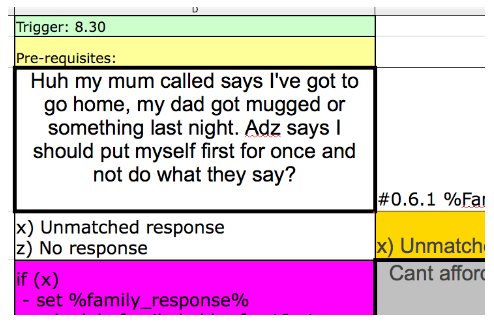
  • Quick few screengrabs from Ivy4Evr script illustrating some of this texture.
  • Again we saw projections of exclusion.
  • e.g. in the week before broadcast a single message went out as a trail, and tech blogger Topfife tweeted: ‘Just got an odd text message, then realised I signed up for C4’s SMS drama IVY4EVR. Very yoof.’
  • ‘Very yoof’? The offending msg? Not very ‘yoof’ at all —->

Slide 5

  • Ewan McLeod in Mobile Industry Review wrote, ‘The site explains that Ivy has left home because “Lilsis” (is that “Little Sister” or somebody else, who knows? I’m over 30) has “done the dirty on her”…’ [actually that’s not my writing but a phrase that emerged in early drafts of press releases etc and stuck, though it’s probably more archaic than contemporary?] ‘Again,’ McLeod continues, ‘forgive me for not quite knowing that definition […] I only point that out because I’m 30+ And I imagine you are too…’
  • So again, slight but unmistakeable (as with Ed Stourton on the Today Programme talking about Foxy-T, and the unnamed radio interviewer on Franco Rosso’s Dread, Beat an’ Blood): a projected fantasy of exclusion and a call to — or suggested complicity with — some imaginary majority. In this case those of us over 30.
  • Here are a few links —
  • Thank you —

§

Caroline Bergvall’s Middling English exhibition was both generous and generative, as were the closing events at John Hansard Gallery.  The conversations continued through the evening, of course, and on the train for those of us who travelled back together. An exhibition publication is promised and I’ll link to this when it becomes available; and similarly if further events emerge from these conversations.

Ivy4Evr – automaton anxieties, entropy and potential

As I write, there is still time to register for the pilot of Ivy4Evr, the SMS drama for young people that was commissioned by Channel 4 Education, created by Blast Theory and written by me. Places are limited and to participate you must visit the actual site at www.ivy4evr.co.uk and register by midnight on 9 October.

In advance of Sunday’s launch there is not really time to reflect, let alone to really write anything and certainly not to discuss the process or any other aspect of the project in any detailed way, but perhaps there will be time to do that later anyway; here and elsewhere. A couple of talks have been offered already. Since I can’t write anything myself I thought it would make a change to string some links together for reference but also to see if anything is emerging in how others are writing about the project.

The blurb for Ivy4Evr promises that: ‘For a week she’ll tell you **everything** but,’ it asks, ‘can she trust you and what will you tell her? Sign up and Ivy will text you about her life. If you text her back she will chat to you.’

The Social Uproar blog (‘Helping charities and non profits use social media’) are typical of much early coverage, giving Ivy4Evr some excellent announcement space. Other writers pick up on the project’s stated interactivity.

Katie Bacon at Youth Work Online (‘Exploring youth engagement in a digital age’) featured Ivy4Evr and one of Katie’s readers responded by using the comments function to ask, ‘who will be on the other end of the phone to talk to [young people] about sex, drugs etc.’ Katie followed up this query by asking Blast Theory for more information. She received and posted a detailed summary which included these two sentences:

The project uses an automated system where SMS messages are generated by the SMS engine. There is no person involved [my emphasis] in the sending of SMS to the registered participants.

Similar anxieties emerge at the Mobile Industry Review where Ewan McLeod also wonders aloud about the nature and the workings of the project:

All you have to do to participate is sign-up to get free text updates from Ivy. Then, I imagine, you can reply to her. Or to the production team sitting watching their SMS console.

It’s a great image, ‘the production team’ at their consoles, thumbing away furiously and replying on behalf of Ivy to every text that comes in. Given the number of potential participants, and the week-long, real-time nature of this pilot episode, for Ewan’s vision to really be the case we’d have needed some vast call-centre with a player:operative ratio of around 1:1. Ewan has signed up and promised to tell us how it goes.

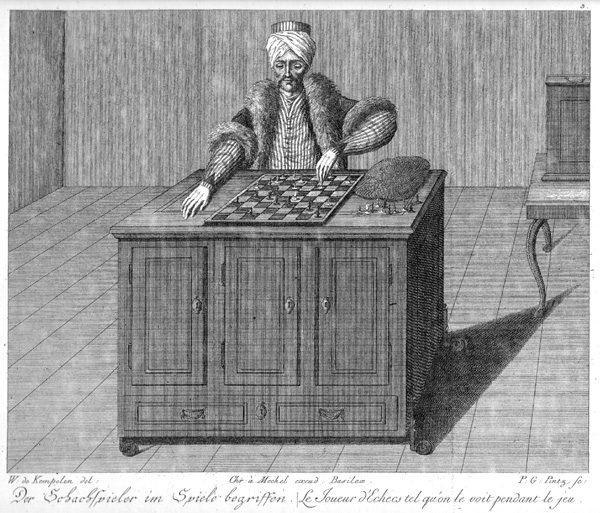
Both writers’ anxieties conjure up visions of Ivy as a contemporary equivalent of Wolfgang Von Kempelen’s ‘Mechanical Turk’ from 1770 — an apparent automaton but one that was in fact operated live and in real time by a person who hid in the rather bulky cabinet beneath.

Ivy is not like that. Not at all.

Some comments that appear following posts about Ivy are themselves automated, like this obviously ‘commentbot’-generated* non sequitur to a post by Carly Bennett that appeared on her blog, Writing from the Tub – My life as a writer in Bath:

‘Dissertation Writing service’ said… Despite the bulk of information online we often fail to get the specific information which is needed this post is good & contains relevant information that I was in quest of .I appreciate your efforts in preparing this post.

Elsewhere Alastair Shortland on Facebook took a more user-centric approach, asking the Ivy4Evr page: ‘Will you also be using MMS [Multimedia Messaging Service]? Will the SMS messages contain links to images or web content? Guess I should just wait and see ;-)’

Some reflect on the fact that texts sent to Ivy are charged at the normal network rates, while others realise that because they live outside the UK they will not be able to participate. We’re sorry about that too.

Last night I had an email from my friend Drazen Pantic. I’ve known Drazen since 2001 when I commissioned various writings to accompany the seminal CODE Conference (‘Collaboration and Ownership in the Digital Economy’) at which he was a speaker. Drazen is a native of Belgrade, Serbia, where in 1995 he founded OpenNet, the internet department of Radio B92 in Belgrade and Serbia’s first internet service provider. In 1999 Drazen Pantic was given the Pioneer Award of the Electronic Frontier Foundation for his use of new media technologies to counter political repression in the former Yugoslavia. He is now based in New York where he continues to explore, promote and create tools for free and open media.

Drazen sent me a link to a very nice online tool called YouReputation, which is,

a viral reputation scanner, based on on [an] innovative mathematical engine and Internet technology. YouReputation scans static and dynamic Web and social networks according to a given query (name, URL, combination of words) and computes viral entropy and viral potential for the query and identifies most viral sources with their Bayesian probabilities.

I love the idea of mapping entropy and potential. As I write this Ivy4Evr has a ‘viral probability’ of 0.483.

I will monitor our progress during the week, and try and speak with Drazen to find out more about his viral reputation scanner, how to read it. For now though, the YouReputation engine and accompanying blurb feels like an apt metaphor for a moment that I have come to recognise just pre-publication of a book, for example, when anything might happen, when entropy and potential are poised, entwined and waiting for the moment when the game starts.

§

Ivy4Evr launches on 10 October 2010.

Sign up and Ivy will text you about her life.

If you text her back she will chat to you.

To register visit http://www.ivy4evr.co.uk

Follow Ivy on Twitter – http://twitter.com/ivy4evr

Join Ivy’s Facebook Fanpage – http://www.facebook.com/ivy4evr

Follow Drazen Pantic and his YouReputation experiment on Twitter http://twitter.com/openplayer

*For information about my own commentbot experiment see an earlier post, ‘Knowledge Commons #3’, from 21 April 2001.

Forget about apps and ebooks for a while, and here’s Y/A

For the past year or so I’ve been working with internationally renowned and BAFTA-nominated artists Blast Theory on Ivy4Evr, an interactive text-messaging drama for young people commissioned by Matt Locke at Channel 4 Education. A pilot episode for up to 5,000 users, drawn from marketing across T4 runs for a week starting on 10 October 2010. You’ll need to register to take part.

Ivy4Evr is commissioned by a major broadcaster, but the drama takes place entirely on the users’ mobile phone, enabling them to interact directly with Ivy via text messages (SMS) and substantially influence their experience of the story as they go along.

I have followed Blast Theory’s work since the since the early 1990s. I visited them in Berlin in 1997 as they were conceptualising a new work which predicted the TV innovations of Big Brother by framing consensual incarceration and surveillance as a new kind of drama and celebrity. Since then they have led the way in using mobile technology and high-end, mixed-reality computing to create new kinds of dramatic and gaming experiences across both real and virtual worlds, sometimes simultaneously.

Now we’re all having to think in this way. In recent years I have been actively exploring the possibilities offered by new forms of distribution, new contexts and new platforms such as ebooks. Since 2007 I have pursued this through collaborations with established but innovative institutions such as the Science Museum, London, where I was writer in residence and we revived their disused publishing imprint for a one-off, free giveaway of Albertopolis Disparu, a specially commissioned new work of fiction; and more recently by collaborating with James Bridle and his experimental Artists’ Ebooks site, where three short stories of mine are currently available as free downloads in the EPUB format and (as of last week) from iBooks, too.

Like all writers (and publishers) I’m interested in anything that helps introduce my fiction to new readers in new ways. Colleagues at the Science Museum put it nicely, framing the Albertopolis Disparu give-away as a means to offer ‘a quality experience’ to thousands of visitors. For me it is also about demystifying those developments and getting a feel for them, and alongside that working in innovative ways to reach huge audiences almost instantly — whether through the vast footfalls of the Science Museum or the enormous reach and popularity of  T4, Channel 4’s 16-25 scheduling slot and website.

Which is why it has been so exciting working with Blast Theory on a truly interactive piece of writing. For more than a decade they have been exploring not only interactivity but also mixed reality computing and the ways that fictional worlds can overlay the real world around us; creating dramatic potential where the two collide. Tapping into this unique collective knowledge as we’ve experimented with the kinds of stories that it might be possible to tell through an interactive SMS platform has been an incredibly rich experience. It has forced me to think differently about writing and about storytelling. At times I have joked that I feel more intelligent when I’m in the same room as Matt, Nick and Ju; as if by some intellectual osmosis or a variation on the Burroughsian ‘Third Mind’.

Channel 4 Education have been behind some really interesting commissioning for young people since their strategic change from TV programmes ‘that went out in the mornings’ to new kinds of content; things like games, alongside some landmark programming such as Stephen Hawking’s Universe. There is an informative presentation about this strategy by Matt Locke, Acting Head of Cross Platform at Channel 4 here. It is great that Ivy4Evr is part of this move.

I’m wondering if it is significant that this project has been created outside the book trade. In light of our work on Ivy4Evr it was interesting to follow the twitter feed yesterday from The Bookseller Children’s Annual Conference at the British Library.  As you might expect there was a lot of tweeting about apps and  Matt Locke’s presentation about focusing on content rather than platform is reported in The Bookseller.

With Ivy4Evr though, creatively as well as in terms of making the story accessible to as many young people as possible, it has been essential to forget about apps and ebooks for a while, and here’s why:

Working on Ivy4Evr forced us to acknowledge the basic fact that most young people don’t have expensive smart phones.

Maybe they will at some point, but not yet. Not the groups that Blast Theory surveyed and we ran workshops with.

Their phones were rubbish old hand-me-downs and the kind that you can buy for a tenner in a bundle that includes a ten-pound top-up.

But the phones they do have are always switched on.

We also found out that they answer their phones in class and they (almost) never use cliched text speak (‘L8r’ etc).

Learning from this enabled us to push past current preoccupations with apps and ebooks for this age-group in favour of the familiar and more ubiquitous medium of text messaging. The really exciting thing about Ivy4Evr has come from combining SMS with some amazing new technology so that my script, with its endless permutations and possible pathways, is at the heart of a new kind of interactive and personalised storytelling; one that is created not just by what I have written but also by how participants respond. As it says in the blurb: For a week Ivy will tell you **everything** but can she trust you and what will you tell her?

§

We are inviting people to take part in an exclusive preview of the pilot episode of Ivy4Evr, which runs for one week from the 10th to the 16th of October and you could also win an iPad.

Registration by midnight on 9th October is essential.

To sign up to participate is free, messages received from Ivy are free, SMS messages sent to Ivy are sent to a standard mobile phone number and charged at normal rate. Everyone who registers and verifies by midnight on 9th October goes into the running to win an iPad.

Visit www.ivy4evr.co.uk

“Vehicle for idiomatic communication”

I have posted links to this Youtube video of Alan Ginsberg performing his poem ‘Father Death Blues’ on Facebook a couple of times. The second time because the first one got taken down and thus the embed code had changed. I love the poem and particularly this rendition of it for many reasons, one of which is that I can equally well imagine Ivor Cutler singing it.

The recording is from a BBC interview programme called Face to Face from 1995. A previous posting of the video included host Jeremy Isaacs asking Ginsberg how he would like ‘us’ to remember him, to which Ginsberg replies, perhaps surprisingly, ‘Oh, I think “Father Death Blues”, the poem “Father Death Blues”. Maybe I should sing that? Would it be of interest?’

The current clip with its Italian subtitles has lost this brief introduction. So it’s lucky that the whole programme is also available on the fabulous Ubuweb, where this exchange occurs around 35 minutes in.

Ginsberg is thoughtful, generous and insightful throughout. At one point Isaacs asks him whether he is a writer or a performer. It feels like a slightly forced question but actually it prompts Ginsberg to talk about poets who perform their writing; about the ‘dimension of sound’ in his own work, and his use of

‘vernacular rhythms and diction […] So that it is possible to perform, or recite, or orate, or vocalise – I would say – my poems, and have them understood more rapidly, almost instantaneously, as ordinary speech. Or intense fragments of ordinary speech…’

I particularly like the slightly garbled way he introduces the train of thought: ‘And there is the preparation in America of vehicle for idiomatic communication.’ [His emphasis.]

I was thinking about this on Monday when I had an email from publishing provocateur and visionary James Bridle of the excellent future of publishing blog Booktwo.org and founder of the experimental Artist’s eBooks project. He wrote with news that the three short stories of mine he published in the EPUB format at the end of 2009 (which I blogged about here) are now also available free from the new iBooks store, a development which operates alongside iTunes and eases compatibility and functionality with iPads and 4G iPhones.

If like me you don’t have an iPad or a 4G iPhone, you can still download the stories free of charge from the Artist’s eBooks site to read on a host of devices, including a Mac or PC using the free Adobe Digital Editions software. Much much more reliable information on formats etc is available on the help page of course. There is also a very nice one on there by the writer Niven Govinden.

One of my stories, ‘How we made “An American Legend” part 1’, was commissioned by Las Cienegas Projects in Los Angeles to accompany a group show entitled Landscape Memories Revisited. I’ve worked with the artist Steven Hull of LCP on a couple of previous projects — including Ab Ovo, a huge collaborative relay that mobilised the psychiatric testing of visual artists to generate children’s stories — and I love his work, so this was an offer I couldn’t refuse.

It was a timely commission too, since I’d been wanting to write about the California where my own late father had lived. At the time, my father’s friend and executor was still trying with little success to sell his car — a 2004 Chevrolet Monte Carlo SS — and wind up the estate, so perhaps it was inevitable that this worked its way into the story:

‘What you get?’ I asked him. ‘An LS?’

‘Nope’

‘SS?’

‘Yup ha ha ha’

‘How much?’ We were looking for fire-sale prices, a dead man’s car.

‘Five three. Dude wanted six nine nine two.’

What we had got for our $5k give or take was a sixth generation 2004 Chevy Monte Carlo SS, two door coupe. Silver with black interior. Good condition. No accidents. Thirty-some-thousand on the clock.

That is SS as in ‘Super Sport’ for any of you non-GM heads. So pretty much a 3.8 liter Buick V6 unit in there. Two-hundred HP. Yes OK I will admit there are better numbers on the SS Super…, but Scott was not complaining. Nice details on the trim too, such as front license plate close-out.

Cool :-)

Never mind idiomatic communication, it crossed my mind as I was writing to wonder, and only half-jokingly, whether I was invoking this particular vehicle as an act of sympathetic magic. As if by writing about a couple of fictional Serbian-American Chevy freaks looking for a second hand car I might help to conjure up some real buyers…

My father was a bit of a gearhead himself and a European migrant though from the UK rather than the Balkans, where Patricia a.k.a. ‘SD Chevy Girl’ the story’s narrator tells us her grandparents hailed from. I don’t think I need to say that all characters and situations in the story are completely fictional and any resemblance to persons living or dead would be entirely coincidental etc. I should also point out that the numerous misspellings in the story — including the name of Filippi’s Pizza Grotto — are the narrator’s own. However the locations are real, and included in the story is a plug for Cruisin’ Grand, a classic car cruise that takes over several blocks of Grand Avenue, Escondido, Ca. every Friday night during the summer.

This Friday’s Cruisin’ Grand (24 September 2010) is the last of the season, so if you’re in the San Diego area or even the wider SoCal megaregion you might want to check it out.

§

Download ‘How we made “An American Legend” part 1’ for free from the Artist’s Ebooks site or on iBooks.

The Void: Hello from Earth

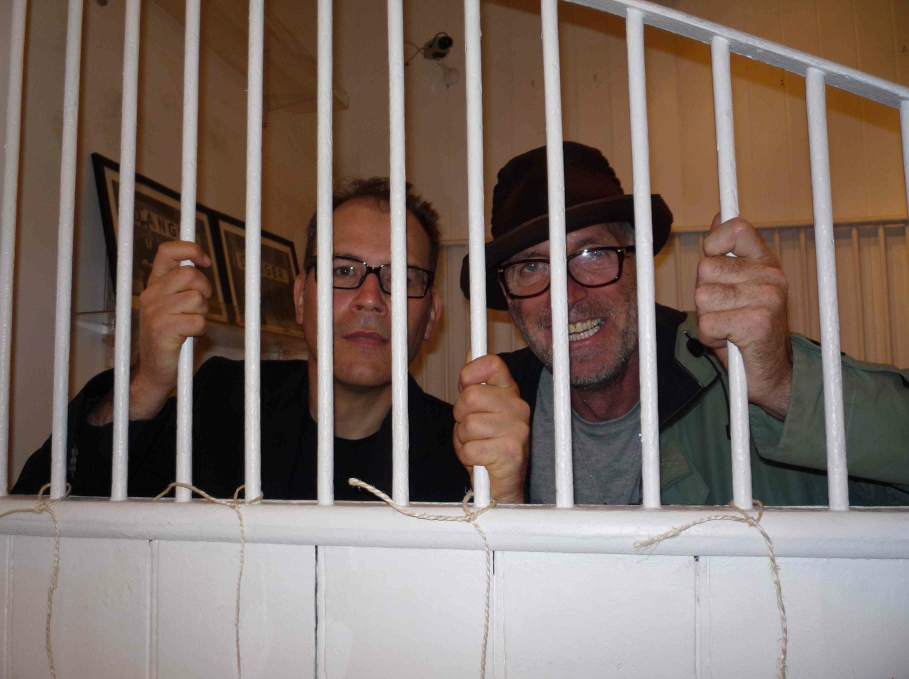
L-R: John Meriton, Liliane Lijn, Tony White

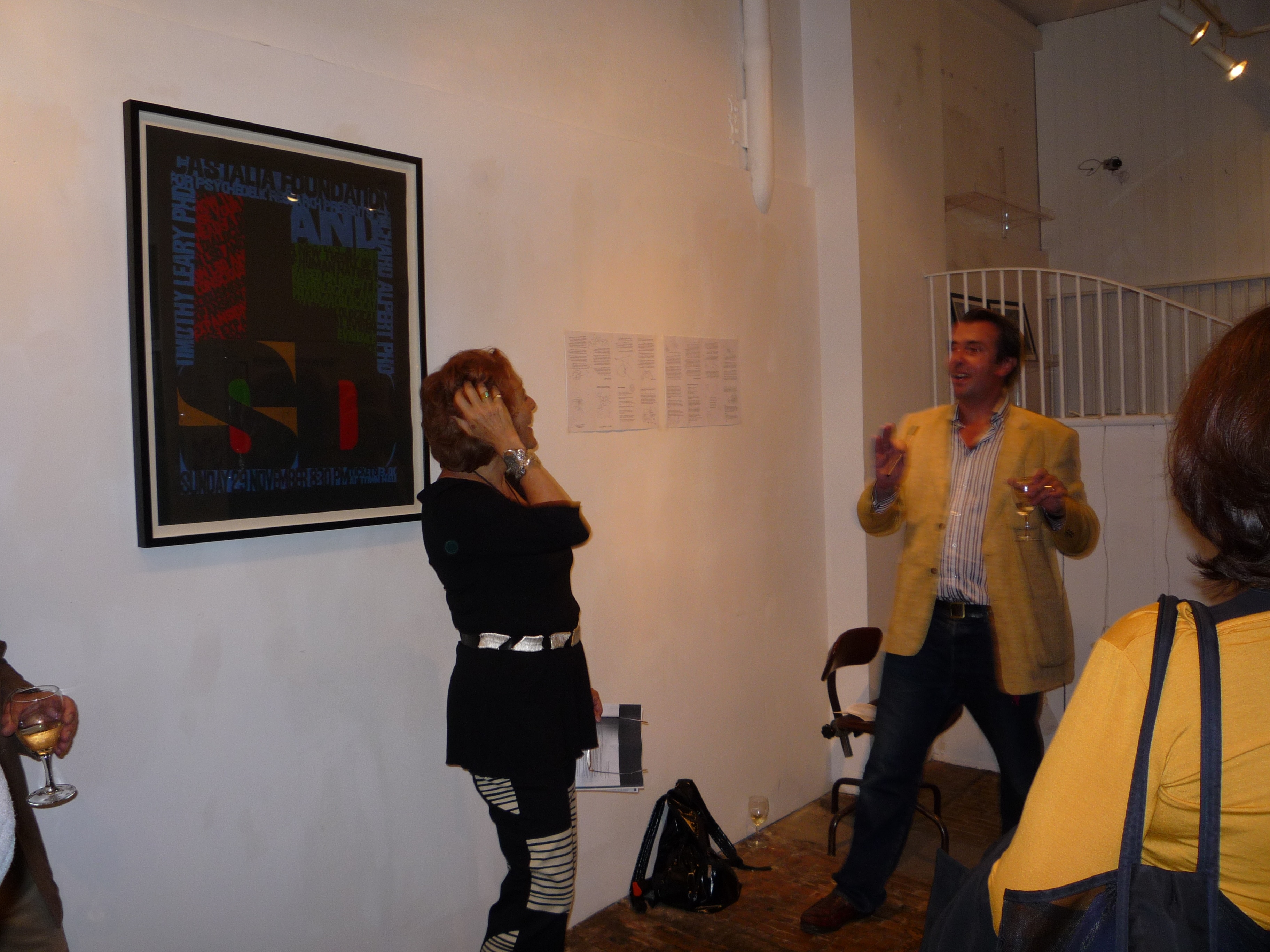
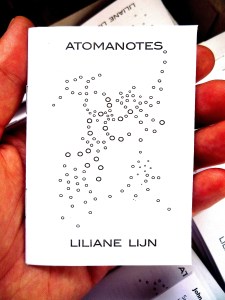
There was a great turn out last night for the launch of ATOMANOTES by Liliane Lijn in the wonderful, bohemian surroundings of the barely-converted mews space that is Maggs Gallery. The reception was generously co-hosted by Maggs Bros. Rare Books, to whom I am very grateful. Here are a few photos.

L-R: Rosemary Bailey, Andrew Wilson, Liliane Lijn, Ken Hollings

Liliane spoke briefly and insightfully about the project, reading a short extract from the introduction to her visionary epic poem Crossing Map (London: Thames and Hudson, 1983) that described the genesis of ATOMANOTES.

Liliane also revealed that the catalyst for her to write Crossing Map had been that she was unable in 1968 to find any scientists who were willing to answer the questions she was formulating about human and atomic behaviour.

L-R: Ken Hollings, Richard Strange

There’s something quite remarkable about questions being posed yet remaining unanswered for forty-two years. That’s a long time.

Forty-two years is precisely how long it would take, for example, to send a radio signal from Earth to the solar system known as Gliese 581d (about 20.3 light years from Earth) and receive a reply.

If you haven’t heard of it before Gliese 581d is a solar system in the constellation of Libra. It is also the home of ‘at least two potentially habitable planets and the most Earth-like planet discovered so far.’

I’m not making this up.

In fact, an experiment to do just this was recently launched from the NASA/CSIRO Canberra Deep Space Communication Complex at Tidbinbilla in Australia. Here is what it says on the Hello From Earth experiment‘s website:

At midday on Friday 28 August 2009, the 70-metre main antenna, known as DSS43, transmitted the signal to Gliese 581d at a frequency of 7.145 gigahertz and a power of 18 kilowatts. The resulting signal, repeated twice over two hours, was equivalent to using the combined power of over 300 billion mobile phones at the same time.

There is way more information on the website, including a live counter which shows that there are still (at time of writing) 19 years, 159 days, 21 hours, 8 minutes and 5 seconds until that signal reaches Gliese 581d.

Back on Earth, the working title Liliane used to gather those questions together in her notebooks forty-two years ago was ‘Atom-man Notes’.

L-R: Liliane Lijn, Tony White

James watching 'What is the Sound of One Hand Clapping', Maggs Gallery. Photos at rear are of William S Burrough in Paris.

When we first met up a couple of years ago to discuss what she might do for Piece of Paper Press, Liliane suggested that it might be worth revisiting those Atom-man Notes. I agreed. The questions (prefaced with the directive, ‘See human beings as atomic stuctures obeying the same laws as atoms’) include the following:

If each atom has a certain field of radiation then what kind of field does each structure called a human being have?
[…]
Imagine human beings travelling at the speed of light. Would we then have a stronger gravitational field? What if the mind could function, thoughts travel at that speed, would it exert a gravitational pull?

Now, finally, the questions have been answered by a number of scientists including John Vallerga, Laura Peticolas, John Bonnell and Ilan Roth. Their answers form the bulk of the text in Liliane’s new book. However, the small, roughly A7 format of Piece of Paper Press editions has forced a compression of that original working title to the single neologism ATOMANOTES.

In the here and now of a rainy September evening in London, when Liliane finished her reading we distributed copies of her book. As with all editions from Piece of Paper Press, ATOMANOTES was given away, so everyone left with a free copy.

§

I love this picture (above left) of James watching a DVD of Liliane’s 1974 film What is the Sound of One Hand Clapping on the monitor when we were setting up.

Looking at the photo earlier I noticed something; a bit of a happy accident.

If you have seen the film, or know about Liliane’s poem machines, you will appreciate that the probability of such a photograph capturing a recognisable word on screen completely by chance would have to be pretty small. Look more closely and you will see that not only did the camera do exactly that, but, even better, framed and almost perfectly registered on the screen is this (hint: click the image for a nice surprise):

Futures and Pasts

In classic cottage industry-style, there is a box on our kitchen table containing 150 copies of ATOMANOTES by Liliane Lijn, which launches tomorrow at Maggs Gallery, London W1.

As described in a previous post, ATOMANOTES continues a conversation that Liliane Lijn started in 1968 (long before I began Piece of Paper Press sixteen years ago, at the tail end of the last recession* in 1994).

Each of the 25 titles I’ve published since 1994 has been made by hand. Which means that at some point either the artist or the writer that I’m working with on a particular title, or myself, or both of us, will have had to sit down with 150 sheets of printed A4 paper, fold each one three times, staple it and, finally, trim the upper and right-hand edges to make a 16-page book. This usually comes at the end of a conversation and a process that can last anything up to a couple of years.

The bit with the stapler and the Stanley knife is important not because it affords opportunities for craftspersonship (which the project has always broadly eschewed), but because Piece of Paper Press was intended to be cheap, sustainable and — in some ways — the least one could do to make a book; if that makes sense. Each edition costs as much or as little to print as the going rate for 150 double-sided photocopies, plus a small amount of labour, which has never been contracted out or bought in. The artist’s or writer’s contributions are impossible to cost. The format was designed so that it would not need funding to continue and could survive with virtually no infrastructure. Continuing this ethos the books are always given away free so don’t have to pay their way and don’t generate more than the most minimal amount of admin. Any other way and I have a feeling that the project would have collapsed years ago. Who would have the time? The flipside in these days of infinite digital ubiquity is obvious: producing something this ephemeral in such relatively small quantities seems to go against the grain.

But just because discussions about developments-in and the future-of publishing concentrate almost exclusively upon developments in technology (ebooks, ipads, google, blah blah — all of which, of course, as a writer, I am having to try and get to grips with) doesn’t mean that this is the only possible future. It is a banality to reflect that the illusion of continuous technological progress is just that; the same can be said of economic growth. So what other futures might publishing have? And what if those futures look more like the past?

A recent conference and publication out of the University of Wisconsin documents and explores one such future, which is happening now. The ‘Cartonera‘ phenomenon first emerged in Argentina during the economic crisis around the turn of the century, and has since spread across the South American continent.

A newish book, Akademia Cartonera: A Primer of Latin American Cartonera Publishers, Academic Articles, Cartonera Publications Catalog and Bibliography (edited by Ksenija Bilbija and Paloma Celis Carbajal) was published to accompany the conference and in her opening essay, Johanna Kunin describes the emergence of the movement very succinctly as follows:

Eloísa Cartonera, in Argentina, was the pioneering project of cartonera publishers, created and promoted by a young writer and two visual artists in 2003, less than two years after the Argentine economic collapse that caused urban cardboard-pickers (cartoneros) to become a symbol of the suddenly increased poverty rates and urban marginality and vulnerability levels.

Cardboard is purchased from cardboard-pickers at a price higher than the value that cardboard-pickers usually receive on the market. That cardboard is then used as book covers, which are decorated with colorful stencil techniques by youngsters; inside, the photocopied pages of the books are hand-bound containing stories and poems. Acknowledged Argentine and Latin American authors grant permission for the publishing house to edit their books without asking for benefits. This has given great visibility to the project. In addition, by publishing the texts of young avant-garde Latin American writers, Eloísa Cartonera also provides a means of expression for authors who would otherwise struggle to have their voices heard. All the books are sold at an affordable price and thus promote “democratic” access to Latin American literature and to reading in general.

There are various online resources about the Cartonera that I’ve been discovering by browsing around the University of Wisconsin site. Best of all is the Latin American Cartonera Publishers Database, an introduction to which reads:

The Cartonera publishing phenomenon began in Buenos Aires in 2003 and was spearheaded by writers and artists interested in reconfiguring the conditions in which literary art is produced and consumed. They came up with a progressive new publishing model that challenges and contests the neo-liberal political and economic hegemony.

The database contains reproductions of scores of Cartonera publishers’ handpainted cardboard covers, including this one which is reproduced on the database homepage.

I shall be looking more closely at the scene in future posts, as I think it is truly visionary and one of the most interesting and exciting things to happen in either literature or publishing in recent years; to my mind a far more vital and forward-looking development than the iPad, for example.

But maybe I would say that because for the past 16 years once or twice a year I’ve sat down for a morning or an afternoon with a pile of printed A4 paper, a stapler and a Stanley knife. With me more often than not will have been an artist or a writer who will have spent a year or more producing a literary or graphic work that is suitable for a 16 page, A7 book. A few cups of tea and some conversation form the backdrop to a task that is by definition repetitive, but which is also very social and above all is simple and functional.

This week, that occasional half-day of stapling and trimming has resulted in 150 finished copies of Liliane Lijn’s ATOMANOTES, a work which has had a longer gestation than any other I’ve published; 42 years. We’re giving most of the print run away tomorrow night. Remaining copies will go to the scientists whose replies to Liliane’s questions comprise the bulk of the text, and to past contributors to Piece of Paper Press. I’m sorry to say that no ebook version is available. Liliane has posted an animated preview of a near final draft on her website, but it must be said that this is a poor substitute for the real thing; ephemeral though that may be.

§

Liliane Lijn, ATOMANOTES, London: Piece of Paper Press, 2010

*Coincidentally as I cycled to Maggs Bros. this morning to set up for tomorrow’s launch, the former, disastrous, Tory Chancellor of the Exchequer Norman Lamont, probably Lord Lamont of Black Wednesday these days, wandered absent-mindedly onto the Hyde Park cycle path. I rang my bell. Didn’t want to damage my bike.

Recharging

After posting (below) my attempt at drawing a Throbbing Gristle-style lightning graphic that I needed for the ebook of a forthcoming short story commission, I suddenly remembered where else I’d recently seen a similar design…

Coming soon: ATOMANOTES by Liliane Lijn

In haste, a quick advanced notice that the next publication from Piece of Paper Press is ATOMANOTES by Liliane Lijn. It will be the 25th title in the series and here is the press release that we just finalised and which will be sent out in due course. We’re going to be holding a launch event at Maggs Gallery in Hays Mews, at the rear of Maggs Bros. Rare Books.

The making of ATOMANOTES spans more than 40 years. Here’s a short extract from the press release:

In 1967, inspired by analogies formulated from her scientific readings, between the structure and behaviour of matter with that of human beings, Liliane Lijn began writing them down in her notebook under the heading Atom-Man Notes. Lijn wanted to collaborate with a physicist to explore relationships between the atomic structure of matter and the human brain and to compare human behaviour with that of atomic particles, but receiving little response from scientists at the time she instead wrote a philosophical epic poem, Crossing Map (Thames & Hudson Ltd. 1983) that explored human relationships in terms of energy transfer and dematerialisation.

It was Liliane’s residency at the Space Sciences Laboratory, UC Berkeley (SSL) that provided a catalyst and opportunity for those questions originally posed in 1968 to be asked again now. See this previous post for background on Liliane’s residency, plus a free download of her essay ‘The Language of Invisible Worlds’. One of the many things that is interesting about this essay is the way that Liliane uses her current research and practice to (as I put it then) ‘continually echo and reframe [her] early explorations’.

Just as has happened in fact with ATOMANOTES.

I went to Liliane’s studio a couple of weeks ago to finalise the book. Various new works were installed around the space including a significant (and surprisingly large, at around 3 metres high) kinetic text work from 2009 called Way Out Is Way In Poemdrum (In homage to William S Burroughs). The making of this work too spans several decades.

(I’d recommend the aforementioned ‘Language of Invisible Worlds’ essay for background on Liliane’s friendships with Burroughs, Sinclair Beiles, Gregory Corso et al in Paris where she lived from 1958-63.)

The list of media used to make Way Out Is Way In Poemdrum is very interesting:

Painted steel solvent drums, 3 phase motor, inverter and programmed speed and direction control chip, halogen lighting. 5 words from Naked Lunch by William S. Burroughs

Liliane has been making kinetic text works for many years. They often comprise motorised cylinders — some aligned vertically, others horizontally like a phonograph — or cones, which subject fragments of text to movements and rotations of varying speeds to transform the words into light and colour. The texts Liliane uses have often derived from conversations and collaborations with writers. Sometimes these text fragments are further subjected to a kind of reductive editorial pragmatism: what will fit. Some early conical works from 1964 onwards are included in the 1974 film What is the Sound of One Hand Clapping.

I was intrigued by the dedication of this recent poemdrum to William Burroughs. Liliane told me that Burroughs wanted her to incorporate some of his text into a kinetic work after seeing an early exhibition of her text works at the Librairie Anglaise on Rue de Seine, Paris in 1963. In a gallery over the road at the same time had been an exhibition of caligraphic paintings by Brion Gysin that were themselves derived from Burroughs’ texts, but which perhaps felt oddly static in comparison with Liliane’s machines and typography. She was summoned by Burroughs, who spoke at length about Naked Lunch and the possibility of collaboration.

Forty-six years later he got his wish, the conversation distilled by time and memory to these five words: way out is way in.

§

ATOMANOTES by Liliane Lijn will be launched with a reception at Maggs Gallery, 50 Hays Mews, London W1, on Tuesday September 14, 2010.

Knowledge Commons #5 – If you can’t find it online, draw it

I’ve been working on a new short story commission which will be published in both ebook and print formats in early 2011, about which more information in due course.

For reasons that will become clear later, I’ve been trying to source a particular kind of lightning flash graphic which for something so familiar and — as I thought — ubiquitous was proving quite a challenge. I even found myself going to the laborious lengths of grabbing, flipping and rotating various dingbats and ‘special characters’ only to find that they were simply not quite right, not to mention that the results were too low-res to be of any real use.

It was only when I’d wasted loads of time on these fruitless attempts to approximate something digitally that I thought, well maybe I should simply try and draw it.

This scan is of my first attempt, which is a bit wonky here and there because the wood grain of the kitchen table showed through the paper that I was leaning on, but it’s still far better than anything I could find online or adapt from any existing image or font resource. It is also certainly good enough to reduce and use as an ornament in the print edition.

‘If you can’t find it online, draw it,’ I thought, without quite realising until later that the reason this formulation sounded slightly familiar was that I was paraphrasing the title of a track from Laurie Anderson‘s 1983 performance of United States I-IV: a piece — I just looked it up — for tape and cartoons dedicated to Ludwig Wittgenstein and called ‘If You Can’t Talk About It, Point To It.’

Not so obscure as it sounds. Those performances were quite a big deal at the time. Anderson had just had a huge hit in the UK with ‘O Superman’, and her epic performances over two nights of the 8-hour United States I-IV were promoted by the ICA at the Dominion Theatre, London in February 1983. I went along. Here is a scan of the programme. It has probably survived the years so relatively unscathed because I stored it inside a record sleeve.

There was a great kind of home-made quality to Anderson’s work up to and including this period, even when she was using or ‘talking about’ technology (in as far as she ever really talked ‘about’ anything directly, which would be almost never; prefering as she did to tell oblique stories). This home-made quality very quickly disappeared though as her studio recordings went mainstream, only to be replaced for a while with what felt, feels, to me like an instantly kitsch, almost generic NY arthouse hi-life style; cue what seemed at the time to be the inevitable Adrian Belew guitar solo (impossible to better after this highpoint). Via the music- and art-press interviews and features accompanying her hit single ‘O Superman’ and those performances of United States I-IV, it had been Anderson’s references that had switched my teenaged self on to writers like Gertrude Stein and Thomas Pynchon, but by the time she returned to the Dominion Theatre in 1990 for the ‘Empty Places tour’ it seemed that the same old anecdotes were being trotted out in every interview (albeit to audiences that were never anything less than appreciative). Strange to say perhaps, since the recitation of anecdotes was a big part of her work, but it all started to feel a bit repetitive.

If you don’t know it, ‘If You Can’t Talk About It, Point To It’ is a short and very slight instrumental — almost like a sketchbook piece, which I mean in a good way — in which a small number of taped voice ‘samples’ are effectively sequenced to form a few seconds of shrugging, breathy funk which has both the reduced range and the percussive quality of an instrument like an mbira. It is odd to be reminded of and writing about a piece of music that was insubstantial even 30 years ago, but since I am, I suppose it is worth registering that the title is also an obvious Wittgenstein gag i.e. you don’t have to pass over in silence what you can’t talk about, you can also point to it.

Maybe I am also picking up on some media traffic following Anderson’s use of an appearance on US TV show Letterman a couple of weeks ago precisely to point at something, in this case the Gulf oil spill disaster, through a topical rewrite of her recent song ‘Only An Expert’. (Something that a number of UK artists have been doing recently too, by contrasting, for example, BP’s activities in the Gulf of Mexico with the company’s domestic sponsorship of the arts, particularly through the Liberate Tate movement.)

A .png of the Art Not Oil website

There is a nice quote in the programme accompanying those 1983 United States I-IV performances. ‘In this work,’ Anderson writes:

‘I have tried to make a distinction between art and ideas. Because ideas have a direct line to the brain; but art sneaks in through the senses. It drifts in. So there isn’t time to analyze it…’

It is a bit of dialectical whimsy which seems to fall somewhere along the same spectrum as her distinction after Wittgenstein between talking about something and pointing to it.

It is interesting looking at a significant and monumental art work like United States I-IV across the digital event horizon; looking back to those pre-internet, analogue days. There’s a prophetic line in her Burroughs homage, the song ‘Language is a Virus’ (or at least there is in the the United States I-IV-era live version of the song; it is missing from the overproduced and nonsensically cheery version on her album Home of the Brave). In the former Anderson tells of attending a science lecture. ‘So I walked in,’ she writes, ‘and there were all these salesmen and a big pile of electronics […] And they were singing: We’re gonna link you up […] We’ve got your number.’ Which, I suppose, they did and they have.

‘Picture a Christmas tree,’ they tell her, ‘with lots of little sparkly lights.’

So now that we are all ‘sort of hanging off the same wire‘ and I often find that even when I’m working, writing stories, much of my time is spent doing little more than simply pointing at stuff (albeit sometimes clicking, too), does that distinction between talking about it or pointing to it, between ideas and art, still hold? Or does the pervasiveness and the myriad ubiquity of information and media mean that it is ideas and information that sneak in ‘through the senses’, while art has the more direct line? It certainly felt that way when out of exasperation I drew this lightning flash and a couple of others for the cover of a forthcoming short story.