Road Rage archive #1

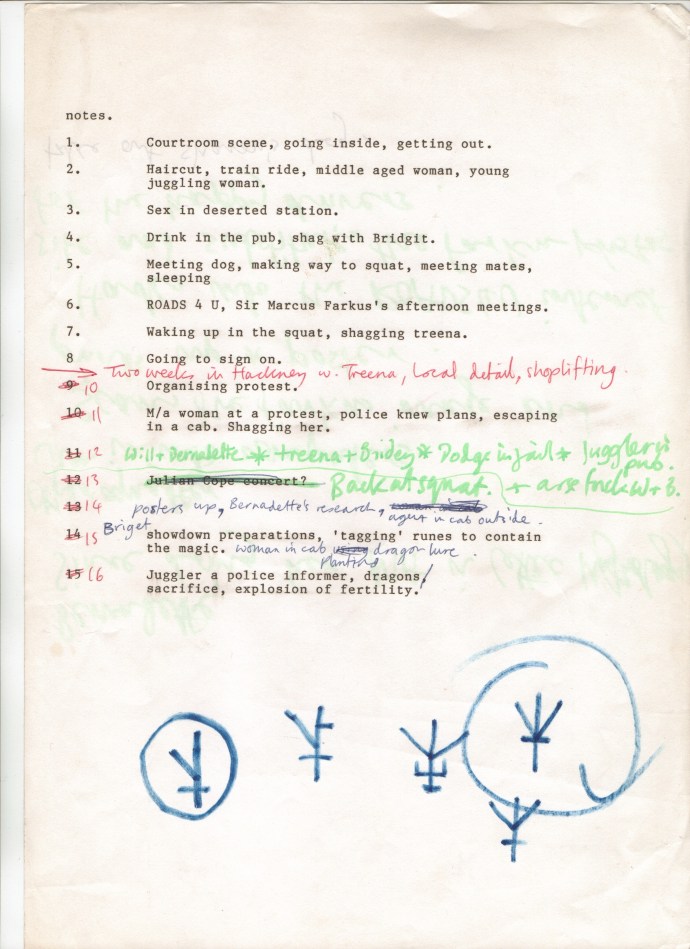
This is a scan of the chapter plan for my ‘avant-pulp’ novel Road Rage! which I found filed among quote sheets and other bumf when I updated the Press section of this site.

The manuscript was written over the course of a two week period in 1995. From memory I wrote this plan about halfway in (i.e. once I’d reached about Chapter 7 or 8) because I needed to organise the remaining chapters. I’m amazed that it survived.

Chapter plan for Road Rage!

It is odd to see this piece of yellowing A4 and its sparse contents; the cringe-making use of words like ‘shag’; the ‘daisy-wheel’ printer type from the Amstrad word processor I used at the time. All seem to belong to another age.

Because it was another age.

Strange too to remember the writing process, which was: do no research whatsoever, write a minimum of one chapter per day, and try to ensure there is at least one ‘transcendent act’ (as I would say when talking about this at the time) of sex or violence per chapter. The idea to write ‘a crusty novel’ along these lines, using a process that consciously explored connections between an imagined pulp productivity and automatic writing, had been reinforced in a throwaway conversation one afternoon in Endcliffe Park, Sheffield with friends Tim, Roy and Robin when I was visiting that city.

Road Rage cover – photograph ‘Fire Artist’ © David McCairley, 1997

Writing Road Rage!, getting it published, was a way of contributing to what I saw as a kind of ‘conversation’ about London, about British pulp fiction generally and the ‘Richard Allen’ skinhead novels in particular that was being conducted in print around the east London where I lived at the time. This appropriation of Allen’s novels had been anticipated in the mid-1980s by the aforementioned Roy Bayfield who incorporated the books into his rambling spoken-word-act-come-job at the Zap in Brighton. It was also prefigured by the appropriation of skinhead imagery in the work of artists including Gilbert and George, Psychic TV, and independent artist film-maker John Smith with his short film OM (1986).

In the early 1990s I was tuning in to this conversation via novels like Victor Headley‘s Yardie, which was published by the then London Fields-based X-Press and was for sale in various local newsagents, and Stewart Home‘s Red London, which was set in and around the home in Grove Road, Mile End, that would become known after it was demolished as Rachel Whiteread’s House.

I didn’t know when I started who might want to print this, but I’d wanted to make a connection, too, with Michael Moorcock’s pulpier sword-n-sorcery novels from the late 1960s and early 1970s which were written at the breakneck speed of three days per volume (putting my ‘chapter-a-day’ regime to shame of course).

Road Rage! takes some liberties with the ‘sprawling consensual hallucination that is Hackney’, chiefly by relocating a lightly-drawn (no research, remember) analogue of the then M11 Link Road protests (which centred around the proposed ‘East Cross Route’ in Leytonstone) a few miles west to Well Street, E9. Events take place in a number of expedient and/or contingent locations around Well Street and London Fields: in the Pub on the Park, on Hackney Central railway station and the trains of the North London Line, in the Hackney DSS office and a still markedly pre-gentrification Broadway Market that would be unrecognisable now. This was where I lived at the time.

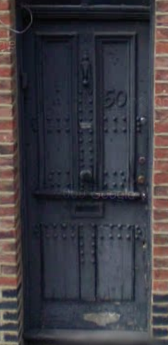
Psychic cross on the door of 50 Beck Road, London, former residence of Genesis Breyer P-Orridge

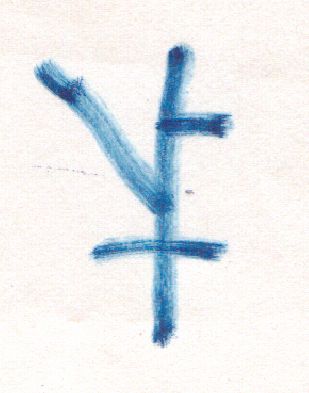
Looking at the chapter plan again, my gaze is drawn to the blue felt-tip pen drawings at the foot of the page. I’m aware that these ‘sketches towards’ a ‘runic pictogram’ of a tree that I’d realised was needed at a particular point in the story may have taken fewer minutes to refine than there are iterations here.

Whether I realised it at the time or not, it seems obvious now that this device was almost certainly psychic cross-inspired (see left, and this blog thread on John Eden’s uncarved.org). Judging from the second sketch (counting from L-R) in particular, I effectively did little more than move a couple of the horizontal bars around (see figs.1 and 2 below). It would appear that I immediately circled and ticked the fifth attempt (where two bars are used to form an inverted chevron above the central cross-piece), as if to say, ‘That’ll do.’

John Smith, OM, film still

It’s interesting the kinds of sources that a deadline forces one to draw upon. In the case of Road Rage! this extended to more than simply adapting the psychic cross symbol that was marked out in studs on what by then was Barry and Nick‘s front door down the street. Having mentioned John Smith’s OM, above, it seems obvious that the barbershop scene which opens chapter two of Road Rage! incorporates an unconscious reference to that film. In those pre-YouTube days I had only seen OM once, when Smith came and did a talk to our year on the Fine Art course at the then Sheffield Poly in perhaps 1988. I had practically fallen out of my chair to see that the film’s central character was played by an old friend of mine at the time. After the screening I asked Smith how he’d come to cast John Harding in this role and he said something like, ‘Oh they were just some Psychic Youth art school skinhead types who lived down the road from me in Forest Gate.’

‘Runic tree’ as adapted psychic cross? fig.1 pictogram sketch (detail)

There is another surprise in this chapter plan. I had completely forgotten that at any stage I was considering Chapter 12 or 13 taking place at a ‘Julian Cope concert’, even one accompanied by that tentative question mark. I have also, unfortunately, forgotten why I changed my mind and crossed it out. Maybe there was a gig happening that week which I couldn’t get to.

I loved and still love David McCairley‘s dramatic photograph that was used (see above) for the front cover of the Low Life paperback of Road Rage! The picture was taken that same year at a demonstration outside Hackney Town Hall protesting evictions from some squatted former office buildings on the opposite side of the road. There’s another blog to be done about George Marshall’s short-lived Low Life imprint. Too much to say here, other than that I am indebted to him as ever.

‘Runic tree’ as adapted psychic cross? fig.2

Some press is collected here, but this is what Steve Beard wrote in i-D magazine when Road Rage! was published, nailing that early 1990s moment at least as far as Victor Headley and Stewart Home:

Who would have guessed that Richard Allen’s range of ’70s bootboy novels would have proved so influential? First Stewart Home samples the speed and aggression in order to turn round the political message and make the link with Burroughs and Blake; then Victor Headley steals a few riffs to draw up a map of the Black Atlantic in London. […] what subculture could be appropriated next? Tony White’s Road Rage makes it clear. Mixing psycho-social realism and techno-pagan fantasy, Tony White stakes out a position between Stewart Home and Martin Millar to offer a vision of London which is romantic, revolutionary and conservative all at the same time. […] a signpost to the fantastic worlds of a Michael Moorcock or an Alan Garner.

Knowledge Commons #3

As blogged here, Kevin Carter’s Landscape/Portrait gives participants the opportunity to post their own video portraits alongside ‘demographic portrait’ texts that are derived from national census data for every UK postcode and used to inform policy and planning decisions.

Each video portrait also features a facility for registered users to respond to other participants’ videos. Looking for a way to occupy and animate these comments boxes, or at least those that accompany portraits made during the Bournemouth and Poole phase of the project, I’ve sketched two ‘commentbot’ simulations: Daisy Botanist and Postal Coder.

I wanted these sketches to also lightly reflect Simon Yuill’s A New Kind of Commons project (blogged here) by linking out to historical information about the changing uses of the commons in the Bournemouth area and online resources about types of plants found on Turbary or Kinson Commons.

Unlike ‘real’ commentbots that (with apologies for the following demonstration of my non-geekness) send out spam comments in order to plant phishing or malware links into blogs, chat spaces on social networks etc., the messages from Daisy Botanist and Postal Coder are tailored to each location and each video portrait. Furthermore they are benign and the links they offer are genuine (now that these comments have been posted, HTML-writing capability within the comments boxes has been disabled).

Daisy Botanist and Postal Coder are each little more than a log-in and a series of simple functions. I wanted to see if it was possible to create comment generators that could contrast aspects of CACI‘s census-derived but oddly general, dated and cliché-ridden demographic portraits with the corresponding ways that Landscape/Portrait participants from these same postcode areas actually describe themselves. As would appear to be the case with the CACI portraits, these sketches are generated by a process that is at least partly-automated and then edited.

I took a cue from Robert Frank and Alfred Leslie’s 1959 film Pull My Daisy, with its improvised narration by Jack Kerouac, then simplified it. I wanted an excuse to watch all the portraits and a way to sample-and/or-write on the fly, in real time.

§

The Daisy Botanist comments are generated in response to each video portrait by contrasting CACI‘s generalised postcode descriptions and taxonomies (which on the site are displayed to the left of the video player) with a sampled fragment of each person’s own response to the question, ‘If I were to describe myself what words would I use?’ Each comment was then attributed (or each participant ‘given’) a species of local flora, in order to create a simple kind of syntax which I initially envisaged as:

You say [self-description sample], they say [CACI description sample]: they’re pulling our [name of local flora + link].

Toadflax photograph Georg Slickers, Creative Commons Attribution-Share Alike 2.5 Generic

Putting that into action, here is an example of the kind of basic comment structure that Daisy Botanist produces:

Do short fat bald and ugly men only occur in seaside towns? They are extracting the Milkwort

§

The Postal Coder comments are designed specifically to contrast the types of very real personal or community-based creativity that people discuss in their own video portraits with the bizzarre and affectless CACI portraits in which people are reduced to an agencyless classification or, most crassly, a ‘type’, according to certain extrapolated consumption habits.

To place participants’ creativity in a historical and geographical context, the Postal Coder simulation then combines this sample with a local field name from a database relating to the 19th century Inclosures in Canford Magna and Kinson (when most of the common land in the area was given over to private ownership), the first part of each user’s current postcode and a sample from their response to the question, ‘Where is the place that is special to me?’, giving the following approximate structure:

From [19th century fieldname + link] to [current postal shortcode] and [participant’s chosen place], still [type of creativity described].

Here is an example of the kind of basic comment structure that Postal Coder produces:

From Netherway to BH11 or the gymnasium, still meeting people out in the fresh air.

§

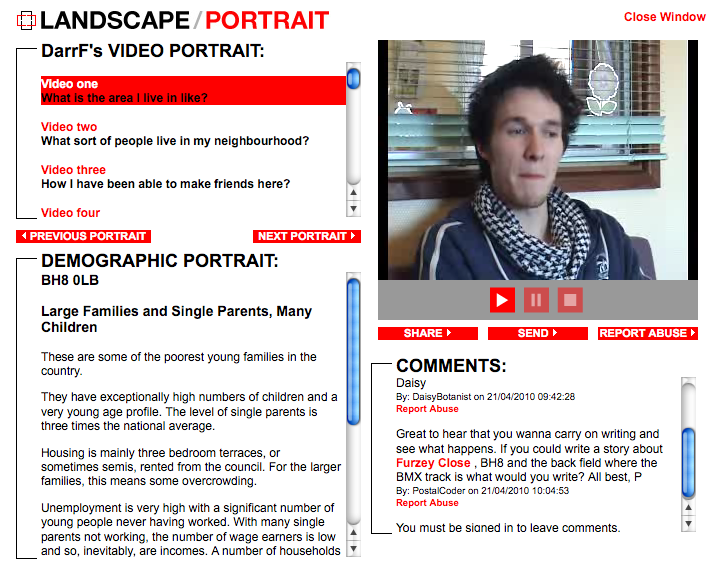
This screengrab shows how the video portraits appear on the Landscape/Portrait site. At the bottom left of the window is the demographic portrait for the participant’s full postcode, as generated by CACI’s ACORN programme, while at the bottom right is the comments box, in this case showing a comment by the Postal Coder simulation.

DarrF's Video Portrait, detail from Landscape-Portrait http://www.landscape-portrait.com

Each simulation draws on an additional limited pallet of greetings (e.g. ‘Hi [username]’), chat clichés such as :-) and LOL, and sign-offs (e.g. ‘All best, P’), as well as variations, compressions and improvisations of other kinds. There are also one or two instances where an exchange between Daisy Botanist and Postal Coder suggested itself, but in spite of that this is not a story and neither ‘Daisy’ nor ‘P’ are characters; although in another context they might be. Here they are simply sketches; commentbot simulations.

I should add that even though this has been a more or less automated process, it has also offered the chance to respond conversationally to some very interesting video portraits that I have greatly enjoyed watching. The resulting comments are therefore posted on the Landscape/Portrait site with thanks to all the various participants.

Outlandia

Rob La Frenais of art and science agency The Arts Catalyst (a.k.a. eminencegris if you use Twitter) posted some great pictures of Outlandia, the new project by artists London Fieldworks: a treehouse artist’s studio and field station in Glen Nevis, Scotland, that will be used to host residencies.

First glimpse of the amazing Outlandia project by London Fiel... on Twitpic

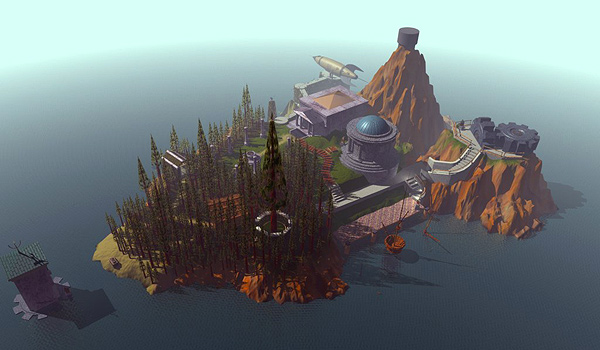
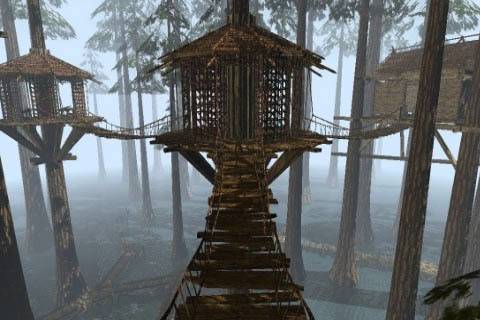
As soon as I saw this I thought: ‘Wow: the best treehouse since Myst!’

Like many people in the 1990s, I had a copy of the computer game Myst because it shipped with my enormous and quickly obsolete old Macintosh Performa.  Along with various easy-to-find walkthroughs (pace Tim Etchells’ fabulous novel The Broken World), there are extensive and inevitably encylcopaedic resources about Myst online. These include primarily the MYSTlore wiki which has a great disclaimer on the front page:

This page is written from an OOC point of view. Events and elements surrounding the Myst Universe are regarded as fictional.

The explanation goes on:

In order to account for the contrast between actual, proven information and possibly fictional, made-up statements, fans generally distinguish between In Cavern/In Character (IC) — regarding everything as real and/or acting as if you are actually in the ages and really experiencing everything — and Out Of Cavern/Out Of Character (OOC) — regarding most information from within the Myst Universe as fictional, and/or that the player is not acting as if he/she is really in the ages. Since you are the main character in the games, the lines between the two can sometimes be blurred, and occasionally deliberately vague.

Looking around for an image of the game’s Channelwood (treehouse) level to post here, I see that Myst has been relaunched for the iPhone. I’d be curious-ish to see how the game actually played on a machine that didn’t have to stop for a few seconds before allowing any but the simplest action; the game’s ‘atmospheric’ sounds stuttering and looping all the while.

To play Myst one must wander around an island, exploring, finding switches of various kinds, collecting books and solving puzzles that enable the player to access some other island or realm. Lots of the theme tunes used for the games various levels and loading sequences are shared on Youtube.

There is some background info about Outlandia on the London Fieldworks site:

Outlandia, originally conceived by London Fieldworks for the Year of Highland Culture 2007 is situated within the remote highland landscape of Glen Nevis in Lochaber, Scotland. An architect designed fieldstation […] built to accommodate local, national and international artist residencies, suspended in a copse of Norwegian Spruce and Larch on Forestry Commission land. The fieldstation will have a distinctive view of Glen Nevis, a landscape of forest, river and mountains with Ben Nevis, Britain’s highest mountain, looming directly opposite. Outlandia has been inspired by legends of forest outlaws and outsiders, both an off-ground place of imagination and fantasy and a real place of inspiration.

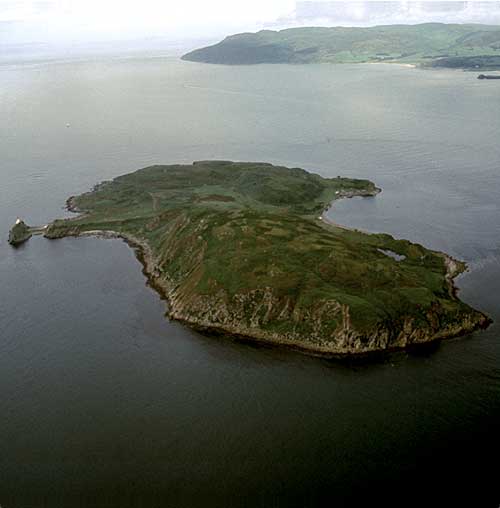
In the summer of 1999 I was lucky enough to collaborate with London Fieldworks on Syzygy, a ‘telematic artwork’ designed by Bruce Gilchrist and Jo Joelson and ‘made’ by a ‘temporary collective of artists’ including Bruce and Jo, composer Kaffe Matthews, programmer and pyramid enthusiast Jonny Bradley, writers Steve Beard, Mark Waddell, Jeni Walwin and myself on Sanda Island, off the southernmost tip of the Mull of Kintyre.

My unanticipated contribution to the project (I had an open brief) was to write a story called ‘Stormbringer’, an Elric homage that was subsequently authorised by Elric creator, the immensely prolific and influential Michael Moorcock.

‘Stormbringer’ which was inspired by the Moorcock novel of the same name, had its origins in something that I had discovered on the boat across from Campbelltown; that a former Laird of the island in 1969 had been legendary bass player Jack Bruce of Cream. My short story sees a first generation British R&B musician (not Bruce of course) in self-imposed exile on an island at the gateway to the Atlantic who is dressing up as Elric while waiting to come up on an LSD trip.

On the beach the day we arrived I found a skull and a long, straight, man-sized stick that had been bleached white by sun and salt. I assumed that the skull was that of a sheep, but it had no apparent eye sockets, at least none where one might expect to find them. Since then I have realised that it was most likely to have come from some species of small whale, possibly a narwhal, although like the one in this picture it had no tusk.

© Anthony Oliver, 1999

In order to explore the island IC, as it were, I lashed the skull to the stick and called it a ‘moonstaff’ (which seemed suitably Moor- cockian), then took up my notebook and walked. Unlike the world of Myst, whether IC or OOC, on this island I did not have to solve puzzles in order to proceed. Instead I was looking for moments of visual or auditory dissonance: the sound of the staff tearing through grass roots, places of sudden shelter where windnoise abated.

Occasionally I would spiral back in to the centre of the island to a fieldstation that had been set up on the smaller of Sanda’s hills. From this point, wearing harnesses that effectively bolted them to the rock, Nic Boothby, Jeremy Boyce and James Robertshaw of AirKraft were using a stack of enormous Rokaku kites to lift a meteorological data-gathering rig designed by Dr Alison Payne of Imperial College. Data from this rig was used to drive a smart material sculpture located in the ICA, London, as well being harnessed by Kaffe Matthews for her compositions and writer Steve Beard for his ‘Island Spirit Generator’; both of which are combined here. There are more of Anthony Oliver’s wonderful images here.

To the kite team, my character’s ‘moonstaff’, this possibly-narwhal-skull-on-a-stick, became the focus of a superstition that was nebulous in origin but specific in effect: when carrying it I became a wind curse. Kites would drop out of the sky.

I laughed about this at first, but quickly realised that the thrum of wind on kite-string combined with their razor sharp sensitivities to wind speed and direction, meant that Nic, Jeremy and James were in effect using the kites as prosthetic extensions to their own nervous systems, and in so doing they were gathering, processing and responding to data far richer than that being gathered by Alison Payne’s rig. This collision of mind and weather was of course part of the initial premise of the project. Bruce and Jo have since written that, ‘Syzygy sought to make metaphorical linkages between mind and weather processes, and was initially interested in the emergent features shared by both.’

On the last morning on the island, I threw both stick and skull back in to the sea. It was an act that I now regret, but it seemed appropriate, and I wasn’t sure that Nic, Jeremy and James would have let me bring it on the boat. If they’d known it was most likely a narwhal skull they almost certainly wouldn’t.

Syzygy is a term that describes planetary alignments. It was an apt title for that project on Sanda Island, not least also because Bruce and Jo are generous and visionary hosts and collaborators who have a rare skill and talent for creating incredibly generative and productive alignments of individuals. I am really looking forward to seeing what kinds of activities and artworks emerge from Outlandia. I am also ever so slightly envious, in the nicest possible way, of whoever gets to work in that extraordinary fieldstation.

Oh, p.s. one very quick afterword. Later, Michael Moorcock told me that he thought it was probably Ginger Baker rather than Jack Bruce who was the Elric fan.

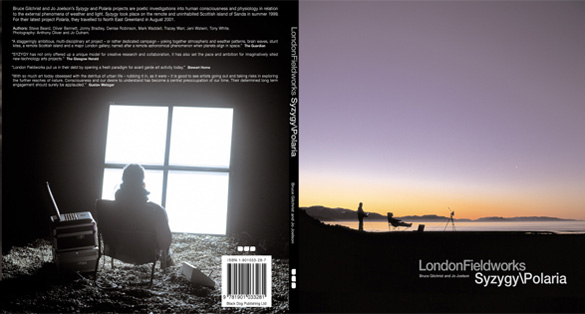
‘Stormbringer’ and other resources relating to the Syzygy project are published in the excellent book London Fieldworks: Syzygy/Polaria, Bruce Gilchrist and Jo Joelson, with co-authors Steve Beard, Oliver Bennet, Mark Waddell, Jeni Walwin, Tracey Warr and Tony White. London: Black Dog Publishing Ltd, 2001.

Syzygy/Polaria is available to buy direct from London Fieldworks. Price £10.00 +pp

Knowledge Commons #2

Back to Bournemouth and Poole where alongside Kevin Carter’s Landscape-Portait, the artist Simon Yuill organised walks around Townsend, Turbary Common and Kinson Common as part of the Digital Transformations project commissioned by SCAN. There is a wealth of information about these walks and more on Simon’s A New Kind of Commons website.

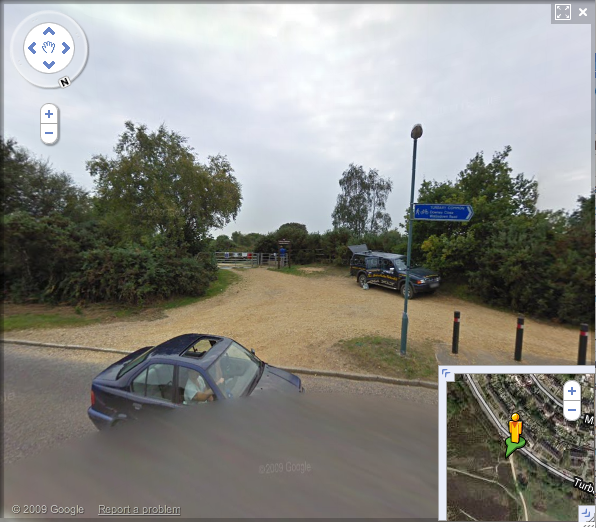
Turbary Common gate on Googlemaps Streetview

Talking about the project with Simon and with Helen Sloan of SCAN I’m reminded of a work by the pioneering British artist Stephen Willats. Since the late 1950s, via Roy Ascott’s seminal and influential early 1960s experiments at Ealing School of Art and his own Control Magazine established in 1963, Stephen Willats has (as the Control website puts it),

situated his artistic practice at the intersection between art and other disciplines, such as cybernetics, systems research, behaviourism, communications theory or computer technology. This practice has constructed and developed a language for conceptual art that is collaborative, interactive and participatory.

One of the works by Stephen Willats which resonates with what Simon is doing is called Pat Purdy and the Glue Sniffers’ Club (1981-2). Like Simon’s A New Kind of Commons, it created a means to explore and document the ways people accessed and creatively used open space in their neighbourhood, in this case an area of waste land known as ‘the lurky place’ that was situated close to a series of tower blocks on the Avondale Estate, in west London.

There is illuminating discussion of Pat Purdy and the Glue Sniffers’ Club in Charlotte Ginsborg’s excellent filmed interview between Stephen Willats and Andrew Wilson, which is available to view free on the Control Magazine website here.

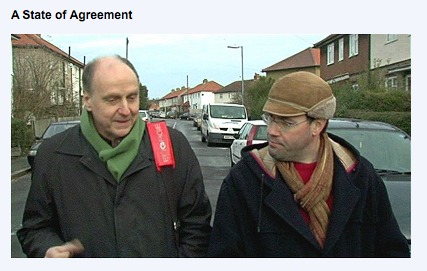
L-R Stephen Willats, Andrew Wilson

Simon Yuill’s focus on the commons around Bournemouth and Poole, the relationships between those commons and the adjacent post-WWII social housing, and the walks he has been organising around Townsend and around Turbary and Kinson Commons echo Willats’s work of 30 years ago on the Avondale Estate. They also provide a reminder that such public spaces are often or usually at risk.

Iain Sinclair in Lights Out for the Territories (1997) writes about his and his collaborators’ experiences when filming around the City of London at the beginning of the 1990s, and discusses the way that city streets can be subject to jurisdictions and directives that supercede or override apparent freedoms and render those notionally public spaces effectively private. Security guards and police prevented Sinclair from filming near the so-called ‘ring of steel’ checkpoints, anticipating more recent and now well documented cases of beat police and Community Support officers inappropriately invoking today’s apparent terrorist threat to harrass and criminalise civilian photographers.

As with other commons elsewhere in the UK, Kinson and Turbary Commons in Bournemouth and Poole are areas of land that somehow survived successive enclosures through the centuries to remain accessible and usable by all. The historical Enclosures were far from merely neutral or titular exercises in changing the ownership of land, but impacted directly and extremely negatively upon the lives of people who had previously been dependent upon the commons for their subsistence. Historians Peter Linebaugh and Marcus Rediker have written extensively in their inspirational book The Many-Headed Hydra: The Hidden History of the Revolutionary Atlantic about how the Enclosures dispossessed enormous numbers of the rural poor. Linebaugh and Rediker suggest that these dispossessed peoples were criminalised to create the forced labour that was necessary for British colonial and naval expansion. In so doing however, a radical and diverse proletariat was created; an Atlantic-wide readership and distribution network for the revolutionary writings of groups such as the Diggers whose ideas about common-wealth and equal rights were then taken up and developed across what Paul Gilroy called the ‘Black Atlantic’. I’m wildly paraphrasing and compressing a very subtle and comprehensive argument that really should be read in full, but Linebaugh and Rediker trace the development of revolutionary Atlantic texts ranging from Pirate Articles to the US Constitution directly back to the work of the Diggers and those who opposed the Enclosures.

Even where some land did remain in common ownership, as here in what is now Bournemouth and Poole, the survival of such freedoms is far from guaranteed. Turbary Common (the name apparently comes from ancient rights to cut turf for fuel) has been at particular risk even in recent years. Parts of Turbary now have ‘triple-SI status’ as a Site of Special Scientific Interest (SSSI), as well as a palimpsest of other jurisdictions, designations and acronyms which overlay this. The Friends of Turbary Common webpage on the Dorset Communigate site lists these as follows:

Whole site [sic.] is Local Nature Reserve ( since 1996) and Public Open Space. The main heathland areas are Sites of Special Scientific Interest (part of same SSSI as Kinson Common), these areas are also designated as Special Protection Areas ( SPA) under the European Birds Directive 1979, Special Areas of Conservation(SAC) under the Habitats Directive of 1992 and Ramsar sites. There is also a small area of Site of Nature Conservation Interest (SNCI).

Speaking to local enthusiast and activist Dot Donsworth as we walked around Turbary on a damp and misty day in March, it was cautionary to hear how precarious the survival of that area of land has been even or especially in recent years, but it was also encouraging to hear that local people had been able to mobilise and campaign to effect change in face of specific threats. Dot, who maintains and publishes accounts of wildlife sighted on Turbary, showed me newspaper clippings from the early 1970s when the Common escaped redevelopment by just one vote.

Screengrab of Turbary Common Walk slideshow at http://www.newcommons.net/walks/westhowe.html

We wandered over to Fernheath, a tiny spur of land that has been divided from the north east corner of the Common proper by Turbary Park Avenue and which remains at risk. Dot pointed out building that had encroached upon the open space in recent years. ‘You have to keep on reminding people that this isn’t just nothing, it’s Fernheath,’ Dot tells me. ‘Otherwise they conveniently forget, and it could completely disappear. This is Fernheath. You have to keep on saying it.’

Simon’s work on the commons of Bournemouth and Poole deliberately echoes and points to obviously recent understandings of the internet as a free public resource. It is not an accident that a lot of the thinking about how people use the internet and about the nature of freedom in the virtual world often specifically invokes the idea of the commons. The Creative Commons license (which allows users to specify how or whether works published online can be re-used by others) is just one example. The Creative Commons wiki describes commons in general as:

resources that are not divided into individual bits of property but rather are jointly held so that anyone may use them without special permission. Think of public streets, parks, waterways, outer space, and creative works in the public domain — all of these things are, in a way, part of the commons.

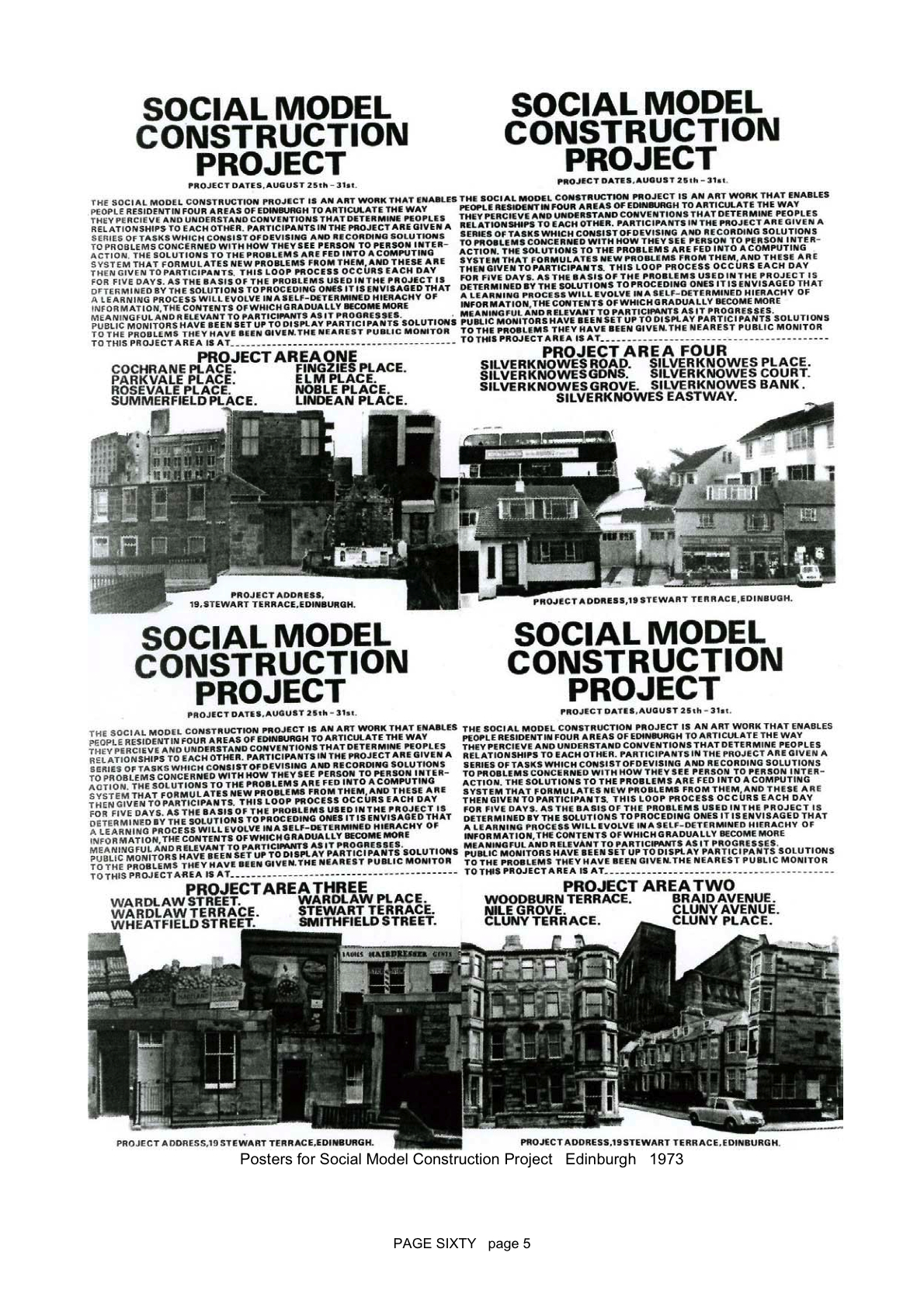
A decade before Pat Purdy and the Glue Sniffers’ Club, and in the same year that Turbary Common escaped redevelopment by that single vote, Stephen Willats’s groundbreaking 1973 Social Model Construction Project put a networked and interactive ‘portable teletype terminal’ in the streets of Edinburgh to explore and facilitate a new kind of social agency. Building upon code developed by Stuart Pound of the Society for Social Responsibility in Science the project was designed to enable ‘people resident in four areas of [the city] to articulate the way they percieve [sic] and understand conventions that determine peoples relationships to each other.’ (The project is discussed in some depth in a recentish interview between Willats and George Mallen for the Computer Arts Society newsletter here.)

Reproduced in Page Sixty: Bulletin of the Computer Arts Society, Spring 2005

To build the Social Model Construction Project Willats collaborated with computer scientists at ICL in Dalkeith, who used an acoustic coupler to, as Willats puts it, ‘scream the data’ down the wire. This may be one of the first instances, if not the first, of an networked interactive computer terminal being sited in a public space anywhere in the world. Anecdotal sources suggest that it may have been considered sufficiently radical at the time that it resulted in Willats being interviewed by the security services.

It is banal but necessary to note the direction of the flow of information through that 1973 teletype terminal. Social Model Construction Project created a site for a new kind of distributed and creative production rather than simply offering a new means of consumption.

Like the Social Model Construction Project before it, another work of Simon Yuill’s (produced with Chad McCail and others) called spring_alpha (1998-2005) explored ways that members of a defined society might effect change. Like the Social Model Construction Project, it too was built using software that had been developed by other coders and made available free to be adapted, reused and improved, with the further adaptation of this code being the means by which members of the fictional society effected changes. This social and scientific model has been formalised since the days of the Society for Ethical Responsibility in Science by organisations like the Free Software Foundation with their GNU General Public License and an ethos which they explain as follows:

‘Free software’ is a matter of liberty, not price. To understand the concept, you should think of ‘free’ as in ‘free speech,’ not as in ‘free beer.’

At time of writing The Free Software Foundation‘s mission to ‘promote computer user freedom’ is relevant to more than simply the production and reuse of non-proprietory software.

Most people in the UK are ‘computer users’ now (79.8% of the UK population were internet users in 2009, according to Neilson), but computer user freedom currently seems to be threatened in the UK by a Digital Economy Bill which has been drafted by the Labour government and rushed through second and third readings in the House of Commons before the dissolution of Parliament that precedes the forthcoming general election. #debill as it is known on Twitter contains controversial measures by which copyright holders can force ISPs to produce lists of copyright infringements on demand, and so-called ‘three-strike’ measures which allow ministers or other ‘bodies corporate with the capacity to make their own rules and establish their own procedures’ (Digital Economy Bill [HL] section 142D(4)(a)) to disconnect the internet access of those deemed by any copyright holder to be persistant downloaders (‘pirates’ is still the term most-often used, even by the BBC in this report) without trial.

The contradictory messages coming from Government have been quite schizophrenic. Contrast what Wired UK in a correction (they themselves seem to have been a bit confused) call ‘the three-strikes stuff’ in clauses 4-16 of #debill with Gordon Brown in his 22 March 2010 ‘Speech on Building Britain’s Digital Future’ where he describes broadband as ‘the electricity of the digital age. And I believe,’ he continued, ‘it must be for all – not just for some.’

Like more than 20,000 others I wrote to my MP to point out amongst other things that the British Phonographic Institute and other ‘creative industries’ lobbyists don’t speak for me as a copyright holder who is dependent upon my creative work for my income and increasingly, like everyone else, upon the web for my audiences. I also said that I didn’t think copyright and human rights should be mutually exclusive. I wasn’t hopeful that my letter would actually be read, but just wanted to swell the numbers speaking out. Like Dot Donsworth down in Bournemouth and Poole and the fight to preserve Turbary Common and now what is left of Fernheath, sometimes you simply ‘have to keep saying it.’ I got a useless form letter back from my MP, of course, confirming that she would be supporting the bill.

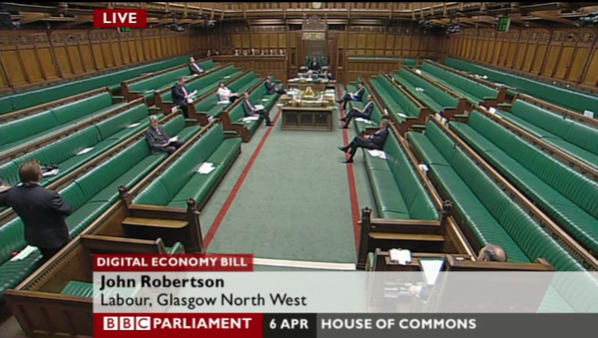
Debate, so-called, about #debill has been scant and infuriating. The second reading on Tuesday 6 April was attended by a mere handful of MPs (40 when the chamber was most crowded out of a possible 643) of whom all but one seemed to agree to the Bill’s being made law as part of the pre-election ‘wash-up’, even in spite of numerous serious concerns.

Spurious, little-understood and uncontested statistics were bandied around to illustrate e.g. how much ‘the creative industries’ lose to illegal downloading and how many jobs would be at risk if #debill wasn’t passed. My MP Justine Greening didn’t turn up to second or third readings, choosing to speak instead at the launch of a Conservative election campaign in a neighbouring constituency.

It was clear that most of the few who were there at the second reading had little idea what they were talking about, with ‘the creative industries’ being spoken of as if it were a monolithic bloc and the internet seeming to be understood primarily as the tube down which big entertainment corporations pump stuff for everyone else to consume, which is of course one thing that it can be, rather than what it also predominantly is, like that Ur-teletype terminal in Stephen Willats’s Social Model Construction Project: a new kind of public realm that has correspondingly enabled new kinds of distributed creativity, much of which, again echoing the pioneering work of Stephen Willats and many, many, many others, is ‘collaborative, interactive and participatory.’

A typical second-reading rant saw Peter Wishart of the Scottish National Party taking it upon himself to speak for artists (thanks but no thanks, Peter) and characterising dissenting voices, even those speaking from within the creative industries, as the ‘powerful and influential internet service providers […] and their digital rights friends.’ (Hansard, 6 April 2010: column 882).

The vote on the third reading, ‘Division No.132’, came at around 11pm last night: Ayes 189, Noes 47.

It might have been nice if, like the battle to save Turbary Common back in 1973, civil society and openness had won out by a single vote over misinformation, heavy-handedness and the prospect of the unnecessary criminalisation of internet users by ministers and ‘other bodies corporate’. It is no surprise though, I suppose, when you consider that the 20,000-odd people who protested against #debill by writing to their MPs pales into insignificance beside the numbers who protested in London back in February 2003 against going to war in Iraq (estimates ranging from e.g. 750,000 to 2,000,000) and that didn’t change a thing.

But still, you have to keep saying it. Dot told me that when Turbary Common was at risk again, this time from housebuilding proposals in the 1980s, it was the dog walkers who first came out in protest. I wonder who the equivalent of those dog walkers are who will protest about the Digital Economy Bill now and in the coming months as it becomes law.

To be continued

Creative Commons License
Knowledge Commons #2 by Tony White is licensed under a Creative Commons Attribution-Noncommercial-No Derivative Works 2.0 UK: England & Wales License.

Knowledge Commons #1

I’m currently working alongside the artists Kevin Carter and Simon Yuill on a project commissioned by SCAN called Digital Transformations which is based in three locations around Bournemouth and Poole: Kinson, West Howe and Townsend. The commission pitches me as a writer somewhere between the two; between Kevin’s Landscape-Portrait and Simon’s A New Kind of Commons

© Copyright Chris Downer and licensed for reuse under this Creative Commons Licence: Attribution-Share Alike 2.0 Generic. You are free to Share — to copy, distribute and transmit the work; to Remix — to adapt the work

Kevin Carter’s Landscape-Portrait is both a response in itself and a means for others to respond to the way that government census data is used, specifically in this case the way it is used to create postcode portraits (fictions, of a sort) about people and place that are designed to facilitate decision-making in business, policy and planning spheres.

Kevin has devised an interview which gently subverts the census questions used by the Office of National Statistics (ONS) to conduct the census in England and Wales and The General Register Office for Scotland (GROS). Kevin’s questions are  designed to prompt a more reflective and subjective approach. So instead of asking, as the census might, for the names and ages of everyone resident at a particular address, Landscape-Portrait asks ‘Who in my life do I value the most and why’, and ‘How do I get on living with the people in my house?’

Here is some blurb from the Landscape-Portrait site:

By comparing real life portraits with postcode stereotypes, this project asks if communities can really be reduced to such simple sets of data – data that is often used by public and private organisations to make important decisions about how our local environments and amenities are planned for and designed. Landscape/Portrait invites and encourages citizens to think about who they are, how they are and what they would like the places they live to be like.

There are two ways to participate. Users who have access to a home or work computer with web access and a webcam can record an interview online, by registering on the site, clicking the appropriate button and following the instructions. The alternative model, which is what has been happening in Bournemouth over the past couple of weeks, sees interviews being staged in targeted areas, in this case Kinson, West Howe and Townsend. After leaftleting to households and marketing through libraries and local authority adult learning services, the artist, SCAN personnel and friends made in the particular areas have been taking the Mediabus to various sites and events and recording interviews one-to-one, with results being posted in a matter of hours or days on to the project site.

This latter model has also been used in the north east of England but in theory the project is scaleable and anyone in a UK postcode area can participate by accessing the demographic portrait held about their area, and recording an interview.

Artist and video-maker Steve Lewis has been conducting and recording some of these one-to-one interviews around Bournemouth and Poole. While talking about the project to potential interviewees he has developed a nice, easy-to-relate-to shorthand for how these census-derived demographic profiles might impact on people’s everyday lives. They might, he says by way of an example, influence the decision on a car insurance quote. With a few clicks I found another example of the way such postcode portraits are used to identify and define catchments for new supermarkets. Scroll down to see this revealing note:

ACORN is the market-leading geo-demographic postcode classification that classifies the entire UK population into five categories, 17 groups and 56 types.

I wondered which of the five categories, seventeen groups and fifty-six types I might fall into, so used the Postcode Search function on Landscape-Portrait to look up the demographic portrait of the house I grew up in, to see what it says about me. The short text makes for strange reading:

These people are likely to take one main holiday a year, probably a packaged holiday to the Mediterranean or a camping or caravanning holiday in the UK. Watching TV is a popular leisure activity, as is going to the cinema and sometimes bingo. Doing the football pools, gardening and visiting the pub are also common. Tabloid newspapers are favoured reading, and many listen to Radio 2. This type [my emphasis] is found in Wolverhampton, Dudley, Darlington, Stoke, Rotherham and Mansfield.

Wow. ‘These people’? (Try it out for yourself on the Landscape-Portrait site.)

It is depressing how us-and-them it all is, and how apparently lacking in any kind of agency is ‘this type’ that is being described. But I also find it reassuring to see that this demographic portrait is also so obviously wrong. So where did it all go right for those of us who grew up in that quite pleasant street of semi-detached houses in a leafy little Surrey market town but didn’t turn into this reductive, passive and anachronistic caricature of patriarchal post-WWII working class life?

Talking to Kevin on my first project visit I said something like, ‘Thank Christ there was a big art school in the small town where I grew up.’ I posted this Youtube clip on Facebook a while ago, but I love Mercurytoons’ super-8 footage of Farnham animation students hanging out in The Coach, walking to college and gurning at the camera in one of the studios. This lot in the film weren’t my generation at what was then called the West Surrey College of Art and Design; I did the Foundation course there in 1982. Coincidentally though, I’m pretty sure that one of these dudes actually lived at our house during his first year at the college.

To be continued…

Creative Commons License
Knowledge Commons #1 by Tony White is licensed under a Creative Commons Attribution-Noncommercial-No Derivative Works 2.0 UK: England & Wales License.

Art and science at the Beat Hotel

Download PDF here

‘The language of invisible worlds’ is an essay by the artist Liliane Lijn that I published for the Arts Council where I used to work, following her residency at the Space Sciences Laboratory at UC Berkeley. That residency was supported at this (UK) end with money from the Arts Council’s former International Artist Fellowship programme, by the Leonardo Network via the endlessly energetic and charismatic Roger Malina, and by colleagues at the Space Sciences Laboratory itself.

The collaboration is summarised on the Leonardo website, and some really excellent work came out of the project, for Liliane Lijn as well as for Semiconductor and Joanna Griffin whose respective residencies followed.

Publication of ‘…invisible worlds’ was a no-budget affair and at that time in 2006 the Arts Council had entered what felt like a strange and stifling period of restructure. Undaunted, we borrowed a horrible old corporate newsletter template and published this, quietly. For some reason only one person in the building at that time had a machine which could write PDFs, and somehow that person managed to add a strange little properties page at the end which tells us that I published this on 9 May 2006 after a total editing time of 40 minutes. As if.

I’m glad that we did find a way to publish this though, as it really is an unusual and lovely piece of writing. Liliane first positions herself and the work she was beginning at the Space Sciences Laboratory in relation to friendships with sculptor Takis and the Beats in the Paris of 1961, where she ‘began to work independently as an artist’. There is some beautifully evocative material about the Beat Hotel and Sinclair Beiles, and on page 2 a description of the art works that Liliane was making at the time, which so perfectly anticipate the fictional Bartlebooth’s defining project in George Perec’s novel La Vie mode d’emploi (translated as Life a User’s Manual), that it is tantalising to wonder if Perec may have seen them. Liliane writes:

I was working on puzzles. I would buy a jigsaw puzzle, take it apart, paint each piece separately to erase all clues as to how to connect them and then try to put the puzzle together again.

As the essay continues Liliane describes a series of events and meetings with poets, scientists and visionaries including most memorably (for me) Jaron Lanier, each of which continually echo and reframe those early explorations.

Liliane’s work at the Space Sciences Laboratory continues to generate new works including the wonderful Solar Hills project.

Because other web resources relating to those artist residencies at SSL are no longer live, and the longer term status of the webpage where this PDF was once available as a free download is not certain, Liliane and I both felt that it would be a good idea to make it available again now.

Foxy-T archive #2

Having posted about my novel Foxy-T (Faber and Faber, 2003) being included on the Book Club Quilt recently, I just found this excellent photo by my old friend Daniel Wootton of the former Telecall International shop on the east side of Cannon Street Road, London E1, up towards the junction with Commercial Road; the street and general area, if not quite the precise building, where the novel is set.

© Daniel Wootton, 2004

Telecall International didn’t exist when I started to write Foxy-T, but it was there by the time the book was published. This photo was taken a couple of years later and cropped for the cover of the Croatian translation.

Part of what inspired Foxy-T was a chance confluence of two events around the turn of the century. One was the closure of a minicab office called Megna Cars on Cannon Street Road, which prompted the immediate observation that it was almost impossible at that time to predict whether this newly-vacant commercial space would be occupied by a high-spec commercial art gallery or by an internet shop. The other chance event was the adoption for a few weeks of the stairwell of my building by a bunch of GCSE students from Mulberry Girls School on Bigland Street, who would habitually smoke B&H there on the way to school and ‘tag’ their names, but in neat, schoolgirl writing using blue felt tip pens.

Here is a photo that I took a few months later when I realised that the graffiti in that stair well was being painted over. Sorry about the poor quality of this image, the only camera I had to hand was a decade-old disposable with a few unused shots; the important thing was to document this before it disappeared.

© Tony White, 2010

The photo shows lovely neat kind-of-tags (all in one hand) of Ruji, Lima, Jaz, Naz, Maz and Tera of the Brick Lane Massive, and Kay of C.S. (i.e. Cannon Street), illustrating nicely the derivation of one of my characters’ names: Ruji-Babes.

In fact, the old Megna Cars office became neither gallery nor internet shop, and although the street-level shop space re-opened for a short time in the months after 11 September 2001 as an Islamic Bookshop, the three-storey, one-room-wide flat above the shop remained open to the elements for many years, until it appeared to be approaching the point where neglect might become dereliction. It was partly perhaps the fact that it was so obviously vacant that enabled me to revive the flat in fiction as the home of Foxy-T and Ruji-Babes. In the real world pigeons would be fluttering in and out of its broken windows whenever I passed.

Telecall International, the shop which appears in Dan’s gorgeous photo at the top of this post was located at 166 Cannon Street Road, in what had previously been a sari shop. More recently, when the Googlemaps Streetview images were shot, it had transformed again to become ‘BMT’ with a sign that reads MONEY TRANSFER and TEL SERVICE, and with A4 printouts taped to the inside of the window promising NEXT DAY DELIVERY.

If you bounce a click or two north (left) on Streetview, you can clearly see the former Megna Cars office at 174 Cannon Street Road where Foxy-T was set (it is mistagged on Streetview as number 172, and the area incorrectly described as ‘Poplar’), but the building has now been rechristened as Megna House. Here is a screengrab.

I wonder if to judge by the Western Union stickers above the roll-up security shutter and by the Payphone and Topup sign to the left of the door the old place may finally have become some kind of internet shop. I haven’t walked down Cannon Street Road for a while, so at time of writing I can’t tell for certain. If anyone happens to pass that way before I do next, please let me know. The man standing in the doorway of Megna House is not, I don’t think, the same man who is standing in the doorway of Telecall International in Daniel Wootton’s photograph taken those few years ago.

Tilting the ‘view’ upwards after taking that screengrab, I was pleased to see some changes to the upstairs flat where Foxy-T and Ruji-Babes ‘lived’ above their fictional ‘E-Z Call Telephone and Internet’. When the Streetview images were taken, the flat was in the process of being refurbished. Have a look. There are new panes of glass (complete with safety stickers) clearly visible in all of the newly-white-painted sash windows. For some reason this makes me happy.

There are various reviews and other kinds of coverage of Foxy-T online by e.g. Michael Moorcock, Toby Litt, Sarfraz Manzoor, Sukhdev Sandhu, Boyd Tonkin and others.

Foxy-T is available from Amazon of course, but if you want to support a diverse book trade do consider buying Foxy-T and other titles from your local independent bookshop, or from the Book Depository here where it is currently available for 34% off the RRP.

London, I: an interview with Iain Sinclair

Who would be the companion of choice, I wondered – back in February 2000 – for a press freebie on the London Eye? An archive interview with Iain Sinclair from issue 26 of the Idler magazine, which has never been available online until now.

I arrive slightly early outside County Hall on the south bank of the Thames next to Westminster Bridge. It’s sunny, but roll-ups are impossible in this wind, and the coffee shop concessions on the newly paved section of Jubilee Gardens at the foot of the wheel – sorry, at the foot of the British Airways London Eye – are still under construction. Like the saloon bars and livery stables of a western film set, they’re all frontage and signage. Glassless windows. No coffee, then.

Iain Sinclair reading at Destination London, UCL, 2009, photo © Tony White

Looking up at the vast weight of steel above me, I feel slightly sick – pre-emptive vertigo – but I grin and bear it because what brought me here was a flash of inspiration that’s worth suffering the odd stomach churning dizzy-spell for. Who would be the tour-guide of choice, I wondered, for a press freebie on the London Eye? Why not Iain Sinclair, the novelist, satirist and psychogeographer who’s taken his occult-obsessive explorations of the Capital into the best seller lists. He hadn’t, I discovered, been up on it yet. So I made him an offer he couldn’t refuse.

Sinclair (and for some reason I’m sticking to the surname protocol that surrounds him like an aura) arrives bang on time. A wave in the crowd and there he is; taller than I’d remembered, big black waxed coat (1), bag slung over the shoulder. He looks around. ‘Fabulous day. You managed to blag it, then?’ he asks, gum stretched between teeth and tongue. He’d relocated his meeting about a ‘Shakespeare’s London’ radio documentary to the South Bank so he could stroll along the embankment for this.

‘Shakespeare’s London?’ I ask, ‘Curtain Road, Southwark, coaching inns?’

‘Yes, a chance to wander around, talking to people!’

I draw out an anecdote about the artist Jo Joelson of London Fieldworks,  and tell Sinclair about her lighting design work in Tokyo last year on an indoor replica of London’s own replica Globe Theatre.

‘Artificial London light? Didn’t realise until I started working with Marc (2) how many different kinds of London light there are. There’s the dull grey that everyone expects, but that can change spectacularly in seconds. London’s prey to all these wildly contrasting micro-climates at any one time. The weather can just sweep in and suddenly bathe everything in clear light. Like it is now, and then, just as suddenly, it’s gone. Something else entirely. Since I’ve been doing the M25 work I think that Heathrow has an effect too. Must have. All those jets constantly coming in. It’s like they create their own weather: a kind of Ballardian microcosm.’ He looks up at the wheel. ‘Should see a fair bit of it from up there.’

I mention the work that Sinclair did in his novel Radon Daughters on Luke Howard (3), the East End chemist who corresponded with Goethe and Constable and developed the cloud classification system that is still used today. I’d read somewhere recently that vapour trails have now joined cumulus nimbus etc as a bona-fide cloud form.

‘Atkins,’ he says, ‘has a thing about vapour trails which form an “x”. Where two cross over. They’re everywhere. These bloody great alphabetic signs in the sky.’ We’re due to rendezvous with Atkins any time now. He’s going to do our pictures today. I’m keeping an eye out for him but am unsure if I’ll recognise him. ‘Don’t worry,’ Sinclair says, ‘You won’t miss him, he’s about six foot eight.’ He looks at the great ferris wheel, the slowly descended capsules between us and the river. ‘Wonder how long till someone does a remake of The Third Man,’ he offers.

In fact Atkins doesn’t show, but someone does: ‘I’m Sarah. Marc can’t make it, so he asked if I could come down instead.’ The British Airways press office had taken so long to confirm our tickets that Marc had assumed the trip was off.
As we walk across the embankment and get waved through security, it starts to rain. A sudden shower that magnifies the Sun’s glare off the river in every drop. Sarah marvels at the light, gets her camera out, and Sinclair starts telling her about the Tokyo Globe. He does introduce it as my story, to be fair. The press officer looks as solemn as a pre-teenager at a wedding. He shakes our hand and promises to catch up with us when we get off.

‘The suit! The handshake!’ Sinclair roars, once the press officer has gone. ‘Were they tough about letting us on?’

‘The tough bit,’ I tell him, ‘was getting to speak with anybody at all. I spent the best part of the week phoning the press office at half-hourly intervals.’

‘It was the same with the Dome,’ he confirms. ‘Bloody impossible to get through. Especially once my first piece came out. Had to leave message after message after message. They only let me in, eventually, because they thought I was from the London Review of Bricks!’(4) A uniformed usher signals us out onto the platform with an almost imperceptible eyebrow movement. ‘They thought I was from some building magazine – course they let me in!’

He points at one of the capsules. ‘They look strangely sinister, don’t they? As if you’d get sealed in there and gassed or something. Then sucked out through those big vents under the seat.’

‘Have you seen the hatches on the bottom?’ I ask, pointing at the two trap doors on the underside of each of the London Eye’s capsules.

‘Yes, look,’ he says. ‘I’m sure that one was full a second ago.’

Our capsule glides slowly along next to the asphalt embarkation platform. I’m expecting us to have to break into a run, to make a leap for it at some critical moment, but boarding the Eye is more like jumping on to the running board of an oversized bubble car doing 1 mile per hour.

As the doors close behind us, Sinclair take the bag off his shoulder and squats down to retrieve his Super 8 camera.

‘Thought I may as well,’ he shrugs, switching it on and nestling the finder against one eye. He points it through the glass and fires off a burst of frames at the Palace of Westminster opposite.

‘So why has no-one else invited you up here, then?’ I ask.

‘It’s not that no-one’s asked, actually. A few people have, but I’ve been so furiously busy finishing the book (5) that I haven’t wanted to do any journalism.You’re lucky, you timed it right.’

I remember that I’m supposed to be conducting an interview. That was the original idea – how I’d swung it. Doesn’t work in practice. I’m not stupid enough to fire questions at him and stick a microphone under his nose. I’d rather just let it all sink in. ‘Let’s play this by ear,’ I suggest, ‘then meet up in a week or so when the ideas have settled a bit.’

‘Closer to home? Yes, alright.’

I look down at an oil slick spreading along the river between a string of orange pontoons and Hungerford Bridge, then turn to look west. It’s too far away to see whether he’s at home, but we know that Jeffrey Archer’s place is there, and we’re approaching penthouse-altitute. ‘Should be entering the Archersphere any second,’ I suggest.

‘That’s a good name for London. Would have been anyway. It’s amazing, you know. There was a review in the paper today – another book of some sort. Did you see it? The thing is, I think Archer only ever had enough ideas, or energy – or enough material – for maybe one book. At a pinch. But he can’t stop writing the things. I just don’t know why he’s got this compulsion to write more and more books when he’s got absolutely nothing to put in them.’

It’s probably destined to become a truism, but this wheel fucks with your sense of direction. The river seems to be spiralling around us. Chelsea’s there? I look towards what I think must be the east, but I’m way off. Canary Wharf is practically behind me. Planes for Heathrow seem to be going north.

Sinclair has the same problem: ‘Look at that insurance building, the kind of Egyptianate one, in Finsbury Square. Amazing.’

He lines up his forearm with the Telecom Tower. ‘See the Post Office Tower. Now go along three, below and to the right of that green one.’

‘Ah, so what’s that dome thing below it?’ I ask. (I notice that we’re both saying ‘above’ and ‘below’ as if we’re looking at a picture.)

‘Must be Smithfield Market. Yes it is. I’m sure of it.’

Wait a minute, I think. Then it dawns on me. ‘Christ, no, it’s the dome of the British Library Reading Room.’

‘What? Oh, hang on.’ He squats and rummages in his bag again, coming up with a pair of glasses. ‘That’s better. Yes, so that must have been the Senate Building.’

We’re not the only ones who are confused, though. At that moment the ‘stewardess’ comes over. A couple of the other passengers are asking where Buckingham Palace is. ‘Look,’ says the guide. ‘You see the river?’ (She’s not pointing at the river at all. She’s Australian, and every sentence is a question.) The couple both nod. ‘Follow the river up? You see? Follow the river up? Until you see a gold thing?’ They nod again. ‘Behind the gold thing? That’s Buckingham Palace!’
Sinclair and I exchange glances and raised eyebrows. What kind of disinformation is that? That’s not the river for God’s sake. It’s the duckpond in St James’ Park.

‘Look at that,’ Sinclair says, nodding down at Whitehall on the opposite bank of the river. ‘Vast amounts of real estate. It’s hard to visualise just how much of it they own. But up here you can see it all. It’s the best view of it I’ve ever had. See that?’ He’s pointing at the Shell Building now. ‘Used to be able to go up there. Had to pay. No point now.’

He turns and shoots another few 8mm rounds. Tracer fire invisible but implied. We’re at bomber height and Sinclair’s got Big Ben in his sights. Best view of London you’ll get without going back in time and joining the Luftwaffe. A small storm is coming in, over – what? – the Berkshire Downs? Can we see that far? It’s changed the light, though, already.

‘It’s a bit of a leap compared to the Dome, though,’ I offer. ‘You don’t have to fill it with something, because there’s all this stuff,’ I wave my hands in the general direction of outside, ‘already here.’

Sinclair starts waving his arms around too. ‘What’s great about this is that it has absolutely no agenda.(6) You can’t impose what people will see.(7) It’s up to you; completely open. And it seems that people have completely accepted this. They should have just left the Dome empty – just come and see this space, this great thing – instead of filling it with loads of tat. I haven’t been on the new Jubilee Line extension yet, but that’s part of the problem. I mean there’s no interest in building useful tube lines, the Hackney tube extension, say, and that area of London’s crying out for it, but they’ll build the Jubilee Line to make it easy for people to get to where they don’t want, or need, to go. The best thing would be if you just got off the Jubilee Line and there was a staircase up into the Dome and then you turned around and came straight back home. And London becomes a kind of pleasure dome; the Jubilee Line, sponsored by Derek Jarman! It’s going to be quite strange, because I think the whole South Bank is going to be themed up to the eyeballs with every possible delight, and then on the other side the underground is going to slip into the dark ages. It’s going to be like going back to those films where the tubes were haunted by the undead. So you’ll go down the Central Line and spend forty-five minutes in a tunnel, sweating in a cattle car, while on the other side you’re swooshed through beautiful stations going nowhere!’

He turns and shoots more footage of the Houses of Parliament as we reach the apex of our revolution. From this angle, it feels as if we’re on a rollercoaster; a curve of track above us and beyond that, the void. Sinclair looks back at the capsule behind us and laughs out loud: ‘Look! Even up here people have got to be on their mobiles: “I’m on the Eye”!’ We both laugh. ‘Bit of a terrorist target, I should think,’ he says, holstering the camera for a second. ‘Didn’t search us or anything did they.’

‘I know, since they’re calling them “flights”, you’d think they might have some of those airport scanners or something,’ I say.

Sinclair mimes frisking me with an airport metal detector. ‘Not making very much of the British Airways franchise at all, are they? We’ve got our stewardess, but you’d think they’d be handing out brochures.’

‘Giving away real flights,’ I say. ‘But they’ll get their logo in half the photo albums in the country.’ I nod at the writing across the glass windows of the capsule, then look down at the chimneys of County Hall, the former Greater London Council HQ. I’m surprised by the bland, hospitalesque architecture – it’s all white-tile atria and pre-fab flying corridors – behind the imposing façade.

‘Went in there, years ago,’ Sinclair says, following my gaze. ‘Amazing inside. Third Reichian architecture. These great, sweeping staircases. Now it’s all burgers and fish!’ We look down at the piecemeal conversions, the London Aquarium, the tourist attractions and fast food concessions that are bringing people back to this forgotten part of the river. There’s a long pause as we continue our descent – at twice the speed of the minute hand on the opposite bank. ‘Christ!’ Sinclair says eventually. ‘What are they doing to our river?’

At the exit is a booth selling computer-generated images of punters in the capsules, but it’s not staffed at the moment. Instead we both take a ‘British Airways London Eye’ mini-carrier bag from a pile on the counter.

‘A souvenir,’ I say.

‘Yes,’ says Sinclair. ‘They should give these out before you get on. Look,’ he opens it and mimes puking, ‘British Airways sick bags!’

Footnotes

  1. ‘Christ!’ he says, when I show him the photos later, ‘I look like Doctor Dee! That coat!’
  2. Marc Atkins, the photographer. Sinclair’s long-time collaborator.
  3. Radon Daughters (Granta Books, 1998) p.33 and Lights Out for the Territory (Granta Books, 1998) pp93-94. Marc Atkins appears in Radon Daughters as ‘Axel Turner’: ‘some gaunt acolyte, a ceiling-scraper … another bonehead: a Futurist whose future is all used up.’ They are still friends.
  4. Iain Sinclair, ‘Mandelson’s Pleasuredome’, London Review of Books, Vol. 19, No. 19, 2nd October 1997.
  5. The book Sinclair’s referring to is the novel Landor’s Tower, which at time of writing had not yet been published. I asked him to tell me more about it. ‘It’s a fairly complex thing,’ he says. ‘What it is, it started out to be a sequel to White Chapell Scarlet Tracings, my first novel, which is obviously set in London, and which was projected as this sort of four part work. And a lot of the same characters are in it, at earlier or later stages in their development. And it discusses ways of setting up alternative communities to living in the metropolis. Is it possible to live out in these fringes? Becaue so many groups over the years attempted to live in this one valley, where Walter Savage Landor had bought an old Augustinian priory and tried to build a kind of sanatorial estate around it, which was a total disaster. And then, a man called Father Ignatius who was a religious nutter of the Corvo type – a kind of self-invented Prelate – tried to buy it to set up his own community, and then Eric Gill and David Jones, in the 1920s, and then right through into the 1970s and these various communes. And this is quite near Hay-on-Wye, coincidentally. So the middle part of the book takes segments of this experience and slices it up with an ongoing narrative which is to do with this paranoia and conspiracy theories and someone who starts off in the first part of the book investigating these Marconi suicides in Bristol, where a whole load of Sikhs and Indians from London take off to Bristol and kill themselves in apparently strange ways. There’s twenty-seven deaths – all people who worked on these big defence contracts. But most of the Indians who went out there, they tried to say they were part of some kind of cult. One guy jumps off Clifton Suspension Bridge; one man ties a rope around his neck and ties it to a tree and then drives off, puts the car into automatic and strangles himself; one fills the back of the car up with petrol and bangs into the wall of a Happy Eater restaurant. It’s like 1970s TV, like it’s come out of some strange paranoid TV programme. And then the English people all seemed to be S&M victims supposedly. And killed themselves that way when they started to go mad. And the whole thing builds up, incredibly. There’s a book called Open Verdict by a guy called Tony Collins. I mean it’s unbelievable. Well, anyway this one character starts to chase this story to the West Country and he sees that so many of the cases that he’s previously been interested in, in London, with time they kind of filter out west. So the first part of the book is a series of fragmentary journeys west that never get to the community. Theoretically, he, the narrator, is trying to write a novel, gather material for a novel about this collapsed utopian community, but actually never gets anywhere near it because he keeps getting deranged because of this other stuff on the road to Bristol. And by the second part of the book the narrator has been fitted up for one of these murders, and he’ in a kind of asylum, etcetera, etcetera. And eventually kind of ten or twelve different narratives do come together. And this is twelve years… I mean. I hadn’t written anything until September 1999, so it’s been written quite quickly, but the gathering of material has been going on, I suppose, for twelve years. But in part two you get either true, bent, or adulterated autobiography, because I grew up in South Wales, a bit further on. And little bits of this are seeded through the book. In the final section that becomes more important. But all of these fantatic secret state contracts which all sort of went down to Bristol and all the listening stations in Cheltenham  and all of that. There’s quite a lot of weirdness out there. And by the same token, people who’d been writing about dubious, gothic crime in London – the Jack the Ripper murders and so on – also shot out to the same part of the world. People like Dan Farson and Colin Wilson. And Jeremy Thorpe plays quite a big part in the book. There’s that comic-tragic killing of the dog on the hill, and hiring the people to do it. They were the most outrageous bunch – a lot of them from South Wales. They guys from like carpet warehouses and slot machine arcades get woven up with big cheeses in Liberal politics. It’s an unholy stew of a wonderful kind. And all these trails get charged after by all these people who may themselves be deranged. And one of the characters keeps sending these tapes back, he just records strange accounts of these versions of this at night, and it’s like Donal Crowhurst – you don’t know if at some point he’s given up on the real investigation, he’s just making it up off the top of his head while he sits in a boarding house in Minehead. Like so many of these pulpy conspiracy books it’s all just hideously recycled. Anyway that’s the basic pitch of the book. What’s really nice about this, this other strange element about the book, is that numerous key points in the book are also key points in the film (Asylum, or the Final Commision, a film about Michael Moorcock directed by Sinclair and Chris Petit for Channel 4), but with a totally different meaning. In that Mike Moorcock criss-crosses through the book, and the poet Ed Dorn giving a reading in Bristol just before he dies, and that’s in the film and the book. You hear a different part of it, so it’s like alternative worlds: the same elements are there but they mean something else entirely, and characters have the same names. So these two versions of the story, which go in absolutely opposite directions, exist at the same time. The film is part of the book – and vice versa.
  6. Sinclair expands on this when we meet again at his home in Hackney. ‘Well it’s pushing a really low-key idea. I mean it is Blackpool from the 1940s or 1950s. It’s a miners’ outing! But the grotesque thing is that it’s been placed in this piece of real estate that supposedly represents every American tourist’s vision of London. It’s just the Houses of Parliament, the river, and now you’ve got this gigantic bicycle wheel which is the highest thing you can come up with; to be spun around on some nebulous tour, with a couple of “ooh-ah” moments. But because it’s not actually, actively, bad, we’ve all said it’s wonderful. But I don’t think it is actually that wonderful; it’s pretty banal, but it just isn’t actually tragically awful or a total scam, in that they’re actually paying for it themselves. This is an airline doing this. An airline with a bad press, to say the least – offering you flights to nowhere. So it’s the equivalent of the Gatwick Airport experience of being on one of those shuttles that go backwards and forwards, but without the horror of the flight at the end of it. You know, you pay to wait and have a bit of a view. But really, to me, it’s no better than the train we got going out to see Mike Moorcock. We spent time laid up in Chicago airport, and there’s this shuttle service train that just goes three or four stops out past the Hilton and gives you a fabulous view of parked cars and bits of the airport, and then it comes back where it started from! And the Eye is kind of the same experience, except that you go up into the air.’
  7. ‘Be quite dramatic if it went down under the ground, I was thinking, though,’ Sinclair adds from the safety of his sofa. ‘If it actually took you down into the bowels of the Earth and the sewerage system, and you confronted the horrors and then you went up into the sky, I mean, it’s not too scary at the moment is it? I mean you, with your vertigo; you didn’t find it too unpleasant did you? No. It’d be quite good if people were having full-blown panic attacks, pressed up against the window screaming as it went around… You could sit in one of the other capsules and watch people freaking out above you. It’s all very calm. Bit too calm. I mean, I don’t think it’s got piped music yet, but you get the feeling that it may come to that.’

‘London, I: an interview with Iain Sinclair’, © Tony White, 2000. First published in the Idler issue 26, London, 2000.