‘Small publishers …’

Michael Caines has written a nice post for the TLS blog about Joanna Walsh’s “Shklovsky’s Zoo” and Piece of Paper Press—as well as some other artists’ book miniatures:

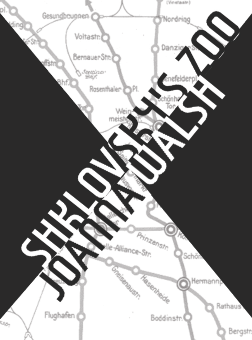
Screen Shot 2015-06-24 at 08.36.59Take a piece of A4 paper. Fold it in half (reducing it to A5 size), then twice more (A6; A7). A little more unfolding and refolding, interrupted by one snip of the scissors, and there you have it – a booklet of eight pages. Stitch it and trim the edges. Now all you have to do is cover it with suitable words and pictures … I read the A7-sized Shklovsky’s Zoo by Joanna Walsh (published earlier this year by Tony White’s deliberately lo-fi and generous-spirited Piece of Paper Press) as a complimentary complement: it’s not about reading the book itself but trying to get hold of a copy, as well as a writing residency, Kafka, the narrator coming adrift (a relationship has ended, and the fellow writing residents aren’t exactly her cup of tea). Or it’s about those things and it’s not … That seems like plenty to find tucked away in a few pages made from a single sheet of paper.

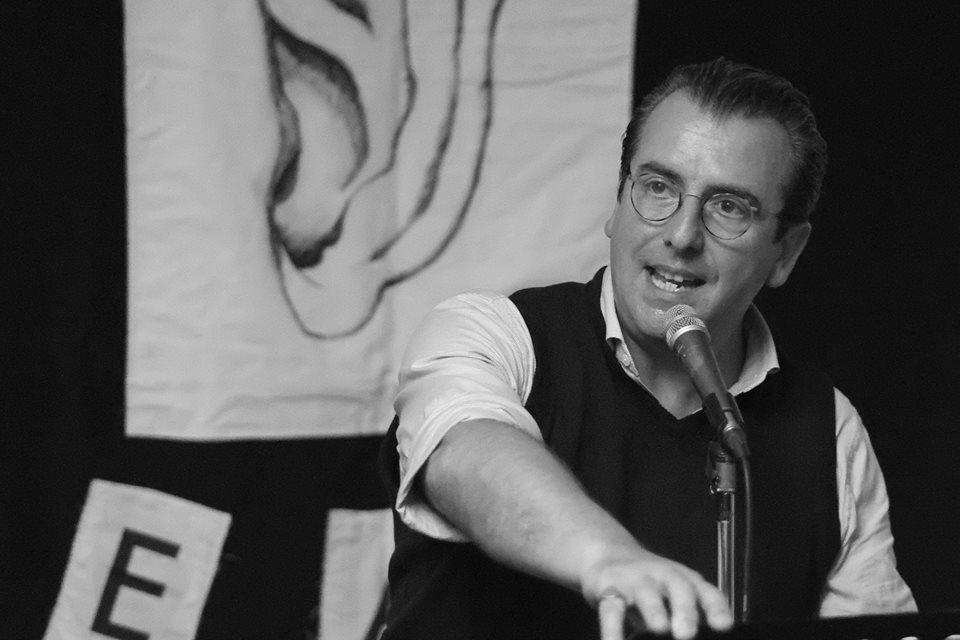
Launch of “Shklovsky’s Zoo” at bookartbookshop, London, July 2015

Launch of “Shklovsky’s Zoo” at bookartbookshop, London, July 2015

§

Read Michael Caines’, ‘Small Publishers, Smaller Books’, on the TLS Blog

Subscribe to my occasional newsletter for invites and news about forthcoming books and events

Live literature

inyerear_coverphotocropThe latest reading of my satirical short story ‘The Holborn Cenotaph’ was at In Yer Ear #15, 27 October 2015 (photo: Peter Clark), with more readings to come in London and beyond.

The reading at In Yer Ear coincided with Death in Police Custody Awareness Week, 26-31 October 2015.

§

-1‘Jaw-dropping’ — Twitter reviews of ‘The Holborn Cenotaph’

Tony White events listings

A word about bookings

Subscribe to my occasional newsletter for invites and news about forthcoming books and events

Petrol heads

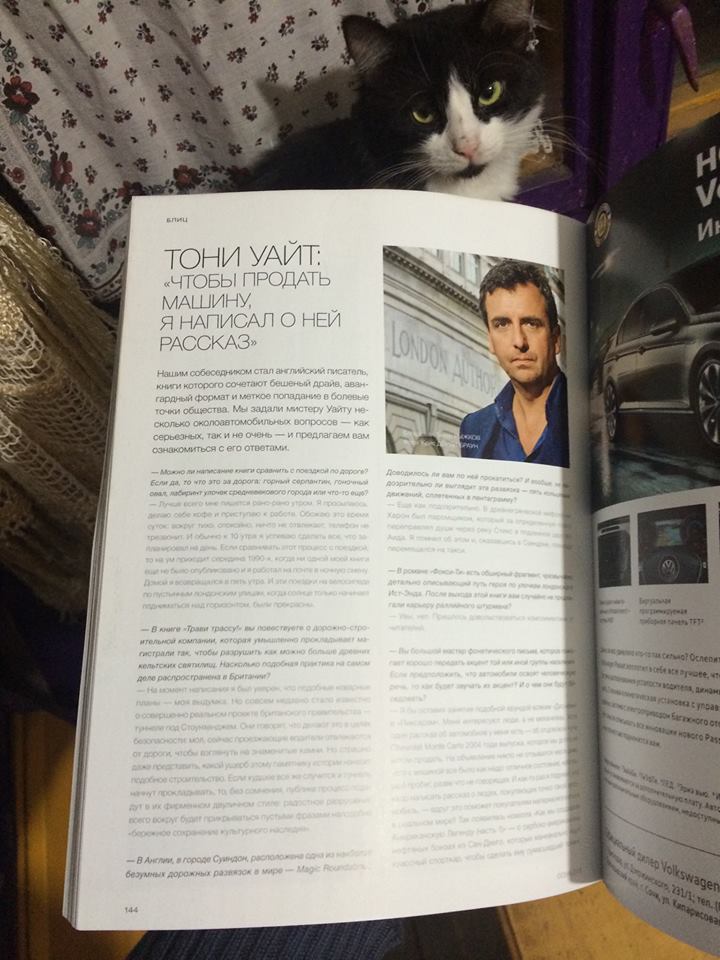
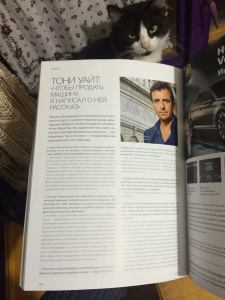
I promised to post the English translation (or the English original) of my recent interview for Russian car magazine Ключавто once the magazine was out. Here is the digital version of the magazine. For non-Russian-speakers, the standfirst reads:

Our interlocutor was the British writer, whose books combine furious drive and avant garde format, and are apt to hit society’s pressure points. We asked Mr. White a few car-related questions—how serious or not…

Here is the interview in English:
12178126_10205080543153947_1550960864_nКлючавто: Can you compare writing with driving? If yes, then what type of road do you drive during writing—mountainous serpentine, racing oval, medieval town labyrinth or something else?

[I don’t really know because I can’t drive, but] ideally I start writing very early every morning. I wake up, make coffee and get going. It is peaceful and there are no distractions, the phone doesn’t ring. I like that time of day. I can get a whole day’s work done by 10am. One thing I can compare this with is that when I used to work nights at the Post Office in the mid-1990s—before my first novel Road Rage! was published—I used to enjoy cycling home through the deserted city at 5am, just as the sun was coming up. It was beautiful. The London streets were empty and there was nobody around except a few other night workers. Maybe these are similar feelings.

Ключавто: The main villain in Road Rage! is the road construction company. Do you remember the moment when it becomes clear in the novel that these companies are trying to pave their highways directly over sacred Celtic sites? Is that practice actually popular in Britain?

Buy Road Rage from the Piece of Paper Press shop using my verified PayPal accountRoad Rage! is a novel about anti-road protesters in the East London of the 1990s, and the plan in the novel to build roads over ancient sacred sites was pure fiction, at least that is what I thought at the time. But actually, right now in the UK there is a genuine government plan to build a road tunnel under Stonehenge, one of the most famous and iconic neolithic sacred sites in the world. The rather simplistic thinking I suppose is that this tunnel will protect the site or restore some lost visual aspect; a landscape without cars. It is also rationalized by saying that the scheme is designed to enhance road safety because the stones are a distraction to drivers! However there is no telling what damage will be done to the site during the construction process itself and furthermore they will be driving this tunnel through as yet unexplored archeological remains. If this happens it will all be done no doubt in the typical hypocritical style, using words like ‘safeguard’ and ‘preserve’ while happily smashing everything.

Ключавто: Ecology is an important theme in your prose. Do you think the automotive industry is genuinely making steps towards greener products, or do they just pretend?

Shackleton’s Man Goes South, square thumbnailThree of my books have [broadly] ecological themes: first Road Rage!, then my Chernobyl novella Dicky Star and the Garden Rule, and my most recent novel Shackleton’s Man Goes South, which is a satirical novel about climate change, published by the Science Museum here in London. Researching the novel I interviewed many scientists working at the cutting edge of climate change research. These were scary conversations. Many scientists will tell you that however bad the official forecasts of catastrophic climate change might be, the current consensus is underestimative. Things may get far worse far more quickly, and the ambition of staying under 2º of average warming may not even be possible. Some so-called greener products such as bio-fuels seem to cause more ecological damage than they prevent, as well as contributing to water stress and higher food prices. There are a few electric cars, which is a start, I suppose, but as far as I can see, those entities who are most invested in the extraction of fossil fuels and the burning of carbon are doing everything they can to carry on with business as usual for as long as possible.

Photo: Dickbauch (public domain)

Photo: Dickbauch (public domain)

Ключавто: For a long time we are looking for someone who has personally overcome one of the world’s craziest crossroads – “The Magic Roundabout” in Swindon. Have you been there? And don’t you think that its shape (five smaller roundabouts bound into a big pentagram) looks really sick?

In ancient Greek mythology Charon was the ferryman of Hades whom you paid to carry your soul across the river Styx from the land of the living to the land of the dead. Learning from this, when I went to Swindon I took a taxi.

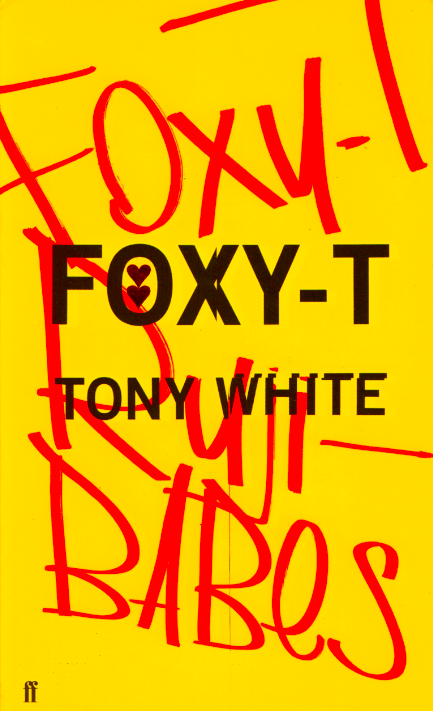
Buy Foxy-T from the Book DepositoryКлючавто: In your novel Foxy-T there is an extended and extremely detailed (and correct, they say) description of some path through London’s East End. Did any rally teams offer you a navigator contract after the publication of this book?

Sadly no, but many people tell me that they really love the book, so that is a small consolation.

Ключавто: As we can see in the novels Charlieunclenorfolktango and Foxy-T, you are a great master of phonetic script that brilliantly shows different accents. Let us imagine, that cars have learned human speech. How will their accent sound? And what will they chatter about?

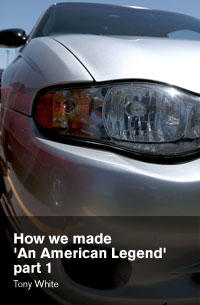
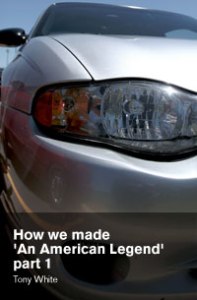
Thank you, but I would prefer to leave that kind of anthropomorphic crap to Disney or Pixar. I am more interested in people. Although actually, now you mention it, I did write a short story once about a 2004 Chevrolet Monte Carlo SS silver two-door coupe. Okay, it wasn’t a talking car, but it was my father’s car. After he died we needed to sell it, American-Legendbut there were no takers for many weeks. It was in great condition, low-mileage, but months went by and no one wanted to buy this car. So I wrote a story that was in part perhaps an act of sympathetic magic. I wondered whether if I wrote about people buying the car in a story I might help to conjure those people into being in the real world. I also wanted to create some kind of mythology and romance around what was in fact quite a bland looking US sports car. In my story—‘How we made “An American Legend” part 1’—some Serbian-American petrol heads in San Diego are desperately looking for a Chevy Monte Carlo to customize. Anyway, I don’t know if my short story helped at all, but we did sell the car.
§

Download the free epub of the 2009 short story ‘How we made “An American Legend” part 1’ direct from the artistsebooks site

Subscribe to my occasional newsletter for invites and news about forthcoming books and events

♬ It’s coming home… ♬

photo(4)
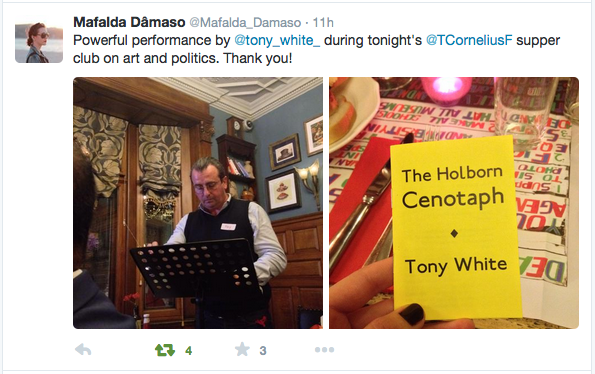
This photo was taken outside the Red Lion pub, Westminster, where I was reading my satirical short story ‘The Holborn Cenotaph’ as part of The Cornelius Foundation’s ART of Conversation Supper Club on art and politics. Without my performing it from the lectern outside number 10 Downing Street, I think this may be about as close to the seat of power (and certainly to Lutyens’s original) as ‘The Holborn Cenotaph’ will get.

Incidentally, the Red Lion’s steak and stilton pie, with chips, cabbage and gravy was pretty good, too.

§

‘Jaw-dropping’ — Read more about ‘The Holborn Cenotaph’

A word about bookings

Read more about Piece of Paper Press editions

Subscribe to my occasional newsletter for invites and news about forthcoming books and events

“How fast it goes”

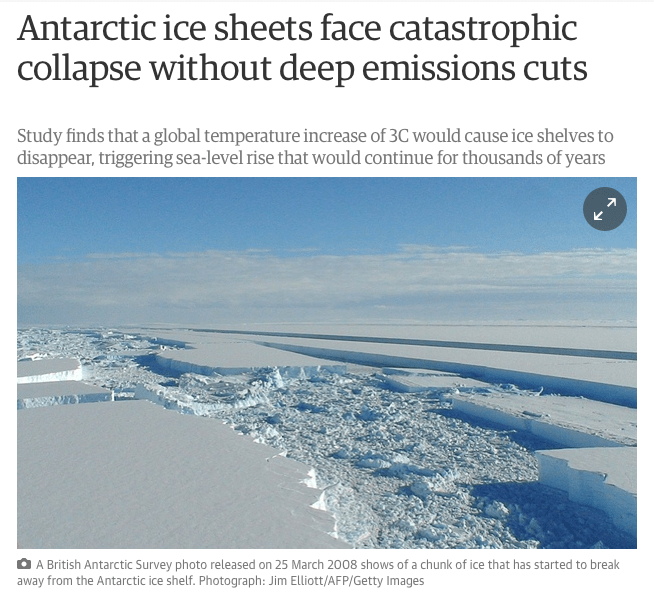
He said the loss of the West Antarctic sheet was “inevitable”; the only thing humans could control was how fast it goes.

Screen Shot 2015-10-15 at 09.40.48

With each new revelation about Antarctic melt—this latest story (above) is from the Guardian—my 2013 climate change novel Shackleton’s Man Goes South seems more and more like a future work of nonfiction…

shackleton book 512x512px

§

Shackleton’s Man Goes South is still available free and DRM-free here

Subscribe to my occasional newsletter for invites and news about forthcoming books and events

Lit Crawl London

-1I’m looking forward to reading as part of the brilliant Lit Crawl London on Friday. Here’s the blurb:

‘Lit Crawl London, in partnership with the Literary Kitchen Festival, invites you to choose your own path through a series of events held right across the neighbourhood. We’ll be taking over pubs, bookshops, an arcade bar, a pool club and coffeeshops to bring readers and writers together. Free events, a relaxed atmosphere … a melting pot for book lovers and anyone drawn to the pleasures of the unexpected.’

12107049_10156238575275651_1342787221572662122_nI’ll be reading with authors Frank Key (of Hooting Yard fame) and Audrey Reynolds as part of Resonance 104.4fm’s ‘Coming Up From Air’ event at Yada’s Kurdish Restaurant, Arch 163, Rye Lane, London, SE15 4ST, from 8:00-8:45pm. Full line up and venues on the London Lit Crawl 2015 site.

12074792_629145490522074_3767841887570478894_n

§

More about the Literary Kitchen Festival 2015

More about Resonance 104.4fm

Lit Crawl London’s Facebook group

Tony White ‘Events and Bookings’ page

Subscribe to my occasional newsletter for invites and news about forthcoming books and events

The Holborn Cenotaph on Twitter—no spoilers

-1I love tweeted reviews, so I have been really pleased to see the responses to my short story ‘The Holborn Cenotaph’ on Twitter.

‘The Holborn Cenotaph’ was first written for an event, The Cenotaph Project and the public sphere—with artists Stuart Brisley and Maya Balcioglu, and Sanja Perovic of King’s College London—that was held in the chapel at King’s as part of their Arts & Humanities Festival 2014. A small proof edition of the text was published to be given away to people attending the event. Since then I’ve given readings of the story at Westminster University’s Small Press Symposium, at In Yer Ear #10, at The MAC in Belfast, at Richard Strange’s legendary Cabaret Futura, at the London Radical Bookfair, the Brixton Book Jam and at Beaconsfield’s birthday fundraiser. Two further editions of ‘The Holborn Cenotaph’ have been given away at these gigs.

Here—without spoilers!—are some examples of what people have said on Twitter.

Thanks everyone.
Screen Shot 2015-10-20 at 11.19.21Screen Shot 2015-12-13 at 11.44.14
Screen Shot 2015-09-26 at 16.25.48
Screen Shot 2015-09-26 at 16.26.17Screen Shot 2015-09-26 at 16.26.33
Screen Shot 2015-04-24 at 13.36.24
Screen Shot 2015-04-24 at 13.35.05
Screen Shot 2015-04-24 at 13.36.58
Screen Shot 2015-04-24 at 13.39.03

I shall be doing more readings from ‘The Holborn Cenotaph’ in the coming weeks and months. Check my Events page for regular listings info. For more advance warning of upcoming gigs and readings, and for invites to events and launches, please sign up for my occasional newsletter. If you are interested in my doing a reading of ‘The Holborn Cenotaph’ at your event I would love to hear from you. As ever see my A Word About Bookings and feel free to email me.

Another Fool…

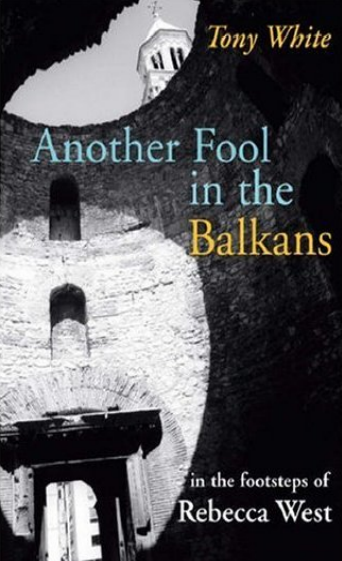
0228515_the-balkans-in-travel-writing_300I was delighted to learn that my 2006 non-fiction book Another Fool in the Balkans is the subject of an amazing essay in a new collection called The Balkans in Travel Writing, edited by Marija Krivokapić (Cambridge Scholars Publishing, 2015), which

revisits images of the Balkans in the travel writing of the twentieth and the beginning of the twenty-first century from the perspective of recent developments in travel writing critical theory and in the humanities in general.

The introduction gives a flavour of editor Marija Krivokapić’s essay on Another Fool…

few books are so courageously acquiescent to the generic limitations of travel writing as is Tony White’s book [ …] he is acutely conscious of his privilege to be thus formatted as a traveller through Yugoslavia […] Yet he still calls himself “a fool” not only because he hopes he could reach the yet indiscernible truth about the region, or how it reflects contemporary Europe, but maybe more because he still hopes his own writing can escape the theorizing urgency of international academia. Finally, he produces a book that is less an account of travel than a meditation on the possibilities of travel, but mostly an essay on the nature of art.

Another Fool in the Balkans is currently out of print, although there are a few second hand copies around. Frustratingly, the publisher was taken over and its non-fiction list discontinued just as the first edition sold out and a reprint might have been considered. At around the same time I had an unexpected phone call from the author Geoff Dyer, who was calling to tell me—in turn—that John Berger had just phoned him, to ask Geoff if he ‘had read this excellent little book called Another Fool in the Balkans?’ (That’s me quoting Geoff paraphrasing John.)

Earlier this year I did a quite in-depth interview with Marija, for issue #10 of Folia linguistica et litteraria: Časopis za nauku o jeziku i književnosti (tr. Journal of Language and Literary Studies), (Filozofski fakultet, Nikšić), which is published by the Institute of Language and Literature of the University of Montenegro.

Screen Shot 2015-09-22 at 15.06.29

Here is a short extract:

What are your thoughts on other western writers on the Balkans?

I continue to be fascinated by all writings about the region, although I should note that as a writer one is almost by definition something of a dilettante, obsessively exhausting a subject while one is writing the book and promoting it, and then forgetting it immediately and moving on to the next obsession, the next book.

Buy Another Fool in the Balkans from AbebooksThe title of my book, Another Fool… was not simply intended as a description of myself, nor as a ‘get-out clause’ (i.e. a way of making allowances for my own inevitable mistakes), but as a slow-burning, bibliographical joke about precisely those other western writers, particularly the more pompous and opinionated ones. If I am merely the latest in a long line of fools, then what are they—the authors of the titles that my book might find itself listed alongside—if not fools too? This was a joke that I thought might manifest in other people’s citations, or on the shelves of bookshops. By the time I was finishing the book, the body of literature that I was most interested in was that produced by the proceedings at the ICTY.

Was Another Fool in the Balkans a difficult book for you to write? What was the whole process of writing the book? Did you take extensive notes, photographs, quotes, etc? Did you call back the friends and colleagues in the region to confirm on the events you witnessed? Or did you mostly rely on your memory?

My instinct and most of my literary experience is in the writing of fiction, so writing a non-fiction work was challenging. In writing fiction you can take a chance, make it up as you go along! Not so in non-fiction. Like Rebecca West I made several trips, to Belgrade, to Zagreb and Split, and to Istria (which of course had not been a part of Yugoslavia at the time of West’s visit), although my journeys were not paid for by the British Council as hers had been, and I did not have a government spin doctor for a guide as she had. Unlike West I did not attempt to meld my several journeys to create the illusion of a continuum, a single journey. Notwithstanding the subtitle of the Cadogan edition (‘in the footsteps of Rebecca West’), I also believed at the time that it would be impossible to reproduce West’s travels exactly, so I didn’t even try. However, in this I have since been proved UbsKvoDWT2bB2Hvw7NvvBZ6XwLQwrong by the Dublin-based artist Dragana Jurisic, whose recent, extraordinary photography exhibition [and book] YU: The Lost Country documents her own attempt to do just that. She visited every location on West’s route and documented it photographically. It is amazing work. [Read More…]

§

Read Marija Krivokapić’s interview with Tony White for FOLIA LINGUISTICA ET LITTERARIA in full (downloads/opens as PDF)—see p.199

Find out more about Marija Krivokapić (ed.) The Balkans in Travel Writing, (Cambridge Scholars Publishing, 2015)

Buy a 2nd-hand copy of Another Fool in the Balkans from these Amazon-affiliated sellers

Dragana Jurisic, YU: The Lost Country, published by Oonagh Young Gallery, Dublin, 2015, (ISBN: 978-0-9929641-1-5)—€38.00

Subscribe to my occasional newsletter for invites and news about forthcoming books and events

Blast Theory BIMA win

project_k_featured-950x534Many congratulations to Blast Theory and the team on winning a BIMA for Karen at the British Interactive Media Association Awards 2015. Karen won the BIMA in the ‘data’ category, which is appropriate, since as the New York Times explains,

Karen is a fictional coach in a software-driven experiential art piece. Part story, part game, designed to be played over a period of days, it offers a deliberately unsettling experience that’s intended to make us question the way we bare ourselves to a digital device.

I am proud to have contributed to Karen, as script editor and story consultant. I always enjoy working with Blast Theory—we previously collaborated on Ivy4evr, an interactive drama for mobile phones commissioned by Channel 4 and broadcast back in 2010—and I always learn a great deal from doing so. There can be few who are more experienced or have a more highly developed, multi-dimensional, practical and nuanced understanding of interactive storytelling and participation than Blast Theory.

Here’s Blast Theory’s own announcement of the win.

And here’s the blurb about Karen:

A cross between gaming and storytelling … Karen is a chaotic and over-friendly life coach in the form of a new smartphone app. Karen gets to know you using psychological testing techniques. She askes questions about your outlook on the world and life experiences, and uses the collected data to profile you and personalise your week-long experience. The app mines data and reflects the results back to the user, in a playful and disconcerting way. Blast Theory is an award-winning artists’ collective and a pioneer in digital storytelling. As your relationship with her unfolds, Karen becomes more and more curious. She is slightly chaotic with few boundaries between her personal and professional life, and she seems to know things about you that she shouldn’t. Karen is in fact profiling you, giving you advice based on your conversations as well as the data scraped from your mobile.

A message from Karen from Blast Theory on Vimeo.

§

karen-shoot-promo-123-1618x1080Karen is now available to download for iOS* from the App Store (search for ‘Karen Blast Theory’), and for Android on Google Play

Karen by Blast Theory has been produced in partnership with National Theatre Wales. Co-commissioned by The Space and 539 Kickstarter backers, Karen has been developed with support from the Mixed Reality Lab at the University of Nottingham and in collaboration with Dr Kelly Page

BIMAS 2015 full list of winners and finalists

Subscribe to my occasional newsletter for invites and news about forthcoming books and events

Remote Performances book

I’m delighted that my short story ‘High-Lands’ is included in the forthcoming Remote Performances in Nature and Architecture edited by Bruce Gilchrist, Jo Joelson and Tracey Warr. The book will be published by Ashgate on 5 October, and there will be a launch event with readings and performances in London (more info on this shortly).
Screen Shot 2015-09-12 at 10.55.39

Based on a series of residencies and radio broadcasts produced by London Fieldworks in collaboration with Resonance 104.4fm, the Remote Performances project enabled twenty invited artists to consider and engage in transmissions, sound performances and dialogues on their artmaking strategies immersed in this specific rural environment of mountain, forest and river; flora and fauna. Some artists engaged in dialogue with people living and working in the area with a range of specialisms and experience in, for examples, forestry, mountain culture, wildlife, tourism, and local history. This book explores the ways in which being in the field impacts on artists and permeates through to the artworks they create. It considers the relationship between geography and contemporary art and artists’ use of maps and fieldwork. It charts these artists’ explorations of the ecological and cultural value of the natural environment, questioning our perceptions and relationships to landscape, climate and their changes. The book is an inspiring collection of ways to think differently about our relationship with the changing natural environment. The book includes essays by Jo Joelson, Francis McKee, Tracey Warr and Bruce Gilchrist, and texts, images and drawings by the artists: Bram Thomas Arnold, Ruth Barker, Ed Baxter, Johny Brown, Clair Chinnery, Kirsteen Davidson Kelly, Ben Drew, Alec Finlay & Ken Cockburn, Goodiepal, Sarah Kenchington, London Fieldworks & Mark Vernon, Lisa O’Brien, Lee Patterson, Michael Pedersen, Geoff Sample, Tracey Warr and Tony White,reflecting on the notion of contemporary remoteness and creative responses to Outlandia and its wider context.

You can listen to audio of Resonance 104.4fm’s live broadcast of ‘High-Lands’, with live soundscape accompaniment from Johny Brown here.

§

Find out more about the Remote Performances in Nature and Architecture book

Subscribe to my occasional newsletter for invites and news about forthcoming books and events