This is a PDF of the cover layout that went to print for my 2013 Science Museum novel Shackleton’s Man Goes South. (The various ‘paste-up’ marks visible here don’t show in the finished print.) The front cover components had been discussed at length and comprise: the background colour gradient, Jake Tilson’s ‘melting’ Shackleton’s Man Goes South logotype, the Science Museum logo, my name, a clear message that this is a novel (an unusual proposition for a book published by the Science Museum), and Marina Warner’s advance quote.
The Museum designed this as a ‘cover kit’ rather than a single, fixed-format image. The idea was that these components could be adapted to different online situations, being easily reconfigured to generate cover images that would be compatible with letterbox, square and other default profile pic and thumbnail formats. The colour gradations, of course, suggest warming.
The cover of Low Life Books’ paperback of Road Rage! featured Dave McCairley’s photograph of a fire artist. The picture had been taken in 1996, during a demonstration outside Hackney Town Hall against evictions from ‘The Spikey Thing With Curves’, which was the name of a large squat in a former Salvation Army building and Methodist Hall opposite the Hackney Empire on Mare Street.
Last year, we raised nearly £30,000 – which allowed us to replace our transmitter, complete a second studio, and cover the increased rent on our broadcast antenna. This year, our target is £50,000 and we want to trial a DAB service, entirely overhaul our website, and increase the range of our FM broadcast beyond central London. If every listener gave £1, we’d have secured this remarkable radio station’s future for the next decade. Resonance provides a radical alternative to mainstream broadcasting; it is a mainstay of and influential force within the global arts community; and it is an invaluable charitable resource which operates on a local, national and global level. If Resonance speaks to you, please support us by attending one of our events, bidding in our online auction, or making a donation of any size. Visit this fundraising site for all events and updates.
Rich and varied, with writers originating from North America, the UK, Ireland, Kenya and India, the shortlist comprises a wide range of international voices. Familiar prize-winning names – Ali Smith and Colm Tóibín – are joined by critically-acclaimed newer voices such as Ben Lerner and Yvonne Adhiambo Owuor. A number of these books are explicitly engaged with the process of writing itself, with each in its own way triumphantly affirming the unique role storytelling plays in making sense of our complex world. With thanks to The Folio Prize and FMcM.
Something Coming Through by Paul McAuley. One of our finest SF writers moves closer to home. London is devastated. New worlds are being explored. And the aliens have arrived…
Crashing Heaven by Al Robertson. Meet Hugo Fist, the most terrifying and enticing AI to grace SF since the works of Al Reynolds and Hannu Rajeniemi.
Twelve-year-old Henry ‘Hank’ Zipzer is smart, resourceful, and he has dyslexia. When problems arise at school he deals with them in unconventional ways, putting him on a direct collision course with his teachers. But Hank always remains positive and convinced that the next big plan will deliver — after all, tomorrow is another day! The Hank Zipzer series draws upon Henry Winkler’s own experiences of growing up with dyslexia. It is now a popular television series with CBBC, and Henry Winkler stars as music teacher Mr Rock.www.hankzipzer.co.uk
I’ll be joining colleagues and pals including Carol Watts, Peter Hughes, Toby Litt, Robert Hampson, Jennifer Cooke, Nicholas Royle, Amy Cutler, Rod Mengham, and Michael Nath, for The Contemporary Small Press symposium and book fair at the University of Westminster on 20 February. Come and join us too. Here’s the blurb:
The last decade has witnessed a turn to considering the legacies of modernism prevalent and operative within contemporary literature and culture. Within the scholarly discourses surrounding this shift, there has been little discussion of the status of the small press in the twenty-first century, and its vital role in the dissemination of avant-garde writing. This symposium seeks to address the role and status of the small press in the UK as a field of academic enquiry. We aim to offer a forum that will bring together a number of small presses, and facilitate productive dialogue between the diverse publishers working with contemporary innovative writers and poets.
The day symposium consists of three panels of scholars, publishers, writers, and poets, which will explore the history of the small press, literary politics and the relationship between the small press and the mainstream, and take up issues surrounding materialities of the text and small press publishing. The Contemporary Small Press Book Fair following the symposium will showcase and market the rich and varied work currently being published by small presses.
Participating presses include Oystercatcher Press, Reality Street, Route, Veer Books, Comma Press, and Equipage.
A collection of new writing by writers and poets taking part in the symposium, outLINES: from the Small Press, published in collaboration with Oystercatcher Press, will be available on the day.
§
Friday 20th February 2015, University of Westminster, 309 Regent Street, London W1
The Contemporary Small Press: A Symposium — 10:00-17:00, Book Fair and readings — 18:00-21:00
Dom is obviously not around to confirm this, very sadly, but Gaz would back me up that he swore us to secrecy and like I say I’m absolutely 100% that he’d known this would happen and that was why he’d done it. It was part of the plan and anyone who remembers Dom will not be surprised when I say this or that he did not leave it there.
That wasn’t Dom’s style. Unfortunately he didn’t really go for half-measures. A few days later (and thinking about it now it must have taken him that long just to prepare everything) he went back more properly equipped and did a whole TG graphic: the black square, red bar across the middle, white flash of lightning down the centre. He put a smaller TG in bold white capitals at the five o’clock position. He was a great artist Dom, and a perfectionist, so he made a really good job of it, painting the whole square white first the way any artist would do, to give himself a good ground to work on for even cover and to get perfect whites in the finished piece. He used stencils and got that slightly off-register look which made it really stand out. Then he took a Polaroid of the finished article which he gave me the next day and I’ve still got, somewhere.
I don’t know who they thought was doing this, but one of their own, evidently, because during the weeks that followed as spring turned to summer the Trouble Gang’s ‘new’ graphic identity really caught on and variations on that black and red square, the lightning flash, the T and the G, started appearing around the place, further afield than just that particular wall over Turbary. You’d see home made stickers on bus stops or lamp posts, that kind of thing.
Trouble Gang.
The lightning flash.
‘Oh, aye-aye,’ Gaz would say.
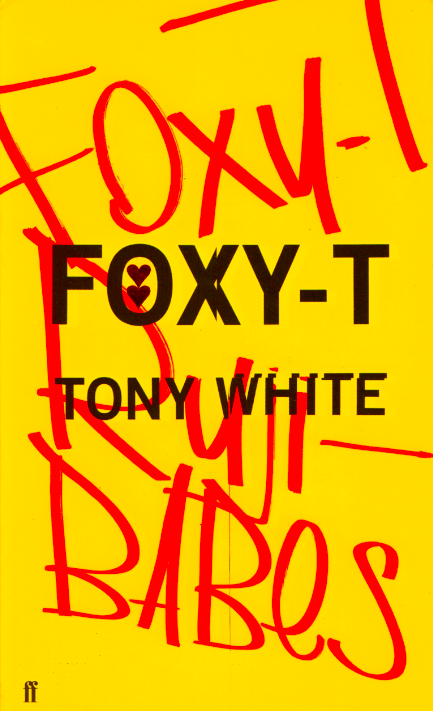
Hello. If you are coming to my site because you have ‘liked’, shared, tweeted or retweeted my photo of Uxbridge’s newest cafe in the past day or so — or seen it in the various newspapers (e.g. Metro, The Mirror) and other websites where the photo has been posted — then I think you might also enjoy my London novel Foxy-T, which is published by Faber and Faber ;-)
Foxy-T is also set in a small shop — the E-Z Call, a fictional internet shop in Whitechapel, London, rather than a tea shop in Uxbridge. Author and critic Toby Litt described Foxy-T as his ‘favourite British novel from the past ten years’. Here’s what else he said:
Foxy T is mostly set in the E-Z Call shop on Cannon Street Road. It’s written in a style that I can only describe as 100% Pure London, meaning a mix of here, there and everywhere. It tells the story of Foxy-T and Ruji-Babes, two very streetwise girls who are not without their troubles. Although not a big book in terms of length, Foxy-T encapsulates an astonishing amount of now – and it does it funnily, honestly, sexily and tenderly. Toby Litt, Guardian
I’ve been amazed by the response to the photo that I tweeted of this little Uxbridge tea shop (maybe I will share some of the incredible stats here another time). I am delighted to know that I wasn’t the only one who did a double take. That is what makes me think that if you ‘liked’ The W*nky Teapot, then you’ll LOVE Foxy-T.
Liliane performed readings from her epic, feminist prose poem Crossing Map, as well as from unpublished earlier drafts of Crossing Map, when it had been a significantly less autobiographical prose work, a science fiction novel in typed manuscript, which had had the working title of Time Zone. Sarah Nicol-Seldon of Resonance 104.4FM was manipulating some incredible voice effects and delay on Liliane’s voice during the Crossing Map readings.
I read the opening chapter from my satirical 1999 police novel CHARLIEUNCLENORFOLKTANGO, which with its policeman narrator’s incessantly prurient and circular self-justification and its violent imagery sets the tone for the rest of the novel. This opening chapter had originally been written as a short story, and was designed to work as a live reading as well as on the page. It is of course a kind of Burroughsian ‘routine’, playing power and its contradictions for laughs.
We talked about Liliane’s early 1960s meetings with Burroughs, and about science fiction, cut-ups and collaboration. My second reading was A Porky Prime Cut, which I performed with an incredible musical accompaniment from Richard Norris of The Grid.
A Porky Prime Cut is a kind of shaggy dog story about acid house, art school and a war of attrition between Throbbing Gristle fans and Soul Boys in early 1980s Bournemouth and Poole, so performing it with Richard — who is a true UK acid house pioneer — seems to bring the whole story full circle. We have performed A Porky Prime Cut once before, for the Free University of Glastonbury in 2011, and there is a studio version of it on my SoundCloud, but hearing it live is the thing. Even though I was concentrating on giving my reading, I was aware of the incredible soundscapes that Richard was mixing live across the composition.
There was a very responsive audience at the October Gallery for our event, and chatting to people over a glass of wine afterwards there was great feedback, including for our considered emphasis on readings. Increasingly the default position at many literary events and festivals is towards panel conversations, to discussions about literature, or more usually, about common denominator issues that may or may not unite a number of authors (and/or, ideally, it would seem, faces from TV). Liliane and I decided to go the other way, and to tip the balance of the event towards readings, to the literature itself. It is interesting to note that when most of the material that Liliane and I were reading from is either no longer or (in the case of Time Zone) was never available in print, one is drawn back to another kind of primary encounter: performance.
Cover of the first issue of Performance Magazine.
The event might have been called ‘Minutes To Go…’, but then all of a sudden the event has happened, and it’s gone. I am reminded of the old line about the only people a performance exists for (and I’m talking about ‘performance art’ here) being the ones who are there. Performance Magazine founder Rob La Frenais used to add to this, saying, IIRC, that there were three kinds of audience for a performance: the ones who were there, the ones who read about it, and the ones who only hear some inevitably garbled version of what happened. Apologies to Rob as I have almost certainly misremembered his formulation, but I think we can now add a further audience: those who hear a good audio recording. Luckily for us, Sarah Nicol-Seldon took a line off the mixing desk, so the gig was recorded, and the life of some otherwise fleeting aspects of the event can be extended. Swedish radio came along and recorded it, too.
Much of my reading from CHARLIEUNCLENORFOLKTANGO might need to be bleeped out for broadcast in the UK, but Swedish radio said it won’t be a problem.
My short story anthology britpulp! was published by Sceptre in 1999, and is published as an ebook for the first time today.
britpulp! features stories from (in order of appearance) Michael Moorcock, Ted Lewis, Richard Allen, Victor Headley, Nicholas Blincoe, Catherine Johnson, Roy A. Bayfield, Steve Aylett, Stella Duffy, Simon Lewis, J.J. Connolly, Jane Graham, Karline Smith, Tim Etchells, Stewart Home, Jenny Valentish (née Knight), Billy Childish, Darren Francis, China Miéville, Steve Beard, me, and Jack Trevor Story.
First time around, Iain Sinclair gave us an advance quote for the cover which was inevitably cut down to a sentence or so. Looking through my papers recently, I found his original letter, which gives a great sense of the book:
britpulp!is urban, nervy, agressive. Fast-twitch prose that fizzes and spits. Narrative with a kick. Jump-cuts that hurt like a knuckle in the eye. Here are the improper (and therefore reliable) tales of the city — most of them Hackney. Here are stars who glory in their anonymity. Here too, in Michael Moorcock, Ted Lewis and Jack Trevor Story, are the best of the reforgotten (they’ve never gone away, although it has taken someone with Tony White’s sharp eye for history to acknowledge a proper debt). Pulp has always been a secret. Read by millions, remembered by few. There is no room for prima donnas in a world where gaudy-covered shockers have the lifespan of a fruitfly. There is only one rule: keep the pages turning. Get your retaliation in early, and often. Let this book read you.
In August 2014 I was lucky enough to have been invited to take part in Remote Performances, a series of live commissions for radio, that was put together by London Fieldworks in association with Resonance 104.4fm. Many of the works were broadcast from Outlandia, an incredible tree-house artists’ studio that London Fieldworks had built high in the larch forest that overlooks the Ben, in Glen Nevis. The radio studio (every part of which had needed to be lugged up a steep mountain path by the Resonance crew) was powered by two silent, hydrogen power cells, each no bigger than shoe-box.
Here is the audio, as a lowish-res MP3 for accessibility.
As ever, please feel free to download the file in order to play it on your own device. (If you use a Firefox browser, try using the Download Helper add-on).
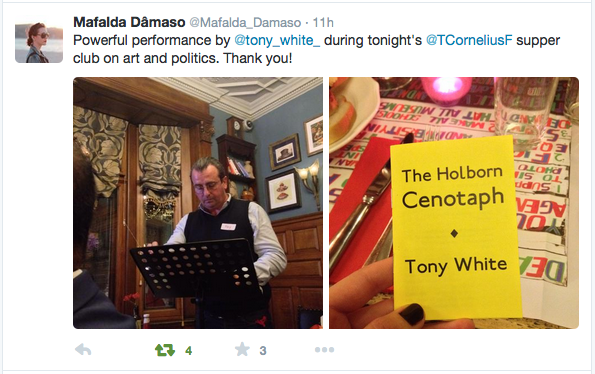
‘High-Lands’ also draws on my current loose research collaboration with the artist Stuart Brisley, which has been funded by CreativeWorks London through a residency at King’s College London. Together with ‘The Holborn Cenotaph’, it is one of two short stories intended as prototypes or test-pieces, after a method adopted by the French poet Louis Aragon in writing his novel about Henri Matisse: ‘a kind of trial approach to my theme, a marginal commentary on [his] method, in order to justify the liberty taken with my subject, my own variations, the sort of detachment I aimed at.’
I recently found this old flyer from 1997, for a gig that I did at Christopher Hewitt’s brilliant but short-lived Hollywood Leather, a performance art space in the basement of a former leather-goods workshop on Sclater Street off Brick Lane in London. (I also found a VHS of the gig, which I will convert and put up here anon.) This was shortly before publication of my first novel Road Rage!, and the first half of the gig revolved around that. At that time I had been finishing the manuscript of what would become my novel CHARLIEUNCLENORFOLKTANGO, so the prospect of doing something at Hollywood Leather prompted me to think about testing that out on a live audience, and how it might be performed. The repetitive and stylised nature of the text, and the way that parts of it were written as exhaustive set-pieces — Burroughsian ‘routines’, playing power and its contradictions for laughs — made me think that it might also suit a musical accompaniment.
The three policemen in CHARLIEUNCLENORFOLKTANGO had first made a brief-but-promising (to me) appearance in an unpublished sequel to Road Rage! that had left me wanting to explore them further, so when Stewart Home asked me for a short story for his then planned Suspect Device anthology I knew what I was going to do. This was in the mid-1990s, during the period leading up to publication of the Macpherson Report, and the novel — or its opening chapter at least — emerged in response to the idea of an alienated police force that appeared (and still appears) to be locked into a cycle of violence (institutional or otherwise) and near-demented-seeming self-justification. The story never made it into Stewart’s anthology, but by that time it had grown into a novel, and one that was being written frenetically, in long-hand, where-ever I happened to be.
Thinking about the Hollywood Leather gig, I approached the musician and composer Jamie Telford to see if he might be interested in doing something with me. As well as being a classically trained composer, Jamie has incredible pop ‘chops’. He used to play Hammond Organ for The Jam. Lucky for me he put all of that experience at my disposal, and was happy to give it a go. For that first gig and the many that followed, he would accompany the reading in the way — it seemed to me — that a pianist might have accompanied a silent movie: improvising to follow the action.
Recently the musician Peter Lanceley, with whom I was working on a piece for radio as part of 2014’s Remote Performances project, asked how collaborating with musicians had become part of what I do. To him it seemed unusual for a writer to work that way. Well, that gig with Jamie at Hollywood Leather was certainly the start of it for me, but actually the roots of the practice almost certainly go back further than that: to formative years listening to Patti Smith, going to Laurie Anderson performances and listening to Michael Moorcock and Hawkwind’s ‘Sonic Attack’. Or listening to the great records that writer and artist Joolz Denby did with Jah Wobble back in the early 1980s, which came out of the spoken word and ranting poetry scene of the time. CHARLIEUNCLENORFOLKTANGO pretty obviously connects with the ranting scene too, which may be why the late, great Steven Wells loved it so much.
Here is one of those Joolz records (and I still have the 12″ single of this — it is the B-side of ‘The Kiss’ — and FYI those singles are now available on a new compilation: Joolz 1983-1985).
I will also be reading my short story ‘A Porky Prime Cut’, and this time with live musical accompaniment from UK Acid House pioneer Richard Norris. ‘A Porky Prime Cut’ is a story about Acid House and art school, about a strange war of attrition between some Throbbing Gristle fans and soul boys in the Bournemouth of the early ’80s. We have done this live once before, for the Free University of Glastonbury, so it will be great fun to do it again. The studio version of ‘A Porky Prime Cut’ is on my SoundCloud. Of all the pieces that I have done with musicians over the years, this one seems to have the most in common with those great Joolz records, perhaps because the story is set at that time — or on a vector between now and then.
CHARLIEUNCLENORFOLKTANGO was published in a beautiful paperback edition a couple of years after that Hollywood Leather gig by the former Brighton-based publisher Codex, whose roster at the time included Billy Childish, Stewart Home, Kathy Acker, Steve Aylett, Jeff Noon, Martin Millar and many more; great company for my bunch of lunatic policemen in a van. Very sadly, Codex folded soon after CHARLIEUNCLE… was published, so the book has been out of print for a while. Unfortunately, bad behaviour by the police never seems to go out of fashion, so I still occasionally get asked to read from the novel at gigs.
This video is of one such reading from 2012, at London’s Horse Hospital as part of an event to commemorate the 30th anniversary of 1982’s legendary Final Academy. This was shot on a phone by the poets Paul Hawkins and Sarer Scotthorne who happened to be sitting in the front row. The reading was pretty rough and ready, too — no musical accompaniment this time — but it was my second gig of the day: I’d just got off the train back from giving a lunchtime reading/Q&A at the Durham Literature Festival.
§
Liliane Lijn and Tony White: Readings and Conversation at October Gallery, 17 January 2015
You must be logged in to post a comment.