Art and science at the Beat Hotel

Download PDF here

‘The language of invisible worlds’ is an essay by the artist Liliane Lijn that I published for the Arts Council where I used to work, following her residency at the Space Sciences Laboratory at UC Berkeley. That residency was supported at this (UK) end with money from the Arts Council’s former International Artist Fellowship programme, by the Leonardo Network via the endlessly energetic and charismatic Roger Malina, and by colleagues at the Space Sciences Laboratory itself.

The collaboration is summarised on the Leonardo website, and some really excellent work came out of the project, for Liliane Lijn as well as for Semiconductor and Joanna Griffin whose respective residencies followed.

Publication of ‘…invisible worlds’ was a no-budget affair and at that time in 2006 the Arts Council had entered what felt like a strange and stifling period of restructure. Undaunted, we borrowed a horrible old corporate newsletter template and published this, quietly. For some reason only one person in the building at that time had a machine which could write PDFs, and somehow that person managed to add a strange little properties page at the end which tells us that I published this on 9 May 2006 after a total editing time of 40 minutes. As if.

I’m glad that we did find a way to publish this though, as it really is an unusual and lovely piece of writing. Liliane first positions herself and the work she was beginning at the Space Sciences Laboratory in relation to friendships with sculptor Takis and the Beats in the Paris of 1961, where she ‘began to work independently as an artist’. There is some beautifully evocative material about the Beat Hotel and Sinclair Beiles, and on page 2 a description of the art works that Liliane was making at the time, which so perfectly anticipate the fictional Bartlebooth’s defining project in George Perec’s novel La Vie mode d’emploi (translated as Life a User’s Manual), that it is tantalising to wonder if Perec may have seen them. Liliane writes:

I was working on puzzles. I would buy a jigsaw puzzle, take it apart, paint each piece separately to erase all clues as to how to connect them and then try to put the puzzle together again.

As the essay continues Liliane describes a series of events and meetings with poets, scientists and visionaries including most memorably (for me) Jaron Lanier, each of which continually echo and reframe those early explorations.

Liliane’s work at the Space Sciences Laboratory continues to generate new works including the wonderful Solar Hills project.

Because other web resources relating to those artist residencies at SSL are no longer live, and the longer term status of the webpage where this PDF was once available as a free download is not certain, Liliane and I both felt that it would be a good idea to make it available again now.

Foxy-T archive #2

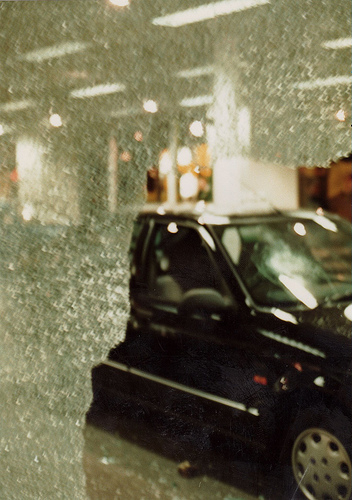
Having posted about my novel Foxy-T (Faber and Faber, 2003) being included on the Book Club Quilt recently, I just found this excellent photo by my old friend Daniel Wootton of the former Telecall International shop on the east side of Cannon Street Road, London E1, up towards the junction with Commercial Road; the street and general area, if not quite the precise building, where the novel is set.

© Daniel Wootton, 2004

Telecall International didn’t exist when I started to write Foxy-T, but it was there by the time the book was published. This photo was taken a couple of years later and cropped for the cover of the Croatian translation.

Part of what inspired Foxy-T was a chance confluence of two events around the turn of the century. One was the closure of a minicab office called Megna Cars on Cannon Street Road, which prompted the immediate observation that it was almost impossible at that time to predict whether this newly-vacant commercial space would be occupied by a high-spec commercial art gallery or by an internet shop. The other chance event was the adoption for a few weeks of the stairwell of my building by a bunch of GCSE students from Mulberry Girls School on Bigland Street, who would habitually smoke B&H there on the way to school and ‘tag’ their names, but in neat, schoolgirl writing using blue felt tip pens.

Here is a photo that I took a few months later when I realised that the graffiti in that stair well was being painted over. Sorry about the poor quality of this image, the only camera I had to hand was a decade-old disposable with a few unused shots; the important thing was to document this before it disappeared.

© Tony White, 2010

The photo shows lovely neat kind-of-tags (all in one hand) of Ruji, Lima, Jaz, Naz, Maz and Tera of the Brick Lane Massive, and Kay of C.S. (i.e. Cannon Street), illustrating nicely the derivation of one of my characters’ names: Ruji-Babes.

In fact, the old Megna Cars office became neither gallery nor internet shop, and although the street-level shop space re-opened for a short time in the months after 11 September 2001 as an Islamic Bookshop, the three-storey, one-room-wide flat above the shop remained open to the elements for many years, until it appeared to be approaching the point where neglect might become dereliction. It was partly perhaps the fact that it was so obviously vacant that enabled me to revive the flat in fiction as the home of Foxy-T and Ruji-Babes. In the real world pigeons would be fluttering in and out of its broken windows whenever I passed.

Telecall International, the shop which appears in Dan’s gorgeous photo at the top of this post was located at 166 Cannon Street Road, in what had previously been a sari shop. More recently, when the Googlemaps Streetview images were shot, it had transformed again to become ‘BMT’ with a sign that reads MONEY TRANSFER and TEL SERVICE, and with A4 printouts taped to the inside of the window promising NEXT DAY DELIVERY.

If you bounce a click or two north (left) on Streetview, you can clearly see the former Megna Cars office at 174 Cannon Street Road where Foxy-T was set (it is mistagged on Streetview as number 172, and the area incorrectly described as ‘Poplar’), but the building has now been rechristened as Megna House. Here is a screengrab.

I wonder if to judge by the Western Union stickers above the roll-up security shutter and by the Payphone and Topup sign to the left of the door the old place may finally have become some kind of internet shop. I haven’t walked down Cannon Street Road for a while, so at time of writing I can’t tell for certain. If anyone happens to pass that way before I do next, please let me know. The man standing in the doorway of Megna House is not, I don’t think, the same man who is standing in the doorway of Telecall International in Daniel Wootton’s photograph taken those few years ago.

Tilting the ‘view’ upwards after taking that screengrab, I was pleased to see some changes to the upstairs flat where Foxy-T and Ruji-Babes ‘lived’ above their fictional ‘E-Z Call Telephone and Internet’. When the Streetview images were taken, the flat was in the process of being refurbished. Have a look. There are new panes of glass (complete with safety stickers) clearly visible in all of the newly-white-painted sash windows. For some reason this makes me happy.

There are various reviews and other kinds of coverage of Foxy-T online by e.g. Michael Moorcock, Toby Litt, Sarfraz Manzoor, Sukhdev Sandhu, Boyd Tonkin and others.

Foxy-T is available from Amazon of course, but if you want to support a diverse book trade do consider buying Foxy-T and other titles from your local independent bookshop, or from the Book Depository here where it is currently available for 34% off the RRP.

London, I: an interview with Iain Sinclair

Who would be the companion of choice, I wondered – back in February 2000 – for a press freebie on the London Eye? An archive interview with Iain Sinclair from issue 26 of the Idler magazine, which has never been available online until now.

I arrive slightly early outside County Hall on the south bank of the Thames next to Westminster Bridge. It’s sunny, but roll-ups are impossible in this wind, and the coffee shop concessions on the newly paved section of Jubilee Gardens at the foot of the wheel – sorry, at the foot of the British Airways London Eye – are still under construction. Like the saloon bars and livery stables of a western film set, they’re all frontage and signage. Glassless windows. No coffee, then.

Iain Sinclair reading at Destination London, UCL, 2009, photo © Tony White

Looking up at the vast weight of steel above me, I feel slightly sick – pre-emptive vertigo – but I grin and bear it because what brought me here was a flash of inspiration that’s worth suffering the odd stomach churning dizzy-spell for. Who would be the tour-guide of choice, I wondered, for a press freebie on the London Eye? Why not Iain Sinclair, the novelist, satirist and psychogeographer who’s taken his occult-obsessive explorations of the Capital into the best seller lists. He hadn’t, I discovered, been up on it yet. So I made him an offer he couldn’t refuse.

Sinclair (and for some reason I’m sticking to the surname protocol that surrounds him like an aura) arrives bang on time. A wave in the crowd and there he is; taller than I’d remembered, big black waxed coat (1), bag slung over the shoulder. He looks around. ‘Fabulous day. You managed to blag it, then?’ he asks, gum stretched between teeth and tongue. He’d relocated his meeting about a ‘Shakespeare’s London’ radio documentary to the South Bank so he could stroll along the embankment for this.

‘Shakespeare’s London?’ I ask, ‘Curtain Road, Southwark, coaching inns?’

‘Yes, a chance to wander around, talking to people!’

I draw out an anecdote about the artist Jo Joelson of London Fieldworks,  and tell Sinclair about her lighting design work in Tokyo last year on an indoor replica of London’s own replica Globe Theatre.

‘Artificial London light? Didn’t realise until I started working with Marc (2) how many different kinds of London light there are. There’s the dull grey that everyone expects, but that can change spectacularly in seconds. London’s prey to all these wildly contrasting micro-climates at any one time. The weather can just sweep in and suddenly bathe everything in clear light. Like it is now, and then, just as suddenly, it’s gone. Something else entirely. Since I’ve been doing the M25 work I think that Heathrow has an effect too. Must have. All those jets constantly coming in. It’s like they create their own weather: a kind of Ballardian microcosm.’ He looks up at the wheel. ‘Should see a fair bit of it from up there.’

I mention the work that Sinclair did in his novel Radon Daughters on Luke Howard (3), the East End chemist who corresponded with Goethe and Constable and developed the cloud classification system that is still used today. I’d read somewhere recently that vapour trails have now joined cumulus nimbus etc as a bona-fide cloud form.

‘Atkins,’ he says, ‘has a thing about vapour trails which form an “x”. Where two cross over. They’re everywhere. These bloody great alphabetic signs in the sky.’ We’re due to rendezvous with Atkins any time now. He’s going to do our pictures today. I’m keeping an eye out for him but am unsure if I’ll recognise him. ‘Don’t worry,’ Sinclair says, ‘You won’t miss him, he’s about six foot eight.’ He looks at the great ferris wheel, the slowly descended capsules between us and the river. ‘Wonder how long till someone does a remake of The Third Man,’ he offers.

In fact Atkins doesn’t show, but someone does: ‘I’m Sarah. Marc can’t make it, so he asked if I could come down instead.’ The British Airways press office had taken so long to confirm our tickets that Marc had assumed the trip was off.
As we walk across the embankment and get waved through security, it starts to rain. A sudden shower that magnifies the Sun’s glare off the river in every drop. Sarah marvels at the light, gets her camera out, and Sinclair starts telling her about the Tokyo Globe. He does introduce it as my story, to be fair. The press officer looks as solemn as a pre-teenager at a wedding. He shakes our hand and promises to catch up with us when we get off.

‘The suit! The handshake!’ Sinclair roars, once the press officer has gone. ‘Were they tough about letting us on?’

‘The tough bit,’ I tell him, ‘was getting to speak with anybody at all. I spent the best part of the week phoning the press office at half-hourly intervals.’

‘It was the same with the Dome,’ he confirms. ‘Bloody impossible to get through. Especially once my first piece came out. Had to leave message after message after message. They only let me in, eventually, because they thought I was from the London Review of Bricks!’(4) A uniformed usher signals us out onto the platform with an almost imperceptible eyebrow movement. ‘They thought I was from some building magazine – course they let me in!’

He points at one of the capsules. ‘They look strangely sinister, don’t they? As if you’d get sealed in there and gassed or something. Then sucked out through those big vents under the seat.’

‘Have you seen the hatches on the bottom?’ I ask, pointing at the two trap doors on the underside of each of the London Eye’s capsules.

‘Yes, look,’ he says. ‘I’m sure that one was full a second ago.’

Our capsule glides slowly along next to the asphalt embarkation platform. I’m expecting us to have to break into a run, to make a leap for it at some critical moment, but boarding the Eye is more like jumping on to the running board of an oversized bubble car doing 1 mile per hour.

As the doors close behind us, Sinclair take the bag off his shoulder and squats down to retrieve his Super 8 camera.

‘Thought I may as well,’ he shrugs, switching it on and nestling the finder against one eye. He points it through the glass and fires off a burst of frames at the Palace of Westminster opposite.

‘So why has no-one else invited you up here, then?’ I ask.

‘It’s not that no-one’s asked, actually. A few people have, but I’ve been so furiously busy finishing the book (5) that I haven’t wanted to do any journalism.You’re lucky, you timed it right.’

I remember that I’m supposed to be conducting an interview. That was the original idea – how I’d swung it. Doesn’t work in practice. I’m not stupid enough to fire questions at him and stick a microphone under his nose. I’d rather just let it all sink in. ‘Let’s play this by ear,’ I suggest, ‘then meet up in a week or so when the ideas have settled a bit.’

‘Closer to home? Yes, alright.’

I look down at an oil slick spreading along the river between a string of orange pontoons and Hungerford Bridge, then turn to look west. It’s too far away to see whether he’s at home, but we know that Jeffrey Archer’s place is there, and we’re approaching penthouse-altitute. ‘Should be entering the Archersphere any second,’ I suggest.

‘That’s a good name for London. Would have been anyway. It’s amazing, you know. There was a review in the paper today – another book of some sort. Did you see it? The thing is, I think Archer only ever had enough ideas, or energy – or enough material – for maybe one book. At a pinch. But he can’t stop writing the things. I just don’t know why he’s got this compulsion to write more and more books when he’s got absolutely nothing to put in them.’

It’s probably destined to become a truism, but this wheel fucks with your sense of direction. The river seems to be spiralling around us. Chelsea’s there? I look towards what I think must be the east, but I’m way off. Canary Wharf is practically behind me. Planes for Heathrow seem to be going north.

Sinclair has the same problem: ‘Look at that insurance building, the kind of Egyptianate one, in Finsbury Square. Amazing.’

He lines up his forearm with the Telecom Tower. ‘See the Post Office Tower. Now go along three, below and to the right of that green one.’

‘Ah, so what’s that dome thing below it?’ I ask. (I notice that we’re both saying ‘above’ and ‘below’ as if we’re looking at a picture.)

‘Must be Smithfield Market. Yes it is. I’m sure of it.’

Wait a minute, I think. Then it dawns on me. ‘Christ, no, it’s the dome of the British Library Reading Room.’

‘What? Oh, hang on.’ He squats and rummages in his bag again, coming up with a pair of glasses. ‘That’s better. Yes, so that must have been the Senate Building.’

We’re not the only ones who are confused, though. At that moment the ‘stewardess’ comes over. A couple of the other passengers are asking where Buckingham Palace is. ‘Look,’ says the guide. ‘You see the river?’ (She’s not pointing at the river at all. She’s Australian, and every sentence is a question.) The couple both nod. ‘Follow the river up? You see? Follow the river up? Until you see a gold thing?’ They nod again. ‘Behind the gold thing? That’s Buckingham Palace!’
Sinclair and I exchange glances and raised eyebrows. What kind of disinformation is that? That’s not the river for God’s sake. It’s the duckpond in St James’ Park.

‘Look at that,’ Sinclair says, nodding down at Whitehall on the opposite bank of the river. ‘Vast amounts of real estate. It’s hard to visualise just how much of it they own. But up here you can see it all. It’s the best view of it I’ve ever had. See that?’ He’s pointing at the Shell Building now. ‘Used to be able to go up there. Had to pay. No point now.’

He turns and shoots another few 8mm rounds. Tracer fire invisible but implied. We’re at bomber height and Sinclair’s got Big Ben in his sights. Best view of London you’ll get without going back in time and joining the Luftwaffe. A small storm is coming in, over – what? – the Berkshire Downs? Can we see that far? It’s changed the light, though, already.

‘It’s a bit of a leap compared to the Dome, though,’ I offer. ‘You don’t have to fill it with something, because there’s all this stuff,’ I wave my hands in the general direction of outside, ‘already here.’

Sinclair starts waving his arms around too. ‘What’s great about this is that it has absolutely no agenda.(6) You can’t impose what people will see.(7) It’s up to you; completely open. And it seems that people have completely accepted this. They should have just left the Dome empty – just come and see this space, this great thing – instead of filling it with loads of tat. I haven’t been on the new Jubilee Line extension yet, but that’s part of the problem. I mean there’s no interest in building useful tube lines, the Hackney tube extension, say, and that area of London’s crying out for it, but they’ll build the Jubilee Line to make it easy for people to get to where they don’t want, or need, to go. The best thing would be if you just got off the Jubilee Line and there was a staircase up into the Dome and then you turned around and came straight back home. And London becomes a kind of pleasure dome; the Jubilee Line, sponsored by Derek Jarman! It’s going to be quite strange, because I think the whole South Bank is going to be themed up to the eyeballs with every possible delight, and then on the other side the underground is going to slip into the dark ages. It’s going to be like going back to those films where the tubes were haunted by the undead. So you’ll go down the Central Line and spend forty-five minutes in a tunnel, sweating in a cattle car, while on the other side you’re swooshed through beautiful stations going nowhere!’

He turns and shoots more footage of the Houses of Parliament as we reach the apex of our revolution. From this angle, it feels as if we’re on a rollercoaster; a curve of track above us and beyond that, the void. Sinclair looks back at the capsule behind us and laughs out loud: ‘Look! Even up here people have got to be on their mobiles: “I’m on the Eye”!’ We both laugh. ‘Bit of a terrorist target, I should think,’ he says, holstering the camera for a second. ‘Didn’t search us or anything did they.’

‘I know, since they’re calling them “flights”, you’d think they might have some of those airport scanners or something,’ I say.

Sinclair mimes frisking me with an airport metal detector. ‘Not making very much of the British Airways franchise at all, are they? We’ve got our stewardess, but you’d think they’d be handing out brochures.’

‘Giving away real flights,’ I say. ‘But they’ll get their logo in half the photo albums in the country.’ I nod at the writing across the glass windows of the capsule, then look down at the chimneys of County Hall, the former Greater London Council HQ. I’m surprised by the bland, hospitalesque architecture – it’s all white-tile atria and pre-fab flying corridors – behind the imposing façade.

‘Went in there, years ago,’ Sinclair says, following my gaze. ‘Amazing inside. Third Reichian architecture. These great, sweeping staircases. Now it’s all burgers and fish!’ We look down at the piecemeal conversions, the London Aquarium, the tourist attractions and fast food concessions that are bringing people back to this forgotten part of the river. There’s a long pause as we continue our descent – at twice the speed of the minute hand on the opposite bank. ‘Christ!’ Sinclair says eventually. ‘What are they doing to our river?’

At the exit is a booth selling computer-generated images of punters in the capsules, but it’s not staffed at the moment. Instead we both take a ‘British Airways London Eye’ mini-carrier bag from a pile on the counter.

‘A souvenir,’ I say.

‘Yes,’ says Sinclair. ‘They should give these out before you get on. Look,’ he opens it and mimes puking, ‘British Airways sick bags!’

Footnotes

  1. ‘Christ!’ he says, when I show him the photos later, ‘I look like Doctor Dee! That coat!’
  2. Marc Atkins, the photographer. Sinclair’s long-time collaborator.
  3. Radon Daughters (Granta Books, 1998) p.33 and Lights Out for the Territory (Granta Books, 1998) pp93-94. Marc Atkins appears in Radon Daughters as ‘Axel Turner’: ‘some gaunt acolyte, a ceiling-scraper … another bonehead: a Futurist whose future is all used up.’ They are still friends.
  4. Iain Sinclair, ‘Mandelson’s Pleasuredome’, London Review of Books, Vol. 19, No. 19, 2nd October 1997.
  5. The book Sinclair’s referring to is the novel Landor’s Tower, which at time of writing had not yet been published. I asked him to tell me more about it. ‘It’s a fairly complex thing,’ he says. ‘What it is, it started out to be a sequel to White Chapell Scarlet Tracings, my first novel, which is obviously set in London, and which was projected as this sort of four part work. And a lot of the same characters are in it, at earlier or later stages in their development. And it discusses ways of setting up alternative communities to living in the metropolis. Is it possible to live out in these fringes? Becaue so many groups over the years attempted to live in this one valley, where Walter Savage Landor had bought an old Augustinian priory and tried to build a kind of sanatorial estate around it, which was a total disaster. And then, a man called Father Ignatius who was a religious nutter of the Corvo type – a kind of self-invented Prelate – tried to buy it to set up his own community, and then Eric Gill and David Jones, in the 1920s, and then right through into the 1970s and these various communes. And this is quite near Hay-on-Wye, coincidentally. So the middle part of the book takes segments of this experience and slices it up with an ongoing narrative which is to do with this paranoia and conspiracy theories and someone who starts off in the first part of the book investigating these Marconi suicides in Bristol, where a whole load of Sikhs and Indians from London take off to Bristol and kill themselves in apparently strange ways. There’s twenty-seven deaths – all people who worked on these big defence contracts. But most of the Indians who went out there, they tried to say they were part of some kind of cult. One guy jumps off Clifton Suspension Bridge; one man ties a rope around his neck and ties it to a tree and then drives off, puts the car into automatic and strangles himself; one fills the back of the car up with petrol and bangs into the wall of a Happy Eater restaurant. It’s like 1970s TV, like it’s come out of some strange paranoid TV programme. And then the English people all seemed to be S&M victims supposedly. And killed themselves that way when they started to go mad. And the whole thing builds up, incredibly. There’s a book called Open Verdict by a guy called Tony Collins. I mean it’s unbelievable. Well, anyway this one character starts to chase this story to the West Country and he sees that so many of the cases that he’s previously been interested in, in London, with time they kind of filter out west. So the first part of the book is a series of fragmentary journeys west that never get to the community. Theoretically, he, the narrator, is trying to write a novel, gather material for a novel about this collapsed utopian community, but actually never gets anywhere near it because he keeps getting deranged because of this other stuff on the road to Bristol. And by the second part of the book the narrator has been fitted up for one of these murders, and he’ in a kind of asylum, etcetera, etcetera. And eventually kind of ten or twelve different narratives do come together. And this is twelve years… I mean. I hadn’t written anything until September 1999, so it’s been written quite quickly, but the gathering of material has been going on, I suppose, for twelve years. But in part two you get either true, bent, or adulterated autobiography, because I grew up in South Wales, a bit further on. And little bits of this are seeded through the book. In the final section that becomes more important. But all of these fantatic secret state contracts which all sort of went down to Bristol and all the listening stations in Cheltenham  and all of that. There’s quite a lot of weirdness out there. And by the same token, people who’d been writing about dubious, gothic crime in London – the Jack the Ripper murders and so on – also shot out to the same part of the world. People like Dan Farson and Colin Wilson. And Jeremy Thorpe plays quite a big part in the book. There’s that comic-tragic killing of the dog on the hill, and hiring the people to do it. They were the most outrageous bunch – a lot of them from South Wales. They guys from like carpet warehouses and slot machine arcades get woven up with big cheeses in Liberal politics. It’s an unholy stew of a wonderful kind. And all these trails get charged after by all these people who may themselves be deranged. And one of the characters keeps sending these tapes back, he just records strange accounts of these versions of this at night, and it’s like Donal Crowhurst – you don’t know if at some point he’s given up on the real investigation, he’s just making it up off the top of his head while he sits in a boarding house in Minehead. Like so many of these pulpy conspiracy books it’s all just hideously recycled. Anyway that’s the basic pitch of the book. What’s really nice about this, this other strange element about the book, is that numerous key points in the book are also key points in the film (Asylum, or the Final Commision, a film about Michael Moorcock directed by Sinclair and Chris Petit for Channel 4), but with a totally different meaning. In that Mike Moorcock criss-crosses through the book, and the poet Ed Dorn giving a reading in Bristol just before he dies, and that’s in the film and the book. You hear a different part of it, so it’s like alternative worlds: the same elements are there but they mean something else entirely, and characters have the same names. So these two versions of the story, which go in absolutely opposite directions, exist at the same time. The film is part of the book – and vice versa.
  6. Sinclair expands on this when we meet again at his home in Hackney. ‘Well it’s pushing a really low-key idea. I mean it is Blackpool from the 1940s or 1950s. It’s a miners’ outing! But the grotesque thing is that it’s been placed in this piece of real estate that supposedly represents every American tourist’s vision of London. It’s just the Houses of Parliament, the river, and now you’ve got this gigantic bicycle wheel which is the highest thing you can come up with; to be spun around on some nebulous tour, with a couple of “ooh-ah” moments. But because it’s not actually, actively, bad, we’ve all said it’s wonderful. But I don’t think it is actually that wonderful; it’s pretty banal, but it just isn’t actually tragically awful or a total scam, in that they’re actually paying for it themselves. This is an airline doing this. An airline with a bad press, to say the least – offering you flights to nowhere. So it’s the equivalent of the Gatwick Airport experience of being on one of those shuttles that go backwards and forwards, but without the horror of the flight at the end of it. You know, you pay to wait and have a bit of a view. But really, to me, it’s no better than the train we got going out to see Mike Moorcock. We spent time laid up in Chicago airport, and there’s this shuttle service train that just goes three or four stops out past the Hilton and gives you a fabulous view of parked cars and bits of the airport, and then it comes back where it started from! And the Eye is kind of the same experience, except that you go up into the air.’
  7. ‘Be quite dramatic if it went down under the ground, I was thinking, though,’ Sinclair adds from the safety of his sofa. ‘If it actually took you down into the bowels of the Earth and the sewerage system, and you confronted the horrors and then you went up into the sky, I mean, it’s not too scary at the moment is it? I mean you, with your vertigo; you didn’t find it too unpleasant did you? No. It’d be quite good if people were having full-blown panic attacks, pressed up against the window screaming as it went around… You could sit in one of the other capsules and watch people freaking out above you. It’s all very calm. Bit too calm. I mean, I don’t think it’s got piped music yet, but you get the feeling that it may come to that.’

‘London, I: an interview with Iain Sinclair’, © Tony White, 2000. First published in the Idler issue 26, London, 2000.

Better than any review: Spring Snow – A Translation

Spring Snow - A Translation, by Alison Turnbull

Spring Snow – A Translation, is a beautiful aritst’s book by contemporary visual artist Alison Turnbull, which was published by Book Works in 2002. Here’s the blurb from the Book Works online catalogue.

‘Alison Turnbull takes Japanese author Yukio Mishima’s novel Spring Snow as a starting point to produce Spring Snow – A Translation, which is literally a visual translation ordered by colour. Drawing on Mishima’s evocative use of colour in the novel, Turnbull condenses the narrative into a colour palette. Working from the English edition, she isolates and orders each of the more than six hundred colours as they appear in the text – what emerges is a visual essay on the nature of translation.’

I wrote a short work of fiction ‘Spring Snow: Mukashi-Banashi’ for the book’s introduction, using cut-ups from Timothy Lea’s Confessions of a Private Soldier and peripheral texts from Lafcadio Hearn’s Kotto: Being Japanese Curios, with Sundry Cobwebs, as well as information about dock strikes in London and Japan in 1896 and 1997 respectively. In this story the narrator, ‘Tony White,’ asks whether, ‘leaders are forged in the crucible of circumstance or whether they emerge from youth fully formed and are themselves the blacksmiths [… In] another time, in different circumstances,’ the story continues, ‘who could say whether Kimitake Hiraoka’s pride and zeal might not have been warped beyond recognition. Instead of a mighty figure on the stage of worker liberation, he might have become […] a swooning fascist.’

In my story Alison Turnbull herself is also recast as an acolyte and contemporary of this parallel universe Mishima. She sends a portfolio of her colour translation of Spring Snow to ‘Tony White’ after their fateful meeting on a train out of Yokohama in 1929, and maintains ‘a fitful correspondence’ with the narrator until her death in 1973. The story ends with the reflection that, ‘it must indeed be gratifying to the publisher to bring it back into print for a new generation that is making its own discovery of Japan.’

Better than any review, some pleasing ripples in the multiverse resulted from the publication of this book; some responding to the gravitational tug of fiction, others to the pull of non-fiction.

Firstly, a couple of writer friends who read Spring Snow – A Translation assumed that the entire project was the fiction, not just my short introduction. They thought that I had not only created that text and this book, but also therefore the character and oeuvre of Alison Turnbull.

Conversely, when searching the British Library‘s catalogue to send information about Spring Snow – A Translation to a reader and colleague who had requested it, I discovered that rather delightfully the British Library have attributed authorship of Spring Snow – A Translation to the fictional ‘Alison Turnbull’ described in my story, who ‘died’ in 1973, rather than to the real Alison Turnbull who is very much alive and represented by Matt’s Gallery, London. Here is a screen-grab of the British Library catalogue record for the book.

British Library catalogue entry for Spring Snow - A Translation, by Alison Turnbull

You can buy Spring Snow – A Translation by the real Alison Turnbull from Book Works online shop here.

Link to an interview with Miljenko Jergović

I wanted to quickly link to a really good and very short interview with Miljenko Jergović on Hungarian Literature Online which I picked up via Maud Newton’s blog.

Miljenko was born in Sarajevo in 1966 and now lives and works in Zagreb. The introduction to the interview notes that readers of Croatian daily Jutarnji List have voted Miljenko the best Croatian writer of the decade. The excellent Words Without Borders writes that his work ‘has been translated extensively throughout the world’, though unfortunately for us Anglophones hardly any of it into English.

There is one short story collection available in English translation, Sarajevo Marlboro. Also, a great story by Miljenko Jergović entitled ‘Araby’ opens the Croatian Nights (Serpent’s Tail, 2005) anthology that I co-edited with Borivoj Radaković and Matt Thorne, and which was published simultaneously in Croatian Translation as Hrvatski Noći (VBZ, 2005).

You can buy Croatian Nights from The Book Depository here.

Croatian Nights, Serpent's Tail 2005

Piece of Paper Press: London and Sydney

Cover shots done for Barbara Campbell’s News Haiku, POPP.024, and my own London Palm, POPP.025. These editions were published and launched simultaneously at an informal event at Riverside Studios bar on 29 November 2009, and at an event in the new Performance Space Clubhouse, Sydney, NSW Australia on 12 February 2010.

News Haiku was written and produced during Camp- bell’s recent visit to the UK and here is the short explanatory statement that she wrote for the press release.

‘While I’ve been in London this autumn, I’ve been searching the Guardian and Observer for buried haiku. The task requires a soft-focus reading. It can take a while to find these signs of the eternal now amongst news of the only-just-happened. Like a poetic code, the five and seven syllable runs of text are dispersed throughout the paper; from items on climate change, local floods, meteor showers, EU and M&S appointments, to what’s on the TV or what to buy your dad for Christmas. I shake the lines free of newsprint, reassemble them into their 5-7-5 haiku formulation, punch them out again with a Dymo labeller and give them to you here for further deciphering.’

London Palm comprises short notes that I wrote to present at a symposium to mark the 1000th night of Campbell’s 1001 nights cast. That symposium was at Performance Space in Sydney, so it was particularly fitting to do the launch of these titles there. I was only sorry that I couldn’t be there this time.

I have a small number of spare copies of both books (which reconciles the print runs we’d given away in UK and Australia) and I’ll make five sets (one copy of News Haiku and one copy of London Palm) available to the first five people to comment here. No rush.

Rapid prototyping: stories for EPUB

At the end of 2009 I collaborated with James Bridle to publish three new short stories in the EPUB format via James’s new electronic publishing project www.artistsebooks.org

Include Me Out, artistsebooks 2009

I discussed these in my presen- tation at the London Libraries Ebook Market- place Seminar at Swiss Cottage Library on Monday 22nd February. It was an interesting event, with librarians and colleagues from publishers and suppliers including Bloomsbury, Exact Editions, Credo, WF Howes, BBC Audiobooks etc.

I’d also read from one of the stories ‘Include Me Out’ a couple of days earlier at Matt Lock’s The Story conference (yes I know, I liked the ‘DePo Masthead’ theme Matt used for The Story’s blog) at Conway Hall on 19 February 2010. So I thought I’d link to them here, now, too.

These ebooks were funded by the Leverhulme Trust. The stories are part of my Balkanising Bloomsbury series and are an outcome of a residency that I’d had at the UCL School of Slavonic and East European Studies (SSEES) which was supported by the Leverhulme Trust. They were published as part of a mini-festival that I co-directed with Dr Wendy Bracewell at SSEES, called Destination London.

I was delighted to work with James as I’ve been following his booktwo blog for a while where he has been exploring the future of publishing with more intelligence than most. In other words he has avoided many of the platitudes, received wisdoms and knee-jerk angsting about piracy etc, that often bedevils serious discussion of the subject. See Mssv take apart some howlers in Jason Epstein’s piece in the current NYRB. And sorry but I’m worried by Danuta Kean’s uncritical embrace of Peter Mandelson’s ‘three strikes’ proposal to deny web access without trial for unspecified periods of time and at ministerial discretion; ‘three strikes’ is frankly more alarming than the supposed problem, i.e. the cure is more damaging than the disease.

I’m not trying to say anything new by noting that most artists and writers operate in a mixed economy where they make pragmatic decisions about giving stuff away all the time. Some we all know have been making a positive virtue of the fact for years. Others actively make work about the law, copyright or issues like piracy; work that involves testing the boundaries of such concepts – I may come back to this in another blog. Quite prosaically, too, though, most of the published writers I know have given stories away or written stories that were always designed to be free, to be out there, with motivations ranging from wanting to take part in a great project like Barbara Campbell’s 1001 nights cast to my giving a story to 3am Magazine because I liked what they were doing. Conversely every writer knows (from experience) that there are well-known magazines that promise to pay but never do.

I’ve been convinced of the value of giving stuff away for ages though. It’s what I’ve been doing with Piece of Paper Press since the early 1990s. I was also involved in the groundbreaking CODE conference nearly ten years ago, commissioning a series of accompanying essays from Matt Locke, Stewart Home, Joe Banks of Disinformation, Steve Beard and others, back in the days when James Boyle, Lawrence Lessig and co were discussing and sharing the conceptual groundwork for Creative Commons, which I have now used to licence these latest EPUB stories. Those CODE essays were published in an early version of the Diffusion eBook developed by Proboscis, which I’ve also used for some other stories in this series. I’ll link to those another time.

I’d been wanting to do something with the EPUB format for a while. I liked the sound of it because it is nonproprietory and doesn’t tie you to a particular device or OS;  because it offers a way to publish things for free; because I saw people I knew, people who read books, wandering around with iPhones that had great ebook reading capability but not much to read on them; and because it’s important as a writer to actually experiment and see what this stuff can do.

So that’s what these are; an experiment. When I was writer in residence at the Science Museum, London in summer 2008, Hannah Redler who directs Science Museum Arts Projects, borrowed some engineering jargon to described such experiments as ‘rapid prototyping’, which is a good way of putting it. At that time I was working with the Museum looking for a way to publish a short story ‘Albertopolis Disparu’ that I’d given them (non-exclusively) as an outcome of my short residency there in summer 2008. Another experiment.

Albertopolis Disparu, A Science Museum Booklet 2009

Plans for a print edition of ‘Albertopolis Disparu’ centred around our revival of their grand old ‘shilling monograph’ imprint A Science Museum Booklet, which I’d discovered in the archive. (Note for geeks: our design also mirrored exactly the format of the Aloes Books chapbook edition of the Thomas Pynchon short story ‘Low-Lands’.) The Museum workshops built a specially-commissioned display that was to be sited outside the lifts on the first floor. They gave away thousands of them. ‘Albertopolis Disparu’ also, I was delighted to hear, passed the ‘litter test’ that generally applies to free print that is given away in those vast halls: they didn’t find any copies of the book discarded in the stair wells. Copies of ‘Albertopolis Disparu’ were also available free to cab drivers from the Cabmen’s Shelter on Thurloe Place in South Ken, reviving the old tradition whereby local publishers gave free books and newspapers to the Shelters.

We also wanted to make ‘Albertopolis…’ available free online, and to publish some great stories that had been produced by participants including Sophie Hope and Al Robertson in a free writing workshop that I ran at the museum in 2008. However at this time in early 2009 EPUB still hadn’t had its possibly iPhone-driven ‘VHS moment’, so we had to resort to using downloadable PDFs on my residency webpage. So this was all still very much in keeping with the unspoken ‘free as in freedom AND free as in free beer’ ethos that (with apologies to the free software movement) I’d adopted for my residency, but felt a bit clunky and outdated. If we’d had EPUB then it would have been great.

A matter of months later, though, and James and I met up for coffee at Maison Bertaux and plotted using EPUB for these Balkanising Bloomsbury stories out of my Leverhulme Trust residency at SSEES. We got talking about artists books and giving stuff away, and it kind of synched up with what he was thinking about for artistsebooks.org

So three new short stories, free to download. They are a kind of rapid prototyping experiment in EPUB. I’m including them in my live events at the moment, and all of them are also available in print formats e.g. here. These EPUB versions should work with iphone, ipodtouch, android, BeBook, Nook, Stanza, eBookPro, SonyReader and Aldiko etc. Comments and feedback are positively encouraged by James and artistsebooks.org and more titles are in the pipeline so it’s definitely worth bookmarking http://www.artistsebooks.org

The stories are:

Bring Me Sunshine

How We Made ‘An American Legend’ Part 1

Include Me Out

Foxy-T on the book club quilt

Ginny sent news that the front cover of the first edition of my novel Foxy-T (Faber and Faber, 2003) is to be included in her book club quilt. Thank you Ginny, this made my month. I will find out more about this anon but I think that the idea of a ‘book club quilt’ is fairly self-explanatory. It is also completely brilliant; such a great idea.

Ginny’s book club has been going for a while now and they’ve read a lot of books, so I’m really honoured that Foxy-T is included. It’s also a particularly nice cover, which was designed by Jonathan Gray of gray318 – who at the time was being justly celebrated for the cover he did for Jonathan Safran Foer’s novel Everything is Illuminated.

Ginny sent this jpeg of the  patch, which I love. It is currently unhemmed. I will ask Ginny to send another few images as the book club quilt nears completion (though I have no idea how many weeks, months or years away that might be).