Sometimes only art will do — a particular book, picture, poem, piece of music. Some people I know can read a book once and then get rid of it, but I never know when I’ll need to go back and look something up.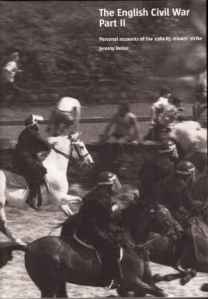
So it was on the evening of Thursday 9 December 2010. Aghast and increasingly anxious at events unfolding in Westminster, both in Parliament and outside where I knew many friends and colleagues were legitimately protesting against the insultingly perfunctory debate on a transformation of higher education the impact of which can scarcely be guessed at but which will likely be felt by many people for many years, I began scouring the shelves for a particular title, but couldn’t find it by the light of the lamp. I looked again this morning, and found it. Here was a book which had suddenly come to mind for what felt like a whole new aptness in face of the ‘tuition fees vote’, Government ministers’ all-too-believeably crass framing of education as a selfish personal gain that is somehow stolen from the taxpayer rather than a public benefit — let alone a national one, or international — and the kind of baldly choreographed police aggression and provocation that was surely designed to produce the violence or the appearance of violence that it claimed to be a response to but that was reported as if the Battle of Orgreave had never happened. (Then, infamously, BBC News coverage reversed the chronology of footage to incorrectly show ‘shots of miners throwing stones at police before showing mounted officers charging the miners’.)
The book I’d been looking for was not artist Jeremy Deller’s The English Civil War Part II — an excellent published collection of, as the subtitle has it, ‘Personal accounts of the 1984-85 miners’ strike’, which was brought out to accompany his 2001 re-enactment of the Battle of Orgreave in Orgreave, an event which I was lucky enough to attend — but the script of the film Wetherby by David Hare. I knew it was there somewhere and I’d wanted to check a line of dialogue that I had (in fact mis-)remembered — if you’ll excuse my paraphrasing — as something like, ‘Right then, those of us who still believe in education, let’s… [something, something, something…]’
If you haven’t seen Wetherby I’d recommend it. It remains one of my favourite films. You might struggle to see it though, because sadly Wetherby doesn’t seem to be currently available on DVD in the UK. The script, too, is out of print although when it seemed that I might not be able to find my own copy I did quickly check to see if any secondhand copies are available online, which they are.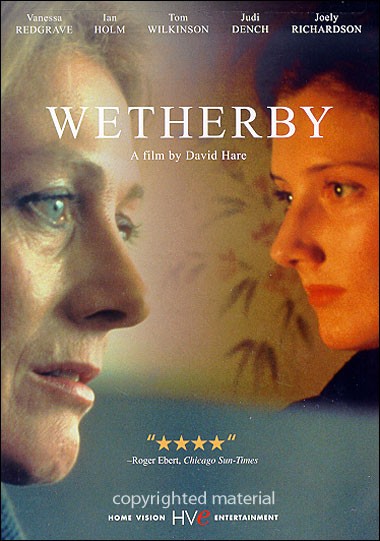
Wetherby is a kind of Thatcher era allegory — from and of the early, mid-1980s — in which an act of unhinged and paranoid Nietzschean violence is visited upon a Yorkshire community as represented by teacher Jean Travers (played by Vanessa Redgrave) and her British Library-worker friend Marcia (Judi Dench). I use the word ‘Nietzschean’ advisedly because the act of violence is tagged as such by several shots of the reading matter of the aggressor, a violent stalker named John Morgan (played by Tim McInnerny). In this much it is such a perfect allegory of the time, of the acts of violence that were perpetrated on communities in Yorkshire and elsewhere during the miners’ strike, that I have to remind myself that given production schedules of course the film must have been written, gone into production even, before the strike even started. In which case it becomes an act of prophesy. It seems scarcely credible now, but looking at the dates today I see that Wetherby premiered in the same week that the Miners’ Strike ended, at the beginning of March 1985. The script lists the premiere as having taken place at the Curzon West End, London on 8 March, although there was also a Leeds premiere at the Hyde Park Picture House, a beautiful 1914, gas-lit, end-of-terrace cinema which features in the film. I remember this because I lived in Leeds at the time, so somehow it has become bound up — as films, music, works of art can — with my own biography (in ways that are both too slight and too convoluted to describe here), but also with my own writing.
In the mid-1990s I was writing a satirical piece of fiction, a short story about a pre-Macpherson police force that had seemed since the early 1980s — with the policing of the miners’ strike, the Battle of the Beanfield, and later with the institutional racism found by Sir William Macpherson in the aftermath of the murder of London teenager Stephen Lawrence — to be locked into a self-perpetuating cycle of alienated violence and prurient self-justification.
 Once I’d started writing though, it was hard to stop and that short story became the novel CHARLIEUNCLENORFOLKTANGO, which was published in 1999 — the same year as ‘The Macpherson Report’ — by the former, now sadly-missed Hove-based publishing house Codex Books. The novel is told in an expletive strewn, phonetic prose style that is structured around a very loose appropriation of the central conceit of Philip K. Dick’s short story ‘The Third Kind’ and features three ‘Retropolitan Police Force’ goons in a riot van whose call-sign is an acronym of my (slightly adapted) phonetic alphabet title. In the period pre- and post-publication I did loads of readings from CHARLIEUNCLENORFOLKTANGO, often with a live, improvised musical accompaniment from James T. Ford, a former Hammond Organ player for The Jam. We performed at the performance art venue Hollywood Leather, at the ICA a couple of times, the Zap, Cabinet Gallery, Vox ‘n’ Roll, and others I can’t remember; then I put the book away for a decade, had other books to promote. Codex went out of business and the book out of print. There are a very small number for sale secondhand, but not many.
The novel is still out of print, but I did a public reading from CHARLIEUNCLENORFOLKTANGO earlier this year at a gig in Shoreditch with the mighty Malcolm Bennett of Brute! fame, which was the first time I’d done so for about ten years. Then again in November at Wordplay’s benefit night for the Cystic Fibrosis Trust, at a great venue called The Good Ship in Kilburn. That was the night before the previous pro-education protest in Westminster, which seemed to give the reading a whole new kind of currency.
The two things — Wetherby and CHARLIEUNCLENORFLKTANGO — are not unrelated. One short passage in my novel was consciously written as a kind of minor homage to Wetherby. It picks up on a fleeting scene in Hare’s film that appears on page 55 of the script. It would take longer to describe what happens on-screen, but in the script, Hare simply writes: ‘In the middle of the road children have lit a bonfire and are playing around it with sticks, and smashing bottles.’ As it happens, CHARLIEUNCLENORFLKTANGO features what (a confessedly irritated) Christopher Tayler in his review of the novel for the LRB called, ‘a tirelessly reiterated opposition of the lights of civilisation and the “dark playsiz”, [and] ow blokes & birds on Erf can keep the dark dark nyte at bay.’ As I was writing those sequences I thought again of that fleeting glimpse of the bonfire in Wetherby, and so in keeping with my prurient police officer narrator’s endless riffing on the light and the dark I used something similar. Near the end of the novel, as the Sarge drives the van back to his own house to inflict some (unseen) act of violence on his own family, he turns off the main road and they drive past ‘sum kidz dan by the garridjiz awl standin round a fyre wot theyv maid owt a sum ole matrissiz & shit […] & there chuckin stix at the cunt.’ I thought of this again when I saw some of the footage being posted on Youtube of Parliament Square, like this short clip by my friend the artist Chris Dorley-Brown.
There is a small nod to Wetherby in my novel Foxy-T as well, but I’ll leave that for now because I don’t want to overload a post that is already too long, and because there is already too much to digest. I am well aware, for one thing, of just how contingent my own engagement with higher education was. Then there are the brutal police tactics used against students and young people in Westminster on 9 December 2010, the innocent people who were kettled on Westminster Bridge until late at night and the odious likes of Michael Gove, the current Secretary of State for Education. I’d initially seen Gove as a kind of comic Dickensian figure, who came on the radio like Tory grotesques of old to try and feed us a burger about this or that, but there was a link floating around this week to a piece he wrote in the Times a few years ago in which he said that pricing education out of people’s reach is ‘all to the good,’ continuing, ‘anyone put off from attending a good university by fear of […] debt doesn’t deserve to be at any university in the first place.’
 It was one of those times when only art will do, when nothing else is up to the task, and this was why I was reaching for my battered old Faber and Faber paperback of the script of Wetherby, and why it suddenly seemed such a good and useful fit; something to be immediately consulted.
Here was violence being visited on a community and being brought into people’s homes.
Here was the rejection of education as fake.
Here the violent desire of an aggressor to take everyone down with them and who blows his own brains out in pursuit of that power.
Here, too — in Wetherby at least — was a policeman who quits the force out of shame.
Most of all though, it was that line that I’d been trying to remember, which comes close to the end of the film (and on pages 90-91 of the Faber edition of the script). The teacher Jean Travers (Redgrave) is back in her classroom where she discovers that one of her pupils has quit school to run away with a boy.
‘Anyone else?’ she asks. ‘Anyone else want to go?’
No one does.
‘Right then, for those of us still remaining — us maniacs, assorted oddballs, eccentrics, folk who still feel that school is worthwhile, I suggest we keep trying. All right everyone?’




















You must be logged in to post a comment.