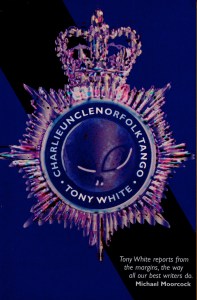
Codex paperback of CHARLIEUNCLENORFOLKTANGO
Friends may be interested to know that right now a small number of rare second-hand copies of my novel CHARLIEUNCLENORFOLKTANGO seem to be available via Abebooks. The novel has been out of print since the publisher Codex sadly ceased trading in the early noughties.
ICYMI at the time, here’s what John Williams said in Time Out:
These days, if you want innovation in crime fiction, you’re better off looking closer to home. Tony White’s Charlieunclenorfolktango sure as hell stands out from the norm. Imagine a cross between Clockwork Orange and Irvine Welsh’s Filth, and you’ll be somewhere close. Written in phonetic cockney geezer-speak and narrated by hell’s own copper . . . there’s a berserk comic energy present that bodes well for White’s future.
While Christopher Tayler reviewing CHARLIEUNCLE… in the London Review of Books alongside Canteen Culture by Ike Eze-anyika and Filth by Irvine Welsh, absolutely hated it, calling it
Bizarre, depressing and unreadable…
And that’s one of the nicer things he had to say. Well, you can’t win ’em all. (Although, incidentally, I learned a really important lesson from Tayler’s LRB review, which I will tell you now: it is never – but never – a good idea to reply to a bad review.)
There are more reviews of CHARLIEUNCLENORFOLKTANGO on my press page (you’ll need to scroll down a bit).
But while reviews are important – and sometimes life-changing – they aren’t everything. There are other kinds of critical feedback, too. Some of which have a very slow burn indeed. Because books do have a long life; even obscure experimental novels like CHARLIEUNCLENORFOLKTANGO, published on the margins in tiny print runs by long defunct small presses. Once a book is out there in the world it has a life of its own – independent of both author and critic – and is reanimated whenever someone picks it up, or remembers something they once-read.
Which reminds me that I meant to say, one of my favourite art exhibitions of recent months was PERIOD by Fiona Banner AKA the Vanity Press at Frith Street Gallery, London which ran from 21 November 2019 to 24 January 2020. Here’s a photo from the Frith Street Gallery site.
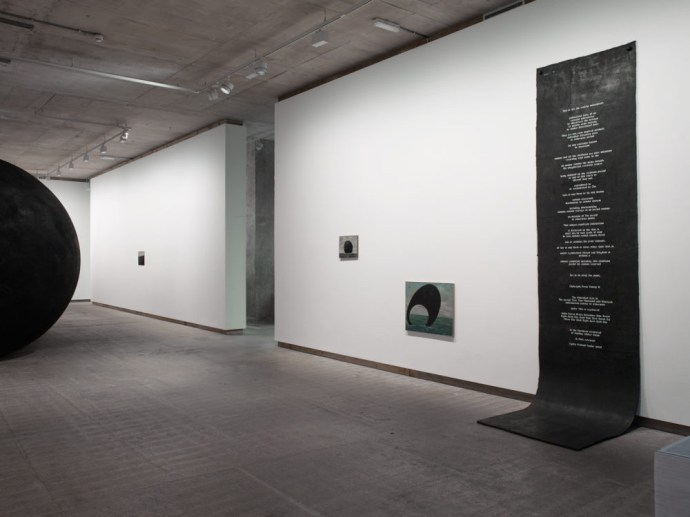
PERIOD, Fiona Banner AKA the Vanity Press, Frith Street Gallery, London, 2019
It was a fantastic show, and I felt especially drawn to the large hanging scroll of marine rubber on the right of this photograph. Entitled ‘Tongue’, this is a book-ish text work that remixes the genres and jargon of the colophon page and the gallery wall text.
I love Fiona Banner’s work, especially her ‘publications’ – in the loosest sense of the word – and the relationships and antagonisms with traditional publishing that they contain and inscribe.
‘Tongue’ even has its own ISBN number, which is written out in full like so:
India Sierra Bravo November Nine Seven Eight dash One dash Nine Zero Seven Six Three One dash Eight Zero dash One
Here’s a close-up that I took on the night of the exhibition’s opening.
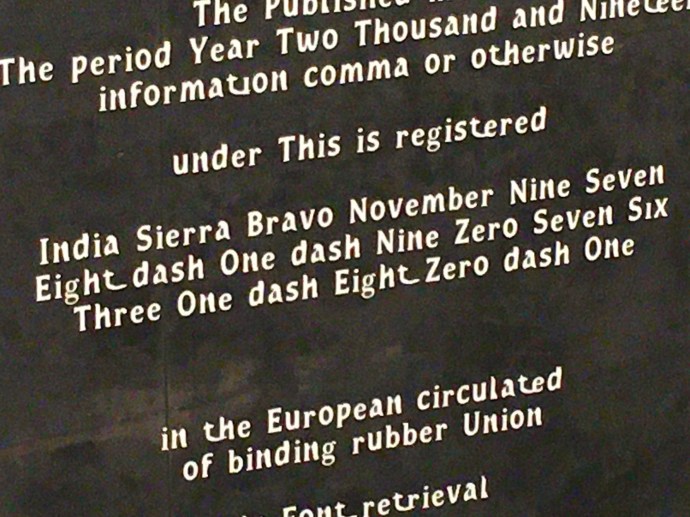
Fiona Banner AKA the Vanity Press, ‘Tongue’ (detail)
Intrigued, I asked Fiona if ‘Tongue’ was a colophon for the whole show (as it were) or a self-contained, stand-alone publication.
It’s the latter, she confirmed: a one-off publication in its own right. ‘The legal deposit people hate me!’
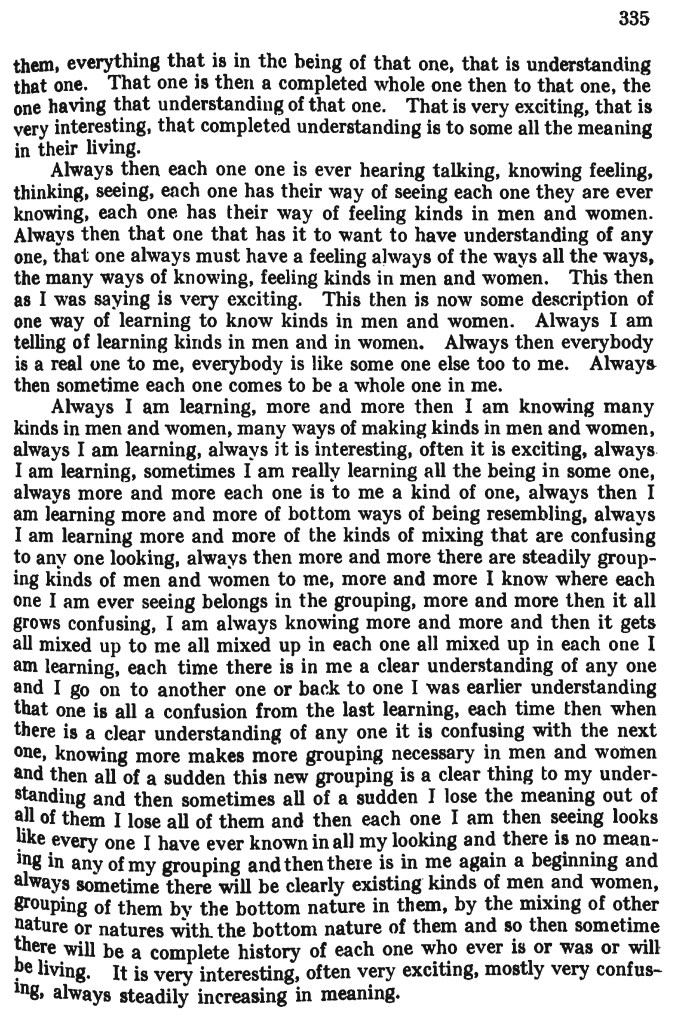
But then, apropos of nothing, Fiona told me that her use of the phonetic alphabet to depict the ISBN was (in her words), ‘inspired by that old book of yours.’
Wow.
‘Can I quote you on that?’ I asked.
§
Fiona Banner aka The Vanity Press
Buy CHARLIEUNCLENORFOLKTANGO via Abebooks
Background to CHARLIEUNCLENORFOLKTANGO here…
More about CHARLIEUNCLENORFOLKTANGO here…
Buy Tony White’s latest novel The Fountain in the Forest from Book Hive
Sign up to receive news and invites to Tony White’s book launches and events






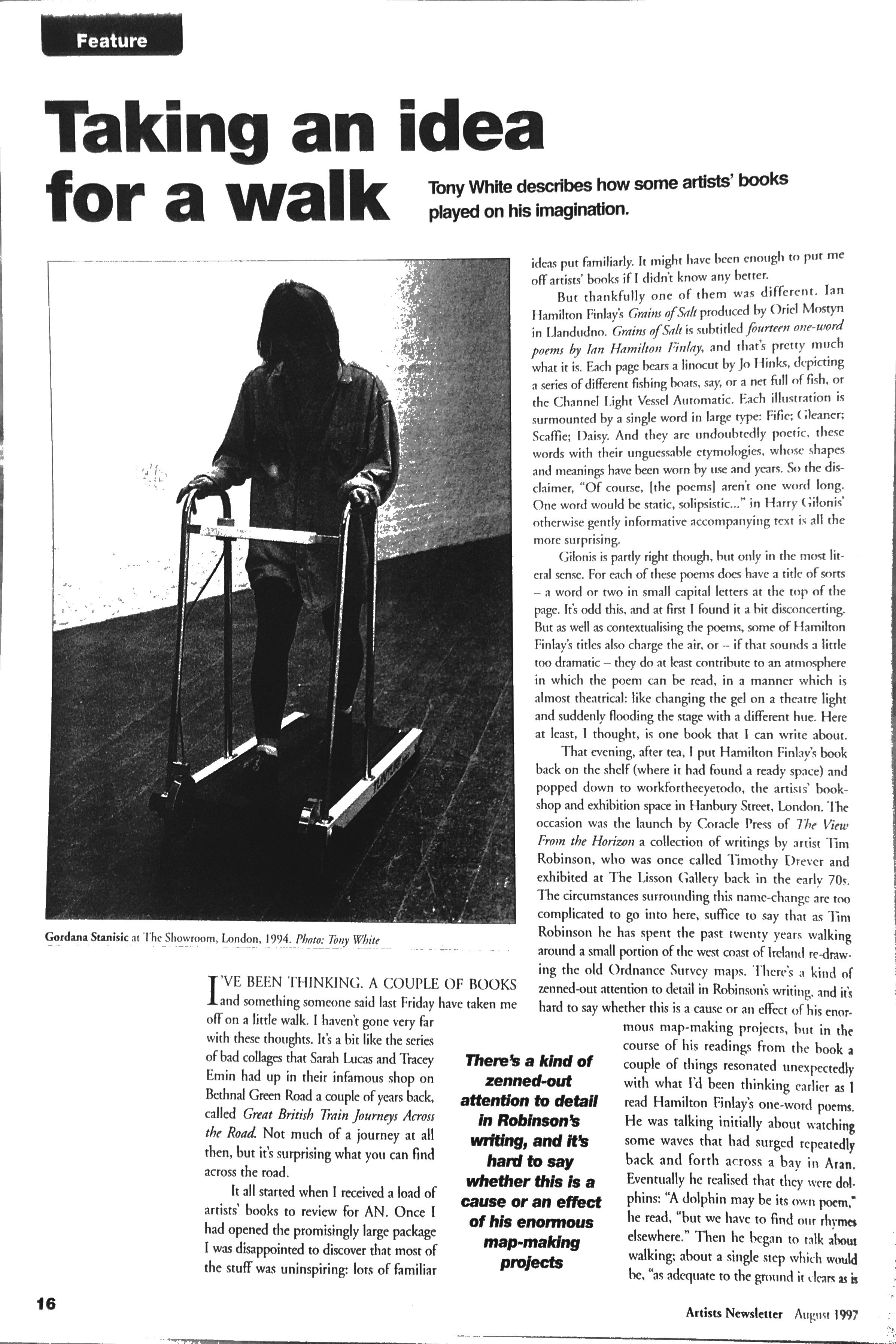
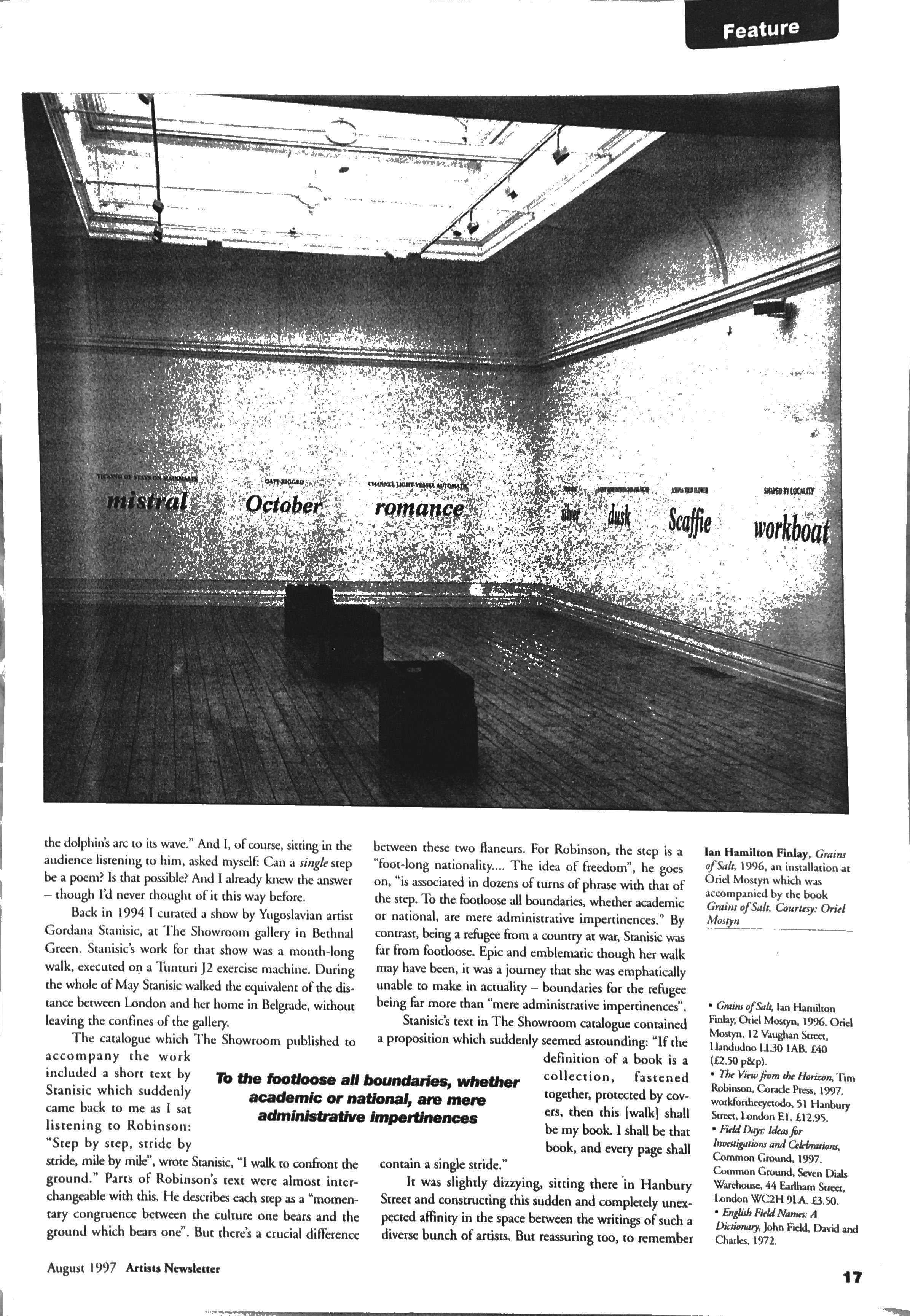
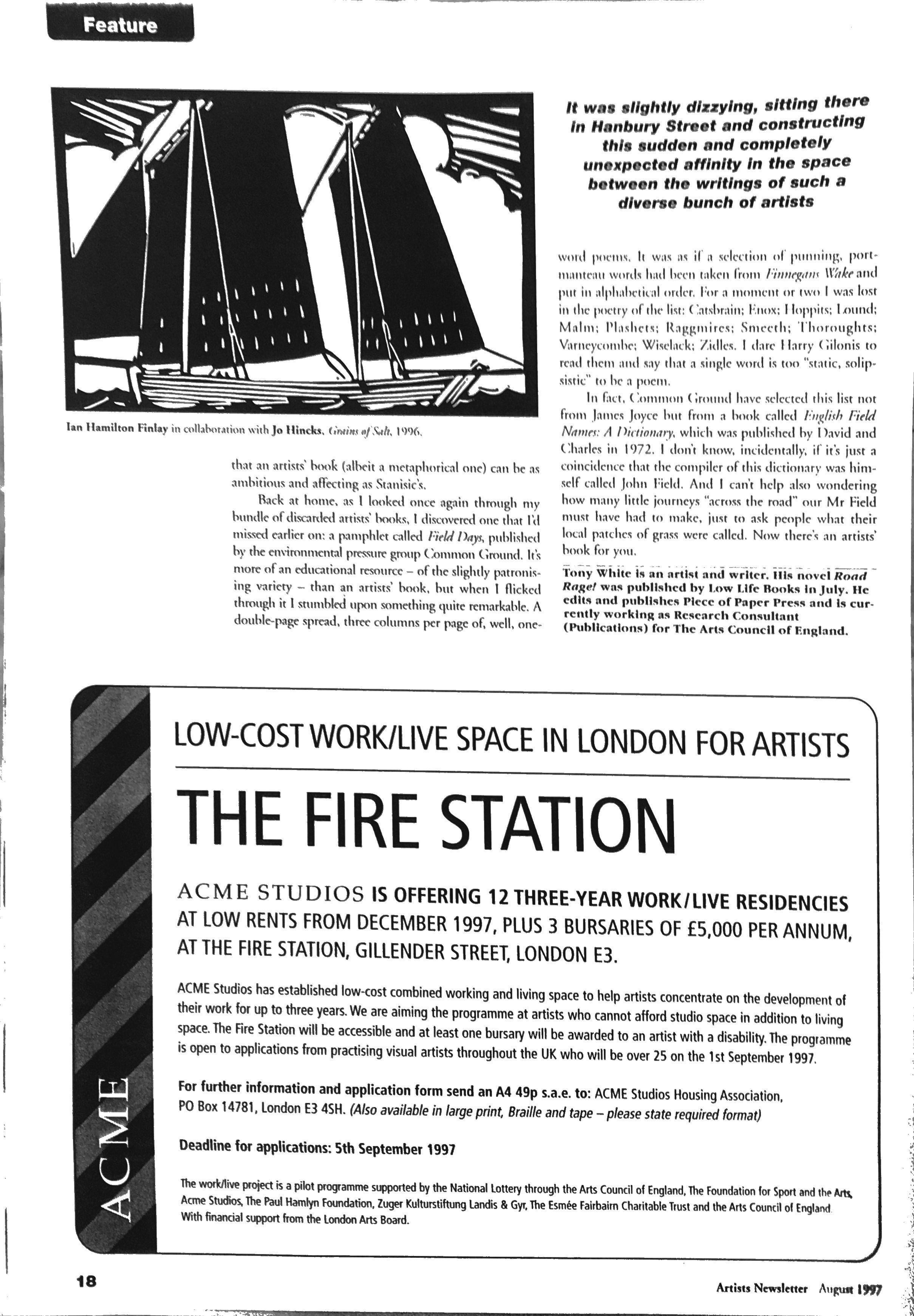
 I’d been privileged to see Robinson reading in 1997, at the launch in Hanbury Street just off Brick Lane, London, of his book The View From the Horizon, published by Coracle.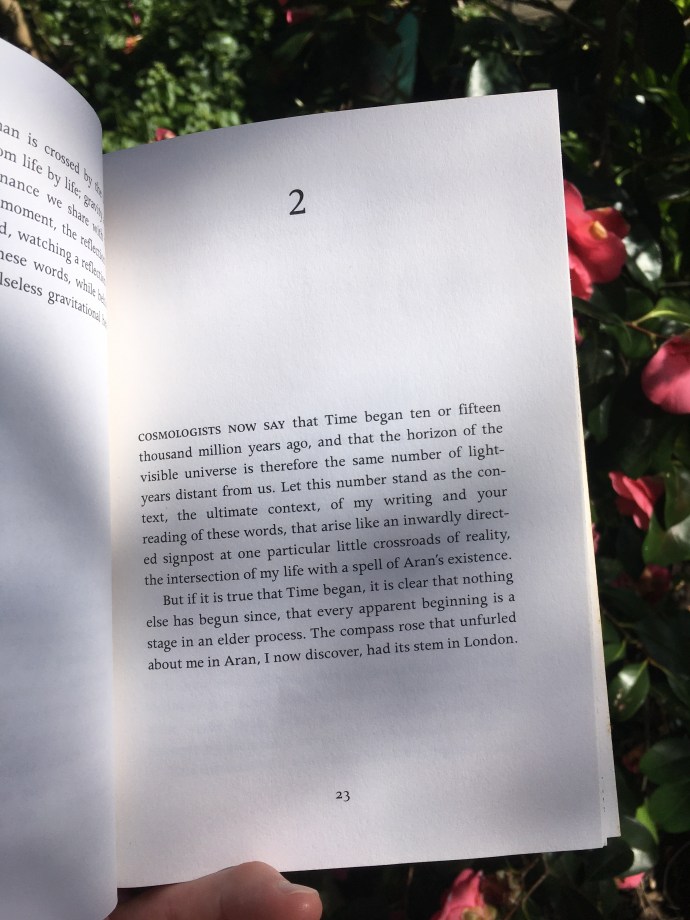
 Buy Tim Robinson The View From The Horizon on Abebooks

You must be logged in to post a comment.