Fellow speakers at the British Library on 20 February include Sam Jordison of the celebrated Galley Beggar Press and the Guardian, authors Susie Nott-Bower and Alex Pheby, and Lynn Michell of the Linen Press. It promises to be a really good day.
N.B. If you are interested in coming along, the advice from the British Library is to book early, as these events are marketed across their lists and tend to sell out rather quickly.
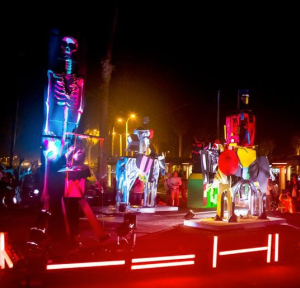
I’ve loved Gibby Haynes’s work with Butthole Surfers over the years, so I was thrilled to be involved in a project with him. The way that his music seems to synchronise with—even to illustrate—the text is all the more incredible since Gibby has said that he ‘intentionally did not read the story then was shocked to find out how much the writing inspired the sounds.’
The story vocal was recorded in one continuous take on an Edirol R09—here’s the high-tech set up ;)
‘Apocryphal Fragment from the Lives of the Conquistadors’ was first published in print and audio (with sounds by Steven Hull) on the gatefold vinyl LP A Puppet Show, by Steven Hull, together with an instrumental version of Haynes’s track, and music by the great Petra Haden, Tanya Haden and Anna Huff.
Steven Hull’s forthcoming book CARNEVIL will be the 30th title from Piece of Paper Press, and is due for publication in early 2016.
Have a great (non-ordinary) Christmas, and I look forward to seeing you in 2016.
I love it when a plan comes together—as the, um, poets say. (There’s more about those poets below*).
But seriously, I am really thrilled that a conversation I have been involved in behind the scenes over the past year or so has resulted in three new and innovative—and well funded—artists’ residencies in the field of climate change, which have been announced this week at COP21.
Back in 2014 I published a provocation entitled ‘Wanted: A New Kind of War Artist’, building on the research I had undertaken in writing my climate change novel Shackleton’s Man Goes South, and the ongoing discussions with scientists and others that writing the novel had both required and engendered. Here is a short extract:
… right now, the climate science and policy communities actually need artists, writers, composers, film directors more than ever: people who know how to tell stories, and how to reach new audiences with new ideas. Models and expertise already exist for artistic intervention within the international scientific arena, models which might relatively simply be adapted and used to create not just ‘flying visits’, but deep and long-term engagements. One ready example is the artists’ residency programme at CERN. Why not artists and writers in residence at the IPCC (or across its operations)? … At the outbreak of WWII (following the work that had been done by artists including Eric Ravilious, Wyndham Lewis and many others during the First World War), a new War Artists’ Advisory Committee oversaw the appointment of artists who were charged not only with documenting the conflict at home and internationally, but—given its scale and complexity—with interpreting it too.
Could it be that the ‘climate crunch’ and the next phase of mobilisation against climate change demand the creation of a new kind of War Artist?
A month or two later, a few of us gathered in a breakout session at TippingPoint Oxford called by the Culture and Climate Change programme of the OU’s Mediating Change partnership. I reprised the ‘War Artist’ analogy, and pointed out that the word ‘scenario’—so prevalent in climate change policy—comes from the arts, from the early days of opera, rather than from military planning. Quickly putting two and two together, Joe Smith and Renata Tyszczuk of Culture and Climate Change wondered whether scenarios might provide a useful focus for some new artists’ residencies. Judith Knight of Artsadmin, Rose Fenton of Free Word Centre and I pooled our knowledge and experience of residencies and—at the invitation of Culture and Climate Change—and together with Robert Butler of The Ashden Trust, we formed an advisory group in order to support them in developing such a programme.
Now, with generous support from the Jerwood Charitable Foundation, in addition to that provided by The Ashden Trust, The Open University and the University of Sheffield, this networked residency idea has been announced, to tie in with COP21. Here is the press release (opens as PDF) and here is the blurb:
We’re delighted to launch the Climate Change in Residence: Future Scenarios Project.
We are seeking three artists to take part in a new form of arts residency, offering access to a network of climate change researchers across the UK. Each residency includes an award of £10,000. We welcome applications from individuals and collectives from any artform to work on new creative projects engaging with scenarios of climate change. The closing date for applications is Monday 15 February, 5pm GMT. This project, sets out to test the idea of ‘networked residencies’. Climate research has long relied on networked collaborations rather than individual, geographically-located centres. Through these residencies, you will be able to research the issue of climate and spend time exploring and developing your own artistic practice. In this way we hope you will introduce a new cultural depth to public conversations around future scenarios.
This project has been developed as part of the Culture and Climate Change programme of work which began in 2009 as a series of discussions, events, podcasts and publications organised by the Mediating Change group. The group is based in the Open University’s Open Space Research Centre, and is rooted in a partnership between the Open University Geography Department and the University of Sheffield School of Architecture.
Hold the date
We will be hosting an evening at ArtsAdmin on Wednesday 27 January, 2016. The event will explore why scenarios are such a key element of climate change research and politics, and also why it is important to invite a wider range of perspectives on these themes. It will also be an opportunity for those wishing to apply for the residency programme to find out more.
A timely and unmissable evening of satire in poetry and prose at The Room, a space for the arts in Tottenham, featuring leading black British novelist Courttia Newland (pictured)—author of The Scholar, Society Within, The Gospel According to Cane, etc.—‘a truly gifted storyteller’ (Time Out)—and the 2011 Eric Gregory Award and 2014 Poetry Business Pamphlet Competition-winning poet Holly Hopkins, who contributed to The Emma Press’s powerful Campaign in Poetry anthology earlier this year. Joining them are London author Tony White, best known for his novel Foxy-T—‘One of the best London novels you’ll ever get to read’ (Sunday Herald)—who will be reading satirical short The Holborn Cenotaph; and Theatre of Mistakes founder, the poet and novelist Anthony Howell, whose performance Table Moves at The Tate was described by Stewart Lee in the Observer as ‘The best performance I have ever seen’. Howell’s first collection of poems, Inside the Castle was published in 1969 and his latest, Silent Highway, is published by Anvil.
Anthony and I first discussed this event earlier in the year, after I read a piece of his—a satirical poem and accompanying note on the current unfashionableness of satire in poetry—on the Fortnightly Review.
Around the time of the Kings College event at which I launched ‘The Holborn Cenotaph’—perhaps earlier that same day—I saw actor and comedian Mark Gatiss on Twitter, bemoaning the ‘satire gap’ on TV. True enough, perhaps, although I disagree with the implicit suggestion that satire and TV impressionists are somehow synonymous. You’re looking in the wrong place, I thought to myself. Instead of looking for the new Mike Yarwood, look at Cassetteboy, whose satirical cut-up of David Cameron’s conference speech has had nearly 6.2m views on Youtube (not so different to the ratings for Coronation Street or EastEnders), or the incisive, screaming incredulity of The Artist Taxi Driver, here with yesterday’s brilliant Let’s Bomb Let’s Degrade Let’s Destroy Jeremy Corbyn:
More recently, discussing satire on BBC Radio 4’s Start the Week, and rather more on point than Gatiss, was novelist Jonathan Coe, who said:
I think there’s an important difference which tends to get blurred between satire and political comedy […] we’d become, already we’d become too accustomed to just having a cosy giggle with our political masters in a way that was almost complicit. So, you know, I don’t have a problem with laughter, but there are different kinds of laughter: there is angry laughter and uncomfortable laughter, and I think that’s what satire is about.
Coe was on the show to plug his latest novel Number 11, which according to the discussion includes a satirical jab at the current London craze for lavishly extended basements. This proved not to be such a stretch, when a lovely Georgian house in South West London collapsed mid-renovation, with most news sources (and tweeters) citing a basement excavation as the likely cause. I think Coe could quite justifiably say, ‘I told you so.’
I’m really pleased that joining us for A Beast in View, will be 2011 Eric Gregory Award winner the poet Holly Hopkins, whose work I first came across in The Emma Press’s Campaign in Poetry anthology earlier this year. Holly’s contribution to the anthology got a good mention in Sabotage Reviews, who write:
Satire and animal allegory has long been associated with writing about politics; one only has to glance at a basic literary shelf housing Orwell or Swift. It is therefore apt that Campaign in Poetry opens with Holly Hopkins’ poem about bees. Only it is not about bees. It is titled ‘The General Election’, and it stings.
Also joining us is the brilliant Courttia Newland, whose work I have admired for some time now. We have been talking for a while about trying to do some gigs together. I get the impression that Courttia is as much an advocate of, and an enthusiast for the live reading as I am, although we haven’t appeared on a bill together for more than a decade.
It should be a good one. Do come along if you can.
I’ll be reading ‘The Holborn Cenotaph’ again on Saturday, and as is usual with readings of this story, I shall be giving away a small pamphlet edition of the full text. This emerged as a format at that first King’s College, London event, which was a panel discussion with the artists Stuart Brisley and Maya Balcioglu and the academic Dr Sanja Perovic, staged as part of King’s Arts & Humanities Festival 2014: Underground. ‘The Holborn Cenotaph’ is partly inspired by a work of Brisley and Balcioglu’s from the 1980s entitled The Cenotaph Project, and Stuart Brisley was a supporter of Piece of Paper Press in its earliest days in the mid-1990s. So when we came to plan that event together it seemed obvious that we should use the format to give away a text on the night. I have tried to maintain this ethos at all subsequent readings of the story. As a result, the Piece of Paper Press edition of ‘The Holborn Cenotaph’ is now in its fourth impression.
The title of our evening of satire in poetry and prose on Saturday comes from the poet Dryden, whom Anthony quotes in that Fortnightly Review article:
Since its heyday in the seventeenth and eighteenth centuries, satire as a poetic form seems to have fallen out of fashion. Of course, in other fields, there are still plenty of satirists. The satirical vein is still very much in circulation. But poetry itself, the principle organ of mockery in Roman times, appears to have lost sight of this cutting tool. While ranting has come into its own, there is not much in the way of satire. Dryden’s Absalom and Achitophel is a satirical masterpiece in which the poet develops an extended metaphor replacing the events of his own time with an incident drawn from biblical history that comes alive thanks to his brilliant gift for portraiture. But imitating the achievements of the seventeenth century now would come over as a cliché. What does seem important to retain though is a sense of one’s subject. With satire, there is a beast in view …
§
A BEAST IN VIEW: AN EVENING OF SATIRE IN POETRY & PROSE
with authors Holly Hopkins, Anthony Howell, Courttia Newland, Tony White
Poetry at The Room, 33 Holcombe Road, Tottenham Hale, N17 9AS
Saturday 5 December 2015
Starts: 7.30
£5 entry plus donation for refreshment
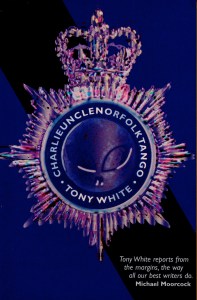
Forget ‘Black Friday’, Black November is the name of the climate change refugees’ liberation movement in my 2013 novelShackleton’s Man Goes South.
Image: Royal Moroccan Police, courtesy of Ursula Biemann and Charles Heller, The Magheb Connection, 2006.
The novel follows Emily and daughter Jenny, climate change refugees who arrive in South Georgia with trafficker Browning, en route to Antarctica and a reunion with husband John who has gone ahead to find work. Emily learns about Black November in a letter from John that has been smuggled from Antarctica back along the trafficking routes. ‘Sweetness, they force us to work every day,’ John writes,
They blackmail us with your lives. They think they can crush us, but we’re organised too. I know we’ll prevail by and by. Oh, Lord. I promise we’ll prevail by and by.
My darling, I have to write this quickly . . . Sweetheart, I think they may suspect . . . My darling, we’re going to proclaim a Jubilee! Remember Shackleton and his struggle to be free, and Isaiah 61 proclaiming liberty? A day of vengeance!
Patience Camp will be patient no more … Black November’s gonna be our Jubilee! Black November’s what we’ll call our Jubilee.
Thanks to Sarah for this great photo taken during an interesting chat that I was privileged to have been a part of at Turner Contemporary, Margate on Saturday. Following my reading of ‘The Holborn Cenotaph’ earlier in the day, I took part in this conversation with Iain Sinclair and Simon Smith, in which we traced literary routes between Cannon Street Road, London E1, and Margate sands—via ‘The Holborn Cenotaph’, and the chronicler of the Kentish underground David Seabrook. This was all part of the Venice Agendas 15 event at Turner Contemporary that was put on in partnership with Work in Progress and the Waugh Office. A great day.
If you didn’t get a chance to see the exhibition at the Science Museum that accompanied their publication of my climate change novel Shackleton’s Man Goes South—and which closed in April 2015 after an amazing two-year run—here’s a short video doc in which I talk about some of the background to the novel and demonstrate the unique touchscreen ebook dispenser that we developed especially for the project.
‘High-Lands’ was a short story commissioned for radio, and broadcast live—with soundscape accompaniment by Johny Brown of Band of Holy Joy—from the Outlandia tree house in Glen Nevis in Scotland as part of the Remote Performances project by London Fieldworks and Resonance 104.4FM. The story has now been published in Remote Performances in Nature and Architecture (edited by Bruce Gilchrist, Jo Joelson and Tracey Warr) published by Ashgate.
These may be books you haven’t read yet, projects you haven’t seen, but as ever I’d love to hear what friends think ;)
So to my question:
Q. which kinds of book/author videos do you prefer, and which do you think give you a better flavour, the live videos or the short documentaries? I’m interested because these are increasingly—with book trailers of course—part of how we all work these days.
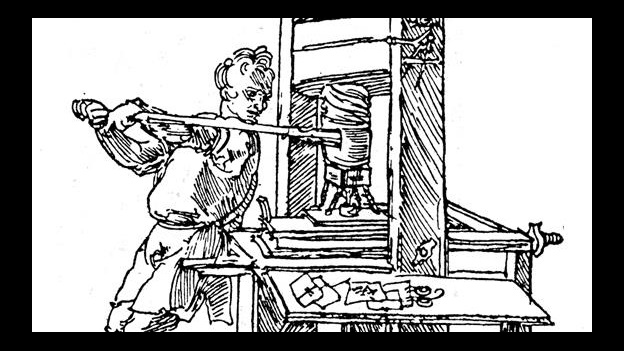 Following on from 2015’s The Contemporary Small Press: A Symposium at the University of Westminster, I am pleased to have been invited to speak at the British Library on 20 February at an event (also organised by Leigh Wilson and Georgina Colby of The Institute for Modern and Contemporary Culture at the University of Westminster) that is described as a ‘symposium and workshop for hungry minds and creative readers, bringing together writers, readers and publishers from independent presses in the UK.’
 I’ll be talking about Piece of Paper Press, the artists’ book project that I set up in 1994, and which was designed as a sustainable publishing platform for commissioning and publishing new works by artists and writers. Since 1994 I’ve published works by artists and writers including Michael Moorcock(left), Joanna Walsh, Liliane Lijn, Pavel Büchler, Peter Bunting, Barbara Campbell, Tim Etchells, Bruce Gilchrist, Halford+Beard, Elizabeth Magill, Penny McCarthy, James Pyman, Borivoj Radaković, Gordana Stanišić, Suzanne Treister, Alison Turnbull, and many more. The image below is of some of the design roughs, colour and print tests generated by Joanna Walsh’s ‘Shklovsky’s Zoo’, which was published by Piece of Paper Press in July 2015. The next title will be the 30th in the series, and is by the brilliant, LA-based artist Steven Hull.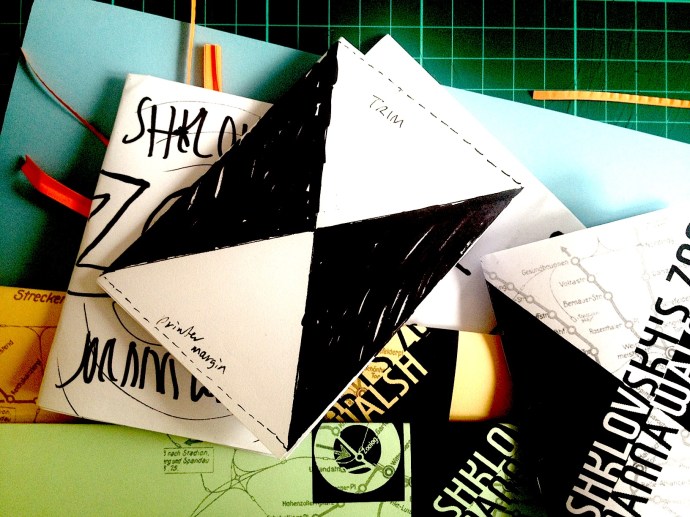

 I’ve loved Gibby Haynes’s work with


 ed a satirical reversal (‘world turned upside down’-style) of the Shackleton myth. More recently I have been
 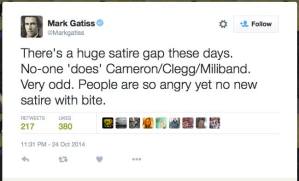 Around the time of the Kings College event at which I launched ‘The Holborn Cenotaph’—perhaps earlier that same day—I saw actor and comedian Mark Gatiss on Twitter, bemoaning the ‘satire gap’ on TV. True enough, perhaps, although I disagree with the implicit suggestion that satire and TV impressionists are somehow synonymous. You’re looking in the wrong place, I thought to myself. Instead of looking for the new Mike Yarwood, look at Cassetteboy, whose
 maintain this ethos at all subsequent readings of the story. As a result, the Piece of Paper Press edition of ‘The Holborn Cenotaph’ is now in its fourth impression.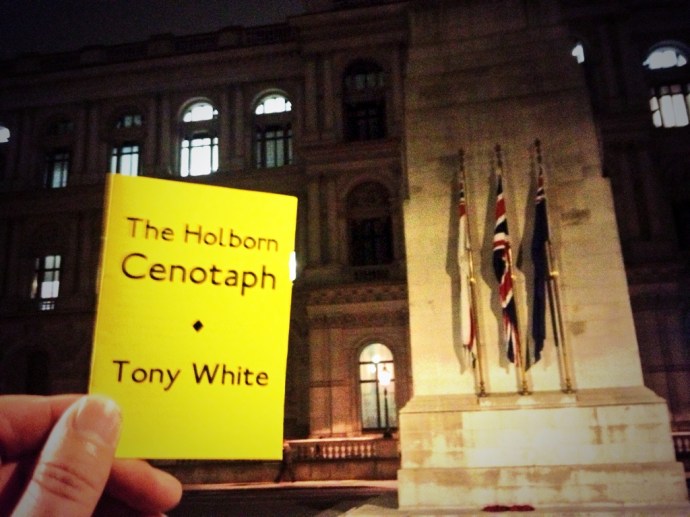

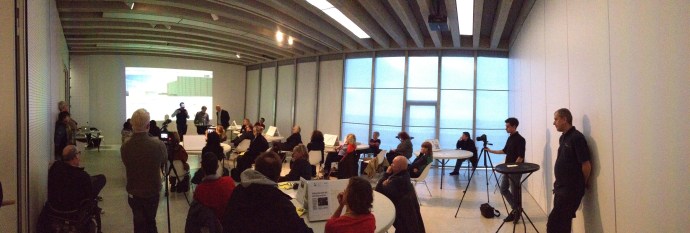 Thanks to Sarah for this great photo taken during an interesting chat that I was privileged to have been a part of at
  Piece of Paper Press & tonywhite.london
You must be logged in to post a comment.