Scenario planning

Screen Shot 2015-12-03 at 15.18.29I love it when a plan comes together—as the, um, poets say. (There’s more about those poets below*).

But seriously, I am really thrilled that a conversation I have been involved in behind the scenes over the past year or so has resulted in three new and innovative—and well funded—artists’ residencies in the field of climate change, which have been announced this week at COP21.

Back in 2014 I published a provocation entitled ‘Wanted: A New Kind of War Artist’, building on the research I had undertaken in writing my climate change novel Shackleton’s Man Goes South, and the ongoing discussions with scientists and others that writing the novel had both required and engendered. Here is a short extract:

… right now, the climate science and policy communities actually need artists, writers, composers, film directors more than ever: people who know how to tell stories, and how to reach new audiences with new ideas. Models and expertise already exist for artistic intervention within the international scientific arena, models which might relatively simply be adapted and used to create not just ‘flying visits’, but deep and long-term engagements. One ready example is the artists’ residency programme at CERN. Why not artists and writers in residence at the IPCC (or across its operations)? … At the outbreak of WWII (following the work that had been done by artists including Eric Ravilious, Wyndham Lewis and many others during the First World War), a new War Artists’ Advisory Committee oversaw the appointment of artists who were charged not only with documenting the conflict at home and internationally, but—given its scale and complexity—with interpreting it too.

Could it be that the ‘climate crunch’ and the next phase of mobilisation against climate change demand the creation of a new kind of War Artist?

Screen Shot 2015-12-03 at 15.03.37A month or two later, a few of us gathered in a breakout session at TippingPoint Oxford called by the Culture and Climate Change programme of the OU’s Mediating Change partnership. I reprised the ‘War Artist’ analogy, and pointed out that the word ‘scenario’—so prevalent in climate change policy—comes from the arts, from the early days of opera, rather than from military planning. Quickly putting two and two together, Joe Smith and Renata Tyszczuk of Culture and Climate Change wondered whether scenarios might provide a useful focus for some new artists’ residencies. Judith Knight of Artsadmin, Rose Fenton of Free Word Centre and I pooled our knowledge and experience of residencies and—at the invitation of Culture and Climate Change—and together with Robert Butler of The Ashden Trust, we formed an advisory group in order to support them in developing such a programme.

Now, with generous support from the Jerwood Charitable Foundation, in addition to that provided by The Ashden Trust, The Open University and the University of Sheffield, this networked residency idea has been announced, to tie in with COP21. Here is the press release (opens as PDF) and here is the blurb:

We’re delighted to launch the Climate Change in Residence: Future Scenarios Project.

We are seeking three artists to take part in a new form of arts residency, offering access to a network of climate change researchers across the UK. Each residency includes an award of £10,000. We welcome applications from individuals and collectives from any artform to work on new creative projects engaging with scenarios of climate change. The closing date for applications is Monday 15 February, 5pm GMT. This project, sets out to test the GSxEvJqzgWbCu8kq61--96qVJm2uWaBVrWl0ptMYwLXT_BEpxhRuGN2MnK_742s-IjYd6Dpe5lk_HHz6rtKw-Vjhe3bWUgzu8KZNZGAGTvcDpM9WJjcfXl47pg=s0-d-e1-ftidea of ‘networked residencies’. Climate research has long relied on networked collaborations rather than individual, geographically-located centres. Through these residencies, you will be able to research the issue of climate and spend time exploring and developing your own artistic practice. In this way we hope you will introduce a new cultural depth to public conversations around future scenarios.

This project has been developed as part of the Culture and Climate Change programme of work which began in 2009 as a series of discussions, events, podcasts and publications organised by the Mediating Change group. The group is based in the Open University’s Open Space Research Centre, and is rooted in a partnership between the Open University Geography Department and the University of Sheffield School of Architecture.

Hold the date
We will be hosting an evening at ArtsAdmin on Wednesday 27 January, 2016. The event will explore why scenarios are such a key element of climate change research and politics, and also why it is important to invite a wider range of perspectives on these themes. It will also be an opportunity for those wishing to apply for the residency programme to find out more.

*Oh yes, and those poets:

§

Climate Change in Residence: Future Scenarios—Application deadline: Monday 15 February, 2016, 5pm. The residencies will take place between June 2016 and May 2017. Click through for full information and application form.

You can still download Shackleton’s Man Goes South free and DRM-free in all ebook formats

‘It’s not often that fiction, a novel, genuinely manages to shock’—Read David Gullen’s review of Shackleton’s Man Goes South on Arcfinity

Subscribe to my occasional newsletter for invites and news about forthcoming books and events

Satire Saturday

On Saturday 5 December, I am joining authors Holly Hopkins, Anthony Howell and Courttia Newland for A Beast in View: an evening of satire in poetry and prose at The Room, London. Courttia posted on Facebook that it ‘Will be a great night of piss taking, promise!’

Courttia2015(1)Here’s the blurb:

A timely and unmissable evening of satire in poetry and prose at The Room, a space for the arts in Tottenham, featuring leading black British novelist Courttia Newland (pictured)—author of The Scholar, Society Within, The Gospel According to Cane, etc.—‘a truly gifted storyteller’ (Time Out)—and the 2011 Eric Gregory Award and 2014 Poetry Business Pamphlet Competition-winning poet Holly Hopkins, who contributed to The Emma Press’s powerful Campaign in Poetry anthology earlier this year. Joining them are London author Tony White, best known for his novel Foxy-T—‘One of the best London novels you’ll ever get to read’ (Sunday Herald)—who will be reading satirical short The Holborn Cenotaph; and Theatre of Mistakes founder, the poet and novelist Anthony Howell, whose performance Table Moves at The Tate was described by Stewart Lee in the Observer as ‘The best performance I have ever seen’. Howell’s first collection of poems, Inside the Castle was published in 1969 and his latest, Silent Highway, is published by Anvil.

Anthony and I first discussed this event earlier in the year, after I read a piece of his—a satirical poem and accompanying note on the current unfashionableness of satire in poetry—on the Fortnightly Review.

I had already been working with the form for a while. First in 1999’s satirical stream of filth CHARLIEUNCLENORFOLKTANGO, and more recently in my novel Shackleton’s Man Goes South which deployBuy Charlieunclenorfolktango from abebooksed a satirical reversal (‘world turned upside down’-style) of the Shackleton myth. More recently I have been including short story ‘The Holborn Cenotaph’ in my gigs. This is a Swiftian ‘modest proposal’ that was first written for a one-off event in the spectacular Gothic chapel at King’s College London in October 2014, but which since then seems to have taken on a life of its own.

12227193_10153347380532017_3616675729493079792_nAround the time of the Kings College event at which I launched ‘The Holborn Cenotaph’—perhaps earlier that same day—I saw actor and comedian Mark Gatiss on Twitter, bemoaning the ‘satire gap’ on TV. True enough, perhaps, although I disagree with the implicit suggestion that satire and TV impressionists are somehow synonymous. You’re looking in the wrong place, I thought to myself. Instead of looking for the new Mike Yarwood, look at Cassetteboy, whose satirical cut-up of David Cameron’s conference speech has had nearly 6.2m views on Youtube (not so different to the ratings for Coronation Street or EastEnders), or the incisive, screaming incredulity of The Artist Taxi Driver, here with yesterday’s brilliant Let’s Bomb Let’s Degrade Let’s Destroy Jeremy Corbyn:

More recently, discussing satire on BBC Radio 4’s Start the Week, and rather more on point than Gatiss, was novelist Jonathan Coe, who said:

I think there’s an important difference which tends to get blurred between satire and political comedy […] we’d become, already we’d become too accustomed to just having a cosy giggle with our political masters in a way that was almost complicit. So, you know, I don’t have a problem with laughter, but there are different kinds of laughter: there is angry laughter and uncomfortable laughter, and I think that’s what satire is about.

Coe was on the show to plug his latest novel Number 11, which according to the discussion includes a satirical jab at the current London craze for lavishly extended basements. This proved not to be such a stretch, when a lovely Georgian house in South West London collapsed mid-renovation, with most news sources (and tweeters) citing a basement excavation as the likely cause. I think Coe could quite justifiably say, ‘I told you so.’

Screen Shot 2015-12-01 at 15.33.02

I’m really pleased that joining us for A Beast in View, will be 2011 Eric Gregory Award winner the poet Holly Hopkins, whose work I first came across in The Emma Press’s Campaign in Poetry anthology earlier this year. Holly’s contribution to the anthology got a good mention in Sabotage Reviews, who write:

Satire and animal allegory has long been associated with writing about politics; one only has to glance at a basic literary shelf housing Orwell or Swift. It is therefore apt that Campaign in Poetry opens with Holly Hopkins’ poem about bees. Only it is not about bees. It is titled ‘The General Election’, and it stings.

Holly in front of books(1)Also joining us is the brilliant Courttia Newland, whose work I have admired for some time now. We have been talking for a while about trying to do some gigs together. I get the impression that Courttia is as much an advocate of, and an enthusiast for the live reading as I am, although we haven’t appeared on a bill together for more than a decade.

It should be a good one. Do come along if you can.

I’ll be reading ‘The Holborn Cenotaph’ again on Saturday, and as is usual with readings of this story, I shall be giving away a small pamphlet edition of the full text. This emerged as a format at that first King’s College, London event, which was a panel discussion with the artists Stuart Brisley and Maya Balcioglu and the academic Dr Sanja Perovic, staged as part of King’s Arts & Humanities Festival 2014: Underground. ‘The Holborn Cenotaph’ is partly inspired by a work of Brisley and Balcioglu’s from the 1980s entitled The Cenotaph Project, and Stuart Brisley was a supporter of Piece of Paper Press in its earliest days in the mid-1990s. So when we came to plan that event together it seemed obvious that we should use the format to give away a text on the night. I have tried to -1maintain this ethos at all subsequent readings of the story. As a result, the Piece of Paper Press edition of ‘The Holborn Cenotaph’ is now in its fourth impression.

The title of our evening of satire in poetry and prose on Saturday comes from the poet Dryden, whom Anthony quotes in that Fortnightly Review article:

Since its heyday in the seventeenth and eighteenth centuries, satire as a poetic form seems to have fallen out of fashion. Of course, in other fields, there are still plenty of satirists. The satirical vein is still very much in circulation. But poetry itself, the principle organ of mockery in Roman times, appears to have lost sight of this cutting tool. While ranting has come into its own, there is not much in the way of satire. Dryden’s Absalom and Achitophel is a satirical masterpiece in which the poet develops an extended metaphor replacing the events of his own time with an incident drawn from biblical history that comes alive thanks to his brilliant gift for portraiture. But imitating the achievements of the seventeenth century now would come over as a cliché. What does seem important to retain though is a sense of one’s subject. With satire, there is a beast in view …

§

A BEAST IN VIEW: AN EVENING OF SATIRE IN POETRY & PROSE
with authors Holly Hopkins, Anthony Howell, Courttia Newland, Tony White
Poetry at The Room, 33 Holcombe Road, Tottenham Hale, N17 9AS
Saturday 5 December 2015
Starts: 7.30
£5 entry plus donation for refreshment

photo(4)

Black NOVEMBER

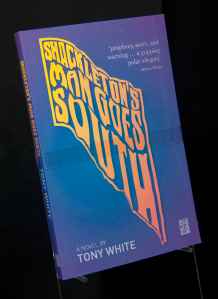
Forget ‘Black Friday’, Black November is the name of the climate change refugees’ liberation movement in my 2013 novel Shackleton’s Man Goes South.

Image: Royal Moroccan Police, courtesy of Ursula Biemann and Charles Heller, The Magheb Connection, 2006.

Image: Royal Moroccan Police, courtesy of Ursula Biemann and Charles Heller, The Magheb Connection, 2006.

The novel follows Emily and daughter Jenny, climate change refugees who arrive in South Georgia with trafficker Browning, en route to Antarctica and a reunion with husband John who has gone ahead to find work. Emily learns about Black November in a letter from John that has been smuggled from Antarctica back along the trafficking routes. ‘Sweetness, they force us to work every day,’ John writes,

They blackmail us with your lives. They think they can crush us, but we’re organised too. I know we’ll prevail by and by. Oh, Lord. I promise we’ll prevail by and by.

My darling, I have to write this quickly . . . Sweetheart, I think they may suspect . . . My darling, we’re going to proclaim a Jubilee! Remember Shackleton and his struggle to be free, and Isaiah 61 proclaiming liberty? A day of vengeance!

Patience Camp will be patient no more … Black November’s gonna be our Jubilee! Black November’s what we’ll call our Jubilee.

§

Download Shackleton’s Man Goes South free and DRM-free in all ebook formats

‘It’s not often that fiction, a novel, genuinely manages to shock’—Read David Gullen’s review of Shackleton’s Man Goes South on Arcfinity

Subscribe to my occasional newsletter for invites and news about forthcoming books and events

(Foxy-T).S. Eliot

photo(5)Thanks to Sarah for this great photo taken during an interesting chat that I was privileged to have been a part of at Turner Contemporary, Margate on Saturday. Following my reading of ‘The Holborn Cenotaph’ earlier in the day, I took part in this conversation with Iain Sinclair and Simon Smith, in which we traced literary routes between Cannon Street Road, London E1, and Margate sands—via ‘The Holborn Cenotaph’, and the chronicler of the Kentish underground David Seabrook. This was all part of the Venice Agendas 15 event at Turner Contemporary that was put on in partnership with Work in Progress and the Waugh Office. A great day.

The next outing for satirical short ‘The Holborn Cenotaph’ is as part of A Beast in View: an evening of satire in poetry and prose on Saturday 5 December at The Room, London. I will be reading alongside some great writers, namely Courttia Newland, Holly Hopkins and The Room’s host Anthony Howell. It should be a good one. Do come along if you fancy ;)

§

Subscribe to my occasional newsletter for invites and news about forthcoming books and events

At the Science Museum, new video

If you didn’t get a chance to see the exhibition at the Science Museum that accompanied their publication of my climate change novel Shackleton’s Man Goes South—and which closed in April 2015 after an amazing two-year run—here’s a short video doc in which I talk about some of the background to the novel and demonstrate the unique touchscreen ebook dispenser that we developed especially for the project.

§

Download Shackleton’s Man Goes South by Tony White, FREE and DRM-free, in all ebook formats

See other videos featuring Tony White on this site

Subscribe to my occasional newsletter for invites and news about forthcoming books and events

Free mailing list

‘High-Lands’ was a short story commissioned for radio, and broadcast live—with soundscape accompaniment by Johny Brown of Band of Holy Joy—from the Outlandia tree house in Glen Nevis in Scotland as part of the Remote Performances project by London Fieldworks and Resonance 104.4FM. The story has now been published in Remote Performances in Nature and Architecture (edited by Bruce Gilchrist, Jo Joelson and Tracey Warr) published by Ashgate.

Signing up to my free invite and mailing list means that you will hear about special projects like this in advance and get invites to gigs and book launches around the country ;)

§

More events listings, plus a word about bookings

New and a Q: Video page

A new page on this website gathers video of various live appearances/readings and the short docs made about particular books and projects such as Missorts, Dicky Star and the Garden Rule, Shackleton’s Man Goes South​, etc. There’s more to come, including a short video doc of the Shackleton’s Man Goes South exhibition at the Science Museum, which ran for two years from April 2013 to April 2015.

These may be books you haven’t read yet, projects you haven’t seen, but as ever I’d love to hear what friends think ;)

So to my question:

Q. which kinds of book/author videos do you prefer, and which do you think give you a better flavour, the live videos or the short documentaries? I’m interested because these are increasingly—with book trailers of course—part of how we all work these days.

§

Subscribe to my occasional newsletter for invites and news about forthcoming books and events

Visit my Video page

‘Small publishers …’

Michael Caines has written a nice post for the TLS blog about Joanna Walsh’s “Shklovsky’s Zoo” and Piece of Paper Press—as well as some other artists’ book miniatures:

Screen Shot 2015-06-24 at 08.36.59Take a piece of A4 paper. Fold it in half (reducing it to A5 size), then twice more (A6; A7). A little more unfolding and refolding, interrupted by one snip of the scissors, and there you have it – a booklet of eight pages. Stitch it and trim the edges. Now all you have to do is cover it with suitable words and pictures … I read the A7-sized Shklovsky’s Zoo by Joanna Walsh (published earlier this year by Tony White’s deliberately lo-fi and generous-spirited Piece of Paper Press) as a complimentary complement: it’s not about reading the book itself but trying to get hold of a copy, as well as a writing residency, Kafka, the narrator coming adrift (a relationship has ended, and the fellow writing residents aren’t exactly her cup of tea). Or it’s about those things and it’s not … That seems like plenty to find tucked away in a few pages made from a single sheet of paper.

Launch of “Shklovsky’s Zoo” at bookartbookshop, London, July 2015

Launch of “Shklovsky’s Zoo” at bookartbookshop, London, July 2015

§

Read Michael Caines’, ‘Small Publishers, Smaller Books’, on the TLS Blog

Subscribe to my occasional newsletter for invites and news about forthcoming books and events

Live literature

inyerear_coverphotocropThe latest reading of my satirical short story ‘The Holborn Cenotaph’ was at In Yer Ear #15, 27 October 2015 (photo: Peter Clark), with more readings to come in London and beyond.

The reading at In Yer Ear coincided with Death in Police Custody Awareness Week, 26-31 October 2015.

§

-1‘Jaw-dropping’ — Twitter reviews of ‘The Holborn Cenotaph’

Tony White events listings

A word about bookings

Subscribe to my occasional newsletter for invites and news about forthcoming books and events

Petrol heads

I promised to post the English translation (or the English original) of my recent interview for Russian car magazine Ключавто once the magazine was out. Here is the digital version of the magazine. For non-Russian-speakers, the standfirst reads:

Our interlocutor was the British writer, whose books combine furious drive and avant garde format, and are apt to hit society’s pressure points. We asked Mr. White a few car-related questions—how serious or not…

Here is the interview in English:

12178126_10205080543153947_1550960864_nКлючавто: Can you compare writing with driving? If yes, then what type of road do you drive during writing—mountainous serpentine, racing oval, medieval town labyrinth or something else?

[I don’t really know because I can’t drive, but] ideally I start writing very early every morning. I wake up, make coffee and get going. It is peaceful and there are no distractions, the phone doesn’t ring. I like that time of day. I can get a whole day’s work done by 10am. One thing I can compare this with is that when I used to work nights at the Post Office in the mid-1990s—before my first novel Road Rage! was published—I used to enjoy cycling home through the deserted city at 5am, just as the sun was coming up. It was beautiful. The London streets were empty and there was nobody around except a few other night workers. Maybe these are similar feelings.

Ключавто: The main villain in Road Rage! is the road construction company. Do you remember the moment when it becomes clear in the novel that these companies are trying to pave their highways directly over sacred Celtic sites? Is that practice actually popular in Britain?

Buy Road Rage from the Piece of Paper Press shop using my verified PayPal accountRoad Rage! is a novel about anti-road protesters in the East London of the 1990s, and the plan in the novel to build roads over ancient sacred sites was pure fiction, at least that is what I thought at the time. But actually, right now in the UK there is a genuine government plan to build a road tunnel under Stonehenge, one of the most famous and iconic neolithic sacred sites in the world. The rather simplistic thinking I suppose is that this tunnel will protect the site or restore some lost visual aspect; a landscape without cars. It is also rationalized by saying that the scheme is designed to enhance road safety because the stones are a distraction to drivers! However there is no telling what damage will be done to the site during the construction process itself and furthermore they will be driving this tunnel through as yet unexplored archeological remains. If this happens it will all be done no doubt in the typical hypocritical style, using words like ‘safeguard’ and ‘preserve’ while happily smashing everything.

Ключавто: Ecology is an important theme in your prose. Do you think the automotive industry is genuinely making steps towards greener products, or do they just pretend?

Shackleton’s Man Goes South, square thumbnailThree of my books have [broadly] ecological themes: first Road Rage!, then my Chernobyl novella Dicky Star and the Garden Rule, and my most recent novel Shackleton’s Man Goes South, which is a satirical novel about climate change, published by the Science Museum here in London. Researching the novel I interviewed many scientists working at the cutting edge of climate change research. These were scary conversations. Many scientists will tell you that however bad the official forecasts of catastrophic climate change might be, the current consensus is underestimative. Things may get far worse far more quickly, and the ambition of staying under 2º of average warming may not even be possible. Some so-called greener products such as bio-fuels seem to cause more ecological damage than they prevent, as well as contributing to water stress and higher food prices. There are a few electric cars, which is a start, I suppose, but as far as I can see, those entities who are most invested in the extraction of fossil fuels and the burning of carbon are doing everything they can to carry on with business as usual for as long as possible.

Photo: Dickbauch (public domain)

Photo: Dickbauch (public domain)

Ключавто: For a long time we are looking for someone who has personally overcome one of the world’s craziest crossroads – “The Magic Roundabout” in Swindon. Have you been there? And don’t you think that its shape (five smaller roundabouts bound into a big pentagram) looks really sick?

In ancient Greek mythology Charon was the ferryman of Hades whom you paid to carry your soul across the river Styx from the land of the living to the land of the dead. Learning from this, when I went to Swindon I took a taxi.

Buy Foxy-T from the Book DepositoryКлючавто: In your novel Foxy-T there is an extended and extremely detailed (and correct, they say) description of some path through London’s East End. Did any rally teams offer you a navigator contract after the publication of this book?

Sadly no, but many people tell me that they really love the book, so that is a small consolation.

Ключавто: As we can see in the novels Charlieunclenorfolktango and Foxy-T, you are a great master of phonetic script that brilliantly shows different accents. Let us imagine, that cars have learned human speech. How will their accent sound? And what will they chatter about?

Thank you, but I would prefer to leave that kind of anthropomorphic crap to Disney or Pixar. I am more interested in people. Although actually, now you mention it, I did write a short story once about a 2004 Chevrolet Monte Carlo SS silver two-door coupe. Okay, it wasn’t a talking car, but it was my father’s car. After he died we needed to sell it, American-Legendbut there were no takers for many weeks. It was in great condition, low-mileage, but months went by and no one wanted to buy this car. So I wrote a story that was in part perhaps an act of sympathetic magic. I wondered whether if I wrote about people buying the car in a story I might help to conjure those people into being in the real world. I also wanted to create some kind of mythology and romance around what was in fact quite a bland looking US sports car. In my story—‘How we made “An American Legend” part 1’—some Serbian-American petrol heads in San Diego are desperately looking for a Chevy Monte Carlo to customize. Anyway, I don’t know if my short story helped at all, but we did sell the car.

§

Download the free epub of the 2009 short story ‘How we made “An American Legend” part 1’ direct from the artistsebooks site

Subscribe to my occasional newsletter for invites and news about forthcoming books and events