Estuary Festival has just released the programme for Shorelines, its Literature festival weekend in September.
Talks, events, exhibition, performance & boats with 70 writers, artists and filmmakers responding to the Thames Estuary. Including walks, family activities and tours of the Port of Tilbury. Shorelines Literature Festival has been curated by acclaimed author Rachel Lichtenstein and includes talks and readings by Deborah Levy, Horatio Clare, Rose George, Patrick Wright, archaeologists, artists, writers, film makers and even a prince to explore the unexpected history, people and geography of the Thames Estuary and wider global waterways.
 I am delighted to be a part of this great festival, and to be reading from my Science Museum novel Shackleton’s Man Goes South in the Departures Lounge of Tilbury Cruise Terminal at 12:00 noon on Saturday 17.
Here is my own personal selection of just some of the Shorelines weekend’s highlights. (SEE THE FULL PROGRAMME HERE.)
Saturday 17 September 2016
SHORELINES MAIN AUDITORIUM (Departures Lounge, Tilbury Cruise Terminal)
2.30–3.10pm: Sea Forts of the Estuary
Acclaimed writer, Rachel Lichtenstein (Estuary: Out from London to the Sea, 2016 Hamish Hamilton) brings together Prince Michael of Sealand with artists Stephen Turner and Chloe Dewe Mathews to talk about filming, being in residence, a Declaration of Independence from the UK, pirates, kidnap, government plots and other adventures on the Principality of Sealand and other Sea Forts in the outer reaches of the Thames Estuary.
3.20–3.40pm: An Unfathomable Ship? Uwe Johnson’s view of the Richard Mongomery
Professor of Literature and Visual & Material Culture at King’s College London, Patrick Wright considers the view across the Estuary from the window of the East German novelist who lived at 26 Marine Parade, Sheerness on the Isle of Sheppey from 1974 until 1984, culminating in the masts of the Richard Montgomery.
4.30–5pm: Arrivals and Departures
For nearly 300 years, the London docks were the busiest in Europe, trading goods from across the world, as well as a point of arrival for immigrants from the colonies and beyond.
Writer on architecture, landscape and public policy, Ken Worpole draws on the memories of those who worked in the dockyards, as well as those for whom landfall in London was the beginning of a new life in a new country. His talk will draw on the photographs of Mike Seaborne and Jason Orton, with whom he has collaborated on books about the landscape and history of the Thames and Essex coastline.
4-4.30pm: Vulgar Things
Author Lee Rourke reads from his novel Vulgar Things, (2014 Fourth Estate) described as part mystery, part romance, part odyssey, and discusses myths and landscapes. N.B. This event is in the SHORELINES SALON (Wren Suite, Tilbury Cruise Terminal)

Sunday 18 September 2016
LOWER LANDING STAGE (Tilbury Cruise Terminal)
6am Raga Dawn
Performance at sunrise by acclaimed vocal performance artist, Caroline Bergvall, with singer Peyee Chen in a unique composition by Gavin Bryars and a site-specific sound design by Sam Grant. Followed by a communal breakfast.
Performance starts at 6.38am – the official moment of Sunrise that day.
Tickets are free, Booking is essential – BOOK HERE

SHORELINES MAIN AUDITORIUM (Departures Lounge, Tilbury Cruise Terminal)
11–11.25am: Seawitches and Sirens: Echoes of past lives in the Estuary
Mystery writer Syd Moore shares her research into the myths surrounding the Estuary, including Sarah Moore, the seawitch of Leigh, and the lost continent of Doggerland.
11.30–11.55am: Black Mariners on C18th Estuary
Author, curator, lecturer and researcher in multi-ethnic and military histories Steve Martin provides an overview of the Black presence in South Essex and North Kent and its centuries-long seafaring connections.
12–12.25pm: Wrecked on the Intertidal Zone
Artist, Graham Harwood presents YoHa’s ongoing enquiry into the Thames Estuary that uses art to stir up the murky, muddy world of South Essex, preoccupied by the genealogical, ecological and political complexity of the Thames.
3.10-3:40pm: Public Record: Estuary
Essex-based, US writer, Justin Hopper’s audio poetry project explores the land and seascape of Leigh-on-Sea, creating poetry from 19th-century newspaper reports of minor shipwrecks and calamities.
4.20–4.50pm: To the Lighthouse
Booker shortlisted author Deborah Levy (Swimming Home, Faber & Faber, 2012) discusses Virginia Woolf’s seminal novel, To The Lighthouse.
5–5.30pm: The Sea Is an Edge and an Ending.
Writer and artist Lavinia Greenlaw introduces her Estuary 2016 artwork. Set along the coast, this short film is a study of the impact of dementia on our sense of time and place, drawing on Shakespeare’s Tempest focusing on what it means for your sense of self to come loose, for the past to float free, and to exist increasingly in the present tense.
Stranger on the Shore (triptych) – 90min
Michael Smith and Maxy Bianco
It’s different by the sea. A bit strange even. Literally, at the edges, the coast has always been a site of myth, eccentricity, transgression and romance. Stranger On The Shore is a cycle of short films exploring these threshold places. the first explores the hinterlands of the Thames Estuary, the second, Hastings and the third, the north-eastern seaside town of Whitby.
Maybe see you there ;)
§
Find out more about the Estuary Festival
Sign up to receive invites to my book launches and events from me and my publishers and producers
Listen to free audiobook extracts of Shackleton’s Man Goes South
Download Shackleton’s Man Goes South as a free PDF direct from publisher the Science Museum



 idea of diversity driving innovation.
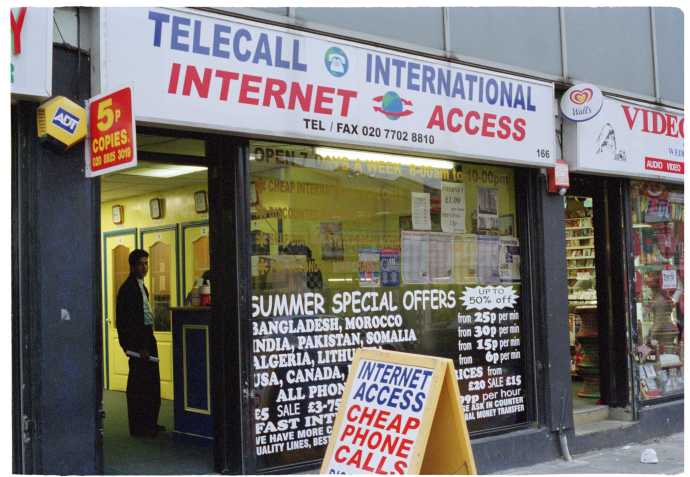
 This is why I love Alana Lake’s ‘pink innit’ so much, just as I love the

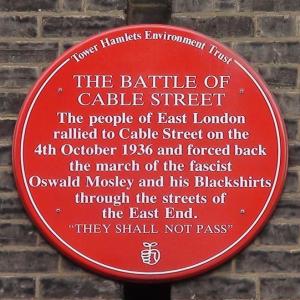

 Jenny Cheshire, Sue Fox, Paul Kerswill & Eivind Torgersen, ‘Ethnicity, friendship network and social practices as the motor of dialect change: linguistic innovation in London’ (Opens as PDF)




 ch and Spanish. To date, English editions of Croatian authors have been the result of individual endeavours and the passion of a small number of translators and publishers with a special interest in translated literature. But while ‘big’ languages have a tradition of systematically promoting books, such as the leading publications 10 Books from Holland and New Books in German, Croatian literature is still terra incognita to most publishers, editors and the broad reading public. This is hardly surprising because well-translated, representative excerpts from the best Croatian titles are neither cheap nor easy to come by. That is why we have decided to launch 5 Books from Croatia – a publication with a clear editorial conception that once per year will present four contemporary authors and one classic, a ‘forgotten gem’.

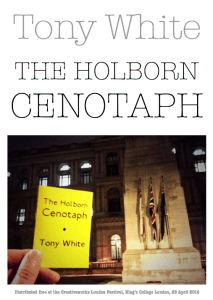
 ‘The Holborn Cenotaph’ was first performed in the Renaissance Revival chapel of King’s College London for King’s Arts and Humanities Festival 2014, as part of a collaboration with the artists Stuart Brisley and Maya Balcioglu, and Dr Sanja Perovic of King’s. At the time, White was Creative Entrepreneur-in-Residence in the French Department at King’s, funded by Creativeworks London. Since then White has taken ‘The Holborn Cenotaph’ to audiences around the UK at venues ranging from the British Library to Turner Contemporary, Margate, London Radical Book Fair and many live literature events and programmes. Following each reading, a pamphlet edition of the full text is distributed free.
 Piece of Paper Press & tonywhite.london
You must be logged in to post a comment.